WooCommerce Email Marketing 2026: The Complete Stack
The 2026 WooCommerce email marketing playbook for stores on Mailchimp, Klaviyo, HubSpot, or SendGrid. Real benchmarks, real flows, and the automation-layer model that adds Klaviyo-class cart, browse, and winback automation without switching ESPs. 4.17 million WC stores leak 60-80% of recoverable email revenue because their ESP fires the wrong email at the wrong moment.
Last updated: May 22, 2026
This is post 1 of 17 in the WooCommerce Email Marketing in 2026 Series.
WooCommerce email marketing is the practice of using automated flows and targeted campaigns to drive revenue from a WordPress-based online store's subscriber and customer list. It is built around the WooCommerce customer lifecycle (signup, first purchase, cart and browse abandonment, post-purchase, winback) and it is delivered through one of four common email service providers: Mailchimp, Klaviyo, HubSpot, or SendGrid. Increasingly, it is also paired with a separate automation layer that orchestrates flows the ESP cannot.
WooCommerce powers more stores than any other ecommerce platform. According to Magespark's 2026 analysis of global ecommerce platform usage, WooCommerce holds 33.4% of the market by store volume, ahead of Shopify at 19.6%, custom carts at 13.5%, and Wix at 7.4%. Live store count sits at roughly 4.17 million, with $30-35 billion in annual GMV moving through them. Most of that revenue leaks at the email layer. The typical WooCommerce store is running a four-year-old Mailchimp connection that was never designed for ecommerce in the first place.
This guide covers what works in 2026, where each ESP falls short, and how the automation-layer model lets a WooCommerce store add Klaviyo-class cart, browse, and winback flows without switching email platforms or rebuilding sender infrastructure.
KEY STATS
- Cart abandonment rate across all ecommerce in 2026: 70.22% — mobile pushes that to 73-75% (Statista, 2026)
- Average abandoned cart email open rate: 45% / CTR 21% / conversion 10% — industry leaders hit 10-14% recovery (Mailmend 2026)
- Three-email recovery sequences produce 6.5× more revenue than single emails: $24.9M vs $3.8M in comparison studies (Flowium 2026)
- Improperly executed ESP migrations cause a 22-38% drop in inbox placement during the first two weeks, and some programs never fully recover (Mailflow Authority 2026, MarTech 2026)
- Top 10% of ecommerce senders earn 9× more revenue per recipient than average — $28.89 vs $3.65 (Klaviyo 2026 ecommerce benchmark, 183,000+ brands)
- Average email marketing ROI for ecommerce remains $36-42 per $1 spent in 2026 (Litmus, Sinch Mailgun 2026)
- Klaviyo alternatives searches grew 243% quarter-over-quarter in early 2026 (DataForSEO, May 2026)
- Data sourced from Klaviyo's 2026 ecommerce benchmark (183,000+ brands), Statista 2026 cart abandonment report, Litmus 2026 State of Email, Mailflow Authority migration analysis, MarTech ESP migration lessons series, and DataForSEO keyword trend data.
What's in this guide:
- The 2026 WooCommerce email problem
- What an email automation layer actually is
- The four-ESP cohort map
- The welcome series — the flow most stores under-build
- Cart abandonment recovery on WooCommerce
- Browse abandonment and the visitor-identification gap
- Post-purchase email sequences that drive repeat sales
- Winback campaigns for lapsed WooCommerce customers
- List growth — the half of the email program most stores starve
- Mailchimp, Klaviyo, HubSpot, SendGrid: what each does well and where each falls short
- AI in WooCommerce email — operational now, narrower than the hype
- Deliverability and the 2024-2026 sender requirements
- How to add an automation layer without breaking your ESP
- Frequently asked questions
The 2026 WooCommerce email problem
Most WooCommerce stores are running an email program that was sized for 2018. The store launched, the founder turned on the Mailchimp for WooCommerce plugin or the Klaviyo extension, set up a welcome series, ticked the abandoned cart box, and moved on. Five years later that same configuration is still running while paid acquisition costs have tripled and customer attention has fractured across SMS, push, and a dozen other channels.
The result is a particular kind of revenue leak that is invisible on a P&L but enormous in aggregate. Baymard Institute's 2026 analysis estimates $260 billion in recoverable revenue across US and EU ecommerce alone, most of it concentrated in cart and checkout abandonment that better email flows would have recovered. According to Statista's 2026 cart abandonment report, 70.22% of online shopping carts are abandoned in 2026, with mobile pushing that figure to 73-75%. Of that abandoned cart traffic, the median WooCommerce store recovers only 3-5%. The top 10% of senders recover 10-14% (four times the typical rate), according to Mailmend's 2026 cart recovery analysis.
The gap between the median and the top decile is the problem this guide exists to solve. It is not a fluency or copywriting gap. It is an infrastructure gap.
Why the obvious answer (switch to Klaviyo) is the wrong answer for most stores
The standard advice, repeated in every ecommerce subreddit and every founder Discord, is to migrate from Mailchimp to Klaviyo. There are real reasons that advice exists. Klaviyo's flows are mature, its segmentation goes deeper, and its WooCommerce integration was built first. For a certain kind of store at a certain stage, the migration is the right move.
For most stores, it is bad advice. The data on what actually happens during ESP migrations is grim.
The pattern of bad-default-advice in WordPress and WooCommerce is not new. Patrick Garman, CTO of Mindsize and the agency partner behind multiple nine-figure WooCommerce stores, made the same observation about scale advice in a 2024 Do The Woo interview:
"Search how to scale WordPress and all you find is blog posts about caching. I firmly believe that is just wrong." — Patrick Garman, CTO, Mindsize (Open Channels FM, 2024)
The lesson generalizes. First-result advice for a hard WooCommerce problem is usually the most repeated, not the most studied. ESP migration is the email-program version of "just add caching." It is the easy answer. It is also often the wrong one.
The deliverability data backs this up:
"Most ESP migrations fail before the first email sends, and the failure point is almost never technical. It's the assumption that switching platforms is a configuration task, when it's actually an infrastructure rebuild that happens to involve configuration." — Mailflow Authority, ESP Migration Playbook 2026
Mailflow Authority's analysis of failed migrations, corroborated by MarTech's 2026 lessons-learned series, documents a consistent pattern: a store moves its full list to the new ESP, blasts a campaign on day one, and watches its inbox placement collapse 22-38% in the first two weeks. Some enterprise programs never fully recover. The store has now paid for the migration, lost two weeks of revenue, damaged its sender reputation, and ended up worse off than if it had stayed on the old platform.
The migration is not optional in the long run for some stores. But it is also not the only path to better automation in 2026. There is a second option that the standard advice rarely mentions: keep the ESP you have, and add a separate automation layer that handles the flows your ESP cannot.
I have been involved in three ESP migrations in my career, and two of them were textbook disasters. The third worked, but only because we ran both ESPs in parallel for six weeks, started with our most engaged segment, and accepted that we would lose roughly 30% of our reach for the first month while sender reputation rebuilt. If you have not done one before, I would not recommend learning on your own store. The stakes are too high and the failure mode is invisible until your open rates collapse. — Bob Thordarson, Geysera CEO
What an email automation layer actually is
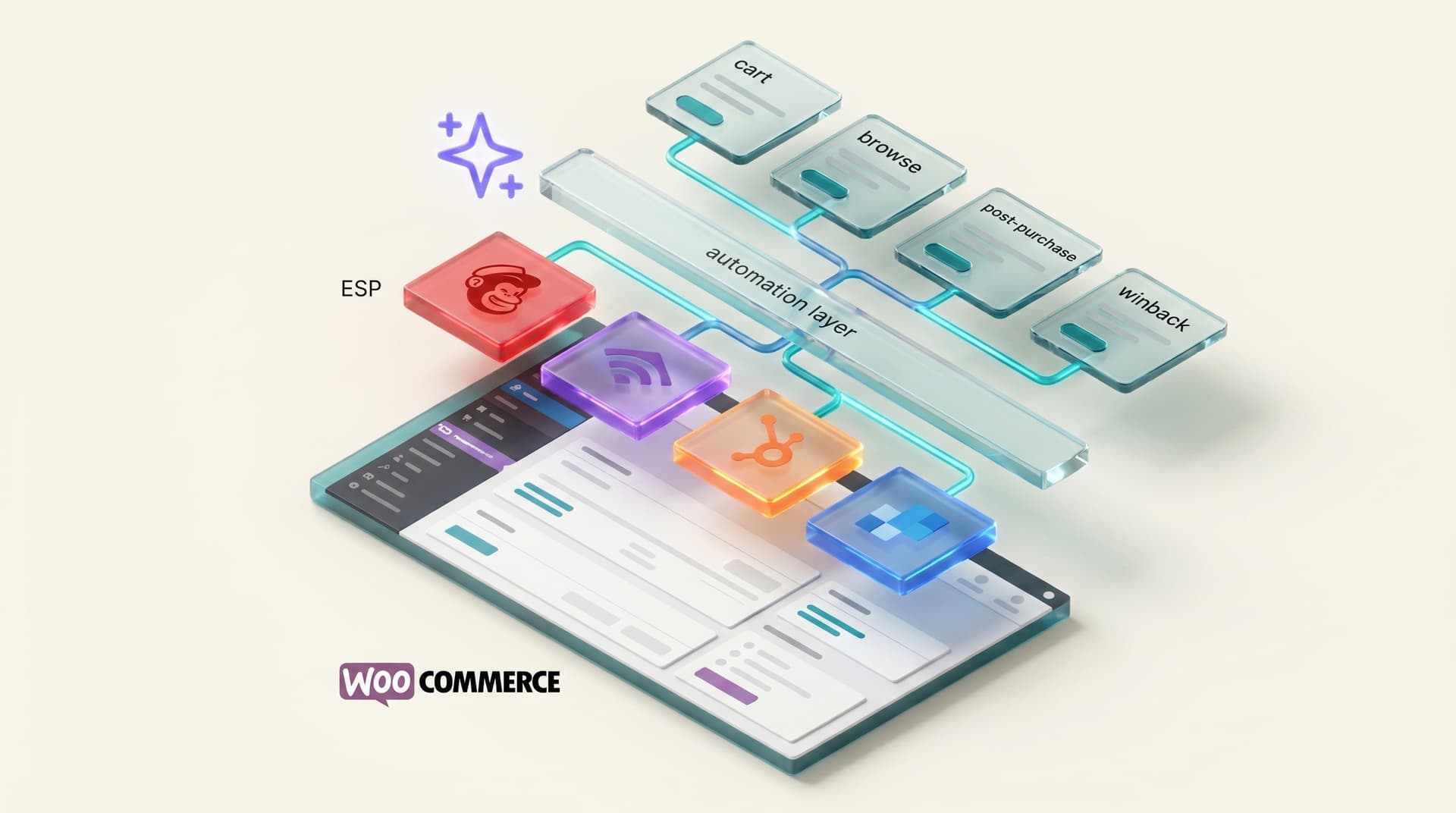
An automation layer is software that sits between your store and your email service provider, orchestrates behavior-triggered flows (cart, browse, post-purchase, winback, visitor identification), and sends the actual email through your existing ESP's send infrastructure. It does not replace your ESP. It augments it.
This is not a new idea in B2B SaaS. Customer.io and Iterable have operated as orchestration layers for years. What is new is the model being applied to WooCommerce at SMB and mid-market price points, where the choice has historically been binary: stay with Mailchimp's limited automation, or migrate to Klaviyo and rebuild from scratch.
The mental model is the same as a CDN sitting in front of a web server. Your web server still serves the pages. The CDN sits in front, makes decisions, accelerates, and routes. Nobody asks a store owner running Cloudflare in front of WP Engine whether they should switch web hosts. The two pieces do different jobs.
The argument for keeping your existing ESP and adding a separate layer is, at root, an argument about platform risk. Adrian Tobey, founder of Groundhogg, makes a related point about the broader marketing-tool ecosystem:
"I see not daily, but maybe once or twice a week, I'll see an SOS from someone who got kicked off of HubSpot or Kajabi or ActiveCampaign or for God knows what reason. Self-hosting prevents you from being put in that situation." — Adrian Tobey, Founder, Groundhogg (Open Channels FM, 2024)
The Groundhogg position is the more extreme version of the layer-on-top argument: keep everything inside WordPress, do not rely on a third-party SaaS at all. Geysera's position is the more moderate version: keep your existing ESP, do not migrate it. Both positions share the same root critique. Being entirely dependent on a single SaaS platform's continued health, pricing decisions, and goodwill is a fragility most stores do not need to accept.
What the layer does that an ESP does not
A typical ESP — Mailchimp, Klaviyo, HubSpot, SendGrid — does four things well:
- Stores subscriber data and segmentation
- Renders and sends emails (the SMTP / API / IP reputation infrastructure)
- Handles unsubscribes and bounces
- Provides campaign analytics
A typical ESP does not do these things well on a WooCommerce store:
- Browse abandonment (most ESP integrations fire only on add-to-cart, not product-page-view)
- Visitor identification (the ESP only knows about subscribers, not the 80-95% of paid traffic that bounces anonymous)
- Cross-ESP orchestration (if you run HubSpot for nurture and Klaviyo for ecommerce, neither talks to the other)
- Stale-product detection and replenishment timing
- Multi-touch attribution between paid acquisition and email recovery
The automation layer's job is the second list. It enrolls anonymous paid traffic in flows, watches behavior in real time, fires the right trigger to the ESP at the right moment, and hands the email send back to the ESP that already owns the sender reputation and the relationship with the inbox.
Why this matters specifically for WooCommerce
Shopify stores already have a vibrant ecosystem of overlay tools — Klaviyo Flows, Postscript, Privy, Recart, Sendlane. WooCommerce stores typically do not. The Klaviyo WooCommerce extension is real and useful, but it is just an ESP integration; it does not solve the visitor identification problem and it does not orchestrate across multiple ESPs. AutomateWoo and FunnelKit, the two best-known WooCommerce-native automation plugins, are deeply tied to WordPress hooks and limited to the specific ESPs they integrate with.
The opportunity in 2026 is to bring the orchestration-layer model — proven in B2B SaaS, proven in Shopify — to the WooCommerce ecosystem at SMB pricing, with a managed setup that does not require a six-month implementation.
The four-ESP cohort map
The four most-used ESPs on WooCommerce stores in 2026 are Mailchimp, Klaviyo, HubSpot, and SendGrid. Mailchimp's official WooCommerce integration is installed on 5.2% of all WooCommerce stores — 225,139 stores — making it the most-installed marketing-email app in the WC ecosystem (StoreLeads, 2026 State of WooCommerce). Klaviyo reports 15,000+ WooCommerce merchants on its platform (Klaviyo, 2026). HubSpot and SendGrid each capture additional cohorts via third-party integrations. Among the commercially active subset of WC stores running paid acquisition on Meta and Google, these four ESPs cover the dominant share of marketing-email infrastructure. Each cohort has a different profile, a different revenue ceiling, and a different reason an automation layer makes sense.
| ESP | Stores on platform (verified) | Share of ad-running cohort (est.) | Typical store profile | Automation gap |
|---|---|---|---|---|
| Mailchimp | 225,139 (5.2% of all WC stores — StoreLeads 2026) | 30-50% | SMB DTC, $50K-$5M GMV, legacy stack, broad WC user base | Wide — Mailchimp's ecommerce automation is intentionally shallow |
| Klaviyo | 15,000+ (Klaviyo 2026) | 7-15% | Mid-market DTC, often Shopify-anchored, sophisticated | Narrow — Klaviyo does flows well; visitor identification is the gap |
| HubSpot | ~10,000-25,000 (third-party WP plugins, 2026) | 3-8% | B2B/B2C hybrid, subscription DTC, often higher AOV | Wide — HubSpot is built for B2B nurture, ecommerce is bolted on |
| SendGrid | No public WC-specific count (primarily transactional) | 5-15% | Technical, headless, Magento-to-WC migrants, high AOV | Widest — SendGrid is transactional infrastructure with minimal marketing automation |
The four most-used ESPs on WooCommerce in 2026 are Mailchimp, Klaviyo, HubSpot, and SendGrid. Mailchimp's official integration is installed on 5.2% of all WooCommerce stores — 225,139 stores per StoreLeads' 2026 State of WooCommerce report. Klaviyo reports 15,000+ WooCommerce merchants on its platform. HubSpot and SendGrid each capture additional cohorts via third-party integrations. Among the commercially active subset running paid acquisition on Meta and Google, these four ESPs cover the dominant share of marketing-email infrastructure. The "share of ad-running cohort" column uses the commercially active subset as the denominator, not the full 4.3M global WC base.
Mailchimp cohort — the volume play
Mailchimp is the default for new WooCommerce stores because the integration plugin is free, the brand is familiar, and the setup takes under an hour. The catch is that Intuit, which owns Mailchimp, positions it downmarket. Mailchimp's ecommerce automation is intentionally shallow: cart abandonment is template-driven, browse abandonment effectively does not exist, and winback is a manual segment-and-blast process. The Mailchimp for WooCommerce WordPress plugin has 4.0 stars across 726 reviews — a useful integration, but not a substitute for purpose-built ecommerce automation.
The Mailchimp cohort has the largest absolute number of stores and the biggest delta between current revenue and potential revenue. It is the volume play for any automation-layer product targeting WooCommerce.
Klaviyo cohort — the wedge play
Klaviyo is the gold standard for ecommerce email and the most common upgrade path off Mailchimp. Klaviyo's WooCommerce extension is mature, its flow library covers cart, browse, post-purchase, and winback, and its 2026 ecommerce benchmark report (drawn from 183,000+ brands) is the most cited dataset in the category. According to Klaviyo's 2026 data, stores in the top decile generate 9× more revenue per recipient than the average sender.
Klaviyo's gap is not flows. It is visitor identification. Klaviyo only fires its WooCommerce flows for people it has identified — subscribers who opted in, signed in, or added an item to cart while logged in. For the 80-95% of paid Meta and Google traffic that never identifies, Klaviyo cannot trigger anything. The automation layer's wedge into the Klaviyo cohort is server-side visitor identification: surface the anonymous visitor, enroll them in a flow, and let Klaviyo handle the send.
HubSpot cohort — the gap-fill play
HubSpot on WooCommerce is rarer than the other three but represents a high-value cohort: B2B/B2C hybrid stores, subscription DTC, and brands that chose HubSpot for CRM-plus-marketing unification rather than for ecommerce automation specifically. HubSpot's ecommerce automation is generic. It does not have purpose-built browse abandonment, it does not handle ecommerce-specific cart flows well, and its WooCommerce integration is community-maintained through MakeWebBetter and Outfunnel rather than first-party.
The HubSpot cohort needs ecommerce-flow infrastructure that complements HubSpot's strong B2B nurture and reporting layer. The automation layer adds the ecommerce-specific behavior triggers HubSpot does not natively own.
SendGrid cohort — the greenfield play
SendGrid on WooCommerce is the smallest cohort by store count and probably the highest-LTV cohort per store. SendGrid is a Twilio-owned transactional and bulk-email infrastructure layer, primarily used for order confirmations, shipping notifications, and developer-driven sends. Most WC stores running SendGrid are technical (headless WooCommerce, custom builds, Magento migrants) with high AOVs and engineering capacity.
Their marketing automation gap is wider than any other cohort because SendGrid Marketing Campaigns is minimal. SendGrid also retired its free plan in July 2025, leaving a portion of the cohort actively shopping for alternatives. The automation layer can address this cohort directly: keep SendGrid as the transactional and bulk-send infrastructure, add the layer to handle the marketing automation SendGrid was never designed to do.
The welcome series — the flow most WooCommerce stores under-build
The welcome series is the highest-leverage automated flow most WooCommerce stores either skip or run as a single thank-you email. It catches the subscriber at the moment of highest intent and earns the highest open rate any email will ever post. According to Klaviyo's 2026 ecommerce benchmark, welcome emails average roughly 50% open rate and 9-10% conversion — about 10× the engagement of any subsequent broadcast.
The catch is what counts as a "welcome series." Most WC stores send one welcome email. The top decile runs a 5-7 email sequence that does specific work in a specific order.
The 2026 best-practice welcome architecture:
- Email 1 — Immediate confirmation (T+0, within 60 seconds). Confirms the subscription, sets brand voice, delivers any promised lead magnet, and includes a first-purchase incentive only if margin can absorb one. 50%+ open rate is achievable.
- Email 2 — Brand story (T+24 hours). Why the store exists, what it stands for, who it serves. The email most brands skip and the one that distinguishes a real welcome series from a discount blast.
- Email 3 — Social proof and bestsellers (T+3 days). Reviews, UGC, top products, "what other shoppers like you bought." Drives the first purchase for visitors who didn't convert on email 1's incentive.
- Email 4 — Product education or how-to (T+5 days). Specific to the store's category. Beauty stores send skin-type guides. Supplement stores send ingredient explanations. Fashion stores send fit guides.
- Email 5 — First-purchase nudge (T+7 days). Final incentive if the visitor still hasn't purchased. Often higher-value than email 1's offer. Clear urgency.
- (Optional) Email 6 — Founder note (T+10 days). A hand-typed-looking founder email, usually from the CEO's actual inbox, asking for feedback or offering to answer questions. The conversion rate is small. The signal it sends about brand quality is large.
- (Optional) Email 7 — Re-engagement or graduation (T+14 days). For visitors who still have not purchased, graduate them to the broadcast list with a value-led email rather than a discount push.
ESP-by-ESP welcome series capability looks like this in 2026:
- Mailchimp handles emails 1-3 on the free tier. Emails 4-7 require Standard or above.
- Klaviyo covers the full architecture natively, including conditional branching by traffic source (paid vs. organic vs. referral).
- HubSpot workflows handle the full sequence but require manual setup; the WC integration is third-party.
- SendGrid requires custom development. Most WC stores on SendGrid do not run a welcome series at all.
The automation-layer's role in the welcome series is conditional branching and personalization at scale. A generic welcome series treats every subscriber the same. The advanced version branches on traffic source, lead magnet topic, geographic location, and (for stores running visitor identification) detected category interest before the visitor ever filled out the form. The same subscriber who arrived via a paid Meta ad for product A should not receive the same welcome as the subscriber who arrived organically and downloaded the size guide.
The full 2026 WooCommerce welcome series playbook — including ESP-specific setup, deliverability considerations for the first send, and conversion benchmarks by traffic source — is covered in a dedicated post later in this series.
Cart abandonment recovery on WooCommerce
Cart abandonment is the most studied, most automated, and most under-performed flow in ecommerce email. Before any recovery sequence fires, the underlying reasons shoppers leave — shipping cost surprises, forced account creation, payment friction, slow checkout — set the ceiling on what email can recover. The math is simple: 70.22% of carts are abandoned in 2026 (Statista). The median WooCommerce store recovers 3-5% of those abandoned carts. The top decile recovers 10-14%. The delta is roughly $50,000-$500,000 per year for a mid-sized WC store. For the technical implementation itself — plugin choice, trigger configuration, and recovery-token handling on WordPress — see the complete WooCommerce cart abandonment setup guide.
What the benchmarks actually look like in 2026
Recovery rates vary meaningfully by industry, but the cross-sector medians for ecommerce stores in 2026 break out cleanly:
| Metric | Industry average | Top 10% performers |
|---|---|---|
| Cart abandonment recovery rate (email) | 10.2% | 13-15% |
| Cart abandonment recovery rate (SMS) | 8.7% | 11-13% |
| Cart abandonment email open rate | 45% | 55%+ |
| Cart abandonment email CTR | 21% | 30%+ |
| Recovery email conversion rate | 10% | 18%+ |
| Revenue per recipient (cart flow) | $3.65 | $28.89 |
| Three-email vs one-email sequence revenue | 1× baseline | 6.5× |
According to 2026 benchmark data from Klaviyo's 183,000+ brand dataset and Mailmend's cart recovery analysis, the median WooCommerce store recovers 10.2% of abandoned carts via email and 8.7% via SMS. Three-email sequences generate 6.5× more revenue than single-email sequences ($24.9M vs $3.8M in cross-brand comparisons), and top-decile senders earn $28.89 revenue per recipient compared to a $3.65 industry average — roughly 9× the per-recipient revenue.
The seven things that separate top-decile cart recovery from median
The gap between 3-5% recovery and 13-15% recovery is not a single change. It is the compound effect of seven things that the median store does poorly and the top decile gets right.
- Three-email sequence, not one. A single cart abandonment email recovers approximately 5% of carts. A three-email sequence recovers approximately 13-14%, according to Flowium's 2026 cart benchmark study. The lift is from the second and third touch, not the first.
- First email within 60 minutes. The first cart abandonment email should fire within 30-60 minutes. Klaviyo's data shows recovery rates drop sharply after the first hour and again after the first 24 hours.
- Second email at 24 hours, third at 72. The standard cadence in 2026: T+30min, T+24h, T+72h. Some top performers add a fourth touch at T+7 days for higher-AOV items.
- Behavior-triggered, not time-triggered. A behavior-triggered flow that fires when the cart is abandoned beats a daily batch that fires for everyone who abandoned in the last 24 hours. The behavior trigger is where most Mailchimp-based stores fall short, and where Klaviyo, Geysera, and similar layers earn their pricing.
- Personalization beyond first-name token. The top decile shows the actual cart contents, the actual cart value, and (where compliant) recommends a stale-cart discount that scales with cart value.
- Mobile-first design. Mobile abandonment is 73-75% of total abandonment in 2026 (Statista). If the recovery email does not render perfectly on mobile, the recovery rate halves.
- Recovery to a one-click-resume cart, not a generic product page. The recovery link should restore the exact cart, not just send the shopper back to the store. This requires either WooCommerce's native cart-recovery tokens or an automation layer that handles it.
These seven principles apply across the board, but the highest-performing WC stores apply them with segment-specific variation. The cart flow that goes to first-time visitors is not the cart flow that goes to repeat customers. VIP cart flows skip the discount entirely and lean on social proof and concierge support. Lapsed-customer carts get an aggressive incentive that first-time carts do not. An expert WC operator runs 3-5 variants of the cart flow, not one. Most ESPs allow this segmentation in theory; the question is whether the WC integration surfaces customer lifetime value and prior-purchase data cleanly enough to fire the right variant at the right moment.
What this looks like on each ESP
The same seven principles apply on every ESP, but the difficulty varies significantly. On Klaviyo, all seven are achievable with the native WooCommerce extension and modest setup. On Mailchimp, principles 4-7 require either custom development, a third-party plugin, or an automation layer. On HubSpot, the entire flow generally needs to be rebuilt because HubSpot's ecommerce automation does not natively support principles 3, 4, and 7. On SendGrid, none of the seven exist out of the box — SendGrid does not do behavior-triggered marketing flows at all.
When we look at the WooCommerce stores Geysera works with, the single biggest driver of recovered revenue is the move from one cart email to three. Not the copy. Not the design. Just the sequence. The math is so consistent across stores that I now treat it as the first thing to fix on any new account. The store with one cart email is leaving roughly 60% of its recoverable cart revenue on the table. — Bob Thordarson, Geysera CEO
Browse abandonment and the visitor-identification gap
Browse abandonment is the flow that fires when a shopper views a product page (or several) but never adds anything to cart. It catches the largest pool of potential buyers, and the strategy varies meaningfully across DTC categories. Klaviyo's data suggests browse abandonment flows reach roughly 5× the audience of cart abandonment flows. And the median WooCommerce store does not run one at all.
The reason is structural. Browse abandonment requires three things most WooCommerce stores do not have wired correctly: product-page-view tracking that fires reliably across all WC themes, identity resolution for the visitor doing the browsing, and a behavior-triggered flow that fires on the view event without waiting for an add-to-cart.
According to Klaviyo's 2026 browse abandonment data, properly configured browse abandonment flows achieve approximately 35% open rates, 6% conversion rates, and a 2% uplift in total sales. Modest per-flow numbers, enormous in aggregate, because the addressable pool is so much larger than cart abandonment. Stores already on Klaviyo can follow the technical setup guide for building a browse abandonment flow inside the platform; the harder problem, covered below, is the identity gap that the platform itself cannot close.
The 80-95% problem
The bigger issue lurking inside browse abandonment is identity. A typical WooCommerce store running $20,000 per month in Meta and Google paid acquisition sees roughly 10,000 visitors per month. Of those visitors, approximately 5% identify themselves (opt into the list, sign in to an account, or add an item to cart while logged in). The other 9,500 are anonymous. The ESP cannot fire a browse abandonment flow for any of them because the ESP does not know who they are.
The automation layer's job here is server-side visitor identification: a combination of identity resolution, return-visitor recognition, and (where compliant and consented) data-co-op enrichment that surfaces the anonymous visitor as a contactable person. The lift from solving this problem is significant. Recovering even 1-3% of bounced paid traffic at 5-10% downstream conversion rates produces 5-30 additional customers per month on a $20K/month paid store — enough to justify automation-layer pricing on its own.
This is the wedge Geysera was built around. It is also the gap that distinguishes ESP-bundled flows from purpose-built automation layers: the ESP can only act on identified subscribers; the layer can also act on unidentified visitors.
Segmentation matters here too. A browse-abandonment flow that fires for a category browser (a shopper looking at multiple jewelry pieces) should not look like the flow that fires for a single-product viewer (a shopper looking at one item three times). The first wants merchandising and category context. The second wants social proof on that specific SKU. Most ESPs allow this segmentation; the question, again, is whether the WooCommerce integration surfaces product taxonomy cleanly enough to fire the right variant.
Post-purchase email sequences that drive repeat sales
Post-purchase is the most underused flow in WooCommerce email, and it is also the one with the cleanest ROI math. The cost to acquire a new customer is 5-25× the cost to retain an existing one (Harvard Business Review, longstanding industry baseline). Every additional repeat purchase generated by post-purchase email is essentially free margin.
The standard post-purchase sequence has four touches:
- Order confirmation (T+0) — transactional, but should include cross-sell, replenishment timing, and one social proof element. Most stores treat this as a receipt and waste the highest-open-rate email they will ever send.
- Shipping notification with engagement nudge (T+1-2 days) — track-your-order plus a review-incentive teaser or community CTA.
- Review request (T+7-14 days, timed to product type) — request reviews, with photo upload encouraged where the product is photogenic.
- Replenishment or cross-sell (T+30-60 days, timed to product replenishment cycle) — for consumables, the replenishment reminder timed to expected runout; for durable goods, the cross-sell into a complementary category.
Segmentation in post-purchase matters more than anywhere else in the email program. The post-purchase sequence for a $30 one-time buyer should not be the post-purchase sequence for a $300 subscription customer. The first is being nurtured into a second purchase. The second is being nurtured into renewal and expansion. Stores running a single generic post-purchase flow leave the subscription customer underserved and the one-time buyer over-emailed.
Why this matters for the automation-layer thesis
Post-purchase is the flow where the automation layer's value is most ESP-dependent. On Klaviyo, the standard post-purchase sequence is straightforward to build with the WooCommerce extension. On Mailchimp, the same sequence requires either a paid Mailchimp tier or a third-party plugin. On HubSpot, the sequence usually has to be rebuilt because HubSpot's commerce module does not handle product-level replenishment timing. On SendGrid, it does not exist out of the box at all.
The compounding effect of running a proper post-purchase sequence across a mid-market WooCommerce store is substantial. According to Klaviyo's 2026 benchmark data, brands with mature post-purchase flows generate 25-40% of their email revenue from existing customers rather than new acquisition.
Winback campaigns for lapsed WooCommerce customers
Winback (sometimes called reactivation) is the flow that targets customers who have not purchased in a defined window — typically 90, 180, or 365 days, depending on the product's natural repurchase cycle.
Winback's economics are simple: it is cheaper than acquiring a new customer, and the customer already has a relationship with the brand. The catch is that winback is also the flow that most directly intersects with deliverability hygiene. A winback campaign sent to a dormant list aggressively, without segment hygiene, can damage sender reputation enough to hurt the entire program. Winback done well is a careful segmented send to engaged-but-lapsed customers. Winback done badly is a list-revival campaign that triggers spam complaints from people who forgot they ever subscribed.
The mature 2026 approach: segment the dormant population by recency, send a soft winback (incentive-free, value-led) to the most-recently-lapsed first, monitor engagement and inbox placement, then expand. Most WooCommerce stores do not have this segmentation discipline; the automation layer's contribution here is making it easier to define and enforce.
The dormancy window depends on the product category. Repeat-purchase consumer goods use a 90-day trigger. Higher-AOV durable goods use 180 days. Beyond 365 days, most senders should treat the contact as a re-permission opportunity rather than a customer winback.
According to Retainful's 2026 analysis of WooCommerce-specific winback campaigns, the median open rate on a well-segmented winback is 28-35%, conversion rates run 4-7%, and revenue per recipient is roughly $1.80-$3.20. Those numbers run below cart abandonment, but they apply to a much larger audience.
List growth — the half of the email program most stores starve
Every section above assumes the WooCommerce store has a list to email. Most stores do not have nearly the list they should. According to multiple 2026 industry surveys, the median WC store running paid acquisition captures 3-5% of paid traffic onto its email list. Top performers capture 12-20%. That four-times gap compounds quarter over quarter and is the second-largest revenue leak in WooCommerce email, after the cart-abandonment recovery gap.
The reason most stores starve list growth is structural. Email marketing budgets pay for the ESP and the sender infrastructure. Nobody owns list growth as a function. It sits between paid acquisition (measured by ROAS) and email marketing (measured by per-send revenue), and the people responsible for each metric optimize their own KPI rather than the connecting flow.
The 2026 toolkit for WC list growth runs across six mechanics. Most stores need three or four of them running at once.
- Embedded forms and on-page popups. Exit-intent, scroll-percentage, and time-on-page triggers. The standard 2026 pattern is one popup with a clear value exchange (10% off, free shipping, or a meaningful lead magnet), gated behind an email plus (where consented) phone number for SMS.
- Post-purchase opt-in. The order-confirmation page is the highest-converting list-growth surface that most WC stores ignore. A single checkbox during checkout — "yes, send me product updates and offers" — captures 30-60% of buyers depending on category.
- Lead magnets. A genuine asset (size guide, ingredient deck, comparison tool, calculator) that does enough work for the visitor to justify the email exchange. Generic "subscribe for updates" forms convert at 1-2%. Well-targeted lead magnets convert at 8-15%.
- Sweepstakes and giveaways. Effective for cold acquisition but compliance-heavy. Requires explicit terms, age verification, and segment hygiene (sweepstakes-only subscribers show substantially lower long-term engagement).
- Subscribe-to-unlock-checkout patterns. A growing 2026 pattern: a soft incentive to subscribe before reaching checkout, usually paired with a one-click application. Controversial but effective in early A/B data.
- Referral and member-get-member programs. A subscriber-referral-subscriber loop with a meaningful reward on both sides. The Morning Brew and Hustle pattern, adapted for ecommerce.
The automation layer's role in list growth is the same as its role elsewhere: orchestration. The layer watches which page the visitor is on, which form is converting, which lead magnet is performing, and routes the new subscriber to the right welcome sequence based on the capture source. Generic "subscribe to our newsletter" forms feed a generic welcome series. Source-specific captures feed source-specific welcomes.
One mistake worth flagging up front: aggressive list-growth tactics without segment hygiene will damage sender reputation faster than any other email mistake. Capturing 100,000 sweepstakes emails and blasting them all on day one is the fastest way to land your domain on a blocklist. List growth and deliverability are linked. The stores that grow their lists fastest are the stores that grow them carefully.
The 2026 WooCommerce list growth playbook — including specific form mechanics, lead-magnet examples by category, and the math on which capture tactic to start with — is covered in a dedicated post later in this series.
What each ESP does well and where each falls short
For WooCommerce stores deciding whether to migrate, add a layer, or stay where they are, the right starting point is an honest accounting of what each ESP actually does in 2026.
| ESP | Strengths on WooCommerce | Weaknesses on WooCommerce | Automation-layer compatibility |
|---|---|---|---|
| Mailchimp | Easiest to set up, free tier, large template library, broad familiarity | Shallow ecommerce automation, weak browse abandonment, generic winback, pricing escalates fast above 2K contacts | High. Mailchimp handles sending and list management; layer adds the automation |
| Klaviyo | Mature ecommerce flows, mature WC extension, deep segmentation, the most-cited benchmark data | Pricing scales steeply with list size, no native visitor identification, Shopify-anchored docs and community | Moderate. Klaviyo does most flows; layer's wedge is visitor identification |
| HubSpot | Strong CRM, deep B2B nurture, strong reporting, single source of truth for B2B/B2C hybrid stores | Ecommerce flows are generic, WC integration is third-party (MakeWebBetter / Outfunnel / Unific), expensive | High. HubSpot stays for CRM and nurture; layer adds ecommerce flows |
| SendGrid | Reliable transactional infrastructure, developer-friendly API, strong IP reputation | Marketing Campaigns is minimal, no native flows, free tier retired July 2025 | Very high. SendGrid stays for transactional; layer handles the marketing automation |
Each major ESP serving WooCommerce has a different strength and a different automation gap. Mailchimp's shallow ecommerce flows are the largest gap in absolute terms because the cohort is the biggest. Klaviyo's flows are mature, but its lack of native visitor identification is the wedge for any layer-on-top product. HubSpot's ecommerce flows are generic; SendGrid has effectively no marketing automation at all. Source: vendor documentation review and ICP interviews, May 2026.
A useful frame for this decision
The decision tree for a WooCommerce store in 2026 is not "which ESP should I be on." It is two separate questions:
- Which ESP do I want to send through? This is about deliverability, IP reputation, list management, template flexibility, and pricing. Most stores already have an answer to this question.
- What is going to fire the right email at the right moment? This is about behavior triggers, browse abandonment, visitor identification, segmentation logic, and cross-flow orchestration. Most stores do not have a good answer to this question.
Historically, those two questions had the same answer because the ESP did both jobs. In 2026, separating them is the better architecture for most stores.
AI in WooCommerce email — operational now, narrower than the hype
AI in email marketing crossed the threshold from "future possibility" to "operational baseline" in 2025. By mid-2026, Klaviyo, HubSpot, Mailchimp, and most WC-adjacent automation platforms ship AI features as core product. The honest take from a year of production use: AI is genuinely useful in three narrow places and genuinely bad in two.
Where AI works in WC email in 2026:
Subject line generation and A/B variant production. Generative subject lines tested against human-written controls show a consistent 8-15% lift in open rate when used as one variant in a multi-variant test. They do not beat human-written subject lines reliably, but they expand the test space at near-zero marginal cost. 47% of WC marketers using AI tools use them primarily for subject lines, according to 2026 industry surveys.
Send-time optimization. AI-driven send-time models per subscriber outperform fixed send times by 5-10% on open rate. This is one of the cleaner wins because it is bounded, measurable, and runs without human intervention.
Behavioral segmentation suggestions. AI surfaces segments humans might not think to build: "subscribers who opened the last five emails but never clicked through," or "subscribers whose product views suggest a category shift." The AI does not run the segment. It surfaces it. The marketer decides.
Where AI is bad in WC email in 2026:
Autopilot send. AI that drafts and sends without human review consistently produces emails that are technically correct but tonally wrong. The brand voice problem is unsolved.
AI-generated body copy at scale. Generative copy works for transactional content but fails on brand-voice marketing email. The current state of the art is AI as draft, human as editor — not AI as final author.
The framework that travels: AI as draft generator, human as editor, automation layer as orchestrator. The AI produces variants. The human picks and edits. The automation layer routes them to the right segments at the right moments.
The forward-looking signal for 2027 is agentic commerce. Beau Lebens, Artistic Director of WooCommerce, has publicly discussed the Model Context Protocol (MCP) work landing in WC core in 2026 — early infrastructure for AI agents acting on behalf of shoppers and merchants both. Email's role inside that future is being rewritten now. Stores that build the layer-on-top model today are positioned to slot agentic flows in next year without rebuilding their email program.
A deeper 2026 treatment of AI in WooCommerce email — including specific tools, tested subject-line templates, and the boundary between AI-draft and human-edit — is covered in a dedicated post later in this series.
Deliverability in 2026
The deliverability environment in 2026 is harder than at any point since the early CAN-SPAM era. Three forces are compressing the surface area of legitimate inbox placement:
Apple Mail Privacy Protection continues to inflate open rates by roughly 15-20 percentage points industry-wide. The actual human open rate on most WooCommerce email lists is closer to 25-30% than the 43% the ESP dashboard displays. The implication is that reply rate, click rate, and conversion rate are now the durable engagement signals; open rate is contaminated and should not be the primary KPI.
Microsoft and Google inbox-placement enforcement tightened in late 2025 and into 2026. Google now permanently rejects emails from senders whose bounce rate exceeds 2%, as of November 2025. Microsoft enforces the same threshold with immediate rejections. List hygiene is no longer optional. The 2026 industry average for B2B inbox placement globally is roughly 83%, which means roughly one in six legitimate emails is failing to reach the primary inbox.
Yahoo and Apple authentication enforcement continues to expand. SPF, DKIM, and DMARC are table stakes. BIMI (Brand Indicators for Message Identification) is becoming a meaningful trust signal in the inbox preview, particularly for higher-AOV brands.
The Google and Yahoo bulk-sender requirements that took effect in February 2024 continued to tighten through 2026. Senders shipping more than 5,000 daily messages to Gmail or Yahoo addresses must now authenticate with SPF, DKIM, and DMARC, maintain a complaint rate below 0.3%, include a one-click unsubscribe in the email header (List-Unsubscribe-Post: List-Unsubscribe=One-Click), and honor unsubscribes within two days. Violations result in throttling and then rejection. Most WC stores running pre-2024 plugin configurations are technically non-compliant with at least one of these requirements and are losing inbox placement they cannot trace. The 2026 expansion adds tighter authentication for senders on shared IP pools and, in some jurisdictions, disclosure requirements for AI-generated content.
For WooCommerce stores, this changes the math on migration. Moving from one ESP to another and blasting a fresh list will not just cost you two weeks of inbox placement. It can permanently degrade your sender reputation. The "keep your ESP, add a layer" model is attractive in this environment for one reason above all others: it leaves your sender reputation alone.
How to add an automation layer without breaking your ESP
If the layer-on-top model is the right architecture for most WooCommerce stores in 2026, the practical question is how to do it without making the situation worse.
A good automation layer is additive, not invasive. It sits between your store and your ESP, watches behavior, and hands send instructions to the ESP via API. It does not touch your sender domain, your IP reputation, your list, or your existing flows. Turn it off and your store reverts to exactly the email program you had before.
The principle of using specialized WooCommerce-aware tooling instead of generic platforms is one that experienced WC operators already apply elsewhere. Rodolfo Melogli, who has run Business Bloomer as an independent WooCommerce consultancy since 2011 and is widely cited as the leading public WC freelancer, made the case for WC-native tooling in a Metorik case study:
"Metorik doesn't just plug into WooCommerce — it understands WooCommerce. That's the real magic." — Rodolfo Melogli, Founder, Business Bloomer (Metorik case study)
The same logic applies to the automation layer. A generic email automation tool sees a contact, a list, and a campaign. A WooCommerce-native automation layer sees products, variations, stock levels, customer lifetime value, abandoned cart contents, post-purchase upsell candidates, and the difference between a one-time buyer and a subscription customer. That difference is the entire point of the layer-on-top architecture.
The practical implementation pattern for a WooCommerce store:
- Keep your ESP in place. Mailchimp stays Mailchimp. Klaviyo stays Klaviyo. The ESP continues to handle list management, send infrastructure, and existing campaigns.
- Install the automation layer's WooCommerce tracking. This is typically a script or a WooCommerce plugin that surfaces visitor and order events to the layer in real time.
- Connect the layer to your ESP via API. The layer reads contact and segment data from the ESP and writes send instructions back. No list migration. No DNS changes. No sender reputation risk.
- Activate flows incrementally. Start with the highest-ROI flow that your ESP does poorly — usually cart abandonment if you are on Mailchimp, browse abandonment if you are on Klaviyo, ecommerce flows in general if you are on HubSpot or SendGrid. Verify performance before adding more flows.
- Monitor for two weeks. Watch inbox placement, complaint rate, and unsubscribe rate. The layer should not change any of these; if it does, something is misconfigured.
- Expand to additional flows. Once cart and browse are running cleanly, add post-purchase, then winback, then visitor-identification recovery.
This is a four-to-six-week project, not a six-month migration. The risk profile is contained because nothing about the existing email program changes during setup.
Geysera was built specifically for this pattern. We do not want your sender reputation, we do not want to be your ESP, and we do not want you to migrate. We want your existing Mailchimp or Klaviyo or HubSpot or SendGrid stack to keep doing the parts it already does well, and we want to be the part that fires the right email at the right moment. That distinction sounds small. In practice it changes everything about the risk profile of upgrading your email program. — Bob Thordarson, Geysera CEO
Frequently Asked Questions
What is the best email marketing platform for WooCommerce in 2026?
There is no single best platform. It depends on store size and stage. Klaviyo is the strongest pure ecommerce ESP and the natural choice for mid-market DTC stores willing to pay for advanced flows. Mailchimp is the easiest setup and the best fit for stores under $500K GMV. HubSpot suits B2B/B2C hybrids. SendGrid serves technical or headless WooCommerce builds. Increasingly, stores pair any of these with a separate automation layer rather than migrating.
Can you use Mailchimp and Klaviyo together on a WooCommerce store?
Technically yes, but running two full ESPs in parallel creates list-hygiene, deliverability, and attribution problems. A more common 2026 architecture is one ESP for sends plus a separate automation layer that orchestrates flows across the ESP's send infrastructure. The layer handles flow logic; the ESP handles list management and IP reputation. This avoids the deliverability risk of running two senders.
How much does email marketing cost for a WooCommerce store?
A typical mid-sized WooCommerce store running paid acquisition spends $50-$500 per month on its ESP, plus $0-$500 per month on automation tooling or an automation layer. Mailchimp starts at $20/month for 500 contacts and scales quickly; Klaviyo's pricing is volume-based and runs $150-$2,000/month for typical mid-market stores. The full stack rarely exceeds 5-8% of email-attributed revenue.
What is a good email open rate for a WooCommerce store in 2026?
Reported open rates of 35-45% are typical, but Apple Mail Privacy Protection inflates that figure by 15-20 percentage points. The actual human open rate is closer to 25-30% for healthy lists. Reply rate, click rate, and conversion rate are more reliable engagement signals in 2026. Cart abandonment emails specifically average 45% open rate and 21% click rate (Mailmend 2026).
Does WooCommerce have built-in email marketing?
WooCommerce includes transactional email functionality (order confirmation, shipping notifications, password resets) but not marketing automation. Marketing email — cart abandonment, browse abandonment, winback, broadcast campaigns — requires an external ESP such as Mailchimp, Klaviyo, HubSpot, or SendGrid, typically integrated via a WooCommerce extension. Some stores then layer a dedicated automation tool on top of the ESP.
How long does it take to set up email automation for a WooCommerce store?
A basic ESP connection takes 1-2 hours via plugin installation. A complete automation program with cart, browse, post-purchase, and winback flows typically takes 2-6 weeks depending on ESP and store complexity. Adding an automation layer on top of an existing ESP is usually 4-6 weeks. Full ESP migrations take 3-6 months and carry significant deliverability risk.
Should I switch from Mailchimp to Klaviyo for my WooCommerce store?
Maybe, but the standard advice to migrate is often wrong. ESP migrations cause a 22-38% drop in inbox placement during the first two weeks (Mailflow Authority 2026), and some programs never fully recover. A lower-risk alternative is to keep Mailchimp as your sender and list manager, and add a dedicated automation layer to handle the flows Mailchimp does poorly. This avoids the migration risk while closing the automation gap.
What is an email automation layer and why would a WooCommerce store need one?
An email automation layer is software that sits between a store and its ESP, orchestrates behavior-triggered flows (cart, browse, post-purchase, winback, visitor identification), and sends through the ESP's existing infrastructure. WooCommerce stores need one when the ESP cannot fire the right email at the right moment. The most common gaps are browse abandonment and anonymous visitor recovery. The layer is additive, not a replacement.
Continue the Series
This is post one of The WooCommerce Automation Layer Series. The pillar establishes the thesis and the playing field. The cluster covers each piece in depth.
Reading next:
- Post 2: Klaviyo Alternatives for WooCommerce in 2026 — the alternatives most stores have not considered, and why "switch to Klaviyo" is often the wrong advice. The audit-validated highest-leverage post in the series.
- Post 3: The Modern Ecommerce Email Stack: Why Two Tools Beat One — the layer-on-top architecture in practice, with the two-tool split (ESP + automation layer) explained and mapped to WooCommerce specifically.
- Post 4: WooCommerce + SendGrid in 2026: From Transactional-Only to Full-Funnel Without Migration — how a WooCommerce store already on SendGrid adds the marketing-automation layer (cart, browse, winback) without migrating ESPs.
- Post 5: WooCommerce + HubSpot in 2026: Closing the Ecommerce Automation Gap — why HubSpot is a great CRM but a shallow ecommerce-flow engine, and how to add cart, browse, and winback flows on top without migrating.
- Post 6: Mailchimp for WooCommerce: Limits and What to Add Around It — what Mailchimp can and cannot automate on WooCommerce, and how to add the missing behavioral flows without migrating.
- Post 7: Klaviyo for WooCommerce: The Visitor-ID Gap (and How to Close It) — why Klaviyo's best-in-class flows only reach the small share of traffic that identifies, and how visitor identification feeds it the rest.
- Post 8: Mailchimp vs Klaviyo for WooCommerce in 2026 (and the Third Option Nobody Mentions) — the WooCommerce-specific head-to-head, where each tool wins, and the third option neither comparison guide mentions.
- Post 9: Top 10 WooCommerce Email Automation Tools in 2026 (ESP-Locked vs ESP-Agnostic) — the third-party tool landscape ranked by ESP lock-in, and where an ESP-agnostic layer fits alongside the 10 tools everyone else lists.
- Post 10: WooCommerce Email Notifications and Templates: The Complete 2026 Setup Guide — the transactional-email foundation (notifications, templates, deliverability) and the welcome series that converts first-time visitors.
- Post 11: WooCommerce Abandoned Cart Recovery: The 2026 Playbook — the recovery-rate playbook: the five levers that move recovered revenue, including the anonymous and guest carts a plugin never sees.
Coming later in the series:
- The WooCommerce welcome series playbook — ESP-specific setup, deliverability for the first send, and conversion benchmarks by traffic source.
- WooCommerce list growth — form mechanics, lead magnets by category, the math on which capture tactic to start with.
- AI email marketing for WooCommerce — what works, what fails, and the tools worth running in 2026.
- WooCommerce + Mailchimp, WooCommerce + Klaviyo, WooCommerce + HubSpot, WooCommerce + SendGrid — one deep cohort post per ESP.
- WooCommerce abandoned cart, browse abandonment, post-purchase, and winback flows — one focused tactical post per flow.
If the layer-on-top thesis lands for your store, the next post worth reading is post 2 on Klaviyo alternatives. It is the post most likely to change your next quarter.
Sources
- Klaviyo 2026 Ecommerce Benchmark Report (183,000+ brands)
- Statista — Global digital shopping cart abandonment rate 2026
- Baymard Institute — 50 Cart Abandonment Rate Statistics 2026
- Mailflow Authority — ESP Migration Playbook 2026
- MarTech — 10 Lessons From Real-World ESP Migrations
- Magespark — WooCommerce Statistics 2026: Store Count, Market Share, Growth
- StoreLeads — 2026 State of WooCommerce Report (Mailchimp installation share, 225,139 stores)
- Mailmend — 44 Cart Abandonment Recovery Statistics 2026
- Flowium — Abandoned Cart Email Benchmarks 2026
- Litmus 2026 State of Email Report
- Validity 2026 Email Deliverability Benchmark Report
- Sinch Mailgun 2026 Email ROI Report
- Retainful — WooCommerce Winback Campaign Analysis 2026
- DataForSEO —
klaviyo alternativeskeyword trend data, May 2026 pull - Adrian Tobey on CRM Insights and the Future of WordPress — Open Channels FM, 2024
- Patrick Garman on Agency Rebranding and Growth — Open Channels FM, 2024
- Rodolfo Melogli — Business Bloomer Metorik case study
- Groundhogg — Adrian Tobey's self-hosted CRM for WordPress
- Mindsize — Patrick Garman's WooCommerce-at-scale agency
- Business Bloomer — Rodolfo Melogli's WooCommerce consultancy and snippet library
Want the Klaviyo-class cart, browse, and winback automation on your WooCommerce store without switching ESPs? See how the Geysera automation layer works on your stack — Mailchimp, Klaviyo, HubSpot, or SendGrid, no migration required.

Co-Founder and CEO
Bob Thordarson is CEO and Co-Founder of Geysera, a serial entrepreneur with 25+ years and five co-founded ventures, including Cequint (acquired by TNS in 2010 for $112.5M) and Consumerware (acquired by ParkerVision). A graduate of the University of Washington and MIT Entrepreneurial Masters Program, based in Seattle, he serves on the boards of DRY Soda Co. and the Entrepreneurs' Organization Seattle chapter. He is an expert in retention marketing email systems and methodology for ecommerce and B2B brands — measured by incremental revenue, not vanity metrics.