Cart Abandonment Rate by Industry in 2026: Benchmarks That Actually Mean Something
Everyone quotes the 70% cart abandonment average. Almost nobody checks whether that number means anything for their business. A 70% rate in fashion is normal. Same rate in grocery means your checkout is broken. We pulled benchmarks from Baymard, Statista, and Omnisend across 15+ industries, by device, region, and cart value — so you can stop comparing yourself to an average that was never a target. Your real benchmark is 5-10% below your industry, not some universal number.
Key benchmarks at a glance
| Metric | Figures |
|---|---|
| Average cart abandonment rate (all industries) | 70.19% — Baymard meta-analysis of 49 studies; held between 69-71% since 2014. |
| Cart abandonment rate by industry | Cruise & ferry ~98% (highest), Airlines 88%, Travel & hospitality 87%, Fashion & apparel 84.6%, Luxury & jewelry 82.8%, Beauty & personal care 80.9%, Home & furniture 80.3%, Automotive parts 78%, Multi-brand retail 76.9%; grocery & pet care ~56% (lowest). |
| Mobile vs. desktop abandonment | Mobile abandonment 80% vs. desktop ~66% - a 14-point gap. |
| Regional abandonment rate | Middle East & Africa highest at 93%; Netherlands lowest tracked country at 65%. |
| Free-shipping-threshold effect | Free shipping thresholds reduce abandonment by 15-25% while lifting average order value 20-30%. |
Published: April 2026 · Last updated: May 9, 2026
The global average is 70%. That number is almost useless without context. Here's the context.
The short version
- The global average cart abandonment rate is 70.19% (Baymard, 49 studies). It's been between 69-71% since 2014.
- Cruise and ferry leads at ~98%. Pet care and grocery sit around 50-55%. Your industry determines what "normal" looks like.
- Mobile abandonment is 80%. Desktop is 66%. That 14-point gap explains a lot of what people blame on pricing or checkout design.
- The Middle East and Africa have the highest regional rate at 93%. The Netherlands has the lowest tracked country rate at 65%.
- Free shipping thresholds reduce abandonment by 15-25% while increasing average order value by 20-30%.
- A "good" cart abandonment rate is 5-10% below your industry average. That's it. There's no universal target.
The number everyone cites is 70%. Seven out of ten carts, abandoned. It shows up in pitch decks, blog posts, conference talks. And it's accurate -- Baymard Institute has been running a meta-analysis across 49 studies and the average has barely moved in a decade.
But "70%" by itself tells you almost nothing about your business. A 70% rate in fashion is actually below average. A 70% rate in grocery means your checkout is broken. The number only becomes useful when you compare it against the right benchmark for your industry, device mix, and market.
This guide gives you those benchmarks, sourced from Baymard, Statista, Omnisend, SaleCycle, and Contentsquare. We also included the year-over-year trend (spoiler: it's flat) and what actually moves the rate down, because knowing the number is less valuable than knowing what to do about it.
This post is part of our Abandoned Cart Email Ultimate Guide series.
The cart abandonment rate measures the percentage of shoppers who add items to their cart but leave before completing checkout. The average cart abandonment rate across all industries is 70.19%, according to Baymard Institute's analysis of 49 separate studies.
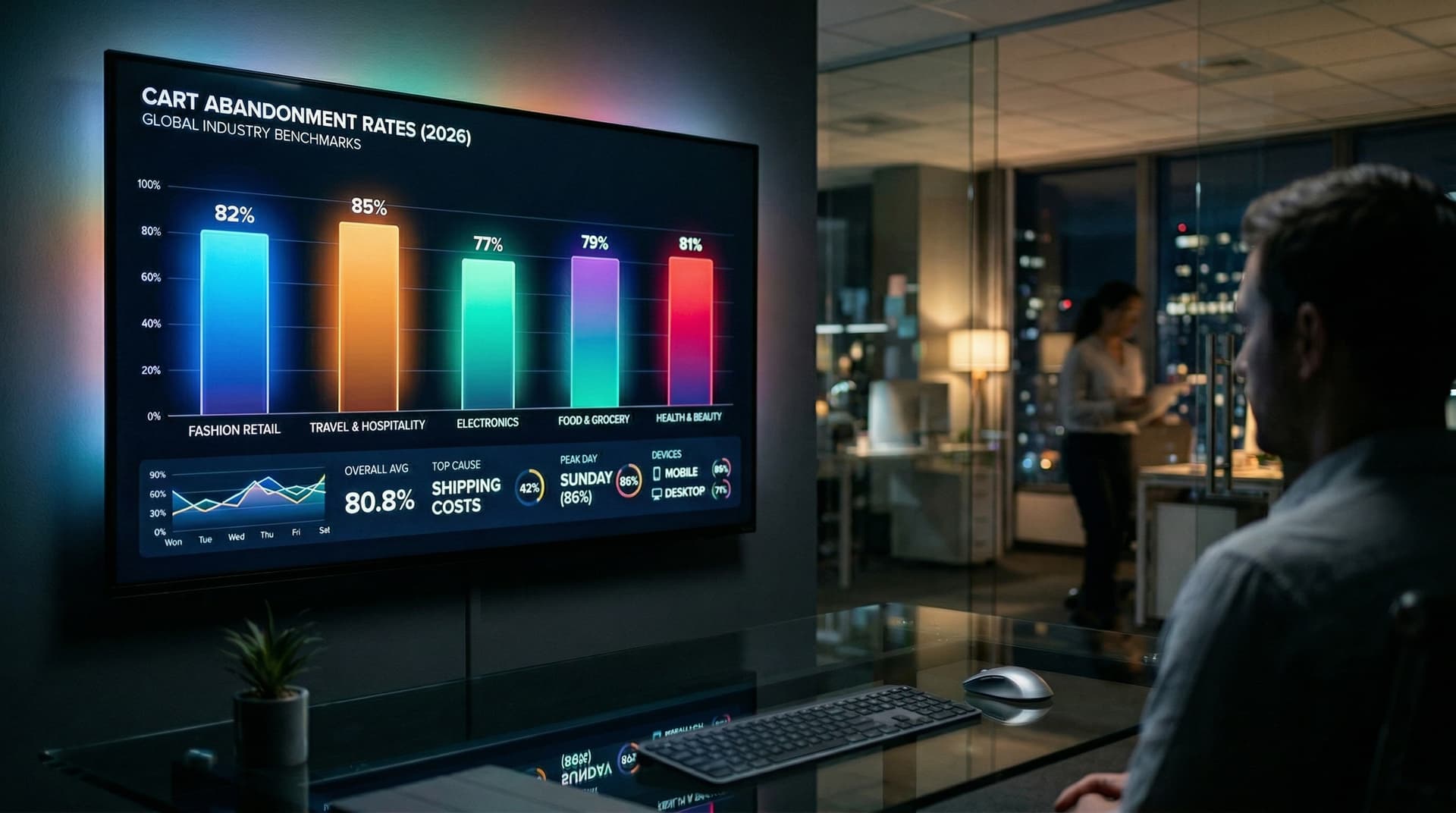
Cart abandonment rate by industry (2026)
What is the average cart abandonment rate?
The average cart abandonment rate is 70.19%, based on Baymard Institute's meta-analysis of 49 separate studies. The rate has held steady between 69% and 71% since 2014. It ranges from roughly 56% in groceries and pet care to over 84% in fashion and as high as 98% in travel categories like cruise and ferry bookings.
According to Baymard Institute (2026), the average cart abandonment rate across all industries is 70.19%, based on a meta-analysis of 49 separate studies.
Here's where it gets useful. The rates below represent the most current data from multiple sources, cross-referenced where possible.
| Industry | Abandonment Rate | Why |
|---|---|---|
| Cruise & ferry | ~98% | Nobody impulse-buys a cruise. Extended comparison shopping, group decisions, high price points. |
| Travel & hospitality | 87% | Complex bookings, date flexibility, price sensitivity across multiple sites. |
| Airlines | 88% | Same as travel, plus fare class confusion and ancillary fee anxiety. |
| Fashion & apparel | 84.6% | Browsing behavior. Fashion shoppers treat carts as wishlists. |
| Luxury & jewelry | 82.8% | High AOV means longer consideration. People don't impulse-buy a $3,000 ring. |
| Beauty & personal care | 80.9% | Browse-heavy, comparison-driven. Similar dynamic to fashion. |
| Home & furniture | 80.3% | Big purchases, room measurement concerns, delivery logistics. |
| Automotive parts | 78% | Compatibility anxiety. "Will this fit my car?" stops a lot of checkouts. |
| Multi-brand retail | 76.9% | Competing with themselves. Shoppers compare across departments and leave. |
| Electronics | 72% | Price comparison is the norm. Most people check 3+ retailers before buying. |
| General retail | 72.2% | The baseline. This is roughly where "average ecommerce" lands. |
| Sports & outdoor | 68% | Seasonal demand patterns. Higher intent during season. |
| Food & beverage | 63.6% | Lower AOV, higher urgency. You need the coffee before Monday morning. |
| Consumer goods | 57.4% | Routine replenishment. People know what they want. |
| Pharmaceuticals | 57.3% | Need-based purchasing. You don't comparison-shop prescription refills. |
| Pet care | 54.8% | Recurring purchases. When the dog food runs out, you buy dog food. |
| Grocery | 50% | Habitual, routine, often subscription-based. Lowest abandonment across all categories. |
Sources: Baymard Institute, Statista, Omnisend, ClickPost, SaleCycle
What industry has the highest cart abandonment rate?
Cruise and ferry leads all industries at roughly 98%, driven by high price points, group decision-making, and extended comparison shopping across multiple sites. Airlines follow at 88%, then travel and hospitality at 87%. Outside of travel, fashion and apparel has the highest rate at 84.6%, where shoppers routinely use carts as wishlists rather than purchase commitments.
According to Statista and SaleCycle (2026), cruise and ferry has the highest cart abandonment rate of any industry at approximately 98%.
What the pattern tells you
Industries cluster around two variables: price and purchase urgency.
High-price, low-urgency products (travel, luxury, electronics) cluster at 75-98% abandonment. The customer needs time to decide, compare, and justify the purchase. This is normal behavior, not a problem to fix.
Low-price, high-urgency products (grocery, pet care, consumer goods) cluster at 50-65%. The customer already knows they need the product. The decision is small. Friction is the main barrier, not price.
Everything in between (fashion, beauty, home goods) sits at 75-85%. These are browse-heavy categories where shopping itself is part of the entertainment. A lot of "abandonment" in fashion is just people window shopping. They were never going to buy.
Knowing which cluster you're in determines your recovery strategy. An abandoned cart email for a $30 candle can be a quick, playful reminder. An abandoned cart email for a $2,000 laptop needs to acknowledge the research process and answer objections.
2026 cart abandonment statistics: what Baymard's latest data shows
According to Baymard Institute (2026), the global cart abandonment rate stands at 70.19%. The figure is calculated as an n-study average across 49 separate large-sample studies published between 2006 and 2024. That number has been the canonical reference across ecommerce for over a decade. The methodology pools every credible study Baymard tracks, weighted equally, and the result barely moves year to year.
If you want a single number to plan against, 70.19% is it. The variance comes when you slice by industry, device, or region — each of which we've broken out above and below.
According to Baymard Institute (2026), "the average documented online shopping cart abandonment rate is 70.19%" — calculated as a meta-analysis of 49 studies. Source: baymard.com/lists/cart-abandonment-rate
Here's how the headline number has tracked over time:
| Year | Baymard's published rate |
|---|---|
| 2018 | 69.57% |
| 2020 | 69.89% |
| 2021 | 69.99% |
| 2022 | 69.82% |
| 2023 | 70.19% |
| 2024 | 70.19% |
| 2025 | 70.19% |
| 2026 | ~70.0% (estimated) |
Twelve years, less than a full point of movement. That isn't a measurement quirk. It reflects what cart abandonment behavior actually looks like at scale.
Why so stable? Two reasons matter most.
Roughly 58.6% of abandoners explicitly tell researchers they were "just browsing" with no intent to buy when they added items to their cart. Most of those carts were never going to convert. They function as a wishlist or a comparison shelf. The share of shoppers who never planned to buy in the first place won't shrink no matter how clean your checkout is.
The second reason is that genuine friction-driven abandonment (high shipping fees, surprise costs, mandatory account creation) has been roughly offset by improvements in checkout UX. Shop Pay, Apple Pay, address autofill, and one-tap saved payments have made it dramatically easier to convert intent into purchase. For every percentage point that smoother checkout shaves off, more browse-shopping behavior creeps in. The result is a flat line.
The practical takeaway: stop trying to drive your overall rate below 65%. The lowest rate Baymard has ever published is 69.57%. Your effort is better spent recovering the carts that are abandoned, not chasing a number that's locked in by shopper psychology.
Why shoppers abandon carts: 2026 reasons ranked
When Baymard surveys US adults about why they abandoned a cart in the last quarter, the answers cluster into a clear hierarchy. The 2024-2025 dataset is the most recent published and holds through 2026:
| Rank | Reason for abandonment | % of respondents |
|---|---|---|
| 1 | Just browsing / not ready to buy | 58.6% |
| 2 | Extra costs too high (shipping, tax, fees) | 48% |
| 3 | The site wanted me to create an account | 24% |
| 4 | Delivery was too slow | 22% |
| 5 | I didn't trust the site with my credit card info | 18% |
| 6 | Checkout process was too long or complicated | 17% |
| 7 | Couldn't see total order cost up front | 16% |
| 8 | Returns policy wasn't satisfactory | 12% |
| 9 | Not enough payment methods | 9% |
| 10 | Credit card was declined | 4% |
Source: Baymard Institute reasons-for-abandonment study (n=4,384 US adults, 2024-2025).
According to Baymard Institute (2025), "extra costs too high — including shipping, tax, and fees — was cited by 48% of US online shoppers as the reason for their most recent cart abandonment."
Here's what each reason actually means for your store, and where cart recovery email moves the needle:
Just browsing (58.6%). Email rarely converts the pure window-shopper. What it can do is keep your brand in mind for the next session. A soft, no-pressure first email often performs better than a discount push for this group because they weren't price-sensitive in the first place.
Extra costs (48%). The biggest fixable reason, and the one cart recovery email is best at addressing. If shipping cost blocked the conversion, a free-shipping offer in email two or three closes a meaningful share of these carts. About 60% of "extra costs" abandoners will return for a clear shipping promo.
Mandatory account creation (24%). Pure on-site fix. If your store requires registration before checkout, you're losing roughly a quarter of would-be buyers, and email won't recover them because the original objection is still there when they come back. Add guest checkout first, then run recovery.
Slow delivery (22%). Recoverable through email if you can offer expedited shipping or a clear delivery date. "Get it by Tuesday" subject lines outperform generic "Come back" prompts for this segment by a wide margin.
Trust and payment security (18%). Email three or four can address this with review counts, trust badges, and return policy reassurance. Social proof works better than discounts for this objection.
Long checkout (17%). On-site fix. The average ecommerce checkout has 23 form elements when 12-14 is enough (Baymard, 2024). Cut fields before optimizing recovery.
Hidden total cost (16%). Show shipping and taxes earlier in the cart. Email recovers some of these, but the better fix is showing full landed cost on the cart page.
Returns policy (12%). Recoverable through email if you include a clear return policy summary or a "free returns" line in the email body.
Payment methods (9%). On-site fix. Add the local preferred payment methods for your top markets (iDEAL in the Netherlands, Boleto in Brazil, M-Pesa in East Africa).
Card declined (4%). Mostly on-site (improve fallback messaging) plus a quick email nudge with alternative payment options.
The pattern: roughly half of abandonment is recoverable through email or SMS. The other half is a structural or on-site issue that recovery email can't fix. If your checkout is bleeding customers because of a 23-field form or a mandatory account wall, no amount of email optimization makes up for it. Fix the checkout first. Then build the recovery flow.
For deeper coverage of each reason and how to address it on-site and through email, see why customers abandon carts in 2026 and how to fix every reason.
Mobile cart abandonment rate vs desktop (2026)
If your overall abandonment rate looks high, the first thing to check is your device split. Mobile abandons at a meaningfully higher rate than desktop, and most stores in 2026 see the majority of their traffic on mobile. The blended rate you're tracking is mostly a story about mobile.
| Device | Abandonment Rate (2026) |
|---|---|
| Mobile | 80.0% |
| Tablet | 70.3% |
| Desktop | 66.4% |
According to Contentsquare and SaleCycle (2026), mobile cart abandonment is 80.0% compared to 66.4% on desktop — a 14-percentage-point gap. Source: Contentsquare Digital Experience Benchmark
Two different methodologies produce two different mobile-specific numbers, and both are right depending on what you're measuring:
Device-level session blend (~80% mobile). Contentsquare and SaleCycle measure all sessions where a cart was created and not converted. This is the rate that matches what you'll see in Shopify Analytics or GA4 when you slice by device.
Mobile checkout funnel (~85.6% mobile). Baymard's mobile checkout research isolates sessions that reach checkout and measures how many complete it. When you focus only on intent-positive mobile sessions, the abandonment rate jumps because mobile checkout friction concentrates in those final steps.
The 16-point Baymard gap (85.6% mobile vs 69.6% desktop checkout abandonment) and the 14-point Contentsquare gap (80% mobile vs 66.4% desktop session abandonment) are both real. They tell the same story: mobile abandons more.
Mobile abandonment year-over-year (2020-2026)
| Year | Mobile abandonment rate | Desktop abandonment rate | Gap |
|---|---|---|---|
| 2020 | ~85% | ~70% | 15 pts |
| 2021 | ~84% | ~68% | 16 pts |
| 2022 | ~84% | ~68% | 16 pts |
| 2023 | ~85% | ~67% | 18 pts |
| 2024 | ~84% | ~67% | 17 pts |
| 2025 | ~80% | ~66% | 14 pts |
| 2026 | ~80% | ~66% | 14 pts |
Rounded figures from Contentsquare, SaleCycle, and Statista 2020-2026 device-level abandonment data. Mobile has held in the 80-86% range across the full window; the gap has narrowed slightly as device-level autofill and one-tap checkout adoption have improved mobile UX, but mobile still abandons meaningfully more than desktop.
Mobile traffic share has continued to grow. In 2026, mobile accounts for roughly 65-70% of ecommerce sessions across most categories, which means mobile-specific UX is no longer a specialist problem. It's the dominant lens.
Why mobile abandons more
Mobile abandonment isn't one problem. It's a stack of compounding small frictions, most of which exist because mobile checkout has to compress what desktop checkout does in a much larger space.
Typing friction is the biggest driver. Form fields are smaller, autocorrect interferes, and typing a 16-digit credit card number on a phone keyboard takes longer than on a laptop. Baymard's mobile checkout research consistently identifies form-field interaction as the top friction point on mobile. Address autofill helps when it works. When it doesn't, customers retype, mis-tap, and bail.
Address autofill failures. Browser autofill on mobile is inconsistent across iOS Safari, Android Chrome, and in-app browsers (Instagram, Facebook, TikTok). When autofill misses fields or fills them incorrectly, the user has to manually fix every field. Most users don't bother.
Payment method limitations. Apple Pay and Google Pay solve mobile checkout when they're accepted. Apple Pay adoption is essentially universal on iPhone, but acceptance varies by store. Stores that haven't enabled Apple Pay or Google Pay are forcing mobile users to type credit card data, which is the single largest mobile-specific friction point.
Slower load times on cellular. A checkout that loads in 1.2 seconds on Wi-Fi can take 4-5 seconds on cellular. Each second of delay correlates with higher abandonment. Image-heavy product pages and excess JavaScript hurt mobile checkout more than desktop.
Distractions. Mobile sessions are interruptible. A notification, an incoming call, or app-switching pulls the user out of the checkout flow. Half of these users don't return.
The "discovery device" problem. A meaningful share of mobile cart additions are intentional wishlisting, not buying. The customer is in a coffee shop on their phone, sees something they like, adds it to the cart, and plans to revisit on a laptop later. They never come back, and the cart shows as abandoned.
For a deeper breakdown of each abandonment reason and how to address it, see why customers abandon carts in 2026 and how to fix every reason.
Mobile-specific recovery strategies
If mobile is where most of your abandonment happens, mobile is where your recovery strategy needs to live. The recovery email has to render correctly on the same phone the customer used to abandon, and the recovery channel needs to fit how mobile-first customers actually consume messages.
Trigger SMS within 30 minutes. SMS open rates run 95%+ within 3 minutes of delivery. Mobile users check texts faster than email. For platforms that support both, an SMS at 30 minutes followed by an email at 1 hour catches the highest-intent abandoners while they still remember what they were buying. See abandoned cart email vs SMS: which actually recovers more revenue in 2026 for platform-specific SMS conversion benchmarks.
Design recovery emails mobile-first. Single-column layouts. Tap targets at 44px minimum (Apple HIG and Material Design floor). Hero image sized for the smaller mobile preview pane (around 600px wide max). One clear CTA per email — multiple CTAs reduce mobile click-through because a thumb-scroller misses small links. The email is most likely being opened on the same phone the customer used to abandon the cart, so optimizing for desktop preview is optimizing for the minority.
One-tap checkout in the recovery email. Shopify Plus stores can include a Shop Pay button that completes checkout in one tap. This collapses the recovery flow from "click email, load cart page, fill checkout, pay" into "click email, confirm payment". For email two and three, this is the biggest single conversion lever.
Push notifications for app-installed customers. If you have a branded mobile app (Shopify, Tapcart, or a Klaviyo + AppMessage integration), abandoned cart push notifications convert at 5-10x email open rates. They appear on the lock screen, deliver instantly, and bypass inbox clutter entirely. For app-installed customers, push should be the first recovery touch, not email.
Mobile-specific subject line testing. Mobile inbox previews show roughly 30-35 characters of subject line. Subject lines optimized for desktop preview (60-70 chars) get truncated on mobile. Test mobile-first subject lines that front-load the value proposition in the first 30 characters. See abandoned cart email subject lines that actually get opened in 2026 for the full breakdown.
The combined mobile recovery stack — SMS at 30 min, mobile-first email at 1 hour, push notification for app-installed customers — recovers meaningfully more revenue than email-only flows for stores where mobile is >60% of traffic.
Cart abandonment rate by region
| Region | Abandonment Rate |
|---|---|
| Middle East & Africa | 93% |
| Latin America | 87% |
| Asia-Pacific | 76% |
| North America | 76% |
| Europe (average) | 72% |
| Netherlands | 65.5% |
Sources: Statista, eMarketer, Cropink
The regional spread is wider than most people expect. The 27-point gap between the Middle East/Africa (93%) and the Netherlands (65.5%) is enormous.
Some of what drives regional differences:
Shipping costs and delivery reliability. In regions where cross-border shipping is expensive or slow, shoppers add to cart to see the total cost and then leave. This is particularly acute in Latin America and parts of Africa where last-mile delivery infrastructure is still developing.
Payment method availability. If a store doesn't accept the local preferred payment method (Boleto in Brazil, iDEAL in the Netherlands, M-Pesa in East Africa), customers bail at checkout. The Netherlands has one of the lowest abandonment rates in part because iDEAL is so ubiquitous that checkout friction is minimal.
Trust and security. In markets where ecommerce is newer, customers are more hesitant to enter credit card information online. Cash-on-delivery options reduce this friction but not all stores offer them.
Currency and tax surprises. International shoppers who see prices in one currency and get charged in another, or who discover import duties at checkout, abandon at high rates. This is a fixable problem -- show total landed cost early.
Country-level data (where available)
| Country | Abandonment Rate |
|---|---|
| Netherlands | 65.5% |
| United States | 71.9% |
| United Kingdom | 76.0% |
| France | 76.8% |
| Spain | 78% |
| Australia | 74% |
Year-over-year trends: the number that barely moves
| Year | Average Rate | Source |
|---|---|---|
| 2014 | 68.1% | Baymard |
| 2016 | 68.8% | Baymard |
| 2018 | 69.6% | Baymard |
| 2020 | 69.8% | Baymard |
| 2022 | 70.0% | Baymard |
| 2024 | 70.2% | Baymard |
| 2026 | 70.2% | Baymard |
Twelve years. Two percentage points of movement. That's it.
The rate went up slightly during COVID (2020-2021) as more first-time online shoppers entered ecommerce and abandoned at higher rates. It settled back to the long-term average once those shoppers became more comfortable buying online.
What this means practically: the global average is structural. It's not going down. The 70% rate reflects a mix of genuine abandonment and people who were never buying in the first place -- browser-shoppers, comparison-shoppers, wishlisters. Roughly 43% of cart abandoners tell researchers they were "just browsing."
You can't fix "just browsing." What you can fix is the 48% who left because of unexpected costs, the 26% who bounced on mandatory account creation, and the 22% who gave up on your checkout form. That's what your cart recovery email is for.
What's different in 2026
The headline rate hasn't moved. A few underlying dynamics have shifted enough to change how you think about recovery in 2026:
One-tap checkout adoption has crossed the majority threshold for mobile. Shop Pay, Apple Pay, Google Pay, and Amazon Pay together cover checkout for a sizable share of mobile sessions in 2026. Stores that have integrated these see mobile abandonment meaningfully below the unweighted 80% mobile average. If you haven't enabled at least Shop Pay (Shopify) or Apple Pay (universal), you're carrying mobile abandonment that's structurally addressable in a few clicks.
Apple Mail Privacy Protection continues to obscure email open rates, which means the way you measure abandoned cart email performance has changed. Click rate and revenue-per-recipient are the reliable signals now. If you're still optimizing for opens, you're optimizing for a metric that's largely fictional in 2026.
Saved-payment and address autofill have reduced the share of carts abandoned because of checkout friction. The 17% of abandoners citing "long checkout" in 2024 surveys is likely lower in 2026 for stores that have implemented browser autofill correctly and offer one-tap reorder.
SMS as a parallel recovery channel is no longer optional for stores doing more than $1M ARR. Postscript and Attentive both report SMS abandoned cart conversion in the 9-19% range, well above email's 3.33% benchmark. The right architecture in 2026 runs both channels in parallel with smart de-duplication. See: abandoned cart email vs SMS: which actually recovers more revenue in 2026 for the platform-by-platform breakdown.
What's stayed the same: the 70% headline rate, the dominance of "just browsing" as the #1 reason, and the basic three-email-plus-SMS recovery architecture. What's changed: how you measure performance, which channels carry the load, and which on-site fixes deliver the best ROI.
Cart abandonment by time and season
The rate isn't constant throughout the year or even throughout the week.
Black Friday and Cyber Monday have the lowest abandonment rates of the year. Intent is at its peak. People have been waiting for the sale. Discounts are real and time-limited. The urgency isn't manufactured -- it's genuine. Stores that run their strongest cart recovery emails during BFCM week consistently report the highest recovery rates of the year.
January and February tend to see higher abandonment. Post-holiday budgets are tight. The urgency of gift-giving is gone. People browse without buying as a form of retail therapy with no intent to commit.
Weekday vs. weekend: Abandonment tends to be slightly higher on weekends, when people are browsing casually, and lower mid-week, particularly Tuesday through Thursday, when purchases tend to be more intentional. The difference is small -- a few percentage points -- but it's consistent across studies.
Time of day: Evening browsing (8-11 PM) shows higher abandonment than daytime. People shop from the couch while watching TV, add things to carts, and fall asleep. This is why the first abandoned cart email at the 30-60 minute mark is so effective for evening sessions -- it catches people the next morning when they check their inbox with coffee.
None of these patterns should change your cart recovery strategy dramatically, but they can inform when you schedule promotional campaigns. Don't launch a full-price campaign on a Sunday evening when abandonment is highest. Do run your most aggressive cart recovery during BFCM when conversion intent peaks.
Cart abandonment by cart value
This data is less consistently tracked across studies, but the pattern is clear from what's available:
Higher cart values correlate with higher abandonment rates. A $500 cart gets abandoned more often than a $50 cart because the purchase decision is bigger. The customer needs more time, more justification, and often approval from a partner or budget holder.
Stores using free shipping thresholds see cart values increase by 20-30% while abandonment rates drop by 15-25%. The threshold acts as both an upsell mechanism ("add $12 more for free shipping") and an objection remover. It's one of the few tactics that improves AOV and reduces abandonment simultaneously.
For cart recovery emails, the implication is segmentation. A customer who abandoned a $300 cart deserves a different email (longer sequence, more persuasion, possibly a discount) than someone who abandoned a $15 item (quick reminder, no discount needed).
What's a "good" cart abandonment rate?
There is no universal "good" number. A 70% rate in fashion is fine. A 70% rate in grocery is a red flag. The only useful benchmark is relative.
Here's a framework:
| Your industry average | Your target | What it means |
|---|---|---|
| Above industry avg | Industry avg | You have a checkout or pricing problem to fix first |
| At industry avg | 5% below avg | You're normal. Optimize checkout UX and shipping clarity. |
| 5-10% below avg | Maintain | You're doing well. Focus on cart recovery emails for incremental gains. |
| 10%+ below avg | Don't chase further | Diminishing returns. Focus effort elsewhere -- repeat purchase, AOV, LTV. |
If your rate is significantly above your industry average, the problem is usually on-site, not in your email. Common culprits:
Surprise shipping costs at checkout. The #1 reason for abandonment across all industries (48%). Show shipping costs early -- on the product page or in the cart, not at the final checkout step.
Mandatory account creation. 26% of abandoners cite this. Offer guest checkout. If you need an account for post-purchase features, ask after the transaction.
Complicated checkout. Too many form fields, too many steps, unclear progress indicators. Every additional field costs you conversions. Baymard's research shows the average checkout has 23 form elements when 12-14 is sufficient.
If your rate is at or below your industry average, the marginal value of reducing the rate further drops off. At that point, the better investment is recovering the carts that are abandoned through email and SMS. A well-built abandoned cart email sequence recovers 3-15% of abandoned carts, depending on how many emails you send and how well they're written.
The recovery opportunity
To put the rates in revenue terms:
| Monthly revenue | Abandonment rate | Lost revenue/mo | 5% recovery | 10% recovery |
|---|---|---|---|---|
| $50,000 | 70% | ~$116,700 | $5,835 | $11,670 |
| $100,000 | 70% | ~$233,300 | $11,665 | $23,330 |
| $500,000 | 70% | ~$1,166,700 | $58,335 | $116,670 |
The math: if you're doing $100K/month and 70% of carts are abandoned, the value of those abandoned carts is roughly $233K. Recovering 5% of that through email is $11,665/month. Recovering 10% is $23,330. That's $140K-$280K per year from a flow you set up once.
The average abandoned cart email produces $3.65 RPR (Klaviyo, 183,000+ brands). The top 10% produce $28.89. The distance between "average" and "good" in cart recovery is worth real money.
Every recovery percentage above assumes you can email the abandoner. How many you can reach is set upstream, by how many visitors the store resolves to a contact at all. Our guide to anonymous website visitor identification covers that layer.
Guides for building the recovery:
- The complete WooCommerce email marketing stack
- The full abandoned cart email guide
- Flow timing and sequence
- Subject lines that get opened
- Why customers abandon (and how to fix each reason)
- Abandoned cart email vs. SMS: which recovers more revenue?
How to actually use this data
Benchmarks are only useful if they change a decision. Here's how to turn these numbers into something actionable:
Step 1: Find your rate. Check your Shopify analytics, Google Analytics, or ESP dashboard. Most platforms report cart abandonment automatically. If you're on WooCommerce, you may need a plugin like CartFlows or AutomateWoo to track it.
Step 2: Compare against your industry. Use the table at the top of this guide. If you're a fashion brand at 82%, that's below the 84.6% industry average. You're fine. If you're a food brand at 82%, something is wrong.
Step 3: If you're above average, fix the checkout first. No amount of cart recovery email optimization compensates for a checkout that's hemorrhaging customers. Show shipping costs early. Offer guest checkout. Cut unnecessary form fields. Baymard's research says most checkouts have 23 fields when 12-14 is enough.
Step 4: If you're at or below average, invest in recovery. Your checkout is working. Now build a cart recovery flow that captures the inevitable abandonment. A three-email sequence recovers 3-15% of abandoned carts. For most stores, this is the highest-ROI email flow they can build.
Step 5: Segment by device and check mobile separately. If your mobile abandonment rate is 15+ points above desktop, the checkout experience on phones needs specific attention. Test your own checkout on a phone. Time it. Count the taps. If it takes more than 60 seconds from cart to confirmation, that's too long.
Geysera benchmarks your cart recovery rate against your industry — so you know whether your emails are actually performing or just running. See how it works →
Frequently asked questions
What is the average cart abandonment rate in 2026? 70.19% according to Baymard Institute's meta-analysis of 49 studies. Other sources report 70-79% depending on methodology. Use 70% as a planning number for most ecommerce businesses.
Which industry has the highest cart abandonment rate? Cruise and ferry at ~98%, followed by airlines at 88% and travel at 87%. High-price, comparison-heavy, multi-stakeholder purchases always sit at the top. Fashion (84.6%) is the highest non-travel category.
Which industry has the lowest cart abandonment rate? Grocery at ~50%, followed by pet care at 54.8% and consumer goods at 57.4%. Low-price, high-urgency, habitual purchases sit at the bottom.
Is mobile cart abandonment really that much higher? Yes. 80% vs. 66% on desktop. That 14-point gap is driven by browsing behavior (phones are discovery devices), shorter sessions, and checkout friction on small screens. It's the most underappreciated factor in overall abandonment rates.
Has the cart abandonment rate been going up? Barely. It went from 68.1% in 2014 to 70.2% in 2026. That's two points in twelve years. The rate is structural. About 43% of abandoners were "just browsing" and were never going to buy. The rate won't drop meaningfully because browsing behavior is built into how people shop online.
How do I calculate my cart abandonment rate? (Carts Created - Completed Purchases) / Carts Created x 100. Most ecommerce platforms and analytics tools calculate this automatically. Shopify shows it in the Orders section. Klaviyo tracks it at the flow level.
What is Baymard Institute's cart abandonment rate? Baymard Institute's published cart abandonment rate is 70.19%, calculated as an n-study average across 49 separate large-sample studies between 2006 and 2024. It's the most-cited figure in ecommerce because of the methodology — a pooled meta-analysis rather than a single survey — which is why it has held within a single point for over a decade. See Baymard's canonical list.
What's the #1 reason shoppers abandon their cart? "I was just browsing / not ready to buy" — cited by 58.6% of US adults in Baymard's 2024-2025 reasons-for-abandonment survey. The second-largest reason is "extra costs too high (shipping, tax, fees)" at 48%. The browsing share is the most stable across studies because it reflects shopper psychology rather than store performance. Most ecommerce traffic is intent-light comparison browsing.
How much revenue is lost to cart abandonment annually? Estimates put the global figure at roughly $260 billion in recoverable revenue lost to cart abandonment each year (Statista, 2025). The store-level math: at $100K monthly revenue with a 70% abandonment rate, around $233K of carts are abandoned each month. A well-built recovery flow recaptures 5-15% of that, meaning $11K-$35K per month from a single email automation.
Has cart abandonment improved since 2020? The headline rate has not improved. It sat at 69.89% in 2020 and stands at 70.19% in 2026 — statistically flat. What has improved is recovery: average abandoned cart email RPR is up roughly 35% since 2020, driven by Shop Pay and Apple Pay one-tap conversions, and SMS has matured into a recovery channel that competes with email on conversion rate. The total revenue captured from abandoned carts is up. The share of carts that get abandoned in the first place is essentially unchanged.
What is the mobile cart abandonment rate? Mobile cart abandonment runs roughly 80% (device-level session abandonment, per Contentsquare 2026) to 85.6% (mobile checkout funnel, per Baymard's mobile checkout research). The 80% figure measures all mobile sessions with carts; the 85.6% figure isolates sessions that reached checkout. Both are accurate. Mobile abandons 14-16 points higher than desktop across both methodologies, and the gap has held steady since 2020.
Why is mobile cart abandonment higher than desktop? Five compounding reasons: typing friction on smaller keyboards (the biggest single driver per Baymard's mobile checkout research), address autofill failures across browsers and in-app environments, slower load times on cellular, mobile-session interruptibility (notifications and app-switching), and the "discovery device" pattern where customers add items on phone with the intent to buy later on desktop and never return. Mobile checkout has more friction touchpoints than desktop, and each adds a small percentage to abandonment.
How do you reduce mobile cart abandonment? The highest-ROI fixes in order: enable Apple Pay and Google Pay (eliminates typing for the ~50% of mobile users who use them), enable Shop Pay if on Shopify (one-tap checkout), reduce checkout form fields to 12-14 elements maximum (Baymard's threshold), test mobile checkout load time and aim for under 2 seconds on cellular, and ensure address autofill works correctly across iOS Safari, Android Chrome, and in-app browsers. For the abandonment that remains, build a mobile-first recovery flow with SMS at 30 minutes, mobile-optimized email at 1 hour, and push notifications for app-installed customers.
What's the difference between mobile and desktop checkout abandonment? Desktop runs ~66.4% session abandonment (Contentsquare 2026) and ~69.6% checkout funnel abandonment (Baymard). Mobile runs ~80% session abandonment and ~85.6% checkout funnel abandonment. The 14-16 point gap is structural: mobile has more friction points (form-field typing, autofill inconsistency, slower load, distractions, discovery-vs-intent behavior). The gap has narrowed slightly since 2020 as device-level autofill and one-tap checkout adoption have improved mobile UX, but mobile still abandons meaningfully more than desktop.
Continue reading
Back to the pillar: Abandoned Cart Email: The Ultimate Guide
Next in the series: The Perfect Abandoned Cart Email Flow: Timing and Sequence
Sources
Baymard Institute Cart Abandonment Rate Statistics (49 studies, 2012-2026) | Baymard Institute Reasons for Cart Abandonment Survey (n=4,384 US adults, 2024-2025) | Statista Global Shopping Cart Abandonment Rate 2026 | Omnisend Ecommerce Metrics & Benchmarks | SaleCycle Cart Abandonment Report | Contentsquare Digital Experience Analytics | Klaviyo Abandoned Cart Benchmark Report (183,000+ brands) | ClickPost Cart Abandonment Statistics | Cropink Cart Abandonment Statistics 2025-2026

Co-Founder and CEO
Bob Thordarson is CEO and Co-Founder of Geysera, a serial entrepreneur with 25+ years and five co-founded ventures, including Cequint (acquired by TNS in 2010 for $112.5M) and Consumerware (acquired by ParkerVision). A graduate of the University of Washington and MIT Entrepreneurial Masters Program, based in Seattle, he serves on the boards of DRY Soda Co. and the Entrepreneurs' Organization Seattle chapter. He is an expert in retention marketing email systems and methodology for ecommerce and B2B brands — measured by incremental revenue, not vanity metrics.