WooCommerce Abandoned Cart Recovery: The 2026 Playbook
Installing an abandoned cart plugin is step zero, not the playbook. Recovering more carts comes from the recovery rate, and the levers most WooCommerce stores never touch: trigger timing and sequence depth, the email-and-SMS channel mix, incentive strategy that does not train discount-hunting, and the biggest leak of all, the anonymous and guest carts a plugin tied to known customers never sees. This is the 2026 recovery-rate playbook, and where it sits on top of the cart tools you already run.
Last updated: June 13, 2026
This is post 11 of 17 in the WooCommerce Email Marketing in 2026 Series. Previous: WooCommerce Email Notifications and Templates: The Complete 2026 Setup Guide
Search "woocommerce abandoned cart recovery" and Google hands you a wall of plugins: WooCommerce's own Abandoned Cart Recovery and Abandoned Cart Pro, YITH, VillaTheme, CartFlows, FunnelKit. Install any of them and you can send a reminder email when someone leaves a cart behind. That is worth doing, and we cover exactly how in our WooCommerce abandoned cart setup and plugin guide. But installing the plugin is step zero. It is not the playbook.
The number that matters is the recovery rate: of the carts that get abandoned, how many you actually win back. Two stores can run the same plugin and see wildly different results, because recovery rate is not a feature you switch on. It is the outcome of decisions about timing, channel, incentives, targeting, and which carts you can even see in the first place. This post is about those decisions, and about where they fit on top of the cart tools you already run.
KEY STATS
- Cart abandonment across ecommerce runs near 70% in 2026, the single largest recoverable revenue line for most WooCommerce stores (Baymard Institute, 2026)
- A well-built abandoned-cart email flow recovers roughly 5-10% of otherwise-lost carts, and the first message drives the majority of that recovery (Klaviyo and industry benchmarks, 2025-2026)
- Automated, behavior-triggered flows earn roughly 18x the revenue per recipient of one-off broadcast campaigns, which is why a tuned sequence beats a single reminder (Klaviyo and MailerLite benchmarks, 2025-2026)
- 80-95% of paid Meta and Google traffic to a typical store never identifies, so the carts those visitors abandon are invisible to a recovery plugin that only acts on known contacts (industry visitor-identification analyses, 2025-2026)
- Recovery rate is set by five levers (timing, sequence depth, channel, incentive, and which carts you can see), not by which plugin you install
- Data sourced from the live "woocommerce abandoned cart recovery" SERP (DataForSEO, June 2026), Baymard cart-abandonment research, and aggregated 2025-2026 ecommerce email benchmarks
What's in this guide:
- Recovery rate, not "recovery on"
- Lever 1: Timing and sequence depth
- Lever 2: Channel, and where email and SMS each win
- Lever 3: Incentives without training discount-hunting
- Lever 4: Targeting the carts worth the effort
- The biggest leak: the carts your plugin never sees
- The recovery program, assembled
- How this runs on WooCommerce
- Frequently asked questions
Recovery rate, not "recovery on"
The plugin SERP frames cart recovery as a binary: you either have abandoned-cart emails or you don't. That framing is why so many stores turn the feature on, send one generic reminder, and conclude that cart recovery "doesn't really work for us."
Recovery rate is a dial, not a switch. With cart abandonment sitting near 70%, the abandoned carts are the largest pool of recoverable revenue a WooCommerce store has, and the difference between a lazy setup and a tuned program is most of that revenue. The same plugin that recovers 3% of carts for one store recovers two or three times that for another, and the gap is entirely in the decisions around it.
Mitchell Callahan, co-founder of the WooCommerce agency Saucal, has made the point that the cart is where stores quietly leak the most, and that most owners under-invest in it precisely because the leak is invisible on the dashboard (Saucal, "Don't Abandon Your Cart Page"). Recovery is the same story one step later. You cannot file a support ticket for revenue you never knew you missed, so the recovery rate stays low and nobody notices.
The rest of this playbook is the five levers that move that dial. The first four improve how you recover the carts you can see. The fifth is about the carts you can't.
Lever 1: Timing and sequence depth
The single most common recovery mistake is sending one email, hours too late.
A cart is hottest in the first hour. Intent decays fast after that, which is why a strong recovery sequence opens with a prompt first message (often within an hour), then follows with a second and usually a third over the next day or two, each with a different reason to come back rather than the same reminder repeated. The first message recovers the majority of what you will recover. The later ones catch the people who were genuinely busy, comparison-shopping, or waiting to get paid.
A single reminder leaves most of that on the table. So does a sequence that all fires on day three. The exact cadence, how many messages, and what each one should say is its own subject, and we lay it out in detail in our abandoned cart email sequence guide. The playbook-level point is simple: depth and timing are a lever, and most WooCommerce stores have it set to "one email, eventually."
Lever 2: Channel, and where email and SMS each win
Email is the backbone of cart recovery. It is cheap, it carries images and links, and it has room to make a case. But email is not the only channel, and for some carts it is not the best one.
SMS recovers differently. It is immediate, it is read in minutes, and it works well for the fast first nudge on a high-intent cart, especially on mobile where the abandonment happened. It is also more intrusive and more expensive per message, so it is not where you send three paragraphs about your brand. The practical answer for most stores is not email or SMS but a sequence that uses each where it is strongest: a quick SMS nudge plus an email that can actually sell. We compare the two channels with the numbers in abandoned cart email vs SMS.
The lever here is channel mix. A store running email-only recovery is leaving the fast-nudge recovery that SMS does best uncaptured, and a store blasting SMS for everything is burning money and goodwill on carts that an email would have recovered for a fraction of the cost.
Lever 3: Incentives without training discount-hunting
The fastest way to lift a recovery rate this quarter is to put a discount in every cart email. It is also the fastest way to wreck your margins and teach customers to abandon on purpose.
Shoppers learn quickly. If every abandoned cart reliably produces a 10%-off code an hour later, you have not built a recovery program, you have built a coupon dispenser, and your best customers will start abandoning carts to trigger it. The discipline is to recover with reasons before you recover with money: the items are still waiting, the thing they wanted is low in stock, shipping is free over a threshold they are already past, here is the review that answers the objection that made them hesitate. Hold the incentive for later in the sequence, for higher-value carts, or for first-time buyers where the lifetime value justifies it.
When a discount does earn its place, the size and timing matter as much as the decision to offer one. Our guide on abandoned cart discounts covers when to offer, what to offer, and when holding back recovers more profit than a coupon would. The lever is incentive strategy, and "discount everything immediately" is the setting that quietly costs the most.
Lever 4: Targeting the carts worth the effort
A $40 cart from a first-time visitor and a $400 cart from a repeat customer should not get the same three emails. Treating every abandoned cart identically is the difference between a recovery program and a blast.
The signals that should shape recovery are cart value, whether the shopper is a known customer or brand new, what is in the cart, and why people abandon that kind of cart in the first place. High-value carts justify SMS and a human-feeling follow-up. Carts full of a category you know gets abandoned over shipping cost should lead with your shipping terms, not a generic "you left something behind." The reasons people abandon are specific and addressable, and we catalog them in why customers abandon carts in 2026. Knowing your own numbers helps too: recovery benchmarks vary a lot by category, and our cart abandonment rate by industry reference shows what "normal" looks like for stores like yours.
Targeting is the lever that separates a recovery rate that creeps up from one that climbs. It is also the lever a basic plugin handles worst, because most of them treat the cart as a single event rather than a profile with history.
The biggest leak: the carts your plugin never sees
Here is the lever nobody in the plugin SERP talks about, and it is the largest one.
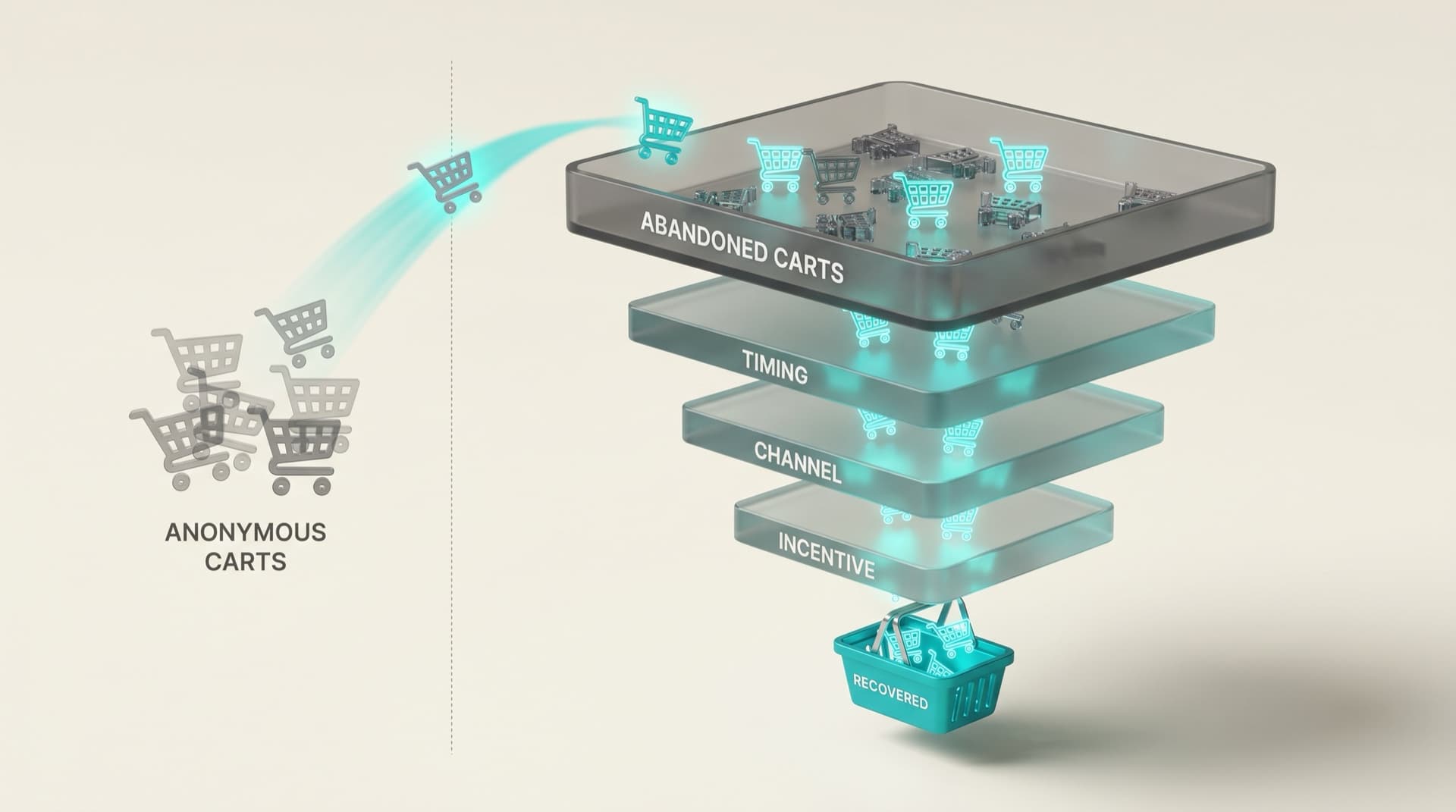
Every recovery plugin shares the same blind spot: it can only recover a cart it can attach to a contact. To send the email, it needs an email address, which means the shopper either logged in, started checkout and entered their address, or was already a known subscriber the tracking could match. On a typical WooCommerce store running paid acquisition, that is the minority of carts. Between 80 and 95 percent of paid Meta and Google traffic never identifies at all. Those visitors browse, add to cart, and leave without ever handing over an email, and a recovery plugin keyed to known contacts simply never sees their carts.
Nadir Seghir, a WooCommerce core engineer on the Cart and Checkout Blocks team at Automattic, has written extensively about how the cart and checkout actually work under the hood (nadir.blog). The mechanics matter here: a cart held by an anonymous, not-logged-in visitor exists in the store, but without an identity attached to it, a standard recovery flow has no one to email. The cart is real. The contact is missing.
This is where recovery rate stops being about better emails and becomes about identity. Closing the gap takes a visitor-identification layer that resolves a share of that anonymous traffic into contactable profiles and feeds them into the same recovery flows, so the carts that were invisible become recoverable. The mechanics of how that resolution works (identity graphs, server-side tracking, and the privacy posture around them) are in our website visitor identification guide.
Patrick Garman, CEO of the WooCommerce agency Mindsize, has spent his career on stores doing serious paid-traffic volume, where this leak is most expensive (Mindsize). At scale, the carts you never see are not a rounding error. They are often the largest single bucket of lost revenue in the store, and no amount of tuning the emails you do send will touch them.
The recovery program, assembled
Put the five levers together and "abandoned cart recovery" stops being a plugin setting and becomes a program.
It opens fast, often inside the first hour, with the channel that fits the cart: an SMS nudge for a high-intent mobile cart, an email that can sell for everything else. It runs as a short sequence, not a single send, with each message carrying a fresh reason rather than the same reminder. It holds incentives for where they earn their keep instead of discounting every cart on reflex. It treats a $400 repeat-customer cart differently from a $40 first-timer. And critically, it recovers from both the carts it already knows about and a share of the anonymous carts it previously could not see, because an identification layer is feeding them in.
That last piece is the architecture this whole series is built on, and we lay it out in full in The Modern Ecommerce Email Stack: keep the tools you use, and add a behavior-and-identity layer on top that runs the flows and recovers the traffic a single plugin cannot. Cart recovery is the flow where that layer pays for itself fastest, because the abandoned carts are the biggest recoverable pool and the anonymous ones are pure found revenue.
| Recovery approach | What it recovers | What it misses |
|---|---|---|
| Single reminder email | A slice of known-contact carts | Later-converting carts, fast nudges, all anonymous carts |
| Plugin sequence, email-only | Most known-contact carts | SMS-best fast nudges, all anonymous carts |
| Plugin sequence, email + SMS | Known-contact carts across channels | All anonymous and guest carts the plugin can't attach to a contact |
| Automation layer (sequence + channels + identity) | Known-contact carts and a share of previously anonymous carts | Far less; the leak is the part most programs never address |
A recovery plugin can only win back carts it can attach to an email address, which on a paid-traffic store is the minority of them. Improving recovery rate means tuning timing, channel, incentive, and targeting for the carts you can see, and adding a visitor-identification layer so the 80-95% of anonymous traffic that abandons carts becomes recoverable instead of invisible.
How this runs on WooCommerce
None of this requires leaving the WooCommerce tools you already use. It runs on top of them.
The plugin or extension you already have (AutomateWoo, FunnelKit, a dedicated recovery plugin, or your ESP's cart flow) stays as the engine that sends to known contacts. The mechanics of setting that up correctly, which triggers to use and how to avoid the common configuration mistakes, are in our WooCommerce abandoned cart setup guide, and if you run Mailchimp specifically, the Mailchimp abandoned cart for WooCommerce guide covers that path. The tool landscape, split by how locked-in each option is, is mapped in Top 10 WooCommerce email automation tools.
What you add on top is the recovery-rate thinking from this playbook and the identity layer that closes the anonymous-cart gap. The full picture of how the pieces fit, across every ESP cohort, is in the WooCommerce email marketing 2026 pillar. The point of this post is narrower and worth repeating: recovery rate is a set of decisions, not a plugin you install, and the biggest decision is whether you are even trying to recover the carts your plugin can't see.
Every store I have worked with treats abandoned cart recovery as a checkbox. Install the plugin, turn on the email, move on. Then they wonder why recovery is a rounding error. The carts are the biggest pile of money in the building, and the program around the plugin is where that money actually comes back, especially the carts from people who never gave you an email. Those are not gone. They are just unaddressed. The stores that win at recovery are the ones that stopped treating it as a feature and started treating it as a number they are responsible for moving.
— Bob Thordarson, Geysera CEO
Frequently asked questions
How do I recover abandoned carts in WooCommerce?
Install a recovery tool (AutomateWoo, FunnelKit, a dedicated plugin, or your ESP's cart flow) to send automated emails to shoppers who leave items behind, then tune the program for recovery rate: open fast, run a short multi-message sequence rather than one reminder, mix email with SMS for high-intent carts, hold incentives for where they earn their keep, and add a visitor-identification layer to reach the anonymous carts a plugin can't attach to a contact. The setup mechanics are in our WooCommerce abandoned cart setup guide.
What is a good abandoned cart recovery rate?
A well-built abandoned-cart email flow recovers roughly 5-10% of otherwise-lost carts, with the first message doing most of the work, though the number varies a lot by industry and average cart value. Treat that as a floor for the carts you can see. The bigger opportunity is usually the anonymous carts a standard flow never reaches at all, which is why stores that add an identification layer often see total recovered revenue climb well past the email-only benchmark.
Why is my WooCommerce cart recovery rate so low?
Usually one of five reasons: the emails fire too late, you send a single reminder instead of a sequence, you rely on email-only when an SMS nudge would catch high-intent carts, you discount every cart and train shoppers to abandon, or, most commonly, you are only recovering the minority of carts tied to a known contact and never touching the anonymous majority. Recovery rate is set by those levers, not by the plugin itself.
How do I see abandoned carts in WooCommerce?
Recovery tools log abandoned carts in your WordPress dashboard. AutomateWoo, for example, lists them under AutomateWoo > Carts with the cart status, the shopper's email if known, item count, and value. The important limitation: these logs only show carts the tool could attach to a contact or session. Carts from anonymous visitors who never identified largely do not appear, which is the blind spot this playbook is built around.
Should I offer a discount to recover an abandoned cart?
Not by default. Leading with a discount on every cart trains shoppers to abandon on purpose and erodes margin. Recover with reasons first (items still waiting, low stock, free-shipping threshold, social proof), and reserve incentives for later in the sequence, higher-value carts, or first-time buyers where the lifetime value justifies it. Our abandoned cart discounts guide covers the specifics of when an incentive helps and when it costs more than it earns.
Can I recover carts from visitors who never entered their email?
Not with a standard recovery plugin, because it needs an email address to send to. This is the largest gap in most recovery programs: on a paid-traffic store, the majority of carts come from anonymous visitors who never identify. Closing it takes a visitor-identification layer that resolves a share of that traffic into contactable profiles and feeds them into your recovery flows, turning previously invisible carts into recoverable ones.
Is abandoned cart recovery worth it for a small WooCommerce store?
Yes, because abandoned carts are the largest pool of recoverable revenue most stores have, and the basic setup is inexpensive. Start with a tuned email sequence, add SMS once volume justifies it, and be disciplined about incentives. The identity layer matters more as paid traffic grows, since that is when the anonymous-cart leak becomes the biggest single bucket of lost revenue.
What is the difference between cart, browse, and checkout abandonment?
Cart abandonment is leaving items in the cart without buying; browse abandonment is leaving after viewing products without adding to cart; checkout abandonment is leaving after starting checkout. Each needs a different recovery flow and different timing. We map all three and how their email recovery differs in our complete email recovery playbook covering browse, cart, and checkout abandonment.
Continue the series
This is post 11 of 17 in the WooCommerce Email Marketing in 2026 series.
- Start with the pillar: WooCommerce email marketing 2026 — the complete stack
- Previous in series: WooCommerce Email Notifications and Templates: The Complete 2026 Setup Guide
- The architecture behind the recovery program: The Modern Ecommerce Email Stack: Why Two Tools Beat One
If you want the WooCommerce-specific automation layer that runs cart recovery (including for the anonymous carts a plugin never sees) on top of whatever tools you already use, that is what Geysera is built for.
Sources

Co-Founder and CEO
Bob Thordarson is CEO and Co-Founder of Geysera, a serial entrepreneur with 25+ years and five co-founded ventures, including Cequint (acquired by TNS in 2010 for $112.5M) and Consumerware (acquired by ParkerVision). A graduate of the University of Washington and MIT Entrepreneurial Masters Program, based in Seattle, he serves on the boards of DRY Soda Co. and the Entrepreneurs' Organization Seattle chapter. He is an expert in retention marketing email systems and methodology for ecommerce and B2B brands — measured by incremental revenue, not vanity metrics.