Email attribution is broken: why your revenue numbers are probably wrong
Your ESP says email generated $X this month. That number is almost certainly too high. Last-click attribution gives email 100% credit for purchases that involved multiple touchpoints, and an estimated $66 billion is wasted annually because of it. This post covers why 51% of CTOs don't trust their platform data, how incrementality testing reveals your real email impact, and what privacy regulation means for the tracking signals attribution depends on.
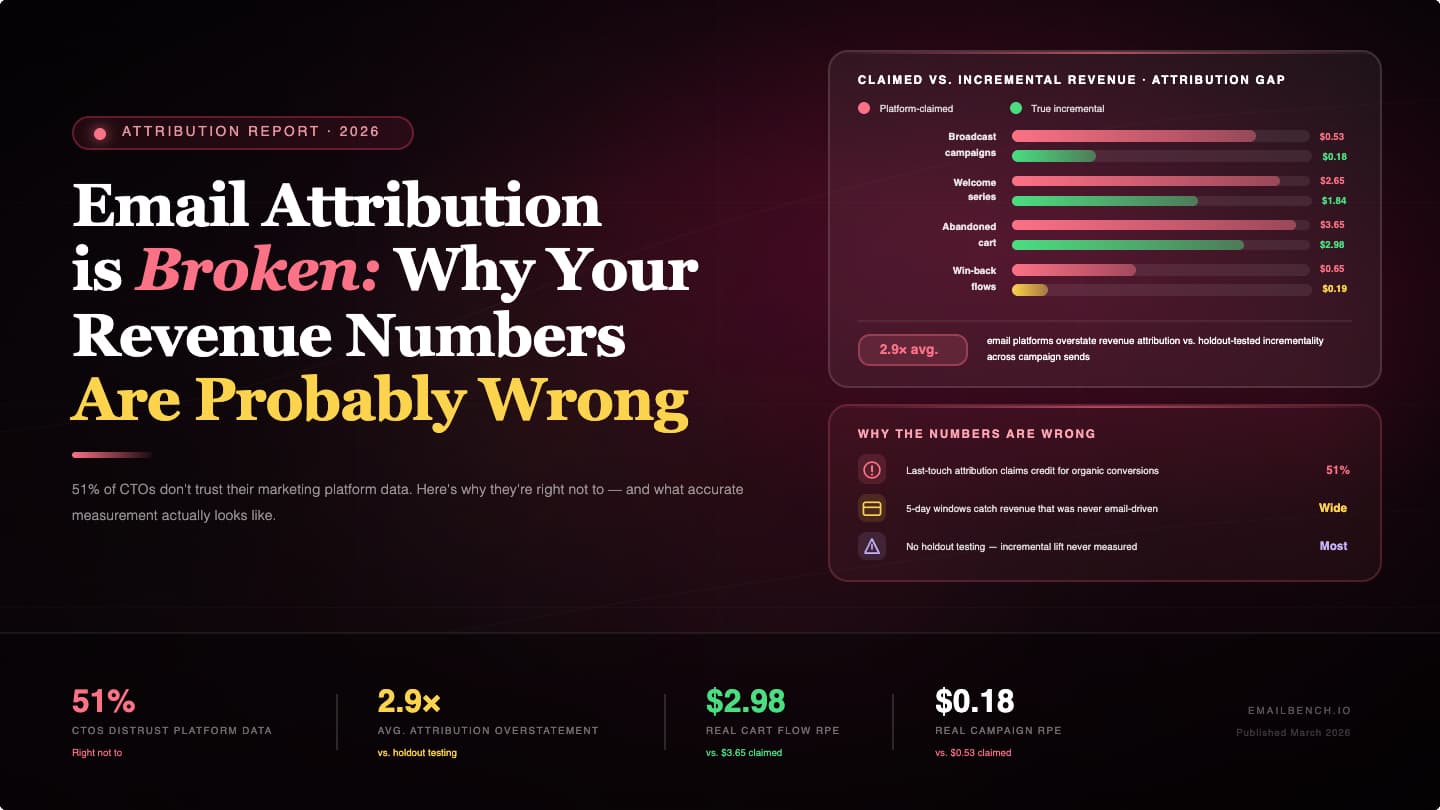
51% of CTOs don't trust their marketing platform data. Here's why they're right not to.
Key takeaways
- Brands waste an estimated $66 billion annually due to broken attribution
- 51% of CTOs don't trust their marketing platform data
- Last-click attribution gives email 100% credit for multi-touch journeys
- Incrementality testing improves marketing efficiency by 15-30%
- 20 US states now enforce privacy laws restricting email tracking; GDPR fines hit 1.2B euros in 2024
Every email marketer has a revenue number they report upward. "Email generated $X this month." The number comes from their Email Service Provider (ESP); it looks precise, and it's almost certainly too high.
The problem isn't that email doesn't work. Email works. The problem is that last-click attribution gives email 100% credit for purchases that involved multiple touchpoints. A customer sees an Instagram ad, reads a blog post, gets retargeted, receives an abandoned cart email, and buys. Email gets all the credit. The other three touches get nothing.
Roughly $66 billion is wasted annually because of attribution like this. Half of CTOs don't trust the data. And expanding privacy regulation is making the tracking signals that attribution depends on less reliable every quarter.
This post is part of our 2026 Email Marketing Benchmarks series.
The scale of the problem
| Metric | Data point |
|---|---|
| Annual marketing waste from broken attribution | $66 billion+ |
| CTOs who don't trust marketing platform data | 51% |
| Companies measuring email ROI poorly or not at all | ~50% |
| Brands investing in multi-touch attribution | 76% |
| Companies >$250M using multi-touch | 73% |
Half of companies admit they can't properly measure email ROI. Half of CTOs don't trust the data they do have. That's not a measurement optimization problem. That's a credibility problem.
How last-click attribution warps email metrics
A realistic purchase path
- Sees Instagram ad, visits site, leaves
- Reads blog post from Google search, browses products, leaves
- Returns via retargeting ad, adds to cart, abandons
- Receives abandoned cart email, clicks, purchases
Last-click attribution: email gets 100% credit.
What actually happened: four touchpoints contributed. The Instagram ad created awareness. The blog built interest. The retargeting ad drove the cart addition. The email was the final nudge — important, but not the whole story.
What last-click overvalues
| Channel | Why |
|---|---|
| Branded search | Captures existing demand, doesn't create it |
| Retargeting ads | Warm audience, already aware and interested |
| Promotional emails | Final nudge gets full credit for a multi-step journey |
| Coupon/deal sites | Intercepts purchases already in progress |
What last-click undervalues
| Channel | Why |
|---|---|
| Prospecting campaigns | Creates the awareness that other channels capture |
| Video advertising | Builds consideration, rarely the last click |
| Influencer partnerships | Drives discovery, conversion happens elsewhere |
| Organic social/content | Educates and builds trust over time |
| Podcast advertising | High influence, hard to measure via clicks |
The uncomfortable question
"If I hadn't sent this email, would the purchase still have happened?"
For an abandoned cart email sent 30 minutes after abandonment to a customer already in your checkout flow, the honest answer is often yes. At least partially.
Alex Greifeld (author of the "No Best Practices" newsletter, ecommerce operator since 2011) makes this point regularly: email platforms have a structural incentive to attribute maximum revenue because that justifies their subscription cost. When your ESP reports a flow "generated" $50,000, how much was truly incremental?
Danavir Sarria (founder of The Upsell, 12-year email marketing veteran) argues that most email agencies report inflated ROI because they pick whichever attribution model makes email look best. He advocates for incrementality measurement even when the numbers are smaller. Honest data leads to better decisions.
Incrementality testing: the closest thing to truth
How it works
Hold back a random percentage of qualified recipients from receiving the email. Compare their purchase rate to the group that got it. The difference is your real incremental impact.
| Group | Treatment | Measurement |
|---|---|---|
| Test group (90%) | Receives the email | Track purchases |
| Holdout group (10%) | Does not receive the email | Track purchases |
| Incremental impact | Test conversion minus holdout conversion | True email effect |
If the test group converts at 8% and the holdout at 5%, the email's incremental impact is 3 percentage points. Not the full 8% that last-click would claim.
What you get from it
Incrementality testing delivers 15-30% improvement in marketing efficiency by showing you which emails drive truly incremental revenue (spend more there), which emails claim credit for purchases that would have happened anyway (reallocate that spend), and where additional sends stop producing incremental value.
How to run it
- Start with your highest-volume flow (usually abandoned cart).
- Hold out 5-10% of qualified recipients randomly.
- Measure purchase rates for both groups over 7-14 days.
- Calculate lift — that's your true incremental contribution.
- Rotate holdout groups so you're not permanently excluding anyone.
- Test quarterly. Incrementality changes as your audience and flows evolve.
Other attribution approaches
Multi-touch attribution (MTA)
| Model | How it works | Use case |
|---|---|---|
| Linear | Equal credit to every touchpoint | Simple, fair baseline |
| Time-decay | More credit to recent touches | Favors conversion-proximate channels |
| Position-based | 40% first, 40% last, 20% middle | Values discovery and conversion |
| Algorithmic/data-driven | ML-assigned weights based on patterns | Most accurate, most complex |
73% of companies above $250M revenue now use multi-touch attribution. 76% of brands are actively investing in MTA to move beyond last-click.
Marketing mix modeling (MMM)
MMM uses aggregated, anonymized data to estimate channel contribution — no user-level tracking required. This makes it privacy-safe and immune to the tracking signal loss from iOS ATT (85%+ opt-out), cookie deprecation, Apple MPP, and state privacy laws.
For brands that need honest measurement in a privacy-first environment, MMM is increasingly the answer.
Profit attribution
A framework that cuts through vanity ROAS:
| Campaign | ROAS | Actual profit margin | Verdict |
|---|---|---|---|
| Campaign A | 5x | 0% | Scales loss |
| Campaign B | 3.5x | 41% | Actually profitable |
Last-click and ROAS-based optimization would scale Campaign A. Profit attribution correctly identifies Campaign B as the one worth scaling. This distinction matters more than most teams realize.
Privacy regulation and the end of individual tracking
The regulatory landscape
GDPR (Europe):
- Tracking individual email opens now requires explicit prior consent (CNIL 2025 draft)
- Campaign-level anonymized rates remain permissible without additional consent
- 2024 aggregate fines: 1.2 billion euros
- France's CNIL fined Google 325 million euros in September 2025
- Violations: up to 20 million euros or 4% of global revenue
US state privacy laws:
- 20 states enforce comprehensive privacy legislation by 2026
- 8 states mandate Global Privacy Control recognition
- Kentucky, Rhode Island, Indiana: GPC required starting January 2026
- California CCPA/CPRA: behavioral profiling is regulated activity
Technical signal loss:
- iOS 14+ ATT: 85%+ of users opt out of tracking
- Apple MPP: inflates opens, masks location and device data
- Third-party cookies: effectively deprecated
- Cross-device identity resolution: increasingly difficult
What email tracking can still collect (and what's regulated)
| Data type | Status |
|---|---|
| Opening timestamps | Requires consent (CNIL 2025) |
| IP addresses / location | Masked by proxies, regulated |
| Device types and OS | Increasingly anonymized |
| Screen resolution | Regulated under privacy laws |
| Open counts/patterns | Unreliable (MPP) and regulated |
| Click data | Best remaining signal (but bot-compromised) |
| Purchase data (first-party) | Most reliable, consent-required |
Dark pattern prohibitions
Regulators are going after manipulative consent practices. Countdown timers creating false urgency invalidate consent. Pre-checked opt-in boxes are prohibited. Easier-accept-than-reject paths are prohibited. Obfuscated opt-out options violate regulations. Accept and reject must have equal prominence.
Where this is heading
Individual-level email tracking is ending. What comes next is less granular but more defensible: cohort-level aggregate measurement, first-party data (declared preferences, purchase history), direct response signals (purchases, replies, forwards), marketing mix modeling, and incrementality testing. You'll know less about each individual subscriber and more about whether your program is actually working.
What to change in your email program
Stop doing
- Trusting platform-reported revenue at face value
- Using last-click attribution as your sole performance measure
- Citing "email generated $X revenue" without an incrementality context
- Optimizing for ROAS without considering profit
Start doing
- Running incrementality holdout tests on major flows quarterly
- Implementing multi-touch or MMM for channel budget allocation
- Tracking profit attribution alongside revenue attribution
- Building first-party data collection into every email touchpoint
- Reporting email's incremental contribution honestly, even if the numbers are smaller
The numbers will be smaller. They'll also be real, which matters more than most people think — especially when someone in finance eventually asks where the revenue figures come from.
Related: Revenue per email: the metric that should have replaced open rates | The email metrics that actually matter
Frequently asked questions
How much money is wasted on broken marketing attribution?
An estimated $66 billion annually across ecommerce. Fragmented data and reliance on last-click models are the main drivers. 51% of CTOs don't trust their marketing platform data.
What is incrementality testing for email?
A holdout experiment where 5-10% of qualified recipients don't get the email. The purchase rate gap between the email group and the holdout group is your true incremental impact. Typically improves marketing efficiency by 15-30%.
Why does last-click attribution overvalue email?
It gives 100% credit to the final touchpoint. Email — especially abandoned cart and promotional emails — is often the last nudge in a journey that started elsewhere. The awareness and consideration built by earlier touches get zero credit.
How are privacy laws affecting email tracking?
GDPR now requires explicit consent for individual open tracking. 20 US states enforce privacy laws, 8 mandate Global Privacy Control. iOS ATT has 85%+ opt-out rates. Individual-level tracking is being replaced by aggregate and first-party measurement.
What is marketing mix modeling?
MMM uses aggregated data (not individual tracking) to estimate each channel's contribution. It's privacy-safe, immune to cookie deprecation and ATT opt-outs, and gives a more honest view of email's role without relying on click-based attribution.
Related reading:
Related reading:
Sources
- LayerFive: Ecommerce Attribution Beyond Last-Click
- InfoSeeMedia: Multi-Touch Attribution Model
- TechBullion: Marketing Attribution Technology
- Heeet: Last-Touch vs Multi-Touch Attribution
- SecurePrivacy: GDPR Compliance 2026
- OneTrust: Privacy Trends 2026
- Mailbird: Email Privacy Compliance 2026
- Alex Greifeld, nobestpractices.co
- Danavir Sarria, theupsell.co
Part of the 2026 Email Marketing Benchmarks series by Geysera

Co-Founder and CEO
Bob Thordarson is CEO and Co-Founder of Geysera, a serial entrepreneur with 25+ years and five co-founded ventures, including Cequint (acquired by TNS in 2010 for $112.5M) and Consumerware (acquired by ParkerVision). A graduate of the University of Washington and MIT Entrepreneurial Masters Program, based in Seattle, he serves on the boards of DRY Soda Co. and the Entrepreneurs' Organization Seattle chapter. He is an expert in retention marketing email systems and methodology for ecommerce and B2B brands — measured by incremental revenue, not vanity metrics.