Welcome Email Best Practices for Ecommerce: First Impressions That Convert
Welcome emails get 50-80% open rates and most stores waste them on a single generic email.
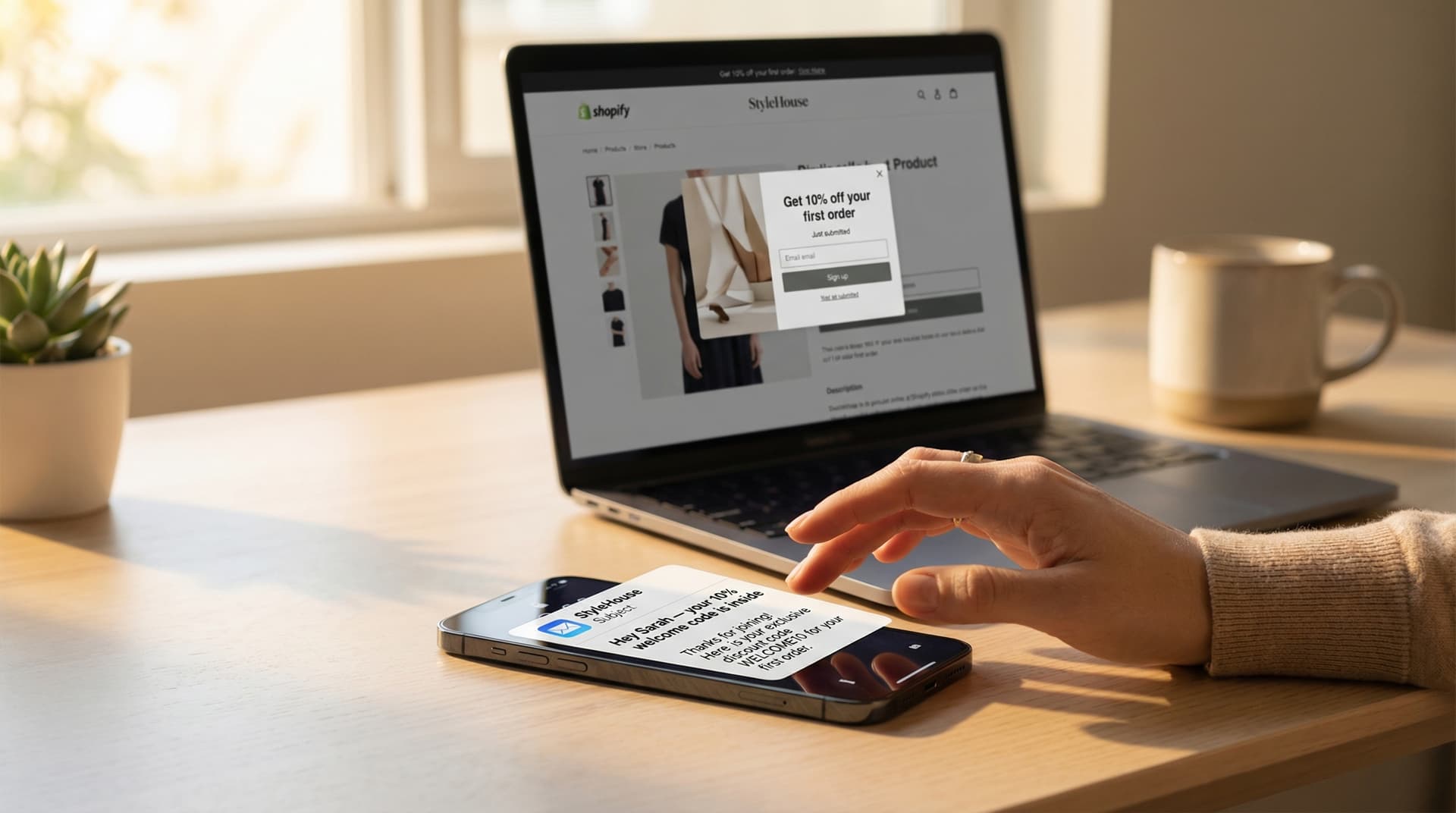
This is post 3 of 12 in the Ecommerce Email Lifecycle Series. Previous: The 7 Essential Ecommerce Email Flows
A welcome email is the first automated message sent to a new subscriber immediately after they join an ecommerce store's email list. Welcome emails achieve 50–80% open rates — three to four times higher than regular campaigns — and generate 3–5x more revenue per recipient than any other email flow, making them the single highest-performing email a store can send.
Those numbers look impressive in a benchmark report. In practice, most stores waste them.
The typical ecommerce welcome email goes something like this. The subject line says "Welcome!", and the body has a logo, a discount code, three product images, two social media icons and a "Shop Now" button. It's sent immediately, which is good, but it's the only welcome email, which is bad. The subscriber either uses the code in the next hour or they don't, and then they're dropped into the general campaign pool with zero onboarding, without knowing your brand story or your bestsellers and with no particular reason to care about the next email that arrives.
A welcome series changes that. Instead of one shot at converting a new subscriber, you get five to seven touches over a week, the window when they're paying the most attention and forming their opinion about whether your brand is worth hearing from again. Waste it with a single email and you don't get a second chance at that level of engagement.
This post covers how to build one that works.
Why the Welcome Email Outperforms Everything Else
The welcome email is your best-performing flow because of timing, more than because of clever copywriting or great design.
When someone signs up for your email list, they just did something voluntary. They typed their email address into a form, on purpose, because they wanted something from you. Maybe it's a discount code. Maybe they just like your brand. Whatever the reason, they're paying attention to you right now in a way they won't be again for weeks or months.
That attention window is narrow. Open rates for welcome emails run 50–80% (Klaviyo, 2024), but by the time you're sending your third campaign two weeks later, you're down to 15–25%, so the gap between "just signed up" and "regular subscriber" is enormous and it closes fast.
Waste it with a generic "Welcome to our store!" email and you've burned the highest-leverage moment in your entire email program. The damage goes beyond one lost sale. Research from Klaviyo shows that subscribers who engage with the welcome series are significantly more likely to stay active on your list long-term. The first impression affects more than whether someone buys this week; it sets the trajectory for the entire relationship.
"A welcome email should do just that: welcome your reader. It should be the beginning of building a relationship, not a sales pitch or a push for your product." — Val Geisler, VP of Customer & Lifecycle Marketing, Digioh (ActiveCampaign)
Geisler uses an analogy that's hard to forget: imagine walking into a store and having the greeter immediately say "Hi! We're having a sale and I think you'd look great in this shirt and it's 50% off so I'll just put it in a fitting room for you okay?" Her contrast is the same salesperson saying welcome, remarking on the heat, giving her name and offering help as you look around, which is the version your welcome email should copy.
Welcome Email vs. Welcome Series
A single welcome email can work for very small stores where the product catalog is simple and the only goal is to deliver a discount code. If you sell one product and someone signed up to get 10% off, a single email with the code and a "Shop Now" button might be enough.
For everyone else, a series is better. Here's why:
A series gives you space to build trust before asking for the sale. You can tell your brand story in one email, surface social proof in another and save the urgency play for the closer, so each email has one job instead of trying to do everything at once.
Single welcome emails try to do all of that in one message, and the result is usually a cluttered email that does nothing well. The subscriber skims it, maybe grabs the discount code, and forgets about you.
Welcome series with 3–5 emails generate more total revenue per subscriber than single welcome emails, because you get multiple bites at converting someone during the week they're paying the most attention.
The Ideal Welcome Series Structure
Here's a 5-email sequence that works for most ecommerce brands. Adjust the timing and content to fit your product, but the structure is reliable across categories.
Email 1: Deliver the promise (send immediately)
Whatever you offered at signup, deliver it first. If the subscriber signed up for a 10% discount, the code should be the first thing they see rather than buried below a brand story and three product blocks, and if you promised a sizing guide or a "find your routine" quiz, link to it immediately.
Make good on your word. A subscriber who doesn't get what they signed up for in the first email won't open the second one.
For the subject line, go direct: "Here's your 10% code" or "Your [Brand] welcome gift is inside." Don't be cute here. They're expecting something specific, so give it to them.
One important piece of flow logic: if the subscriber makes a purchase from Email 1, exit them from the welcome series and move them into the post-purchase flow. There's no reason to keep selling to someone who already bought.
Email 2: Tell your story (Day 1–2)
Now that you've delivered the incentive, earn the right to be in their inbox with an email about building trust rather than driving a transaction.
Who are you, why does your product exist, and what problem does it solve that other products don't? If you have a founder story, tell it here, briefly and honestly, without marketing fluff. If you have a mission or values that mean something beyond "we care about quality", this is where they land.
The best Email 2s don't feel like marketing. They feel like meeting someone.
Email 3: Show your bestsellers (Day 3–4)
The subscriber has their incentive and they know who you are, so now show them what to buy.
This is the email where you stop being polite and start being useful. Surface your most popular products (bestsellers, staff picks, "most reviewed" items) with star ratings and review snippets. If you have dynamic product blocks in Klaviyo, personalize based on what the subscriber browsed before or during signup.
Stores with complex catalogs can turn this into a "category guide" email instead: "New to skincare? Here's where to start" or "Not sure which roast? Take our quiz." The point is to reduce decision fatigue; a subscriber staring at 200 products needs a place to start.
Email 4: Social proof (Day 5)
This one is all social proof: reviews, customer photos, UGC, press mentions, whatever you have that shows real people using your product and loving it.
By Day 5, the subscribers who haven't purchased are on the fence. They're interested (they haven't unsubscribed), but they need one more reason, and social proof gives them that reason without any selling on your part, by showing them that other people already bought.
Email 5: Create urgency (Day 7)
If you offered a signup discount, this is the closer. "Your 10% code expires tomorrow." Discount expiration is one of the most reliable conversion triggers in ecommerce email, because it takes a passive incentive ("I'll use this eventually") and makes it time-sensitive ("I need to use this now or lose it").
If you didn't offer a discount at signup, this email can use a different angle, such as a limited-time bundle, a free shipping threshold or a "most popular starter set" recommendation, whatever gives them a reason to buy today instead of next week.
After Email 5, the subscriber exits the welcome series and joins your regular campaign schedule and any behavioral flows (browse abandonment, cart abandonment) they qualify for.
Welcome Email Best Practices
Beyond the sequence structure, a few details separate the welcome series that convert from the ones that just fill inboxes.
Send Email 1 immediately, not in 30 minutes or an hour. The subscriber is on your site right now, their attention span for your brand is measured in seconds, and every minute of delay costs you open rate.
Use the subscriber's name. This is the personalization baseline: if someone gave you their first name at signup, use it in the subject line and opening line of Email 1. "Here's your code, Sarah" outperforms "Here's your code" consistently, a small thing that signals this isn't a mass blast, and Klaviyo pulls it from the first_name property automatically.
Give each email one CTA, because welcome emails with multiple competing buttons convert worse than emails with a single clear next step. Email 1: use your code. Email 2: read our story. Email 3: browse bestsellers. One job per email. It sounds obvious, but look at any welcome email teardown and you'll see brands cramming three CTAs into a single message.
Design for mobile first, because over 60% of ecommerce email opens happen on phones (Litmus, 2024). Use a single-column layout, large tap targets and text that's readable without zooming; if it doesn't look right on a phone screen, it doesn't work for most of your subscribers.
Set frequency expectations early. Tell the subscriber what's coming: "We'll send you 2–3 emails per week with new arrivals, tips, and exclusive offers." This reduces spam complaints from people who feel ambushed by your campaign schedule two weeks later.
And personalize by signup source when you can. A subscriber who signed up through a popup on your skincare collection page is interested in skincare, while one from a homepage popup might be interested in anything, so use the source to personalize product recommendations in Email 3.
"The second welcome makes you feel seen and human, the first makes you feel like a walking wallet. Your welcome emails should aim to make your readers feel seen and human too. Lead with a warm welcome and save the sales for later on in your customer onboarding." — Val Geisler, VP of Customer and Lifecycle Marketing, Digioh (ActiveCampaign)
Privy's pop-ups run on over 500,000 stores, and an offer or a gamified element usually converts better than a plain form. The quality of your welcome series depends directly on how you build the list that feeds it. A popup converting at 5% gives you five times more subscribers to work with than a footer form converting at 1%.
Welcome Email Subject Lines That Work
Subject lines for welcome emails need to be clear more than clever. The subscriber is expecting this email, and your job is to make sure they recognize it in their inbox and open it.
Incentive delivery (highest open rates):
- Your 10% off code is inside
- Here's your welcome discount, [Name]
- Your [Brand] code: WELCOME10
- Don't forget — 15% off your first order
Brand introduction:
- Welcome to [Brand] — here's what we're about
- You're in. Here's what happens next.
- Meet [Brand]: real [product] for real people
Personalization:
- [Name], your welcome gift is ready
- We picked these for you, [Name]
- [Name], here's what [Brand] customers are loving right now
Curiosity / personality:
- So... what made you sign up?
- First email, no pressure
- The one email you'll actually want to open
Urgency (Email 5):
- Your welcome code expires tomorrow
- Last chance: 10% off ends at midnight
- This is your final reminder (then we're back to full price)
Skip emojis in welcome subject lines unless your brand voice genuinely uses them. They don't improve open rates for welcome emails the way they do for campaigns — the subscriber is already expecting to hear from you.
Setting Up a Welcome Flow in Klaviyo
Andriy Boychuk, founder of Flowium and creator of the Klaviyo Mastery course, teaches a nine-building-block framework for Klaviyo email templates. The welcome flow's job is turning a stranger into a subscriber, then a subscriber into a buyer. His framework is worth studying if you want to go deeper on Klaviyo flow architecture, but the setup below covers what most stores need.
For most Shopify stores, the Klaviyo welcome flow setup takes about 30 minutes:
Trigger: List → "Added to List" (your main email list, not a segment). If you use double opt-in, the flow triggers after confirmation — not after the initial signup. This means your Email 1 might arrive 5–30 minutes after signup rather than instantly, depending on how quickly the subscriber confirms. If you're seeing low welcome email open rates with double opt-in enabled, that delay is likely the culprit.
Flow structure:
- Email 1 (no delay, send immediately)
- Time delay: 1 day
- Conditional split: Has placed order since starting this flow? → Yes: exit flow. No: continue.
- Email 2
- Time delay: 2 days
- Email 3
- Time delay: 1 day
- Email 4
- Time delay: 2 days
- Conditional split: Has placed order since starting this flow? → Yes: exit flow. No: continue.
- Email 5
Flow filters to add:
- Exclude anyone currently in your cart abandonment flow
- Exclude anyone who has placed an order in the last 7 days (they should be in post-purchase instead)
The conditional splits after Emails 1 and 4 are what prevent you from sending a "here's your discount" email to someone who already used it. Without those splits, you look like you're not paying attention.
Measuring Welcome Series Performance
Three metrics tell you whether your welcome series is working.
Start with placed order rate, the percentage of subscribers who enter the welcome flow and end up buying. Benchmarks vary by industry, but 8–15% is a solid target with a signup incentive, and below 5% means something in the sequence is broken.
Then check revenue per recipient (RPR), how much money the welcome flow generates per person who enters it, and compare it to your other flows. Welcome RPR should be second only to cart abandonment; if cart is beating welcome by a wide margin, your welcome series is leaving money behind.
Finally, look at time to first purchase, which a good welcome series compresses. Subscribers should be purchasing within the first 7 days rather than drifting for weeks before converting, and if your average is 20+ days, your urgency email either isn't working or doesn't exist.
What to A/B test
Once your welcome series is running and you have baseline data, test one variable at a time:
- Incentive type (percentage off vs. free shipping vs. dollar amount) — this has the largest impact on placed order rate. Test on Email 1.
- Series length (3 emails vs. 5 emails) — some audiences convert faster and don't need the full sequence. Run this for 30 days and compare total revenue per subscriber, not just per-email metrics.
- Email 1 subject line — test direct delivery ("Here's your code") against curiosity ("Something's waiting for you"). Klaviyo supports A/B testing natively within flows.
- Email 5 urgency framing — "Your code expires tomorrow" vs. "Last chance for 10% off" vs. "We're removing your discount tonight." Small wording changes can move conversion rates 10–20% on the closer.
Don't test everything at once. Start with the incentive type on Email 1 (biggest revenue lever), then work through subject lines and timing once you have a winning incentive structure.
The same iterative approach applies to your other flows too. If you've built your browse abandonment and cart abandonment flows already, the testing framework is the same: one variable, enough volume, measure revenue not opens. Our subject line guide for cart abandonment covers this testing approach in more detail.
Your welcome flow is the one email sequence every subscriber sees. Get it wrong and you're leaking revenue from day one. Geysera builds welcome flows that convert 8–15% of new subscribers into first-time buyers — and we A/B test every element against actual revenue. Get a welcome flow audit →
Frequently Asked Questions
How many emails should be in a welcome series?
Most ecommerce brands should run 3–5 emails over 5–7 days. Five emails is the sweet spot for stores with a signup incentive: deliver the offer, tell the brand story, show bestsellers, build social proof, then create urgency around the expiring discount. Stores without a signup incentive can run a shorter 3-email series focused on brand introduction and product education.
When should you send a welcome email?
Immediately. Not in 30 minutes, not in an hour. The moment someone subscribes, they're paying maximum attention to your brand. Every minute of delay reduces open rates. Klaviyo and most ESPs support instant sending on list-trigger flows.
Should I offer a discount in my welcome email?
It depends on your margin and customer acquisition cost. A 10% welcome discount typically increases signup conversion by 3–5x (from ~1% to ~5% of visitors), and the revenue from those additional subscribers usually outweighs the margin lost on the discount. If your margins are thin, try free shipping instead — it converts nearly as well with less margin impact.
What's a good open rate for welcome emails?
Welcome emails typically achieve 50–80% open rates (Klaviyo, 2024), though Apple MPP has inflated these numbers by 15–20 points since 2021. Click-through rate is a more reliable indicator — expect 10–15% for welcome Email 1, declining to 5–8% by Email 5.
How do I set up a welcome flow in Klaviyo?
Create a flow with the trigger "Added to List" on your main email list. Add Email 1 with no delay, then alternate time delays (1–2 days) with emails 2–5. Include conditional splits after Emails 1 and 4 that check "Has placed order since starting this flow" — if yes, exit the flow. Add flow filters to exclude subscribers currently in cart abandonment or post-purchase flows.
What's the difference between a welcome email and a welcome series?
A welcome email is a single message sent after signup. A welcome series is a 3–5 email sequence sent over 5–7 days. A series outperforms a single email because it gives you multiple chances to convert during the subscriber's highest-attention window, and lets you use discount expiration as a closer on the final email. Most ecommerce brands should run a series.
Continue the Series
Previous: The 7 Essential Ecommerce Email Flows
Next: Post-Purchase Email: The Flow That Turns One-Time Buyers Into Repeat Customers
Full series: Ecommerce Email Lifecycle Series
Sources
- Klaviyo: Ecommerce Email Marketing Benchmarks (2024)
- Litmus: Email Client Market Share and Email Opens by Device (2024)
- Val Geisler: Welcome Email Examples — ActiveCampaign
- Ben Jabbawy: Missed Opportunities in Email Marketing — Bold Commerce

Co-Founder and CEO
Bob Thordarson is CEO and Co-Founder of Geysera, a serial entrepreneur with 25+ years and five co-founded ventures, including Cequint (acquired by TNS in 2010 for $112.5M) and Consumerware (acquired by ParkerVision). A graduate of the University of Washington and MIT Entrepreneurial Masters Program, based in Seattle, he serves on the boards of DRY Soda Co. and the Entrepreneurs' Organization Seattle chapter. He is an expert in retention marketing email systems and methodology for ecommerce and B2B brands — measured by incremental revenue, not vanity metrics.