Abandoned Cart Email Discounts: When to Offer, What to Offer, and When to Hold Back
Half the industry says always discount. The other half says never. Both have data, both are partly wrong. Free shipping converts 2x better than percentage off. At 80% margin, 10% off barely hurts. At 20%, it eats half your profit. The framework: no discount in email 1 (most recover at full price), value-adds in email 2, conditional incentive in email 3 only if the math works. Plus the margin calculator, discount alternatives, and how to stop training customers to abandon on purpose.
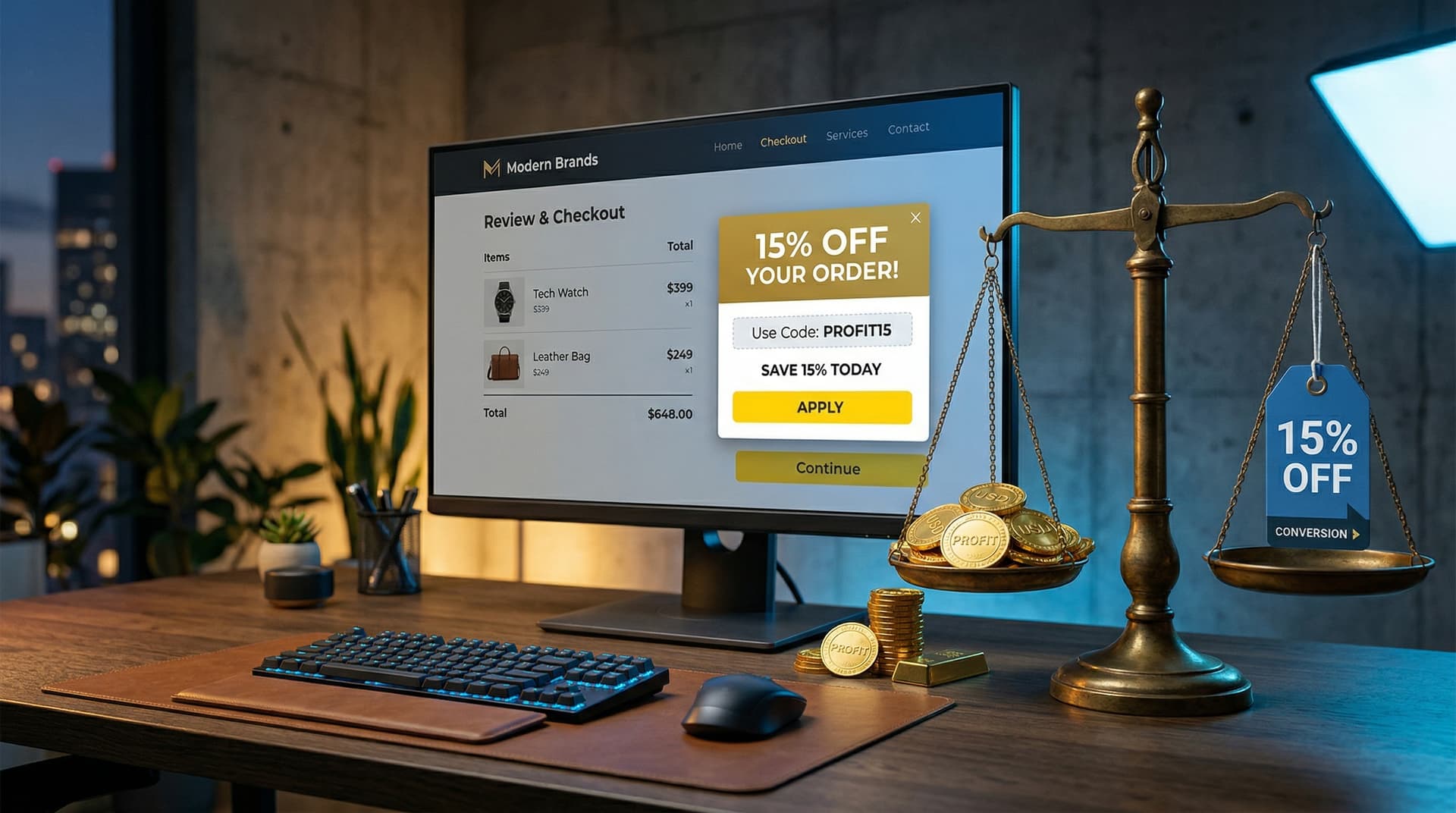
The most debated question in cart recovery. Both sides have data. Here's how to think about it without destroying your margins or leaving money on the table.
The short version
- Free shipping converts about 2x better than percentage-off discounts. 93% of consumers say free shipping makes them more likely to buy.
- Never discount in email 1. Most email 1 recoveries happen at full price. Discounting here gives away margin for no reason.
- If you're going to discount, do it in email 3 -- after you've tried to recover at full margin with emails 1 and 2.
- The "Rule of 100": for products under $100, use a percentage (10% off sounds bigger than $7 off). For products over $100, use the dollar amount ($25 off sounds bigger than 10% off).
- Habitual discounting trains customers to abandon carts intentionally to trigger the discount email. This is a real and documented pattern.
- Alternatives to discounts -- social proof, urgency, extended returns, bonus gifts -- can match or beat discount performance without eroding margins.
- Some brands should never discount in cart recovery: luxury, premium positioning, high-margin products, brands with strong repeat purchase behavior.
I've watched this debate play out at conferences, on Twitter, and in Slack communities for years. One camp says discounts are the fastest way to recover a lost sale. The other says discounting is margin destruction that trains bad behavior. They're both right, and the answer depends on your product, your margins, and your customers.
The problem with most discount strategy advice is that it's binary. "Always offer 10% off" or "never discount." Real life is more complicated than that. A free shipping offer on a $15 item has a different margin impact than 15% off a $500 item. A first-time visitor needs different treatment than a three-time customer. A beauty brand selling at 80% margin can afford discounts that would bankrupt an electronics reseller at 15% margin.
This guide walks through the math, the psychology, the alternatives, and the decision framework. So you can stop guessing and start making the choice based on what actually applies to your business.
This post is part of our Abandoned Cart Email Ultimate Guide series.
The abandoned cart email discount question has no universal answer. Offering a discount too early trains customers to abandon intentionally, while never offering one leaves recoverable revenue on the table. The most effective approach is a conditional escalation framework based on cart value and customer history.
The case for discounting
Let's start with what's true. Discounts work. They measurably increase cart recovery rates. The data on this is clear:
Abandoned cart emails with a discount offer have higher click-through rates than those without. CartBoss data shows that sending a small incentive (5-10%) in the final email of a sequence produces a measurable uplift in conversions. Omnisend's benchmark data shows the same pattern. Shopify's own guides recommend it.
Free shipping is particularly effective. According to Omnisend (2025), free shipping converts approximately twice as effectively as percentage-off discounts in cart recovery emails. According to Shopify (2026), 93% of online consumers say free shipping makes them more likely to complete a purchase. Given that unexpected shipping costs are the #1 reason for cart abandonment (48% — see the full list of reasons customers abandon carts), free shipping directly removes the primary objection.
The math often works. If your average order value is $75 and your margin is 60%, a 10% discount costs you $7.50 and recovers a sale that contributes $37.50 to gross profit. You're still $30 ahead. At scale, even modest recovery rate improvements from discounting can generate meaningful incremental revenue.
So why not just always discount?
The case against discounting
Because it changes behavior. And the behavioral change costs more than the individual discount.
The Pavlov problem
Chris Orzechowski, who says he has sold over $100 million of products through email, runs his cart sequences the other way: "three emails, I like to not go with discounts, especially not for people who are already customers." A discount on every abandoned cart teaches shoppers to abandon carts.
It works like this. A customer adds to cart. They get an email 30 minutes later with 10% off. They buy. Next time, they add to cart, close the tab, and wait for the email. Why would they pay full price when they know a discount is coming? Over time, your abandonment rate actually increases because customers have learned the pattern.
This isn't hypothetical. Brands that run consistent post-abandonment discounts report higher cart abandonment rates over time. The customers aren't forgetting to buy. They're strategically waiting for the discount.
The margin erosion
A 10% discount on every recovered cart doesn't sound like much. But abandonment happens at scale. If you recover 500 carts per month with a 10% discount and your average order is $80, that's $4,000 per month in discounts -- $48,000 per year. Was that $48K in discounts necessary to close those sales, or would some of those customers have bought at full price from a non-discount email?
The answer is usually: a significant portion would have bought without the discount. According to Klaviyo (2025), 30–50% of email-attributed conversions would have happened without any incentive. The discount didn't create the purchase. It just reduced the margin on a purchase that was going to happen.
The brand signal
For some categories, discounting sends the wrong message. A luxury brand that sends "10% off your Moschino bag!" undermines the entire value proposition. The customer is buying the bag because it costs what it costs. Discounting communicates that the product isn't worth the listed price. That's the opposite of what luxury brands want to signal.
Even outside luxury, frequent discounting shifts the customer's anchor. If they've received three 10% off codes in the past six months, they start to believe the "real" price is 10% below the listed price. You've trained them to never pay full price for anything.
The escalation framework that actually works
Most stores shouldn't be in the "always discount" or "never discount" camp. They should be in the "discount strategically and only when necessary" camp.
Here's the framework:
Email 1 (30-60 minutes): No discount
The customer abandoned half an hour ago. They were buying. Something interrupted them. A simple reminder converts 20-25% of recoverable carts at this stage. (For the full breakdown on when to send each email in the sequence.)
Discounting here is the single most common mistake in cart recovery. You're paying for conversions that would have happened for free. Save your margin.
Email 2 (24 hours): Value-add, not discount
The customer didn't respond to the reminder. Something is holding them back. But you still don't know if it's price.
Instead of a discount, try:
Free shipping (if applicable). This directly addresses the #1 abandonment reason (unexpected costs) without discounting the product itself. Your product price stays intact. You're removing a fee, not reducing value.
Extended return window. "Not sure? Return within 60 days, no questions asked." This reduces perceived risk. For apparel, beauty, and anything the customer might worry about fitting or working, this can be more effective than a discount because it addresses the actual objection.
Customer reviews. Social proof costs you nothing and answers the question "Is this worth buying?" without you having to lower the price to make the answer "yes."
A buying guide or FAQ link. For complex or considered purchases, the customer might need information, not a price cut. A comparison guide, sizing chart, or ingredient explanation can move someone from "thinking about it" to "ready to buy."
Email 3 (48-72 hours): Discount if the math works
Two emails, two days, and the customer hasn't come back. This is where a financial incentive makes sense -- if your margins support it.
Free shipping first. Always try this before a percentage discount. It costs less, converts better, and doesn't devalue the product.
If free shipping isn't enough or isn't applicable: 10-15% off, with a deadline. "10% off your cart -- expires in 24 hours." The deadline creates real urgency (it's not manufactured because the code actually expires) and limits the window during which the customer might share the code or hold out for a bigger discount.
For high-AOV products: Consider a dollar amount instead of a percentage. The "Rule of 100" from marketing psychology: for products under $100, a percentage feels bigger (10% off a $50 item = $5, but "10% off" sounds more substantial than "$5 off"). For products over $100, the dollar amount feels bigger ($25 off a $250 item = 10%, but "$25 off" sounds more substantial than "10% off"). Match the format to the psychology.
The margin impact calculator
Before you offer any discount, know your math:
| Your margin | 10% discount cost | Breakeven: how many extra sales to recover the cost |
|---|---|---|
| 80% (beauty, digital) | 12.5% of profit per sale | Every 8 discounted sales costs you 1 full-margin sale |
| 60% (apparel, food) | 16.7% of profit per sale | Every 6 discounted sales costs you 1 full-margin sale |
| 40% (electronics, home) | 25% of profit per sale | Every 4 discounted sales costs you 1 full-margin sale |
| 20% (commodity retail) | 50% of profit per sale | Every 2 discounted sales costs you 1 full-margin sale |
At 80% margin, discounting 10% barely dents your profit. You can afford to be generous. At 20% margin, a 10% discount eats half your profit per sale. You probably can't afford to discount at all, and free shipping should be your only incentive.
Run this math for your specific AOV and margin before deciding on a discount strategy. A 10% discount at 60% margins is a reasonable business decision. A 10% discount at 25% margins might be destroying more value than it creates.
When to never discount
Some situations where discounting in cart recovery does more harm than good:
Luxury and premium brands. Discounting undermines the brand. Instead: complimentary shipping, gift wrapping, personal shopping consultation, early access to new releases. The incentive should feel like elevated service, not a price concession.
Products with thin margins. If your margin is under 25%, a 10% discount might make the recovered sale unprofitable after acquisition costs and fulfillment. Use non-financial incentives: reviews, trust signals, service offers.
Returning customers who buy regularly. If someone has purchased three times and abandons a cart, they don't need a bribe. They need a reminder. Offering a discount to loyal customers teaches them to expect one and erodes the full-price relationship you've already built.
First-time visitors in the first email. You don't know this person. You don't know if they're price-sensitive or just distracted. Offering a discount immediately sets the relationship tone as transactional. Start with value and service. You can always escalate to a discount later. You can never un-teach the expectation.
When you're already known for sales. If your brand runs frequent promotions (BFCM, seasonal sales, loyalty events), customers already know discounts are coming. Adding a cart abandonment discount on top of that creates discount fatigue and conditions customers to never buy at full price, ever.
Alternatives that work as well as discounts
The brands with the best long-term cart recovery economics are the ones that found alternatives to discounting. Here's what the data supports:
Free shipping (the best alternative)
Converts 2x better than percentage off. Costs less than a product discount (shipping cost vs. margin cut). Directly addresses the #1 abandonment reason. This should be your first lever, every time.
Bonus gift
"Complete your order and get a free sample/travel size/accessory." Huel does this well -- a free branded t-shirt with first orders. The t-shirt costs them $3 and builds more brand loyalty than a 10% discount would. The perceived value of a gift is higher than its cost. A "free tote bag with purchase" feels like a $25 value but costs you $4.
Extended returns
"Not sure? Return within 60 days." Purple offers a 100-night trial on their mattresses. For a $2,000 product, the trial IS the incentive. It removes the risk without reducing the price.
Bundle incentive
"Add [complementary product] and save 15% on both." This increases AOV instead of reducing it. The customer feels like they're getting a deal. You're selling more product at a slightly lower margin but higher total revenue.
Loyalty points
"Complete your order and earn 200 loyalty points toward your next purchase." This recovers the current sale at full price while creating an incentive for the next purchase. The discount is deferred, not applied to the current transaction.
Charitable donation
"Complete your order and we'll donate $5 to [cause]." Bombas does a version of this with their one-purchased-one-donated model. For brands with a social mission, this can match discount conversion rates while reinforcing brand values instead of undermining them.
Testing your discount strategy
The only way to know what works for your store is to test. Here's how:
A/B test email 3. Split your audience: half gets a 10% discount, half gets a free shipping offer. Measure by revenue per recipient, not just conversion rate. A higher conversion rate at a lower margin might produce less total revenue.
Test discount vs. no discount. Run a control group that gets email 3 without any incentive. Compare conversion rates. The delta between the incentive group and the control group is your true incremental impact of discounting. If the control converts at 6% and the discount group at 8%, the discount is only responsible for 2 percentage points of recovery. The other 6% would have happened anyway.
Monitor your abandonment rate over time. If you introduce a discount in email 3 and your overall cart abandonment rate increases over the following three months, you may be training abandonment behavior. This is the Pavlov problem in action.
Track repeat behavior. Are customers who received a discount on their first cart recovery email more likely to abandon again on their second purchase? If yes, the discount is creating a dependency. Consider removing it and using alternatives.
How real brands handle the discount question
A few approaches worth studying from brands in different positions:
Allbirds -- no discount, ever. Their cart recovery emails are clean product reminders with a link back to the cart — strong email design doing the heavy lifting. No urgency, no discount code. The product is the pitch. This works because Allbirds has strong brand loyalty, a clearly differentiated product, and margins that make discounting unnecessary. They compete on sustainability and comfort, not price. Discounting would undermine that positioning.
ASOS -- aggressive early discounting. ASOS sends 10% off in what appears to be the first email. They can afford this because of massive volume, thin-but-positive margins, and a business model built on customer acquisition at scale. For most brands, this approach would train abandonment. For ASOS, the math works because their LTV model depends on repeat purchases, and the initial discount is an acquisition cost.
Huel -- bonus gift instead of discount. First-time customers get a free branded t-shirt with their order. The shirt costs Huel maybe $3-4. The perceived value to the customer is much higher. And unlike a discount, the gift creates brand affinity. The customer wears the shirt. Their friends ask about it. The $3 tee becomes a referral tool. This is smarter economics than 10% off.
Adam Kitchen's approach at Magnet Monster. Kitchen runs Magnet Monster, a Klaviyo Elite agency. The storytelling approach to cart recovery tells the customer why the product is worth buying -- materials, sourcing, design process, founder story -- instead of leading with a discount, even if the immediate recovery rate is marginally lower. The customers who convert on brand story buy again. The customers who convert on a discount wait for the next discount.
Columbia -- the price drop angle. Rather than a blanket discount, Columbia notifies customers when an item in their cart goes on sale. This reframes the discount as fortunate timing rather than begging. The customer thinks "I got lucky" instead of "they're desperate to sell this." The "Reveal the new price" CTA adds curiosity, which increases clicks. The limitation: this only works when the price actually drops. Faking it destroys trust permanently.
The pattern across all of these: the brands that do best with cart recovery aren't following a universal rule. They're matching their discount strategy to their margin structure, their brand positioning, and their customer's relationship with price. The right answer for your store depends on your specific economics. The framework in this guide gives you the tools to figure it out.
Should you offer a discount in an abandoned cart email?
Only in email 2 or 3 of your sequence, and only when the math supports it. First-time buyers with a high average order value may need a small incentive to convert. Returning customers who already trust your brand usually don't — a simple reminder or free shipping offer works better. Lead with full-price recovery, then escalate conditionally based on cart value and customer type.
Geysera's discount guardrails protect your margins — the system only offers incentives when the math supports it, based on cart value, customer lifetime value, and historical conversion data. See how it works →
Frequently asked questions
Should I offer a discount in my abandoned cart email?
Not in email 1. Possibly in email 3, if your margins support it and you've already tried to recover at full price with emails 1 and 2. Free shipping should be your first option before percentage off.
What percentage off should I offer?
10-15% is standard. Higher than that and you're training aggressive discount expectations. Lower than that and the perceived value might not move anyone. For products over $100, use the dollar amount instead (the "Rule of 100").
Is free shipping better than a percentage discount?
Yes, in most cases. Free shipping converts about 2x better, costs you less (shipping fee vs. margin cut), and directly addresses the #1 reason customers abandon carts. It also doesn't devalue the product the way a price cut does.
Will offering discounts train customers to abandon on purpose?
It can. Brands that consistently offer post-abandonment discounts see higher abandonment rates over time. The severity depends on how predictable the discount is and how frequently customers shop with you. The escalation framework (no discount in email 1, value-add in email 2, discount only in email 3) reduces this risk.
What should luxury brands do instead of discounting?
Complimentary shipping, gift wrapping, personal shopping consultations, early access to new collections, or a handwritten note with the order. The incentive should feel like elevated service, not a price concession.
How do I know if my discount strategy is working?
Track three things: (1) recovery rate by email position (is email 3 with discount actually recovering more than email 3 without?), (2) overall abandonment rate trend (is it increasing, suggesting trained behavior?), and (3) revenue per recipient across the full sequence, not just the discounted email.
Back to the pillar: Abandoned Cart Email: The Ultimate Guide
Next in the series: How to Set Up Abandoned Cart Emails in Klaviyo + Shopify
This guide is the hub of a 13-part series on abandoned cart email. Each spoke post goes deeper on a specific topic:
- Abandoned Cart Email: The Ultimate Guide to Recovering Lost Revenue in 2026
- Abandoned Cart Email Subject Lines That Actually Get Opened
- Cart Abandonment Rate by Industry: 2026 Benchmarks
- The Perfect Abandoned Cart Email Flow: Timing and Sequence
- 40+ Abandoned Cart Email Examples from Top DTC Brands
- Abandoned Cart Email vs. SMS: Which Recovers More Revenue?
- Why Customers Abandon Carts (And How to Fix Each Reason)
- Abandoned Cart Email Discounts: When to Offer and When to Hold Back (you are here)
- How to Set Up Abandoned Cart Emails in Klaviyo + Shopify
- Abandoned Cart Email Design: Templates, Layout, and CTA Best Practices
- Browse Abandonment vs. Cart Abandonment: The Complete Recovery Playbook (coming soon)
- WooCommerce Abandoned Cart Email: Complete Setup and Plugin Guide (coming soon)
- Mailchimp Abandoned Cart Email for WooCommerce: Setup and Plugin Guide (coming soon)
Sources
- CartBoss Impact of Discounts and Promotions on Cart Recovery
- Omnisend 2025–2026 Ecommerce Digital Marketing Statistics
- Flowium Abandoned Cart Email Discount Analysis
- Shopify Abandoned Cart Email Best Practices 2026
- Optimonk Abandoned Cart Coupon Code Ideas
- Voucherify Cart Abandonment Promotions Teardown
- Klaviyo Cart Recovery Benchmarks (183,000+ brands)

Co-Founder and CEO
Bob Thordarson is CEO and Co-Founder of Geysera, a serial entrepreneur with 25+ years and five co-founded ventures, including Cequint (acquired by TNS in 2010 for $112.5M) and Consumerware (acquired by ParkerVision). A graduate of the University of Washington and MIT Entrepreneurial Masters Program, based in Seattle, he serves on the boards of DRY Soda Co. and the Entrepreneurs' Organization Seattle chapter. He is an expert in retention marketing email systems and methodology for ecommerce and B2B brands — measured by incremental revenue, not vanity metrics.