AI and email marketing in 2026: what's actually working, what's overhyped, and what should worry you
AI is improving email metrics in measurable ways — 22% higher open rates from optimized subject lines, 15-23% lift from send-time optimization, 82% conversion gains from 1:1 personalization. Production time has collapsed from weeks to days. But the same tools are making everyone's emails sound alike, and AI gatekeepers like Gmail's CC agent may soon summarize your emails before subscribers see them. The real question is what happens when optimization alone stops being a differentiator?
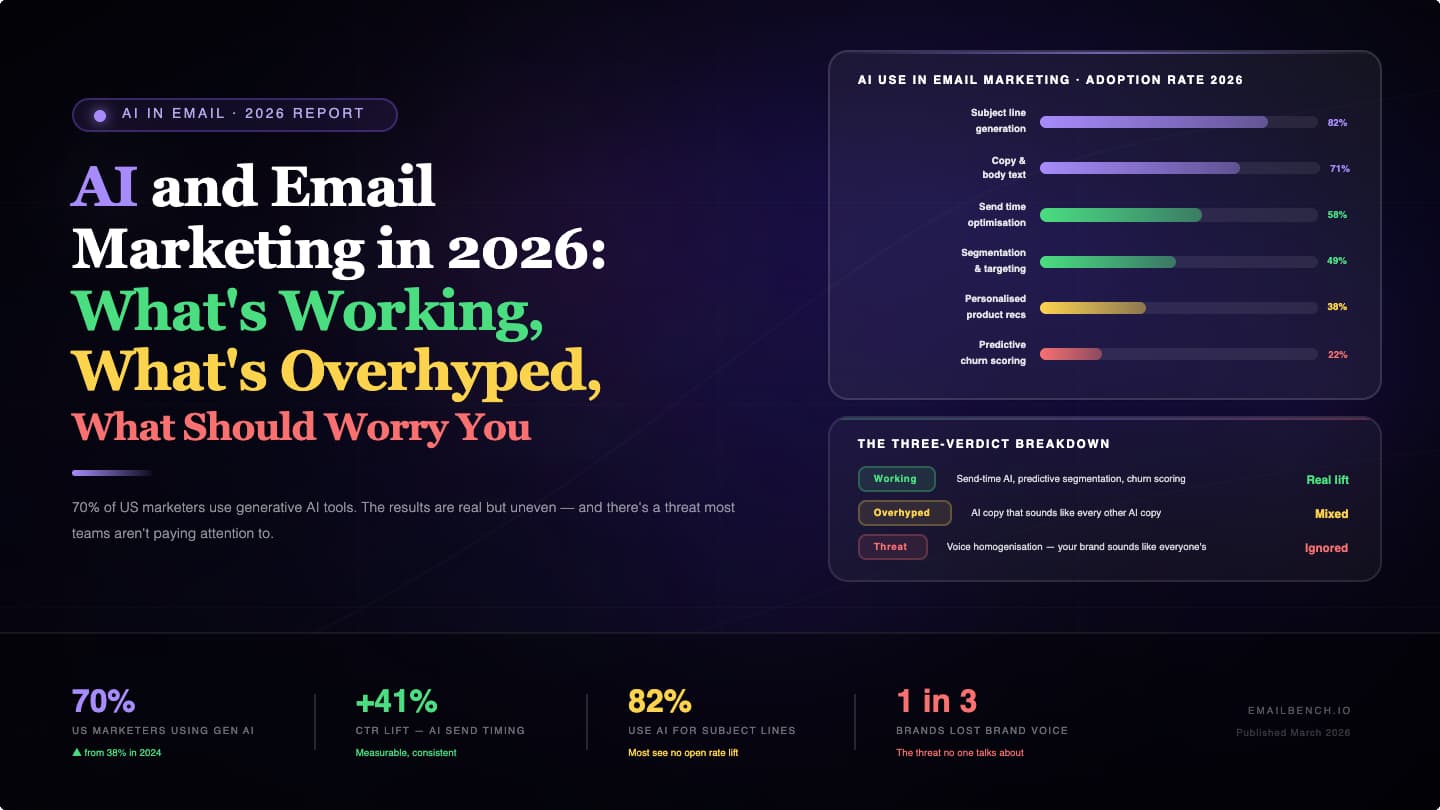
70% of US marketers use generative AI tools. The results are real but uneven — and there's a threat most teams aren't paying attention to.
Key takeaways
- 70% of US marketers use generative AI tools; 34% specifically for email copy
- AI subject lines boost open rates by 22%; AI send-time optimization adds 15-23%
- 1:1 personalization at scale increases conversion rates by 82%
- Only 6% of teams need 2+ weeks to produce emails (down from 62% in 2024)
- Google's CC agent and ChatGPT Pulse may soon summarize emails before recipients see them
I want to be honest about where I land on AI in email marketing, because most of what I read about it falls into two camps: breathless hype or reflexive skepticism. The reality is messier than either camp admits.
AI subject lines boost open rates by 22%. AI send-time optimization adds 15-23%. AI personalization lifts conversions by 82%. Those numbers are real and they come from large datasets. But AI is also collapsing production time so fast that teams are producing more emails without necessarily producing better ones. And there's a developing threat — AI gatekeepers sitting between your emails and the subscriber — that could reshape the entire channel.
This post is part of our 2026 Email Marketing Benchmarks series.
AI adoption in email marketing
How many marketers are using it?
| Metric | Adoption rate |
|---|---|
| US marketers using generative AI tools | 70% |
| Using AI specifically for email copy | 34% |
| Increase in AI image creation for email (2024-2025) | 340% |
| Predict 50%+ of email ops will be AI-driven by end 2026 | 70% |
| Expect AI to handle 50-75% of tasks | 18% |
| Report AI-assisted email outperforms traditional | 51% |
What they're using
| Tool | Adoption |
|---|---|
| ChatGPT | 51% |
| Copy.ai | 21% |
| Scalenut | 19% |
| Jasper | 14% |
Email marketing ranks first for AI content creation at 51% adoption, ahead of social media, blog content, and paid advertising.
What AI actually does to email metrics
Performance improvements by application
| AI application | Metric improvement |
|---|---|
| Subject line optimization | +22% open rates |
| A/B test optimization (AI-powered) | +49% open rates |
| Send-time optimization | +15-23% open rates |
| 1:1 personalization at scale | +82% conversion rates |
| AI-powered campaigns (overall) | +41% revenue vs. traditional |
| CTR improvement | +13% |
| Multivariate testing accuracy | +22% vs. traditional A/B |
| Inbox placement (AI spam detection) | 94.1% |
| Pre-send open rate prediction | 81.4% accuracy |
Revenue impact
Every $1 invested in AI email personalization returns approximately $8.70 (McKinsey). When applied across the full email program, AI personalization can increase revenue by 41%.
AI subject lines: data from 6 billion emails
Jay Schwedelson (founder of SubjectLine.com, host of the marketing podcast Do This, Not That) analyzes data from 6+ billion emails. What's working in 2026:
| Tactic | Open rate impact |
|---|---|
| Priority alerts in subject line | +28% |
| 3 words or less with no preheader | +25% |
| Downplayed urgency (counterintuitive) | +20%+ |
| Emoji usage | +17% |
Subject line length sweet spot: 28-50 characters.
Behavioral personalization in subject lines lifts open rates by 26%.
Worth noting: 69% of recipients mark emails as spam based on the subject line alone. There's a line between relevance and aggression, and AI optimization can cross it if nobody's paying attention.
How AI changes subject line testing
Traditional A/B testing evaluates 2 variants. AI multivariate testing runs 5-10 simultaneously and identifies winning combinations 22% more accurately.
Oracle Eloqua's AI system trains on 20,000+ subject lines with weekly retraining. Phrasee (now 6sense) hits 81.4% accuracy in pre-send open rate prediction — you can kill low-performers before they reach anyone.
Production speed: the most dramatic shift
| Metric | 2024 | 2025-2026 |
|---|---|---|
| Teams requiring 2+ weeks per email | 62% | 6% |
| Average production cycle | Weeks | Days |
A 56-point drop in production time. AI handles first drafts, image generation, subject line variants, and code — collapsing timelines from weeks to days or hours.
The upside: email teams can test more variants and iterate faster. The downside is obvious. More output doesn't mean better output, and I'm already seeing inboxes full of emails that read like they were written by the same machine. Because they were.
Send times: what AI optimization actually shows
AI send-time optimization lifts open rates by 15-23% compared to manual batch-sending. The improvement comes from predicting optimal receive time at the individual level — accounting for timezone, device habits, and recent engagement patterns.
Aggregate data (when you don't have AI STO)
Best days (MailerLite/Omnisend 2026):
| Day | Open rate | Click rate |
|---|---|---|
| Friday | 49.72% | 8.09% |
| Tuesday | 49.30% | 7.84% |
| Wednesday | 48.90% | 7.60% |
| Monday | 49.44% | 7.20% |
Best times:
| Time window | Best for |
|---|---|
| 8-11 AM | Opens (morning inbox clearing) |
| 10 AM | Most reliable all-around |
| 3-4 PM | Clicks (afternoon decision-making) |
| 8-9 PM | Conversions (evening shopping) |
One surprise in the data: 8 PM showed a 59% open rate in 2025 — the highest of any time slot. Evening engagement is underestimated by most teams.
Honestly though, the midweek differences between Tuesday, Wednesday, and Thursday are small enough to be noise. If you have access to AI send-time optimization, use it. It outperforms any static schedule.
Mobile vs. desktop: where engagement actually happens
| Metric | Mobile | Desktop |
|---|---|---|
| Share of opens | 47-60% | 10-29% |
| Average read time | 9.7 seconds | 13.2 seconds |
| CTR | 2.6% | 3.4% |
| Median reply time | 28 minutes | Longer |
| Conversion quality | Lower | Higher |
67% of Gen Z and 59% of Millennials use smartphones as their primary email platform. 93% of marketing emails are mobile-optimized. Responsive design increases unique clicks by 15%.
The pattern is consistent: mobile captures the opens and initial engagement, desktop captures the conversions and deeper engagement. Subject lines and preheaders need to work in mobile preview panes. Landing pages need to work on whatever device converts best for your audience.
The AI gatekeeper problem
This is the part that should get more attention than it does.
Gmail's CC agent and ChatGPT Pulse
Google's CC agent and ChatGPT's Pulse now summarize inbox content before recipients see the actual messages. These AI intermediaries can summarize your email in their own words, decide whether to surface or bury it, and alter how subscribers perceive your brand voice.
If AI agents sit between your email and the subscriber, the thing you've been optimizing — the subject line — becomes less important. What matters instead is sender reputation, relationship quality, and content relevance. Those are the signals AI agents use to decide what's worth surfacing.
The sameness problem
Jeanne Jennings (founder of Email Optimization Shop) puts it well: "Marketers who treat AI as a means to deepen relevance, not a shortcut around fundamentals, will outperform."
When everyone uses the same AI tools to optimize subject lines, the optimization advantage disappears. What's left is whether your brand is actually distinctive and whether subscribers want to hear from you. AI can't manufacture that.
67% of US adults already avoid responding to emails due to spam and scam fears. AI-generated content that reads like every other AI-generated content may accelerate that problem.
What to actually do with AI in email
Where the returns are clear
- Send-time optimization — 15-23% open rate lift, minimal effort to implement
- Subject line testing at scale — multivariate beats A/B; let AI generate and test variants
- Personalization engine — 82% conversion lift from 1:1 relevance
- Production acceleration — use the freed-up time for strategy, not more volume
- Predictive engagement scoring — prioritize high-value subscribers
Where to be careful
- Full autopilot — AI drafts need human review. Brand voice and factual accuracy both drift without it.
- Over-optimization — if everyone's subject lines are AI-optimized, nobody's stand out. This is already happening.
- The gatekeeper trend — AI intermediaries summarizing emails before subscribers see them. Prepare now.
- Confusing speed with strategy — producing emails faster is not the same as producing better ones.
Related: Are email open rates dead? | The email metrics that actually matter
Frequently asked questions
How much do AI subject lines improve open rates?
Up to 22% compared to human-written. Combined with AI-powered A/B testing, improvements can reach 49%. Behavioral personalization adds another 26% lift. Sweet spot for length is 28-50 characters.
What is AI send-time optimization?
It analyzes individual subscriber behavior to predict when each person is most likely to engage. Lifts open rates 15-23% vs. batch sending at a fixed time. Most major ESPs offer it now.
How much does AI personalization improve conversion?
1:1 personalization at scale — customized content, product recommendations, and messaging for each subscriber — increases conversion rates by 82% (HubSpot). Each $1 invested returns about $8.70 (McKinsey).
Will AI replace email marketers?
Not yet. Production time has collapsed (6% of teams need 2+ weeks, down from 62%), but 70% predict up to half of operations will be AI-driven by end of 2026. The role is shifting from execution to strategy and relationship design.
What is the AI gatekeeper threat?
Google's CC agent and ChatGPT Pulse summarize inbox content before recipients see it. This could shift what matters from subject line optimization to sender reputation and relevance — the factors AI intermediaries use to decide what's worth showing.
Related reading:
- Abandoned cart email: the ultimate recovery guide
- The Modern Ecommerce Email Stack: Why Two Tools Beat One in 2026 — Why AI-driven personalization belongs in the orchestration layer, not the ESP, and why Klaviyo's May 2026 Anthropic partnership confirms the layering thesis.
Sources
- HubSpot Email Marketing Statistics 2026
- Litmus State of Email 2025-2026
- Knak Email Creation & AI Statistics 2026
- ArtSmart AI in Email Marketing Statistics
- MailerLite 2025-2026 Benchmarks
- Omnisend Best Time to Send Email 2026
- Jay Schwedelson, SubjectLine.com
- Jeanne Jennings, emailopshop.com
- McKinsey personalization research
Part of the 2026 Email Marketing Benchmarks series by Geysera

Co-Founder and CEO
Bob Thordarson is CEO and Co-Founder of Geysera, a serial entrepreneur with 25+ years and five co-founded ventures, including Cequint (acquired by TNS in 2010 for $112.5M) and Consumerware (acquired by ParkerVision). A graduate of the University of Washington and MIT Entrepreneurial Masters Program, based in Seattle, he serves on the boards of DRY Soda Co. and the Entrepreneurs' Organization Seattle chapter. He is an expert in retention marketing email systems and methodology for ecommerce and B2B brands — measured by incremental revenue, not vanity metrics.