The Abandoned Cart Email Sequence: How Many Emails, What Timing, and Why Most Stores Get It Wrong
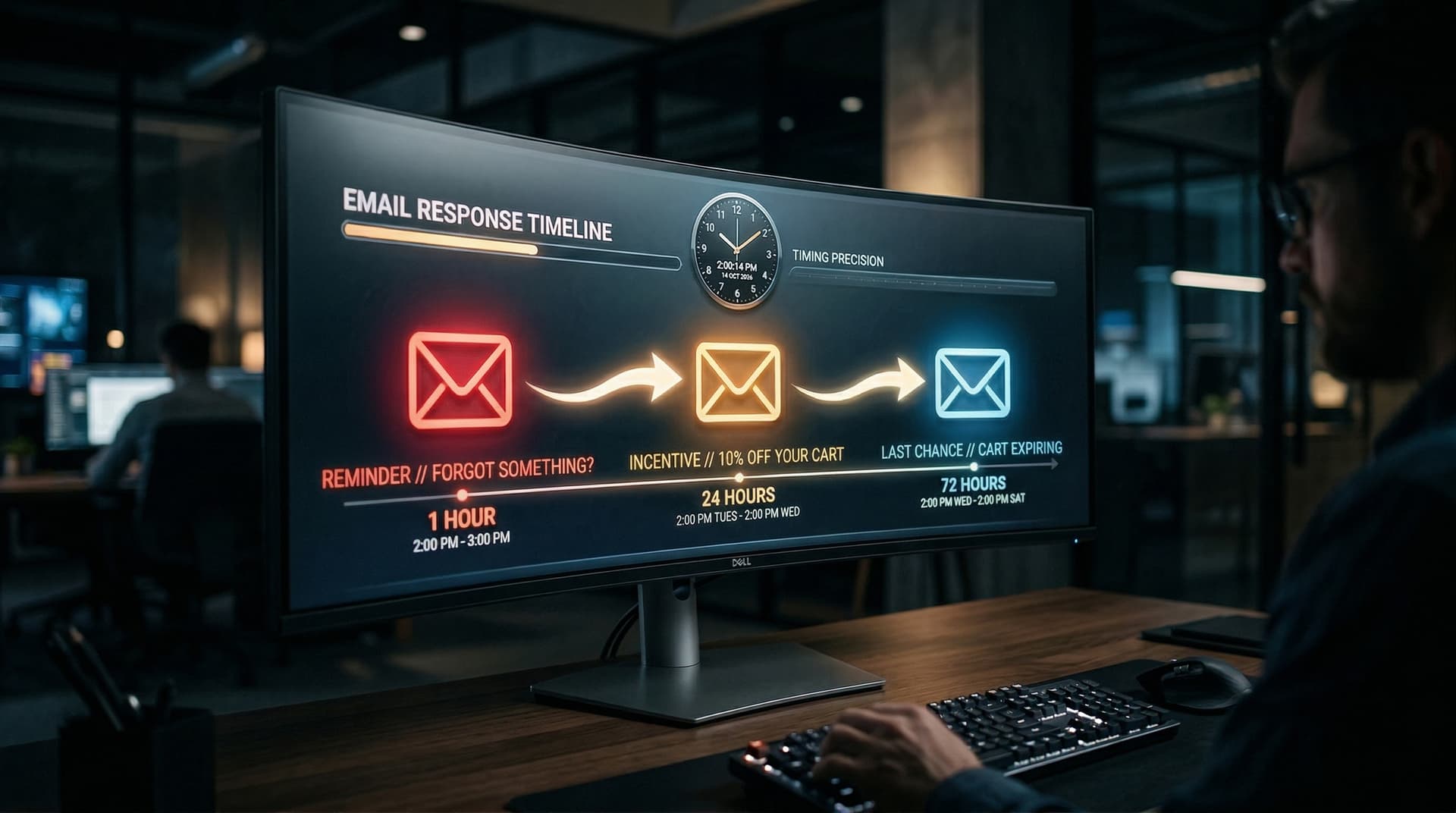
Most stores send one cart recovery email at whatever time their platform defaulted to. That alone costs them half their recoveries. The first email at 30 minutes converts 3-5x better than one sent four hours later. But timing is only part of it — each email needs a different job. Email 1 reminds. Email 2 handles objections with social proof. Email 3 closes with an incentive. Same message three times is not a sequence. Exact timing, content per email, and when to extend beyond three.
Published: April 2026 · Last updated: April 2, 2026
Three emails is the standard. But the timing between them matters more than most people think, and the content of each email should be completely different.
The short version
- Three emails is the baseline. One is a mistake. Two leaves money on the table. Four to seven makes sense for high-AOV products.
- Email 1 goes out at 30-60 minutes. The first hour converts at 3-5x the rate of hours 2-4.
- Email 2 goes out at 24 hours. Different content, different angle. Social proof or urgency, not another reminder.
- Email 3 goes out at 48-72 hours. This is where the incentive lives, if you're offering one.
- The first three days account for almost all cart recovery. Anything sent after day three has marginal returns.
- Each email in the sequence should have a different job. Sending the same "you forgot something" message three times isn't a sequence. It's spam.
Most stores that have an abandoned cart flow at all have one email. Maybe two. They go out at some default time the platform set when the flow was created, and nobody has touched the timing since.
The stores recovering 10-15% of abandoned carts are running three or more emails with tested timing, and each email does something the previous one didn't. The first reminds. The second persuades. The third pushes. They're different emails aimed at the same person at different psychological stages.
This guide breaks down exactly what each email should do, when it should send, and what the data says about the conversion rate at each step. We also cover when to go beyond three emails, when two is enough, and the timing mistakes that cost stores the most money.
Related reading:
This post is part of our Abandoned Cart Email Ultimate Guide series.
An abandoned cart email sequence is a timed series of automated emails triggered when a shopper leaves items in their cart. Most high-performing sequences use 2–3 emails: a reminder at 1 hour, social proof at 24 hours, and a final incentive at 48–72 hours.
Why timing matters more than copy
When should you send an abandoned cart email?
The first email should go out within 1 hour of abandonment — that window converts at 3–5x the rate of later sends. Email 2 follows at 24 hours with social proof or objection handling. Email 3 lands at 48–72 hours and carries the incentive, if you're offering one. Stretching beyond that three-day window yields diminishing returns for most stores.
I'm going to make a claim that will annoy copywriters: the timing of your abandoned cart emails probably matters more than what they say.
According to Rejoiner (2025), an email sent within 30–60 minutes of cart abandonment converts at 3–5x the rate of one sent 4+ hours later. That's not a marginal difference. You could have mediocre copy at the 30-minute mark and outperform a beautifully written email sent the next morning.
The reason is psychological proximity. Thirty minutes after abandonment, the customer still remembers the product. They can picture it. The desire that put it in the cart hasn't faded. By the next day, that mental image is competing with everything else they've seen, read, and been pitched. You're not reminding them of something they forgot. You're reintroducing something they've already moved past.
This doesn't mean copy is irrelevant. It means that getting the timing right is the first optimization, and getting the copy right is the second. Most stores have it backwards -- they obsess over subject lines while their first email goes out 6 hours after abandonment because that's the default Klaviyo set.
The three-email sequence (with data)
What is an abandoned cart email sequence?
It's a timed series of 2–3 automated recovery emails sent after a shopper leaves items in their cart. Each email has a distinct job — remind, persuade, close — with escalating urgency and different content. The goal is to recover the sale at the highest possible margin by reserving incentives for the final touchpoint.
Email 1: The reminder
When: 30-60 minutes after cart abandonment
Conversion contribution: 20-25% of total flow recoveries
The job: Remind. Nothing else. This email catches people who were buying, got interrupted, and haven't thought about it since. The notification buzzed while they were in the checkout. Their kid needed something. The meeting started. They put the phone down and forgot.
What to include:
- The product they left behind (image, name, price)
- A direct link back to their cart (not to your homepage, not to the product page -- to the cart with items still in it)
- One clear CTA: "Complete your purchase" or "Return to your cart"
What to leave out:
- Discounts. Not yet. Most people who convert from email 1 would have bought at full price. Offering 10% off here is giving away margin for no reason.
- Long copy. They don't need a sales pitch. They were already buying 30 minutes ago.
- Multiple CTAs. Don't link to related products, your blog, or your Instagram. One job: get them back to the cart.
Tone: Helpful, brief. "Hey, you left this behind. Here's a link back." That's it.
The 30-minute mark is important. Some platforms default to 1 hour, some to 4 hours, some to the next day. If yours is set to anything beyond 1 hour, change it. The difference between 30 minutes and 4 hours isn't subtle.
SaleCycle data across millions of cart abandonment emails:
| Send time after abandonment | Conversion rate range |
|---|---|
| 30-60 minutes | Highest (20-25% of recoveries) |
| 1-3 hours | Moderate (still good, but declining) |
| 4-12 hours | Noticeable drop |
| 24+ hours | This should be email 2, not email 1 |
Email 2: The persuader
When: 24 hours after abandonment
Conversion contribution: 15-20% of total flow recoveries
The job: Address objections. The customer got your first email and didn't come back. The easy recovery didn't work. Something is stopping them -- they're unsure about the product, comparing prices, weighing whether they actually need it, or they need a push that goes beyond a simple reminder.
What to include (pick one or two, not all):
Social proof. Reviews, star ratings, user-generated photos, number of customers who bought this product. "4.8 stars from 2,847 customers" answers the unspoken question: "Is this actually good?" without you having to make a sales claim. Social proof is borrowed trust. Use it.
Urgency, but only when real. "Only 3 left in your size" works if it's true. "Stock is running low" works if stock is actually running low. Manufactured urgency erodes trust the moment the customer figures out you lied, and they will figure it out when they come back next week and the item is still available.
Objection handling. If you know the common reasons people hesitate (price, fit, quality), address them directly. "Free returns within 30 days" in the email body handles the "what if it doesn't fit?" concern. A link to your sizing guide handles "what size am I?" These aren't generic suggestions. Look at your customer service tickets. Whatever questions people ask before buying -- answer those in email 2.
FAQ or buying guide link. For complex or expensive products, linking to a comparison guide or FAQ can move someone from "thinking about it" to "ready to buy." This works especially well for electronics, furniture, and anything with multiple variants.
What to leave out:
- Discounts. Still probably too early, unless your margins are high and you're testing this intentionally.
- The exact same content as email 1. If this email reads like a copy of the reminder, you've wasted a touchpoint. The customer already saw a reminder and didn't act. Repeating yourself won't change their mind.
Tone: Confident. This email should feel like a knowledgeable friend saying "here's why you should go for it" rather than a brand saying "please come back."
Email 3: The closer
When: 48-72 hours after abandonment
Conversion contribution: 8-12% of total flow recoveries
The job: Make the final push. This is the last email in a standard sequence, and it needs to give the customer something they didn't have before -- either a financial incentive or a genuine last-chance framing.
What to include:
An incentive, if you're going to offer one. This is where the discount lives. Not in email 1. Not in email 2. Here. The logic is straightforward: you've already tried to recover at full margin with emails 1 and 2. If the customer didn't convert, a small incentive might tip them over. If they would have converted from email 1 or 2, you didn't waste margin on them.
Free shipping is the strongest incentive. According to SaleCycle (2025), shipping costs cause 48% of cart abandonments, and free shipping offers convert roughly twice as well as percentage discounts. Free shipping directly solves the problem. A percentage off doesn't.
If you're offering a percentage discount, keep it modest: 10-15%. The goal is to overcome hesitation, not race to the bottom. And make it expire. "10% off -- expires in 24 hours" creates real urgency that doesn't feel manufactured because it has a real deadline.
A cart expiration warning. If your store clears abandoned carts after a few days (many do), this is a genuine scarcity signal. "Your cart expires tomorrow" isn't a pressure tactic. It's a fact.
What to leave out:
- Another reminder. If someone hasn't responded to two emails over two days, a third "don't forget!" isn't going to change their mind. This email needs to bring something new.
Tone: Direct. Slightly more urgent than email 2, but not desperate. "Here's something to help you decide. After this, we'll assume you're not interested."
The full sequence mapped out
| Email 1 | Email 2 | Email 3 | |
|---|---|---|---|
| Timing | 30-60 min | 24 hours | 48-72 hours |
| Job | Remind | Persuade | Close |
| Angle | Cart contents + link back | Social proof, objection handling | Incentive or expiration |
| Discount? | No | Probably not | If you're going to, here |
| Tone | Helpful, brief | Confident, informative | Direct, slightly urgent |
| Recovery share | 20-25% | 15-20% | 8-12% |
| Subject line | "[Name], you left the [Product]" | "What customers say about [Product]" | "Free shipping on your cart -- 24 hrs only" |
The total recovery from a well-built three-email sequence: 5-15% of abandoned carts, depending on industry, cart value, and how well the emails are executed.
For subject line ideas for each position, see our full guide: Abandoned Cart Email Subject Lines
When to go beyond three emails
Three emails is the standard. It's where most stores should start. But there are situations where extending to 4-7 emails makes sense:
High AOV products ($200+). Expensive purchases have longer consideration cycles. A customer who abandoned a $1,200 couch is still thinking about it on day 5. They're measuring their living room, checking competitors, waiting for payday. A sequence that extends to 7-10 days with educational content (buying guides, material comparisons, room inspiration) can convert these customers when a 3-day sequence can't.
Subscription products. The decision to commit to a recurring charge is different from a one-time purchase. An extended sequence can address subscription-specific objections: "Can I cancel anytime?" "How often does it ship?" "What if I don't like it?" Space these over 5-7 days.
Products requiring research. Electronics, software, B2B tools, anything with specs to compare and reviews to read. These buyers aren't procrastinating. They're researching. An extended sequence that includes comparison content, expert reviews, or case studies respects their buying process instead of pressuring them to skip it.
Repeat customers with high LTV. If a customer has bought three times and abandons a cart, they probably don't need a discount. But they might appreciate a "we noticed you didn't finish your order -- anything we can help with?" email on day 5 that's more service-oriented than sales-oriented.
What a 5-email sequence looks like
| Timing | Content | |
|---|---|---|
| 1 | 30-60 min | Cart reminder |
| 2 | 24 hours | Social proof and reviews |
| 3 | 48 hours | Incentive (free shipping or discount) |
| 4 | 5 days | Buying guide or comparison content |
| 5 | 7 days | Final reminder + incentive expiration |
Each email after the third has diminishing returns. Email 4 and 5 won't recover as many carts as 1-3, but for high-AOV products, even a handful of additional conversions at $200+ per order justifies the effort.
When two emails is enough
The opposite case: some stores don't need three emails.
Low AOV, impulse products ($10-30). A $15 phone case or a $12 bag of coffee doesn't warrant three days of follow-up. Two emails -- a reminder at 30 minutes and a final nudge at 24 hours -- is proportionate. A third email with a 10% discount on a $15 item saves the customer $1.50 and costs you more in margin than it's worth.
Extremely high purchase frequency. If your customers buy weekly (grocery, pet supplies, consumables), a long cart recovery sequence interferes with the next purchase cycle. By the time email 3 arrives, they may have already placed a new order. Keep it short.
Small lists. If you're sending to 50-100 abandoners per month, a three-email sequence can feel like oversaturation to a small community of customers. Two emails with a few days between them is sufficient until your volume grows.
Timing mistakes that cost the most
Sending email 1 the next day. This is the most common and most expensive mistake. The default in some platforms sends the first cart email at 24 hours. By then, conversion rates have dropped by 3-5x compared to the 30-minute mark. Change this setting before you do anything else.
Spacing emails too close together. Three emails in 24 hours is aggressive. The customer feels harassed, not helped. The minimum spacing between emails should be 12-18 hours. Standard spacing: 30 min, then 24 hours later, then 48 hours after that.
Spacing emails too far apart. Some stores spread their sequence over 7-10 days with only three emails. By email 3 on day 7, the customer has completely moved on. The three-day window is where almost all recovery happens. Don't stretch a three-email sequence past it.
Same time every day. If someone abandons at 9 PM and all your emails are scheduled for 10 AM, you're sending email 1 thirteen hours late. The best ESPs (Klaviyo, Omnisend) use time-since-abandonment triggers, not fixed send times. Make sure your flow is set to time-from-event, not time-of-day.
No suppression logic. If a customer completes their purchase after email 1, they should not receive email 2. This sounds obvious, but misconfigured flows send discount offers to people who already paid full price. They'll ask for a retroactive discount. You'll either give it and lose margin, or refuse and lose goodwill.
How to set this up in your platform
The flow architecture is the same across platforms, but the setup differs:
Klaviyo: Use the "Abandoned Cart" or "Started Checkout" trigger. Add time delays between emails. Use conditional splits to suppress purchasers and to vary content by cart value or customer segment. Klaviyo's default abandoned cart flow is a reasonable starting point, but you'll want to adjust the timing from their default.
Omnisend: Build a workflow with the abandoned cart trigger. Omnisend supports email + SMS + push in a single flow, so you can add an SMS at the 15-minute mark before the first email if you have phone numbers and consent.
Mailchimp: Use the Customer Journey Builder with the "Abandoned Cart" starting point. More limited conditional logic than Klaviyo, but functional for a basic three-email sequence.
WooCommerce: Depends on your plugin. AutomateWoo, Retainful, and CartFlows all support multi-step abandoned cart sequences with timing controls.
Detailed platform-specific setup:
- Klaviyo + Shopify setup guide
- WooCommerce abandoned cart guide (coming soon)
- Mailchimp + WooCommerce cart recovery (coming soon)
Measuring your sequence performance
The metrics to track at the flow level:
Revenue Per Recipient (RPR) across the entire sequence. According to Klaviyo (2026), the average RPR for abandoned cart flows is $3.65, while the top 10% of brands hit $28.89. If you're below $2, the flow needs work. If you're above $5, you're doing well and should focus on maintaining it.
Conversion rate by email position. Track which email in the sequence drives the most conversions. If email 3 (with discount) converts more than email 1, you might have a timing problem with email 1, or your email 1 content is too weak.
Unsubscribe rate per email. If email 3 has a spike in unsubs, you're either sending to people who already bought (suppression issue) or the tone is too aggressive. A healthy unsub rate for cart recovery is under 0.5% per email.
Recovery rate. The percentage of abandoned carts that result in a purchase after receiving any email in the sequence. Industry average: 3-5%. Good: 5-10%. Top performers: 10-15%. The difference between average and good here is real money -- see the revenue calculator in our benchmarks post.
Geysera optimizes send timing per subscriber, not just per flow — so each shopper gets their recovery email at the moment they're most likely to convert. See how it works →
Frequently asked questions
How many abandoned cart emails should I send?
Start with three. That's the proven framework that works across most industries and price points. If your AOV is above $200, consider extending to 5-7. If your AOV is under $20, two might be enough. Test and measure.
What happens if I only send one abandoned cart email?
You recover about 40-50% of what a three-email sequence would capture. That first email drives 20-25% of total recoveries, but emails 2 and 3 add another 25-30%. You're leaving meaningful money on the table.
What's the best time delay for the first email?
30-60 minutes. There's solid data on this. Rejoiner and SaleCycle both show 3-5x higher conversion in the first hour compared to hours 2-4. If your platform defaults to 4 hours or "next day," change it.
Should all three emails have the same content?
No. Each email should have a different job and different content. Email 1 reminds with cart contents. Email 2 persuades with social proof or objection handling. Email 3 closes with an incentive or expiration. Sending the same message three times is the quickest way to get unsubscribed.
When should I offer a discount in the sequence?
Email 3 at the earliest. The logic: try to recover at full margin first (emails 1 and 2). If the customer didn't convert, then offer an incentive. If you lead with a discount in email 1, you're training customers to abandon on purpose. More on this: Abandoned Cart Email Discount Strategy.
What if someone buys after email 1? Do they still get email 2?
They shouldn't. Make sure your flow has suppression logic that removes purchasers from the sequence. Every major ESP supports this. If yours is misconfigured and sending discount emails to people who already bought, you're losing margin and trust.
Back to the pillar: Abandoned Cart Email: The Ultimate Guide
Next in the series: 40+ Abandoned Cart Email Examples from Top DTC Brands
This guide is the hub of a 13-part series on abandoned cart email. Each spoke post goes deeper on a specific topic:
- Abandoned Cart Email: The Ultimate Guide to Recovering Lost Revenue in 2026
- Abandoned Cart Email Subject Lines That Actually Get Opened
- Cart Abandonment Rate by Industry: 2026 Benchmarks
- The Perfect Abandoned Cart Email Flow: Timing and Sequence (you are here)
- 40+ Abandoned Cart Email Examples from Top DTC Brands
- Abandoned Cart Email vs. SMS: Which Recovers More Revenue?
- Why Customers Abandon Carts (And How to Fix Each Reason)
- Abandoned Cart Email Discounts: When to Offer and When to Hold Back
- How to Set Up Abandoned Cart Emails in Klaviyo + Shopify
- Abandoned Cart Email Design: Templates, Layout, and CTA Best Practices
- Browse Abandonment vs. Cart Abandonment: The Complete Recovery Playbook (coming soon)
- WooCommerce Abandoned Cart Email: Complete Setup and Plugin Guide (coming soon)
- Mailchimp Abandoned Cart Email for WooCommerce: Setup and Plugin Guide (coming soon)
Related reading:
Sources
SaleCycle Cart Abandonment Email Timing Research | Rejoiner Abandoned Cart Email Statistics and Timing | Klaviyo 2026 Abandoned Cart Benchmarks (183,000+ brands) | Omnisend Ecommerce Automation Benchmarks 2025-2026 | ConvertCart Abandoned Cart Workflow Research | Flowium Abandoned Cart Email Benchmarks
Related reading from the WooCommerce email series
- WooCommerce + SendGrid in 2026: From Transactional-Only to Full-Funnel Without Migration — Where the cart abandonment sequence actually runs when SendGrid handles transactional email and a dedicated automation layer handles marketing flows.
- WooCommerce + HubSpot 2026: Closing the Ecommerce Automation Gap — where the cart abandonment sequence runs when HubSpot handles the CRM and a dedicated automation layer handles the ecommerce flows.
- Mailchimp for WooCommerce: Limits and What to Add Around It — where the multi-step cart sequence runs when Mailchimp handles the newsletter and an automation layer handles the flows.
- Klaviyo for WooCommerce: The Visitor-ID Gap (and How to Close It) — where the cart sequence runs when Klaviyo is your flow engine, and why most paid traffic never enters it until you close the visitor-ID gap.
- Mailchimp vs Klaviyo for WooCommerce in 2026 (and a Third Option: Keep Your ESP, Add a Layer) — Where the abandoned-cart sequence actually runs when you weigh Mailchimp vs Klaviyo on WooCommerce, plus the third option both comparison guides skip.
- Top 10 WooCommerce Email Automation Tools in 2026 (ESP-Locked vs ESP-Agnostic) — The tools that can power a cart-recovery sequence, split ESP-locked vs ESP-agnostic, and what to add for the anonymous traffic they miss.
- WooCommerce Email Notifications and Templates: The Complete 2026 Setup Guide — Setting up, customizing, and troubleshooting WooCommerce emails, plus the welcome series that precedes the cart sequence.
- WooCommerce Abandoned Cart Recovery: The 2026 Playbook — Sequence timing is one lever; the playbook adds channel, incentive, targeting, and the anonymous carts a plugin never sees to lift the overall recovery rate.

Co-Founder and CEO
Bob Thordarson is CEO and Co-Founder of Geysera, a serial entrepreneur with 25+ years and five co-founded ventures, including Cequint (acquired by TNS in 2010 for $112.5M) and Consumerware (acquired by ParkerVision). A graduate of the University of Washington and MIT Entrepreneurial Masters Program, based in Seattle, he serves on the boards of DRY Soda Co. and the Entrepreneurs' Organization Seattle chapter. He is an expert in retention marketing email systems and methodology for ecommerce and B2B brands — measured by incremental revenue, not vanity metrics.