Top 10 WooCommerce Email Automation Tools in 2026 (ESP-Locked vs ESP-Agnostic)
Most "best WooCommerce email tool" lists name the same three or four cloud platforms and skip the question that actually changes your bill and your reach: is the automation locked to a sending platform, or does it work on top of the one you already use? This is the 2026 list split that way, ten tools across WordPress-native and ESP-locked, plus the ESP-agnostic layer that adds the flows and the anonymous-traffic recovery none of them handle.
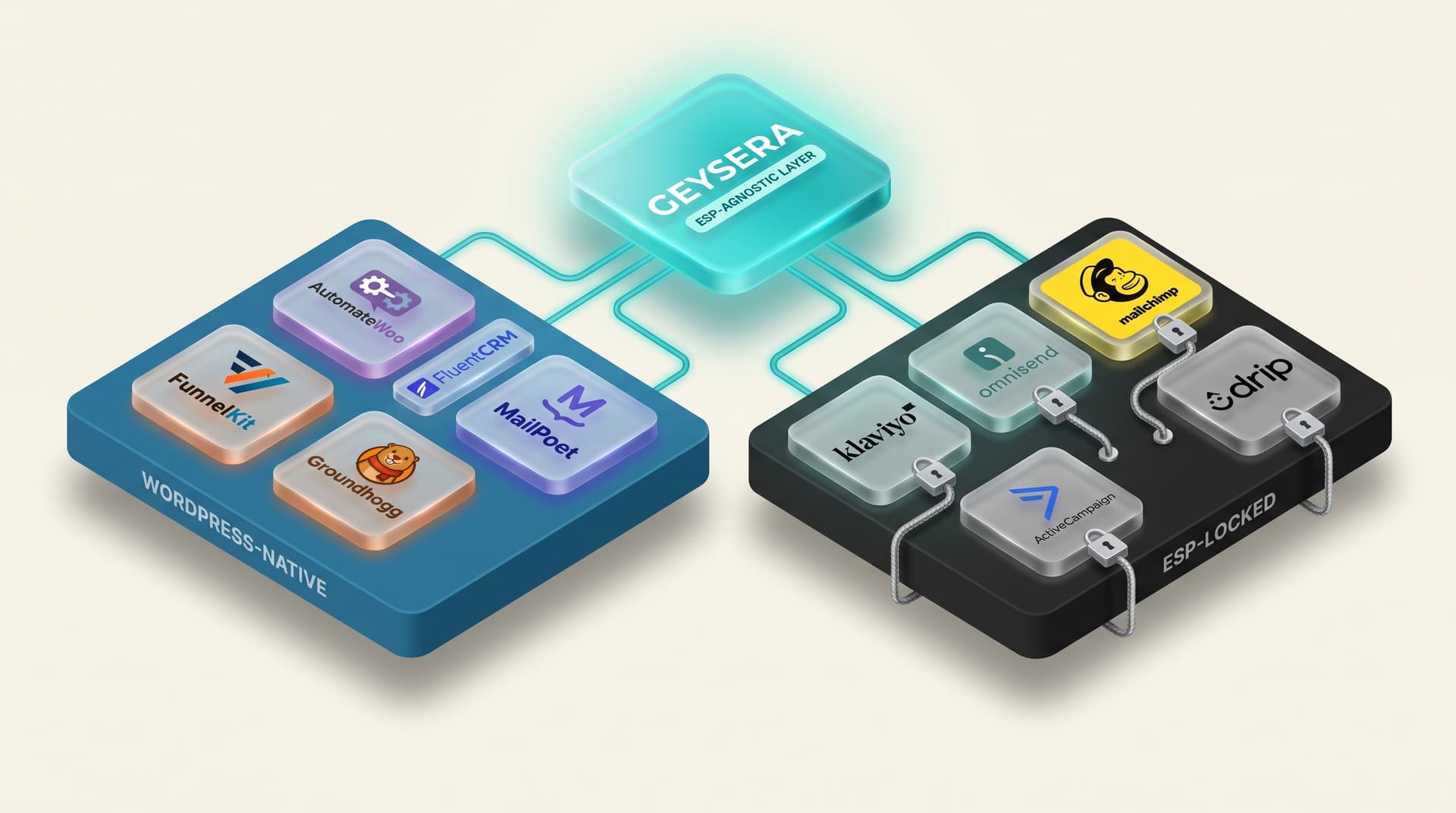
This is post 9 of 17 in the WooCommerce Email Marketing in 2026 Series. Previous: Mailchimp vs Klaviyo for WooCommerce in 2026 (and a Third Option: Keep Your ESP, Add a Layer)
WooCommerce email automation tools are the plugins and platforms that send triggered, behavior-based emails from a store (abandoned cart, welcome, post-purchase, and winback flows) instead of one-off broadcasts you send by hand. WooCommerce itself only sends transactional notifications like order confirmations, so any real marketing automation comes from a tool you add on top.
The lists you find when you search for these tools almost all name the same three or four cloud platforms and rank them by features. That misses the one distinction that actually changes your monthly bill and how much of your traffic you can reach: whether a tool's automation is locked to its own sending platform, or whether it works on top of the sending platform you already run. This guide splits the market that way. Five WordPress-native tools that run on your own store, five ESP-locked tools where the automation lives inside the sending platform, and then the one category that does not fit either column.
KEY STATS
- WooCommerce's own marketing-automation extension, AutomateWoo, is sold on the official WooCommerce.com store, a signal that the platform's default answer to automation is a plugin you run yourself (WooCommerce.com, 2026)
- Cart abandonment averages 70.19% across 49 studies, and every tool on this list can only recover the carts attached to a contact it already knows (Baymard Institute)
- Industry visitor-identification analyses put 80-95% of paid Meta and Google traffic to a typical store as never identifying, the blind spot every profile-based tool shares (2025-2026)
- Behavior-triggered flows earn roughly 18x the revenue per recipient of one-off campaigns, which is the whole reason automation tools exist (Klaviyo, MailerLite benchmarks, 2025-2026)
- Mailchimp's official WooCommerce plugin sits at 3.7 out of 5 across 59 reviews, a reminder that "popular" and "well-integrated on WooCommerce" are not the same thing (WooCommerce.com, 2026)
- Across the live "woocommerce email automation tools" SERP, the top results name the same three or four cloud ESPs and none split the market by whether the automation is locked to a sending platform (DataForSEO SERP analysis, June 2026)
- Data sourced from WooCommerce.com, Baymard Institute, Klaviyo and MailerLite benchmarks, and the live SERP (DataForSEO, June 2026)
What's in this guide:
- How to read this list: ESP-locked vs ESP-agnostic
- The 10 tools at a glance
- WordPress-native automation tools
- ESP-locked automation tools
- The category of one: the ESP-agnostic layer
- How to choose
- Frequently asked questions
How to read this list: ESP-locked vs ESP-agnostic
Almost every tool that automates WooCommerce email falls into one of two realities, and the reality matters more than any feature checklist.
The first is WordPress-native. The automation runs on your own WooCommerce install as a plugin. You bring your own sending, usually an SMTP or transactional provider, and the tool reads store events directly from the database. Nothing is locked to a particular email vendor, but you own the hosting, the updates, and the deliverability setup.
The second is ESP-locked. The automation lives inside a cloud sending platform like Klaviyo or Mailchimp. The flows are deep and hosted for you, but to use them you send through that platform and pay its per-contact or per-profile pricing. Leave the platform and the automation leaves with it. This is the camp most "best tools" lists quietly assume you have already joined.
WooCommerce store owners tend to buy capability one piece at a time rather than from a single all-in-one suite. That habit is exactly why the lock-in question matters. The piece you add for email automation should not quietly force every other decision about how you send.
There is a third reality, and only one tool occupies it, so it gets its own section at the end. For the two main camps, here is the whole list side by side.
The 10 tools at a glance
| # | Tool | Type | Runs where | ESP lock-in | Reaches anonymous traffic | Best for |
|---|---|---|---|---|---|---|
| 1 | AutomateWoo | WordPress-native | Your WP server | None | No | Official, owned automation inside WooCommerce |
| 2 | FunnelKit Automations | WordPress-native | Your WP server | None | No | Funnels plus broadcasts plus automation in WP |
| 3 | FluentCRM | WordPress-native | Your WP server | None | No | Self-hosted CRM and email with flat pricing |
| 4 | Groundhogg | WordPress-native | Your WP server | None | No | Self-hosted marketing automation and CRM |
| 5 | MailPoet | WordPress-native | WP plus MailPoet sending | Light | No | Simple newsletters and basic automation in WP |
| 6 | Klaviyo | ESP-locked | Klaviyo cloud | High | No | Deep ecommerce flows for serious senders |
| 7 | Omnisend | ESP-locked | Omnisend cloud | High | No | Combined email and SMS in one platform |
| 8 | Mailchimp | ESP-locked | Mailchimp cloud | High | No | Broadcasts and light automation for generalists |
| 9 | ActiveCampaign | ESP-locked | ActiveCampaign cloud | High | No | CRM-flavored automation for B2B or hybrid stores |
| 10 | Drip | ESP-locked | Drip cloud | High | No | Ecommerce-focused flows outside the big two |
The ten mainstream WooCommerce email automation tools sort cleanly into two camps. WordPress-native tools (AutomateWoo, FunnelKit, FluentCRM, Groundhogg, MailPoet) run on your own store with no vendor lock-in but leave hosting and deliverability to you. ESP-locked tools (Klaviyo, Omnisend, Mailchimp, ActiveCampaign, Drip) host deeper flows for you but tie sending and pricing to their platform. Every one of the ten acts only on contacts it can already identify, which leaves the same gap open.
WordPress-native automation tools
These run on your WooCommerce install. No third-party platform owns your automation, and you connect whatever sending service you prefer.
1. AutomateWoo
AutomateWoo is WooCommerce's own marketing-automation extension, sold on the official WooCommerce.com store and built by Automattic (WooCommerce.com). It triggers on native store events, abandoned carts, purchases, reviews, subscription renewals, and sends through your existing email setup. Because it is first-party, it reads WooCommerce data without a sync layer, and it is the safest bet for compatibility with future Woo releases. The tradeoff is reach and polish: it does the triggered email well but is not a full campaign or list-growth suite, and it sees only customers who are already in your store's database.
2. FunnelKit Automations
FunnelKit Automations (formerly Autonami) pairs a visual automation builder and a lightweight CRM with FunnelKit's funnel and checkout tools (FunnelKit). For stores that want broadcasts, automated flows, and conversion-optimized checkouts from one WordPress-native vendor, it covers more ground than AutomateWoo. It sends through your own SMTP or a connected provider, so there is no platform lock-in on the email side. As with every tool in this group, the flows fire only for contacts who have already identified themselves on your site.
3. FluentCRM
FluentCRM is a self-hosted CRM and email automation plugin that keeps your contact data inside your own WordPress database rather than a vendor's cloud (FluentCRM). Its pricing is a flat annual license rather than a per-contact climb, which is why growing lists tend to like it. It handles tagging, segmentation, sequences, and WooCommerce purchase triggers. You supply the sending through Amazon SES, SendGrid, or another provider, and you take on the deliverability tuning that a hosted ESP would otherwise manage for you.
4. Groundhogg
Groundhogg is the other major self-hosted option, a marketing-automation and CRM plugin built for store owners who want to keep data and sending under their own roof (Groundhogg). Its funnel builder handles multi-step flows, and it integrates directly with WooCommerce events. Like FluentCRM, it trades the convenience of a managed cloud for control and flat-rate economics. It is a strong fit for stores with a privacy or data-ownership requirement, and a heavier lift for a team that wants automation to just run without server-side maintenance.
5. MailPoet
MailPoet is the most beginner-friendly entry in this group, and it is now part of the WooCommerce family under Automattic (MailPoet). It manages newsletters and a handful of automations (welcome emails, abandoned cart, and basic post-purchase) from inside the WordPress dashboard, and it can send through its own delivery service so you do not have to wire up SMTP. The automation depth is lighter than the tools above it, which makes MailPoet a good first step for a smaller store rather than the engine for an aggressive flow strategy.
ESP-locked automation tools
These host your automation in the cloud. The flows are deeper and managed for you, but you send through the platform and pay its pricing, and moving off it means rebuilding.
6. Klaviyo
Klaviyo is the deepest ecommerce flow engine on this list and the default recommendation in most generic roundups for good reason (Klaviyo). Its branching, segmentation, and native SMS are best in class, which is why mid-market DTC brands gravitate to it. The cost is real, though: Klaviyo bills on active profiles, so a large list of one-time buyers gets expensive, and the platform rewards a skilled operator. We covered its WooCommerce-specific strengths and its one structural gap in Klaviyo for WooCommerce: The Visitor-ID Gap.
7. Omnisend
Omnisend is built around combining email and SMS in a single ecommerce-focused platform, with prebuilt automations for the common store flows (Omnisend). It is friendlier than Klaviyo for a smaller team and leans on templates to get flows live quickly. It is genuinely multichannel, which is its main draw over an email-only tool. The lock-in is the same as the rest of this camp: the automation is Omnisend's, and your sending and pricing live there.
8. Mailchimp
Mailchimp is the broadest-installed name in email and a fine broadcast tool, but on WooCommerce specifically it is the shallow end of automation, and its official Woo plugin sits at just 3.7 out of 5 across 59 reviews (WooCommerce.com). Its cart email is a templated reminder rather than a tuned sequence, and its segmentation caps out where the ecommerce-first tools keep going. It suits a generalist business that also sends plain newsletters. We covered what to keep and what to add around it in Mailchimp for WooCommerce.
9. ActiveCampaign
ActiveCampaign is automation with a CRM flavor, which makes it a common pick for stores that are part B2B or that manage a longer sales relationship alongside transactions (ActiveCampaign). Its automation builder is mature and its WooCommerce integration covers the standard ecommerce triggers. If your business looks more like HubSpot's world than Klaviyo's, it is worth a look, and the same CRM-versus-ecommerce tradeoff we mapped in WooCommerce + HubSpot applies here.
10. Drip
Drip is an ecommerce-focused ESP that sits in the same conceptual lane as Klaviyo, with strong flows and store-aware segmentation, positioned as the alternative for teams that want that depth without the biggest-name pricing (Drip). It is a credible choice if you have decided you want a cloud ecommerce ESP and are shopping outside the obvious two. If you are weighing whether to switch ESPs at all, the Klaviyo alternatives for WooCommerce post covers that decision in detail.
The category of one: the ESP-agnostic layer
Look back at the at-a-glance table and one column reads "No" the whole way down. Every tool above, WordPress-native or ESP-locked, acts only on contacts it can already identify. That is the structural limit they share. Cart abandonment averages just over 70%, and 80 to 95% of paid Meta and Google traffic never identifies, so the visitor browses, leaves, and no tool on the list can email a person it never knew.
This is where the third reality lives, and only one kind of tool occupies it: the ESP-agnostic automation layer. Instead of being a sending platform or a WordPress plugin that replaces your sending, it sits on top of WooCommerce, reads store behavior server-side in real time including from anonymous visitors, runs the behavioral flows, and resolves unknown traffic into known profiles. Then it hands those profiles back to whatever tool you already run (AutomateWoo, Klaviyo, Mailchimp, FluentCRM, any of them) so their own emails can finally reach people they could not see before.
Geysera
Geysera is that layer. It is not on the numbered list because it is not competing for the same job as the ten tools above; it is the piece that makes whichever one you chose reach further. If you run a WordPress-native tool, Geysera adds the anonymous-visitor recovery your plugin cannot do on its own. If you run an ESP-locked platform, Geysera feeds it the traffic it never identified, without asking you to migrate or change how you send. The architecture behind this two-tool split, your existing tool plus a layer on top, is the thesis of the whole series, laid out in The Modern Ecommerce Email Stack and the WooCommerce email marketing 2026 pillar.
How to choose
The honest answer is that the right tool depends on which constraint you care about most, not on a single winner.
If you want automation you own, with no per-contact bill and no platform that can hold your flows hostage, start in the WordPress-native group: AutomateWoo for first-party simplicity, FunnelKit or FluentCRM for more depth, Groundhogg if data ownership is a hard requirement. If you want the deepest hosted flows and have someone to operate them, the ESP-locked group is where that lives, with Klaviyo at the top for ecommerce depth and Omnisend, ActiveCampaign, or Drip depending on whether you weight SMS, CRM, or price.
WooCommerce is a platform you compose rather than a fixed product, so read this list as a set of parts. The email tool is one composed piece, and the better question than "which tool wins" is "which gap am I actually trying to close." The platform you pick matters less than whether it is genuinely set up to capture and act on visitor behavior. A tool nobody operates well will underperform a simpler one that is wired up correctly.
People ask me to name the best WooCommerce email tool like there is a trophy to hand out. There is not. The WordPress-native tools are great if you want to own your stack, the cloud ESPs are great if you want depth without running servers, and the right pick is whichever one your team will actually run. What I will say is this: every tool on that list emails people it already knows, and almost none of your paid traffic ever becomes someone it knows. So pick the sending tool you like, then make sure something is closing that gap. That part is not optional, and it is not what any of the ten are built to do.
— Bob Thordarson, Geysera CEO
The decision that trips stores up is treating "switch tools" as the fix for a reach problem. If your flows are shallow, a better tool helps. If your problem is that most of your traffic never identifies, no tool on the list solves it, because none of them are built to. That is the case for keeping the tool you have and adding a layer, which we make in full in Mailchimp vs Klaviyo for WooCommerce and the website visitor identification guide.
Frequently asked questions
What is the best email automation tool for WooCommerce?
There is no single best tool; it depends on your constraint. For owned, no-lock-in automation, AutomateWoo or FunnelKit lead the WordPress-native group. For the deepest hosted ecommerce flows, Klaviyo leads the cloud group. For reaching the anonymous traffic none of them see, you add an ESP-agnostic layer on top of whichever sending tool you already run, rather than switching tools.
How do I automate emails in WooCommerce?
WooCommerce core only sends transactional notifications like order confirmations. To automate marketing emails, you install an automation tool, either a WordPress-native plugin such as AutomateWoo or FunnelKit, or a cloud ESP such as Klaviyo or Omnisend, that triggers on store events like abandoned carts, purchases, and signups. The tool then sends the right email automatically when the trigger fires.
Does WooCommerce have built-in email automation?
Not for marketing. WooCommerce ships transactional emails such as order and shipping notifications, but it has no built-in behavioral flows like abandoned cart, welcome, or winback sequences. Every tool in this guide exists to add that layer. The platform's own answer is its official extension, AutomateWoo, which you install and run on your store rather than something enabled by default.
Is there a free WooCommerce email automation tool?
Yes. FluentCRM and Groundhogg offer free core plugins, MailPoet has a free tier, and Klaviyo, Omnisend, and Mailchimp all have free plans with sending or contact limits. Free tiers are enough to start basic flows, but they cap contacts, sends, or features as you grow, which is when the WordPress-native flat-license model and the cloud per-contact model start to diverge sharply on cost.
What is the difference between ESP-locked and ESP-agnostic tools?
An ESP-locked tool keeps its automation inside a specific sending platform, so using the flows means sending through that platform and paying its pricing; leaving means rebuilding. An ESP-agnostic tool works on top of whatever sending platform you already use, adding capability without owning your sending. Most tools are ESP-locked or WordPress-native; the agnostic layer is a separate category.
Can I use more than one email tool with WooCommerce?
Yes, and many stores do. A common setup is one tool for broadcasts and campaigns plus a second layer for behavioral flows and anonymous-visitor recovery on top. The tools coordinate around your WooCommerce data rather than conflict, as long as you are clear about which tool owns sending and which owns automation. This is the two-tool stack the rest of this series is built around.
AutomateWoo vs Klaviyo for WooCommerce: which should I use?
AutomateWoo runs inside WordPress, reads store data first-party, and lets you bring your own sending with no per-contact bill, but its flows are simpler. Klaviyo is a cloud platform with far deeper flows, segmentation, and native SMS, at the cost of per-profile pricing and platform lock-in. Choose AutomateWoo to own your stack and keep costs flat; choose Klaviyo for depth if you have an operator.
Do these tools recover abandoned carts from anonymous visitors?
No. Every tool in this guide is profile-based, so it can only recover carts attached to a contact it has already identified. With cart abandonment averaging just over 70% and most paid traffic never identifying, a large share of abandoned carts belong to anonymous visitors no tool on the list can email. Recovering those requires visitor identification, not a different automation tool.
Continue the series
This is post 9 of 17 in the WooCommerce Email Marketing in 2026 series.
- Start with the pillar: WooCommerce email marketing 2026 — the complete stack
- Previous in series: Mailchimp vs Klaviyo for WooCommerce in 2026 (and a Third Option: Keep Your ESP, Add a Layer)
- Next in series: WooCommerce Email Notifications and Templates: The Complete 2026 Setup Guide
- The architecture behind the third option: The Modern Ecommerce Email Stack: Why Two Tools Beat One
If you want the ESP-agnostic automation layer that adds the missing flows and anonymous-visitor recovery on top of any tool on this list, that is what Geysera is built for.
Sources
- AutomateWoo — WooCommerce.com
- FunnelKit Automations
- FluentCRM
- Groundhogg
- MailPoet (WooCommerce / Automattic)
- Klaviyo for WooCommerce
- Omnisend for WooCommerce
- Mailchimp for WooCommerce — WooCommerce.com
- ActiveCampaign
- Drip
- Cart Abandonment Rate Statistics — Baymard Institute
- The Journey and Evolution of WooCommerce with Beka Rice — Open Channels FM
- Brian Coords — WooCommerce Developer Advocate
- Syed Balkhi — Awesome Motive

Co-Founder and CEO
Bob Thordarson is CEO and Co-Founder of Geysera, a serial entrepreneur with 25+ years and five co-founded ventures, including Cequint (acquired by TNS in 2010 for $112.5M) and Consumerware (acquired by ParkerVision). A graduate of the University of Washington and MIT Entrepreneurial Masters Program, based in Seattle, he serves on the boards of DRY Soda Co. and the Entrepreneurs' Organization Seattle chapter. He is an expert in retention marketing email systems and methodology for ecommerce and B2B brands — measured by incremental revenue, not vanity metrics.