Win-Back Email: How to Re-Activate Lapsed Ecommerce Customers
70-80% of first-time buyers disappear after one purchase. A win-back flow catches them before they are gone.
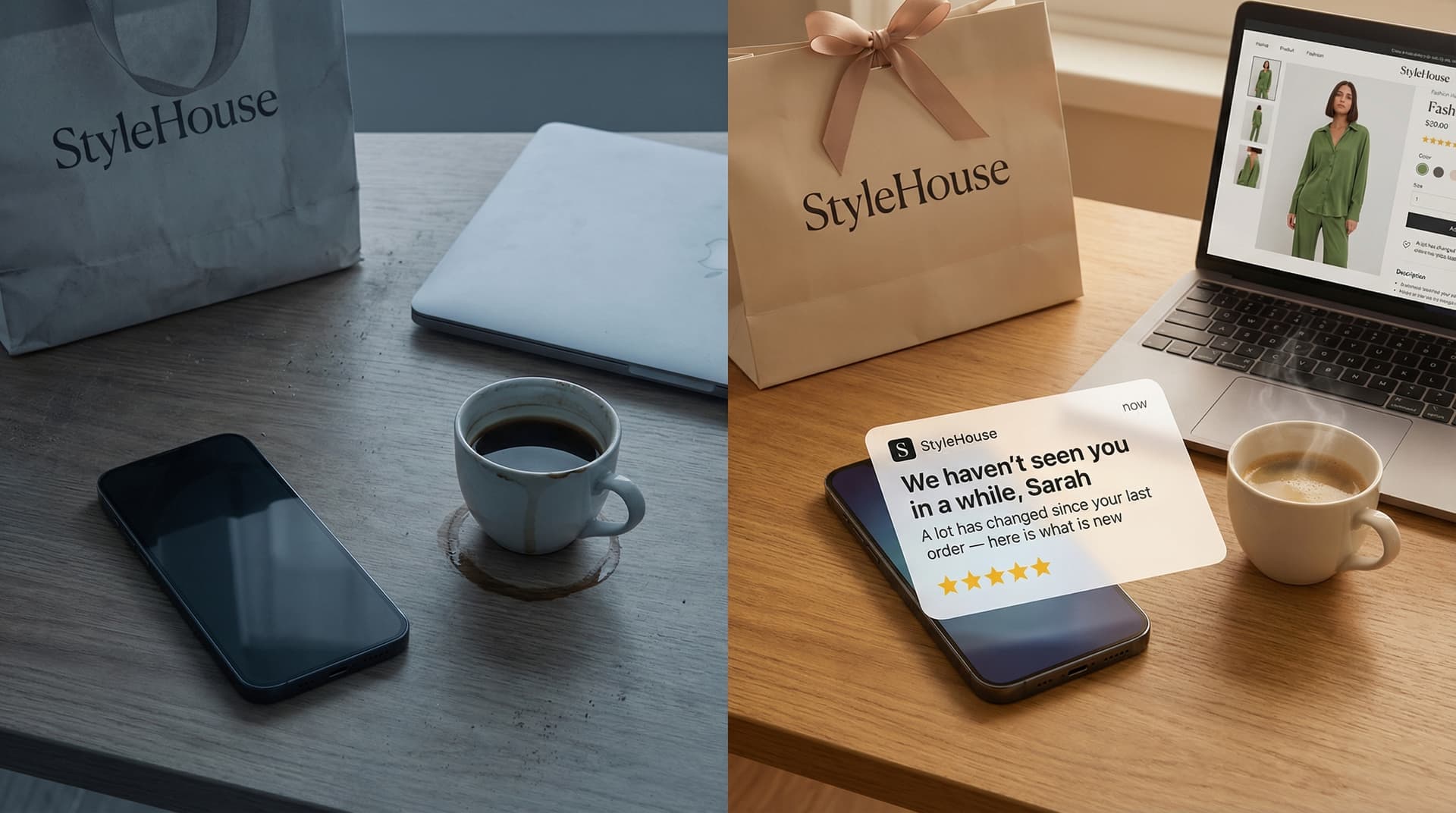
This is post 6 of 12 in the Ecommerce Email Lifecycle Series. Previous: Post-Purchase Follow-Up Email Templates.
A win-back email is an automated message sent to customers who previously purchased but haven't returned within a defined period — typically 60 to 120 days. Unlike re-engagement emails (which target inactive subscribers who may never have purchased), win-back emails specifically aim to reactivate lapsed buyers and recover churning revenue before the customer is lost permanently.
Every ecommerce store has a churn problem, though it doesn't always look like one. The customer database grows, new orders come in, and the dashboard shows revenue going up, so nobody notices that 70–80% of first-time buyers silently disappear after their first order. They don't unsubscribe or complain; they stop buying, and unless you're watching your repeat purchase rate, you won't realize it's happening until the cohort data tells you months later.
The win-back flow is the system that catches them before they're gone for good. And the $28.98 CPC on this keyword tells you something about how urgently store owners are looking for it — that's higher than most product keywords.
This guide covers when to trigger a win-back flow, what the sequence looks like, how to handle the discount question, and how to build it in Klaviyo. For real-world examples and copy you can steal, see the companion post: Win-back email examples and templates.
Win-Back vs. Re-Engagement: Different Problems, Different Emails
Getting it wrong means sending the wrong message to the wrong audience, either wasting a discount on someone who was never a buyer or sending an "are you still interested?" email to someone who spent $500 with you last quarter.
| Win-Back Email | Re-Engagement Email | |
|---|---|---|
| Target | Lapsed buyers (purchased before) | Inactive subscribers (may never have purchased) |
| Trigger | No purchase in 60–120 days | No opens/clicks in 90+ days |
| Goal | Recover revenue, drive repeat purchase | Reactivate engagement or clean list |
| Incentive | Discount, free shipping, new products | Content, preference center, "still interested?" |
| Failure action | Move to sunset flow | Suppress or remove from list |
| Key metric | Reactivation rate, revenue recovered | Click-through rate, list hygiene improvement |
Win-back is about recovering revenue from people who already trust you, while re-engagement is about deciding whether inactive subscribers are worth keeping, so the tactics overlap even though the business case is completely different.
For the full re-engagement playbook, see Re-engagement email guide.
When to Trigger a Win-Back Flow
What counts as "lapsed" depends on the store, so a supplement brand with a 30-day product cycle should worry about a customer who hasn't ordered in 45 days. A furniture brand whose average customer buys once every 18 months shouldn't trigger win-back at 90 days, because that customer isn't lapsed; they're normal.
"It's easy to get a customer once. It's hard to get a customer twice. And the better you can do that, the more successful your e-commerce business will be." — Ezra Firestone, Founder, Smart Marketer (Smart Marketer Podcast)
RFM is the best tool for defining "lapsed" accurately. Instead of picking an arbitrary number of days, use your own data:
Start by calculating your average time between repeat purchases. In Klaviyo, you can find this in Analytics → Customer Insights, or export purchase dates and calculate the median gap between first and second orders.
Then add a buffer, and a common one is average time-between-purchases × 1.5: if your average repeat customer buys again in 60 days, set your win-back trigger at 90 days. The buffer accounts for natural variation, so you don't trigger win-back for customers who are only a week slow.
One case the trigger cannot see: a lapsed customer who returns to the site without signing in. The flow is waiting on a purchase event that never fires, because nothing recognized them. Our guide to anonymous website visitor identification covers what it takes to recognize that return.
Finally, sanity-check against your product type. Some rough benchmarks:
| Product Type | Typical Purchase Cycle | Win-Back Trigger |
|---|---|---|
| Supplements / consumables | 25–35 days | 45–60 days |
| Skincare / beauty | 45–60 days | 75–90 days |
| Fashion / apparel | 60–90 days | 90–120 days |
| Food / beverage | 14–30 days | 30–50 days |
| Electronics / home goods | 120–365 days | 180–365 days (or skip) |
For stores selling non-replenishable products (furniture, electronics), a win-back flow may not make sense, so focus instead on cross-sell flows that recommend complementary products, and use campaigns for seasonal re-engagement.
The Win-Back Email Sequence
Four emails over 21 days. The sequence escalates gradually, without a discount up front, because most of the customers who were going to come back at full price will respond to the first two emails. Leading with a discount trains your list to go inactive on purpose.
Email 1: The soft reminder (Day 0 — trigger day)
"We haven't seen you in a while."
This email is personal and low-pressure, showing what's new since their last purchase (new products, new collections, a bestseller they haven't seen) and referencing their previous purchase if possible ("You loved [product] — here's what's new since then"). The goal is to remind them you exist and give them a reason to come back other than a discount.
No incentive in Email 1. Let the product do the work.
Email 2: Social proof (Day 7 after Email 1)
"Here's what you've been missing."
Bestsellers with reviews and star ratings, and customer photos if you have them. "23,000 customers ordered this last month" — or whatever social proof is genuine for your store. This works on lapsed customers because they already know your brand, so you don't have to re-introduce yourself; you have to show them that the world kept moving while they were away and there's something worth coming back for.
If you have a loyalty program, this is also a good place to mention unredeemed points or tier status: "You have 450 points waiting — that's $15 off your next order."
Email 3: Incentive (Day 14 after Email 1)
Now, and only now, introduce an offer — but only if your margins support it.
Free shipping converts roughly 2x better than percentage discounts for win-back emails (our discount guide covers why). If you offer a percentage discount, make it conditional on cart value, because 15% off a $20 order doesn't add up, and a structure like "$10 off orders over $75" protects your margin while still motivating the purchase.
One thing to avoid is a win-back discount better than what active customers get. If your loyal customers see a 20% win-back offer they never received, it sends the wrong message, so keep win-back incentives in line with (or slightly below) your best active-customer offers.
Email 4: Final chance (Day 21 after Email 1)
"We're going to stop emailing you soon."
This is the closer, so make it clear that this is the last email before you reduce sending frequency or move them to the sunset list: "If we don't hear from you, we'll stop sending weekly emails — but you can always come back."
Some brands use this as a second chance to present the incentive from Email 3 with added urgency ("Your $10 off expires in 48 hours"), while others keep it clean and make the stakes clear. Both approaches work, so test which performs better for your audience.
If Email 4 gets no response, move the customer to the re-engagement/sunset flow. The win-back attempt has run its course. (For where win-back fits in the broader lifecycle system, see our 7 essential flows overview.)
If you're running SMS alongside email, win-back is a strong use case. A text from a brand you haven't heard from in months stands out in a way that email in a crowded inbox doesn't. Consider sending Email 1 as an SMS for customers who've opted into texts, then following up with emails 2–4; SMS open and response rates for win-back are consistently higher than email alone.
Win-back subject lines
Each email in the sequence has a different tone, and the subject line should reflect that:
Email 1 (soft reminder):
- We haven't seen you in a while, [Name]
- [Name], a lot has changed since your last order
- It's been [X] days — here's what's new
Email 2 (social proof):
- Here's what you've been missing, [Name]
- customers ordered this last month
- Your favorites just got some company
Email 3 (incentive):
- [Name], this one's on us — free shipping on your next order
- Come back for [X]% off — just for you
- We saved something for you, [Name]
Email 4 (final chance):
- We're about to stop emailing you, [Name]
- Last chance: your [incentive] expires tomorrow
- Should we keep in touch?
One-Time Buyers vs. Multi-Purchase Lapsed Customers
Not all lapsed customers are equal, and treating them the same is one of the biggest win-back mistakes.
A customer who bought once three months ago and never returned is a fundamentally different situation than a customer who bought five times over a year and then suddenly stopped. The one-time buyer may never have been "retained" in the first place — they tried your product and moved on, while the multi-purchase customer had a relationship with your brand and something changed.
For one-time lapsed buyers, the win-back flow needs to do more selling. They might not remember your brand clearly. Show them bestsellers, reviews, what's popular. The sequence is closer to a re-introduction.
For multi-purchase lapsed buyers, the win-back flow should acknowledge the relationship. "You've been one of our best customers" hits differently than "We miss you" when the customer has ordered five times. Consider adding a conditional split early in the flow that checks total order count and routes multi-purchase customers to a personalized branch — shorter sequence, more direct, possibly a personal note from a real person rather than an automated email.
The Discount Strategy
The discount question trips up more brands than any other part of the win-back flow.
Will Evans, co-founder of FlowCandy and author of The Four Levels of Klaviyo Mastery, is a useful reference for Klaviyo setup. For win-back, the right incentive depends on what the customer is worth. A customer with $2,000 in lifetime spend deserves a different win-back offer than someone who bought once for $25.
In practice, this means building CLV-based conditional splits into your win-back flow:
| Customer Segment | Lifetime Spend | Win-Back Approach |
|---|---|---|
| High-value (top 10%) | $500+ | Personal email from founder or account manager, exclusive early access, generous incentive |
| Mid-value (next 30%) | $100–$500 | Standard 4-email sequence, moderate incentive (free shipping or 10% off) |
| Low-value (bottom 60%) | Under $100 | Standard sequence, minimal or no incentive — if they need a discount to come back from a $25 order, the ROI may not justify it |
Segment aggressively and don't waste discounts on customers whose reactivation doesn't pencil out. Bostjan Belingar's Hustler Marketing, a Klaviyo Elite Master Partner that says it generated $110M for clients in 2025, has served 450+ ecommerce brands; blasting 20% off to everyone is the habit to resist.
Win-Back Best Practices
Reference their last purchase. "You bought [product] on [date]" immediately personalizes the email and signals that this isn't a mass blast. In Klaviyo, use event variables from the "Placed Order" metric to pull the product name, image, and purchase date dynamically. And show what's new, not what they already bought — new launches, limited editions, seasonal drops. Give them a reason to come back that didn't exist when they left.
Escalate incentives across the sequence: Email 1 has no offer, Email 2 has social proof, Email 3 introduces the incentive and Email 4 adds urgency. Customers who would have returned at full price convert before you give away margin, and only the most resistant customers see the discount.
Include a prominent unsubscribe link. It sounds counterintuitive, but win-back emails go to people who haven't engaged in months, and if they're not interested, you want them to unsubscribe rather than mark you as spam. A spam complaint costs you deliverability across your entire list, while an unsubscribe removes one contact. And while you're setting up filters, exclude anyone currently in the re-engagement or sunset flow from the win-back trigger, because a customer shouldn't receive both at the same time.
Common win-back mistakes
A few things that undermine win-back flows more often than brands realize:
Triggering too early is probably the most common. If your average customer reorders every 90 days and you trigger win-back at 60, you're emailing people who aren't actually lapsed — they're just on their normal cycle. False-alarm win-back emails train customers to ignore them when they actually matter. Related: ignoring seasonality. A customer who bought a winter coat in December and hasn't reordered by March isn't lapsed — they just don't need another winter coat. Product-specific triggers that account for seasonal patterns outperform generic calendar-based ones.
Using "we miss you" for one-time buyers is another one. A customer who ordered once doesn't have a relationship with you yet. "We miss you" is hollow when you've never met. For first-time lapsed buyers, lead with the product and what's new. Save the personal tone for customers who've actually purchased multiple times.
And leading with a discount is the most expensive mistake of all. The customers who would have come back at full price convert from Emails 1 and 2 — they just needed a reminder. If you open with a discount in Email 1, you're giving away margin to people who didn't need the incentive. Worse, you're training your list to go inactive on purpose because they've learned that silence gets rewarded.
Building a Win-Back Flow in Klaviyo
Trigger: Metric → "Placed Order" (trigger on what someone did, then use a time delay to target when they stop doing it). Alternatively, use a segment-triggered flow based on "Has not placed order in last X days."
The segment-trigger approach is more common for win-back because it's easier to define "lapsed" as a segment condition than as a metric-based time delay.
Segment definition: Has placed order at least once, AND has not placed order in last [90] days (adjust to your trigger window), AND is in your main email list.
Flow structure:
- Email 1: Soft reminder (no delay after entering segment)
- Time delay: 7 days → Conditional split: has placed order since entering flow? → Yes: exit. No: continue.
- Email 2: Social proof
- Time delay: 7 days → Conditional split: has placed order? → Yes: exit. No: continue.
- Email 3: Incentive
- Time delay: 7 days → Conditional split: has placed order? → Yes: exit. No: continue.
- Email 4: Final chance
CLV split (add after segment entry): Conditional split on "Predicted CLV" (Klaviyo's predictive analytics) or "Historic CLV" (total revenue from this customer). Route high-value customers to a premium branch with a more generous offer or personal outreach. Route low-value customers to the standard sequence.
Flow filters:
- Exclude anyone currently in the welcome series
- Exclude anyone currently in the post-purchase flow
- Exclude anyone currently in the re-engagement/sunset flow
- Exclude anyone who has placed an order in the last 7 days
Re-entry setting: Because win-back is segment-triggered, you need to enable re-entry so customers can go through the flow again if they reactivate and then lapse a second time. In Klaviyo's flow settings, set the flow to allow re-entry after a customer has exited. Without this, a customer who gets won back and then lapses again six months later won't re-enter the flow — they'll just churn silently.
Measuring Win-Back Performance
Reactivation rate is the metric that matters most. What percentage of customers who enter the win-back flow make another purchase? Benchmarks: 5–15% is typical, with well-segmented flows at the higher end.
From there, calculate revenue recovered — reactivation rate × number of customers who entered the flow × average reactivated order value. This is the number you compare against the cost of any discounts offered. Quick example: you offered 10% off to 1,000 lapsed customers, 80 reactivated with an average order of $75, that's $6,000 recovered at a discount cost of $600. A 10:1 return. If only 20 reactivated, you recovered $1,500 at a cost of $150 — still positive but marginal. Track this ratio to decide whether your incentive level is right.
The metric most brands forget: long-term retention of reactivated customers. A reactivated customer who buys once and disappears again wasn't truly won back — they were discount-hunting. Track whether reactivated customers make a third purchase within 90 days. If most of them don't, your win-back flow is recovering transactions, not relationships. (This connects to the broader challenge of measuring email's true impact vs. attributed revenue.)
The win-back flow also feeds into your post-purchase flow — when a lapsed customer reactivates, they should re-enter the post-purchase sequence for their new order, getting the same check-in, review request, and cross-sell treatment as any other buyer.
Win-back flows are where most brands either over-discount or give up too early. Geysera builds win-back sequences calibrated to your customer's purchase cycle — with escalating incentives tied to CLV, not guesswork. See a win-back flow breakdown →
Frequently Asked Questions
What is a win-back email?
A win-back email is an automated message sent to customers who previously purchased from your store but haven't returned within a defined period, typically 60–120 days. It's different from a re-engagement email, which targets inactive subscribers who may never have bought anything. Win-back emails aim to reactivate lapsed buyers and recover churning revenue.
When should I send a win-back email?
Trigger timing depends on your product's purchase cycle. Calculate your average time between repeat purchases and multiply by 1.5. If customers typically reorder every 60 days, trigger win-back at 90 days. Supplement brands might trigger at 45 days; fashion brands at 90–120. The key is using your own data rather than picking an arbitrary number.
How many win-back emails should I send?
Four emails over 21 days is the standard sequence: soft reminder (day 0), social proof (day 7), incentive (day 14), and final chance (day 21). Each email escalates. If the customer doesn't respond after all four, move them to the re-engagement or sunset flow rather than continuing to email.
Should I offer a discount in win-back emails?
Not in the first email. Most recoveries happen at full price in Emails 1 and 2. Introduce an incentive in Email 3 only if your margins support it. Free shipping converts roughly 2x better than percentage discounts. If you do offer a percentage off, make it conditional on cart value to protect margin. Segment by CLV so high-value customers get a more generous offer than low-value ones.
What's the difference between a win-back email and a re-engagement email?
Win-back targets lapsed purchasers — people who bought before but haven't returned. Re-engagement targets inactive subscribers who stopped opening and clicking, regardless of whether they ever purchased. Win-back focuses on recovering revenue; re-engagement focuses on reactivating engagement or cleaning the list. The tactics overlap but the audiences and goals are different.
What's a good reactivation rate for win-back emails?
5–15% is a typical range, with well-segmented flows (CLV-based splits, personalized content) performing at the higher end. Below 5% usually means the trigger timing is off, the sequence isn't escalating properly, or the offers aren't relevant. Above 15% is excellent and usually indicates strong product-market fit combined with good email execution.
What happens after a win-back flow fails?
If a customer doesn't respond to all four win-back emails, move them to the re-engagement or sunset flow. This flow gives them one more chance to opt back in ("Should we stop emailing you?"). If they still don't respond, suppress them from regular sends. Don't delete — suppress. You keep the data for analytics, you just stop sending. Some brands run a quarterly re-engagement email for suppressed contacts as a last-resort check.
Continue the Series
Previous: Post-Purchase Follow-Up Email Templates
Next: Win-Back Email Examples & Templates That Actually Work
Full series: Ecommerce Email Lifecycle Series
Sources
- Drew Sanocki: Ecommerce Advanced Email Marketing (Drop Dead Copy Podcast)
- Will Evans / FlowCandy: The Four Levels of Klaviyo Mastery
- Hustler Marketing — Klaviyo Elite Master Partner (Bostjan Belingar)
Related reading from the WooCommerce email series
- The Modern Ecommerce Email Stack: Why Two Tools Beat One in 2026 — Winback campaigns are an orchestration-layer job, not an ESP job, and why the split-stack architecture handles them better than all-in-one ESPs.
- WooCommerce + SendGrid in 2026: From Transactional-Only to Full-Funnel Without Migration — How to add winback flows on top of a SendGrid transactional setup without an ESP migration.
- WooCommerce + HubSpot 2026: Closing the Ecommerce Automation Gap — where winback flows actually run when HubSpot is your CRM, and why behavior-tied winback beats generic CRM workflows.
- Mailchimp for WooCommerce: Limits and What to Add Around It — why winback in Mailchimp is a broadcast to a lapsed segment, and what a behavior-tied winback flow adds on top.
- Klaviyo for WooCommerce: The Visitor-ID Gap (and How to Close It) — why Klaviyo's winback only reaches profiles it still recognizes after cookies expire, and how server-side identity keeps returning shoppers reachable.
- Mailchimp vs Klaviyo for WooCommerce in 2026 (and a Third Option: Keep Your ESP, Add a Layer) — Comparing Mailchimp and Klaviyo winback automation on WooCommerce, and the layer that runs winback flows on top of either tool.
- Top 10 WooCommerce Email Automation Tools in 2026 (ESP-Locked vs ESP-Agnostic) — Which of the 10 automation tools handle win-back campaigns, and the ESP-locked vs ESP-agnostic trade-off.
- WooCommerce Email Notifications and Templates: The Complete 2026 Setup Guide — The WooCommerce email foundation (notifications, templates, deliverability) and the 7-email welcome series a winback program builds on.
- WooCommerce Abandoned Cart Recovery: The 2026 Playbook — Lift the recovery rate while the cart is still warm, so fewer shoppers ever reach the win-back stage; the 2026 playbook.
- Klaviyo Alternatives in 2026: 10 Options Compared — If Klaviyo is not the right home for these flows, ten alternatives compared on pricing, integration depth, and migration risk.

Co-Founder and CEO
Bob Thordarson is CEO and Co-Founder of Geysera, a serial entrepreneur with 25+ years and five co-founded ventures, including Cequint (acquired by TNS in 2010 for $112.5M) and Consumerware (acquired by ParkerVision). A graduate of the University of Washington and MIT Entrepreneurial Masters Program, based in Seattle, he serves on the boards of DRY Soda Co. and the Entrepreneurs' Organization Seattle chapter. He is an expert in retention marketing email systems and methodology for ecommerce and B2B brands — measured by incremental revenue, not vanity metrics.