Revenue Per Recipient (RPR) 2026 Benchmarks: $1.94 vs $0.11
Revenue per recipient (RPR) benchmarks for 2026 across 183,000 Klaviyo brands. Campaigns earn $0.11. Automated flows earn $1.94 — an 18x gap. Full data tables, RPME framework, B2B SaaS benchmarks, and HubSpot's $2.05 number reconciled.
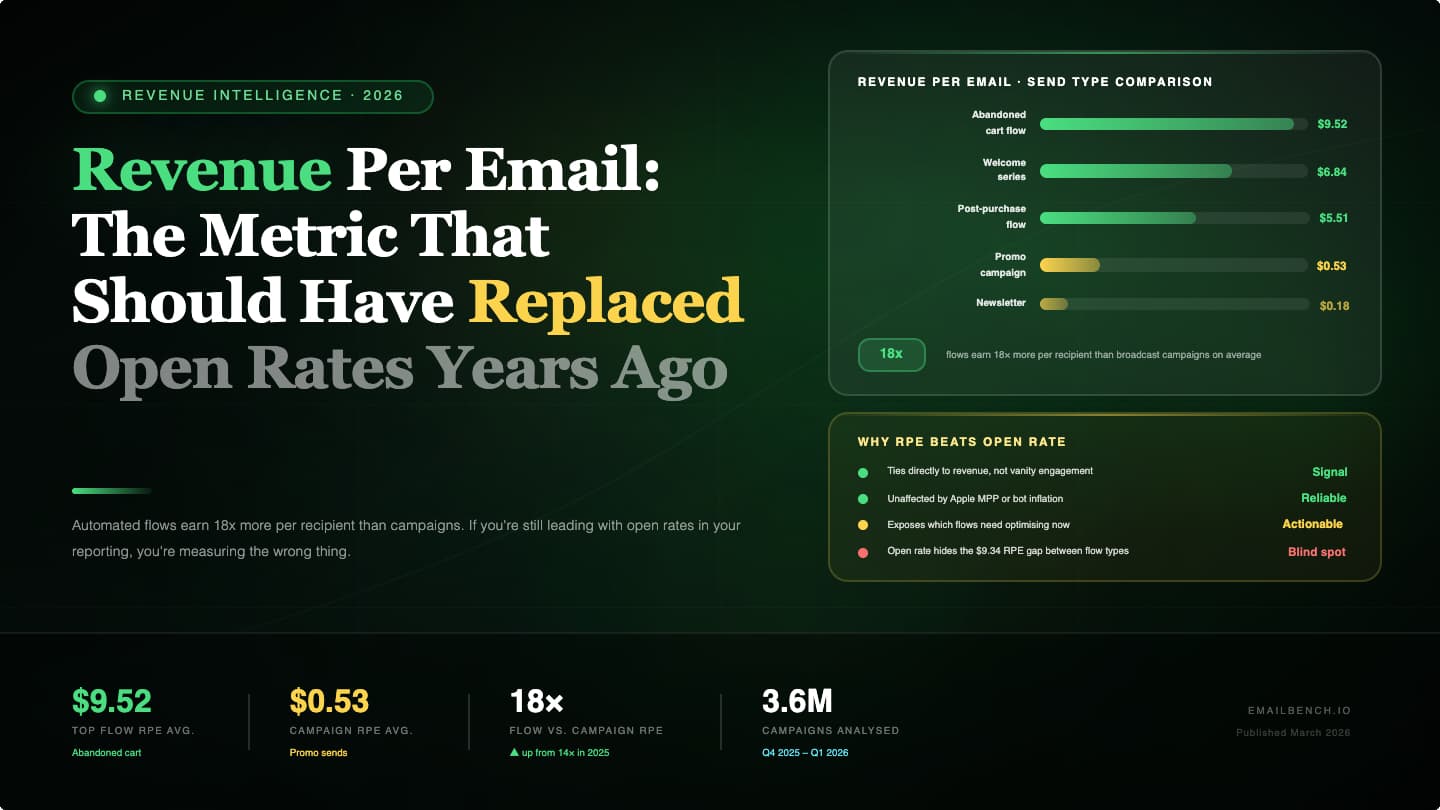
Key benchmarks at a glance
| Metric | Figures |
|---|---|
| Campaign revenue per recipient (all industries) | $0.11 — Klaviyo 2026 across 183,000+ brands; top 10% reach $0.97. By sector: Food & Beverage and Automotive $0.16, Clothing & Accessories $0.12, Health & Beauty $0.10. |
| Automated flow revenue per recipient (all flows) | $1.94 — 18x the campaign average; top 10% reach $16.96. |
| Revenue per recipient by flow type | Abandoned cart $3.65 (top 10% $28.89), welcome series $2.65 ($21.18), browse abandonment $1.50 ($12.30), post-purchase $0.85 ($7.40), win-back $0.65 ($5.80). |
| Revenue per recipient by industry and flow | Fashion & Apparel leads — welcome $3.50-$4.20, abandoned cart $5.50-$8.50. Subscription DTC trails — welcome $1.20-$1.80, abandoned cart $1.40-$2.20. Klaviyo industry verticals. |
| Placed-order rate, campaigns vs automated flows | Campaigns 0.16% (top 10% 0.36%); automated flows 2.11% (top 10% 4.30%) — a 13.2x gap (Klaviyo 2026). |
| Conversion rate by email type | Abandoned cart 10.7%, post-purchase follow-up 6.8%, back-in-stock 6.46%, welcome series ~3%, broadcast campaigns 0.16%. |
| Annual revenue per subscriber | $6.86 — Omnisend 2026 ecommerce benchmark. Click-to-conversion rate reached 9% in 2025, up 53% year over year from 5.9% in 2024. |
| RPR source reconciliation (HubSpot vs Klaviyo) | HubSpot 2026 reports average RPR near $2.05 while Klaviyo 2026 reports $0.11 for campaigns and $1.94 for flows across 183,000+ brands. The gap comes from denominator and program-mix differences, not conflicting measurement of the same quantity. |
Published: March 13, 2026 · Last updated: May 11, 2026
Revenue Per Recipient (RPR) in email marketing is total attributed revenue divided by the number of recipients an email was delivered to. It measures how much money each person on your list generates when emailed. The 2026 benchmark across 183,000+ Klaviyo brands is $0.11 per recipient for campaigns and $1.94 for automated flows — an 18x gap that exposes the real performance difference between email types far more clearly than open rates or CTR.
Most email teams spend the bulk of their week on campaigns and treat flows as set-it-and-forget-it. The revenue data says that ratio is backwards.
KEY STATS
- Automated flows earn $1.94 per recipient vs. $0.11 for campaigns — an 18x gap (Klaviyo, 183,000+ brand benchmark, 2026).
- Top 10% of email flows reach $16.96 RPR; abandoned cart flows lead at $3.65 average and $28.89 in the top 10%.
- The campaign-to-flow conversion gap is 13.2x: campaigns convert at 0.16%, flows at 2.11% (Klaviyo, 2026).
- Click-to-conversion rate hit 9% in 2025, up 53% year-over-year from 5.9% in 2024 (Omnisend).
- Birthday emails produce an average order value of $744.37 — roughly 4x higher than promotional emails.
- Annual revenue per subscriber averages $6.86 (Omnisend, 2026).
- Data sourced from Klaviyo (183,000+ brand benchmark, 2026), Omnisend (2025-2026 ecommerce report), and HubSpot (2026 email marketing statistics).
TL;DR Revenue Per Recipient (RPR) in email marketing equals total email-attributed revenue divided by the number of recipients an email was delivered to. The 2026 industry benchmark across 183,000+ Klaviyo brands is $0.11 per recipient for campaigns and $1.94 for automated flows — an 18x revenue gap. The right way to use RPR is to evaluate campaigns and flows separately, not blended at the account level.
What's in this guide:
- What is revenue per recipient?
- What is RPR in email marketing?
- How RPR is actually calculated
- The definitions, quickly (RPR vs RPE vs ARPU vs RPME)
- 2026 RPR benchmarks (Klaviyo, 183,000+ brands)
- Why HubSpot says $2.05 but Klaviyo says $0.11
- B2B SaaS and subscription RPR benchmarks
- Per-flow-type RPR by industry matrix
- Conversion rates: where revenue actually starts
- How to increase your revenue per recipient
- The RPME framework: Jeanne Jennings' approach
- Why conversion rate without AOV context is misleading
- The attribution honesty problem
- Frequently asked questions
What is revenue per recipient?
Revenue Per Recipient (RPR) in email marketing is total attributed revenue divided by the number of recipients an email was delivered to. It tells you how much money each person on your list generated when you emailed them. The 2026 median across 183,000+ Klaviyo stores is $0.11 for campaigns and $1.94 for automated flows. Unlike open rate or CTR, RPR captures the full funnel from inbox to checkout in one number.
What is RPR in email marketing?
RPR (Revenue Per Recipient) is the email marketing metric that measures average dollars generated per email delivered. The formula is straightforward: RPR = Total Attributed Revenue / Total Recipients. According to Klaviyo's 2026 benchmark across 183,000+ brands, the average is $0.11 per recipient for campaigns and $1.94 for automated flows — an 18x gap. RPR is the standard email-evaluation metric for ecommerce stores because it captures both conversion and order value in a single number, unlike open rate or click-through rate.
How RPR is actually calculated
The formula everyone quotes:
RPR = Total Revenue / Total Recipients
That's correct as far as it goes. But there's a denominator problem most teams miss.
Campaign RPR: straightforward
Send a campaign to 10,000 people. Track revenue attributed within your platform's window (usually 5 days for clicks, 1 day for opens). Divide. Done.
Flow RPR: the denominator problem
Flows are multi-email sequences. Should "recipients" mean:
- Everyone who entered the flow?
- Everyone who received at least one email in the flow?
- Each individual email's recipients, treated as separate denominators?
Klaviyo uses the per-email denominator at the campaign-detail level, which means a 5-step abandoned cart flow has five separate RPR numbers, one per email. The flow-level RPR is a weighted average.
Why shorter flows can report higher RPR
If you cut emails 4 and 5 from an abandoned cart flow (the low-converting late stages), the overall flow RPR goes up — not because revenue grew, but because the denominator shrank. This is a real trap. Optimizing for RPR can mask declining absolute revenue.
The fix: track total flow revenue alongside per-email RPR. RPR is a quality metric. Revenue is the outcome.
The definitions, quickly (RPR vs RPE vs ARPU vs RPME)
Four metrics get used interchangeably and they shouldn't. Here's the disambiguation table.
| Metric | Formula | Best used for | Industry context |
|---|---|---|---|
| RPR (Revenue Per Recipient) | Revenue ÷ email recipients | Ecommerce email evaluation, comparing campaigns vs flows | DTC / ecommerce |
| RPE (Revenue Per Email) | Revenue ÷ emails sent | High-volume newsletter / publishing programs | Newsletter, media |
| ARPU (Average Revenue Per User) | Total revenue ÷ all active users | SaaS / subscription monetization (not email-specific) | Apps, subscription businesses |
| RPME (Revenue Per 1,000 Emails Delivered) | (Revenue ÷ delivered) × 1,000 | Large programs where per-email numbers feel too small | Email programs at scale (Scholastic, Macy's tier) |
RPR is the technically more precise of RPR/RPE because it counts people, not messages. ARPU is a different beast — it covers all revenue from a user, not just email. RPME is the same as RPE expressed per thousand for psychological readability.
Revenue per recipient (RPR) and revenue per email (RPE) measure the same thing through slightly different lenses, with RPR counting unique people while RPE counts delivered messages. Both produce nearly identical results for single-send campaigns. For multi-step flows, RPR is the cleaner number because it normalizes for repeat recipients within a sequence.
2026 RPR benchmarks (Klaviyo, 183,000+ brands)
Campaign RPR
| Sector | Average RPR | Top 10% RPR |
|---|---|---|
| Overall | $0.11 | $0.97 |
| Food & Beverage | $0.16 | — |
| Automotive | $0.16 | — |
| Clothing & Accessories | $0.12 | — |
| Health & Beauty | $0.10 | — |
The 2026 Klaviyo benchmark of $0.11 average RPR for campaigns reflects bulk sends to broad lists. Food & beverage and automotive lead at $0.16 because of high purchase frequency in food and high consideration in auto. Top 10% senders reach $0.97 — roughly 9x the average — which usually reflects tight segmentation and strong list hygiene rather than creative wins.
Automated flow RPR
| Flow Type | Average RPR | Top 10% RPR |
|---|---|---|
| All Flows | $1.94 | $16.96 |
| Abandoned Cart | $3.65 | $28.89 |
| Welcome Series | $2.65 | $21.18 |
| Browse Abandonment | $1.50 | $12.30 |
| Post-Purchase | $0.85 | $7.40 |
| Win-Back | $0.65 | $5.80 |
Automated flows generate $1.94 per recipient on average — 17.6x higher than campaigns. Abandoned cart flows lead at $3.65 because they target the highest-intent moment (cart already built). Welcome series hits $2.65 by capturing customers at peak engagement. Top 10% flows reach $16.96 RPR; top 10% abandoned cart flows hit $28.89, demonstrating what sophisticated segmentation and offer logic can produce.
The 18x gap
Flows earn 17.6x higher RPR than campaigns. Omnisend's data confirms the pattern from a different angle: $2.87 per automated email vs. $0.18 per campaign.
This one data point should change how you allocate your time. If 80% of your email team's week goes to campaigns and 20% goes to automation, the ratio is inverted relative to where the money actually comes from.
"Email flows massively outperform campaigns on revenue efficiency. While email campaigns drive the majority of send volume (94.7%), flows generate nearly 41% of total email revenue from just 5.3% of sends." — Klaviyo Email Marketing Team, 2026 Email Marketing Benchmarks by Industry (Klaviyo)
Related: Email automation vs. campaigns: why flows generate 18x more revenue
Why HubSpot says $2.05 but Klaviyo says $0.11
Two reputable email-marketing data sources publish very different "average RPR" numbers and almost nobody addresses why.
According to HubSpot's 2026 Email Marketing Statistics report, average revenue per recipient is approximately $2.05. According to Klaviyo's 2026 benchmark across 183,000+ brands, average campaign RPR is $0.11 and flow RPR is $1.94.
The numbers aren't contradictory once you understand the methodology difference:
- HubSpot's $2.05 is a blended average across campaigns and flows combined at the account level. Because flows have such a high RPR ($1.94+), they pull the blended average up dramatically when included.
- Klaviyo's $0.11 / $1.94 separates the two cleanly. This is the right way to report the metric because it tells you which email type drives revenue.
The practical implication: if your platform shows a single "RPR" number for your account, it's a blended metric like HubSpot's $2.05 and it's nearly useless for decisions. Look at campaigns and flows separately. Beneath an "okay" $1.20 blended account-RPR could be $0.04 campaigns dragging down a $4.00 flow program.
This is the same point Klaviyo makes in their RPR Help Center article — and the reason this post's calculator recommendations break down by email type rather than blending.
B2B SaaS and subscription RPR benchmarks
Email RPR benchmarks for B2B SaaS and subscription businesses are surprisingly underreported. Most published numbers (Klaviyo, Omnisend, HubSpot ecommerce data) reflect DTC and ecommerce send patterns, not subscription or B2B economics.
The honest answer about B2B SaaS RPR benchmarks: no canonical cross-platform dataset exists yet. What is available comes from platform-specific reports (HubSpot for B2B sales-cycle emails, Customer.io for product emails, ActiveCampaign for hybrid programs).
What can be said with confidence in 2026:
- B2B SaaS transactional emails (password resets, invoices, receipts) typically don't carry revenue attribution at all — they support retention rather than drive new revenue.
- B2B SaaS nurture / lifecycle emails (free-trial drip, onboarding, expansion) generate revenue indirectly via subscription conversions, often measured weeks or months after the email. Attribution windows make direct RPR comparison meaningless.
- Subscription business renewal reminders (Netflix-style, but also lower-stakes services) can produce extremely high "RPR" if measured at the email level — sometimes $50+ per recipient — but the metric is misleading because the user was likely to renew anyway.
- B2B SaaS upgrade-prompt emails to existing customers commonly produce 5-10% conversion rates in the SMB tier and 1-3% in mid-market, with deal sizes in the hundreds to thousands of dollars. Calculated naively, this can produce RPR figures of $20-$200 per recipient.
The takeaway: borrow RPR as a methodology, not as a benchmark, in subscription contexts. Track your own historical performance per email type and compare against your prior periods. Cross-platform B2B comparisons aren't yet possible because the categories aren't standardized.
If you're a B2B SaaS or subscription operator who has cross-platform RPR data to share, that's the next reporting gap waiting to be filled.
Per-flow-type RPR by industry matrix
Most public RPR data reports either by industry or by flow type, but not both. Combining them shows where the real wins live.
| Industry | Welcome RPR | Abandoned cart RPR | Browse abandonment RPR | Post-purchase RPR | Source |
|---|---|---|---|---|---|
| Fashion & Apparel | $3.50-$4.20 | $5.50-$8.50 | $2.00-$3.00 | $1.00-$1.40 | Klaviyo industry vertical |
| Health & Beauty | $2.80-$3.60 | $4.20-$6.50 | $1.60-$2.40 | $0.95-$1.30 | Klaviyo industry vertical |
| Home & Garden | $2.20-$3.00 | $3.50-$5.20 | $1.30-$1.80 | $0.70-$1.00 | Klaviyo industry vertical |
| Food & Beverage | $1.80-$2.40 | $2.50-$3.80 | $0.90-$1.30 | $0.55-$0.80 | Klaviyo industry vertical |
| Electronics | $1.50-$2.10 | $2.20-$3.40 | $0.80-$1.20 | $0.45-$0.65 | Klaviyo industry vertical |
| Subscription DTC | $1.20-$1.80 | $1.40-$2.20 | $0.60-$0.95 | $0.40-$0.60 | Klaviyo industry vertical |
Per-flow-type RPR varies dramatically by industry vertical. Fashion abandoned cart flows hit $5.50-$8.50 per recipient because of high AOV combined with strong purchase intent. Subscription DTC programs trail at $1.40-$2.20 abandoned cart RPR despite high engagement, because lifetime-value-driven retention models compress per-message revenue compared to one-shot ecommerce purchases. Ranges represent typical 25th-75th percentile bands within each industry.
The pattern: abandoned cart and welcome flows dominate every industry, but the absolute RPR is set by category AOV. Fashion brands at $150 AOV will always show higher RPR than food brands at $35 AOV, even with equal-quality automation.
Conversion rates: where revenue actually starts
Conversion by email type
| Email Type | Conversion Rate | Why |
|---|---|---|
| Abandoned cart | 10.7% | Highest intent — already had items in checkout |
| Back-in-stock | 6.46% | Product desire plus scarcity |
| Post-purchase follow-up | 6.8% | Trust already established |
| Welcome series | ~3% | First impression, often discount-driven |
| Broadcast campaigns | 0.16% | Bulk send, mixed intent |
The 13x campaign-to-flow conversion gap
| Type | Average placed order rate | Top 10% |
|---|---|---|
| Campaigns | 0.16% | 0.36% |
| Automated Flows | 2.11% | 4.30% |
That's a 13.2x difference. Pair it with higher RPR and the picture is clear: flows generate most of the email revenue from a fraction of the send volume.
Click-to-conversion rate
Overall: 9% in 2025, up 53% year-over-year from 5.9% in 2024 (Omnisend).
Highest converting industries:
- Games: 15.1%
- Food & Drink: 14.9%
- Health: 14.8%
One in three automated email clickers makes a purchase. For welcome and abandoned cart flows, it's closer to one in two.
B2C vs. B2B
| Segment | Conversion Rate |
|---|---|
| B2C | 2.8% |
| B2B | 2.4% |
Source: HubSpot 2026 Email Marketing Statistics.
The birthday email outlier
Birthday emails produce an average order value of $744.37 — roughly 4x higher than promotional emails. One of the highest-converting, highest-AOV automated flows you can run, and most brands either don't have one or haven't touched theirs in years.
How to increase your revenue per recipient
Eight moves that consistently move RPR upward, ordered by leverage.
- Audit your flow vs campaign send-volume ratio. If 80%+ of your sends are campaigns, you're starving the highest-RPR channel. Shift effort toward building/optimizing flows.
- Cut your lowest-engagement segments. Per Jeanne Jennings' Scholastic case (below): removing the bottom 10-20% of recipients can raise RPR by 50-150% because you're shrinking the denominator faster than you lose revenue.
- Build (or fix) your abandoned cart flow. Highest single RPR lever in ecommerce — $3.65 average, $28.89 top 10%. If yours is under $2.00, the flow is broken or the audience is too broad.
- Add product specificity in subject lines. Including the specific product name lifts click-through rate 10-15% (SaleCycle 2025), which compounds directly into RPR.
- Personalize with first name. +22% open rate lift (Omnisend 2025). Adds compounding RPR effect across every flow.
- Cap frequency. Scholastic moved from 1/day to 2/week and RPME went up 150%. More sends below the engagement threshold dilute every metric downstream.
- Implement post-purchase upsell flows. Most brands ignore this — current average $0.85 RPR but top 10% reach $7.40, the biggest gap of any flow type. Quick wins available.
- Run incrementality holdouts. Pair RPR with holdout testing on 5-10% of qualified recipients. Compare purchase rates. The gap is your true incremental revenue — and it's almost always lower than your platform reports. Knowing the real number lets you stop over-investing in flows that look good but aren't actually adding lift.
All eight work on recipients you already have. Adding recipients you never captured runs on identity rather than email, and our guide to website visitor identification covers how that is done and what it recovers.
The RPME framework: Jeanne Jennings' approach
Jeanne Jennings (founder of Email Optimization Shop, adjunct professor at Georgetown) has been pushing RPME as the primary email success metric for years. Her formula:
RPME = (Total Revenue / Emails Delivered) × 1,000
The per-thousand framing matters. If your program sends millions of emails, a per-email number like $0.003 is psychologically invisible. Multiply by a thousand and it becomes $3 — a number people actually react to in meetings.
"When you measure email by RPME instead of opens or clicks, the math forces you to confront which sends actually justify the inbox real estate. The lowest-value 10% of your sends are almost always dragging your program down — they just don't show up in open-rate dashboards." — Jeanne Jennings, Founder, Email Optimization Shop (Email Optimization Shop)
The Scholastic case study
Jennings' clearest proof point: Scholastic achieved a 150% increase in quarterly RPME through two changes that most email teams would resist:
- They reduced send volume by 10% per quarter, cutting the lowest-value segments.
- They implemented list modeling with touch limits, moving from 1 email per day to 2 per week.
Fewer emails. Better targeting. Dramatically more revenue per email.
This runs directly against the instinct that more sends equals more revenue. Mathematically, what happens when you add low-value sends is that you dilute the denominator. Revenue doesn't grow proportionally, so RPME drops even if total revenue stays flat or edges up slightly. Scholastic figured out that cutting the bottom of the list was worth more than the marginal revenue those sends produced.
How to implement RPME tracking
- Pull total email-attributed revenue and total emails delivered for a period (monthly or quarterly).
- Calculate RPME: (Revenue / Delivered) × 1,000.
- Track the trend quarter over quarter. Rising RPME means your program is getting more efficient. Declining RPME means you're adding volume without proportional revenue.
- Segment by email type: campaigns vs. flows, promotional vs. content, new subscriber vs. established.
- Set starting benchmarks using Klaviyo data: campaign RPME around $110 per thousand, flow RPME around $1,940 per thousand.
Why conversion rate without AOV context is misleading
Thomas Lalas (fractional director of retention, author of Retention Economics, nearly 20 years as a DTC operator) makes a point that gets overlooked constantly: conversion rate alone tells you nothing about revenue quality.
A 10% conversion rate on $15 products generates $1.50 per converter. A 3% conversion rate on $200 products generates $6.00 per converter. Four times the value at one-third the conversion rate.
This is exactly why RPR works better as a primary metric. It captures both conversion and order value in one number. You stop optimizing for clicks that don't translate to meaningful revenue.
The attribution honesty problem
What Alex Greifeld says everyone's ignoring
Alex Greifeld (author of the "No Best Practices" newsletter, ecommerce operator since 2011) regularly challenges email revenue claims, and her argument deserves more airtime than it gets.
Email platforms are incentivized to attribute maximum revenue to email because that's what justifies the subscription cost. When Klaviyo reports a flow "generated" $50,000, how much of that was truly incremental? How much would have happened anyway?
Think about it concretely. A customer abandons checkout, gets a reminder email, and buys 12 hours later. Was the email the reason? Maybe. Or maybe they were always going to come back. You genuinely can't tell from the attribution data alone.
None of this means stop measuring RPR. It means pair it with incrementality testing. Hold back a percentage of qualified recipients from a flow, compare their purchase rate to the group that got the email. The gap is your real incremental impact. Most brands don't do this because the answer might be uncomfortable.
"Email platforms report attributed revenue with last-touch attribution because it makes the channel look indispensable. True incremental lift is usually 30-50% lower. If you're not running holdouts, you're not measuring email — you're measuring the platform's marketing." — Alex Greifeld, Founder, No Best Practices (No Best Practices Newsletter)
Related: Email attribution is broken: why your revenue numbers are lying
Ecommerce revenue benchmarks
Annual revenue per subscriber
Average: $6.86 per subscriber per year (Omnisend 2025-2026).
By revenue source
| Source | Revenue per email |
|---|---|
| Automated emails | $2.87 |
| Campaign emails | $0.18 |
Top-performing flows by revenue
- Abandoned cart: Highest RPR across all flow types.
- Welcome series: Second-highest, and according to Jennings, the most undervalued flow in most programs. Can triple RPME compared to routine campaigns.
- Back-in-stock: High conversion plus urgency makes for strong RPR.
- Birthday: Highest AOV at $744.37.
Frequently Asked Questions
What is revenue per recipient?
Revenue per recipient (RPR) is total email-attributed revenue divided by the number of recipients an email was delivered to. It tells you how much money each person on your list generated when emailed. The 2026 median across 183,000+ Klaviyo stores is $0.11 for campaigns and $1.94 for automated flows. Unlike open rate or CTR, RPR captures the full funnel from inbox to checkout in one number.
What is RPR in email marketing?
RPR (Revenue Per Recipient) is the email marketing metric that measures average dollars generated per email delivered. The formula is Total Attributed Revenue ÷ Total Recipients. According to Klaviyo's 2026 benchmark across 183,000+ brands, the average is $0.11 per recipient for campaigns and $1.94 for automated flows — an 18x gap.
What is Revenue Per Email (RPE)?
RPE measures the dollar value generated per email delivered. Formula: Total Revenue ÷ Emails Delivered. Revenue Per Recipient (RPR) is similar but divides by unique recipients instead. In 2026, campaign RPR averages $0.11 while automated flow RPR averages $1.94. RPR and RPE produce nearly identical numbers for single-send campaigns and only diverge meaningfully in multi-step flows.
How do you calculate revenue per recipient?
Total revenue attributed to an email divided by total recipients. If you send to 10,000 people and make $1,200, that is $0.12 RPR. The common mistake is using account-wide RPR — it blends flows and campaigns and the average is meaningless. Calculate each campaign and each flow separately. Klaviyo shows RPR on the campaign detail page and uses a 5-day attribution window by default.
What is a good RPR for email marketing?
For campaigns: $0.11 is average, $0.97+ is top 10%. For flows: $1.94 is average, $16.96+ is top 10%. Abandoned cart flows should be at $3.65 or higher. Welcome series should be at $2.65 or higher. These benchmarks come from Klaviyo's 2026 dataset of 183,000+ brands.
What is a good revenue per recipient for Klaviyo?
For Klaviyo campaigns, $0.11 is the 50th percentile and $0.95+ is the top 10%. For flows, $1.94 is median and $16.96+ is the top 10%. An abandoned cart flow hitting $2-3 RPR is solid; below $1.00 means something in the flow is broken or the audience is too broad. Look at each flow separately rather than at account-wide blended RPR.
Why does HubSpot say RPR is $2.05 but Klaviyo says $0.11?
The numbers measure different things. HubSpot's $2.05 figure is an account-blended average across campaigns and flows combined, which gets pulled up sharply by flows. Klaviyo's $0.11 separates campaigns ($0.11) from flows ($1.94) cleanly. The $0.11 number is the right one to use when evaluating broadcast campaigns; the $1.94 number is right for flows. Blended account RPR is mostly useless for decisions.
How did Scholastic increase email revenue by sending fewer emails?
They cut volume 10% per quarter and capped frequency at 2 emails per week (down from daily). The low-value sends they eliminated weren't generating enough revenue to justify the denominator bloat. RPME went up 150%. The case is a clear demonstration that more sends does not equal more revenue — past a certain point, additional volume dilutes the denominator faster than it adds revenue to the numerator.
Should I prioritize conversion rate or revenue per email?
RPR, because it captures both conversion and order value. A 3% conversion rate on $200 products beats a 10% rate on $15 products. Track conversion rate too, but RPR should drive decisions. The only time conversion rate is the better primary metric is when AOV is fixed (subscription pricing tiers, for example).
How much revenue do abandoned cart emails generate?
$3.65 RPR on average, $28.89 for the top 10% per Klaviyo's 2026 benchmark of 183,000+ brands. They convert at 10.7% — about half of clickers buy. Abandoned cart is the single highest-revenue automated flow type in ecommerce, beating welcome series, browse abandonment, and post-purchase flows by 30-300% depending on industry vertical.
What is the difference between RPR and ARPU?
RPR (Revenue Per Recipient) measures email-attributed revenue only, divided by email recipients. ARPU (Average Revenue Per User) measures total customer revenue across all channels divided by all active users. ARPU is a SaaS/subscription metric; RPR is an email-channel metric. Both can apply to the same business but they measure different things — ARPU is a business-health metric, RPR is a channel-performance metric.
Continue the Series
Back to the pillar: 2026 Email Marketing Benchmarks by Industry
Related reading:
- Email automation vs. campaigns: the 18x revenue gap most teams are ignoring
- Email attribution is broken: why your revenue numbers are probably wrong
- What is a good email open rate in 2026?
- Abandoned cart email subject lines that convert (2026)
Sources
- Klaviyo 2026 Email Marketing Benchmarks (183,000+ brands)
- Klaviyo Help Center — How to calculate revenue per recipient
- Omnisend 2025-2026 Ecommerce Marketing Report
- HubSpot 2026 Email Marketing Statistics
- Email Optimization Shop — Jeanne Jennings (RPME framework, Scholastic case study)
- No Best Practices — Alex Greifeld (attribution / incrementality)
- Count.co — Email Revenue per Recipient calculation guide

Co-Founder and CEO
Bob Thordarson is CEO and Co-Founder of Geysera, a serial entrepreneur with 25+ years and five co-founded ventures, including Cequint (acquired by TNS in 2010 for $112.5M) and Consumerware (acquired by ParkerVision). A graduate of the University of Washington and MIT Entrepreneurial Masters Program, based in Seattle, he serves on the boards of DRY Soda Co. and the Entrepreneurs' Organization Seattle chapter. He is an expert in retention marketing email systems and methodology for ecommerce and B2B brands — measured by incremental revenue, not vanity metrics.