WooCommerce + SendGrid in 2026: From Transactional-Only to Full-Funnel Without Migration
SendGrid retired its free plan in July 2025, and the 8-year-old top Google result for "woocommerce sendgrid" still mentions 12,000 free emails per month. For WooCommerce stores running SendGrid in 2026, here is what changed, why SendGrid is still excellent transactional infrastructure, and how to add a marketing automation layer on top without migrating ESPs.
This is post 4 of 17 in the WooCommerce Email Marketing in 2026 Series. Previous: The Modern Ecommerce Email Stack: Why Two Tools Beat One in 2026
WooCommerce stores running SendGrid in 2026 are running a different product than the one most setup guides describe. Twilio retired the SendGrid free plan on July 26, 2025, paused accounts that did not upgrade, and deleted contact records above 100 for those accounts. The eight-year-old article that still ranks #1 on Google for "woocommerce sendgrid" mentions 12,000 free emails per month. That offer does not exist anymore.
The free-plan retirement is the headline. The deeper story is that SendGrid in 2026 is still excellent transactional infrastructure and still bad at marketing automation, and the right response for most WooCommerce stores is not to migrate to a different ESP. It is to keep SendGrid where SendGrid is strong and add an automation layer on top for the work SendGrid was never designed to do.
This guide covers what changed, why SendGrid is still worth running, what it does not do, and how the 2026 architecture pattern works for technical WooCommerce stores, headless builds, and high-AOV brands that already chose SendGrid for a reason.
KEY STATS
- SendGrid retired its Free Email API and Marketing Campaigns plans effective July 26, 2025, after a 60-day notice period announced May 27, 2025 (Twilio changelog)
- Accounts that did not upgrade had email sending paused and any stored contacts above 100 deleted (Twilio changelog)
- The current paid floor is $20 per month for 50,000 emails on the Email API plan (Twilio SendGrid pricing)
- The top Google result for
woocommerce sendgridin the United States as of May 2026 is a WooCommerce.com article dated May 22, 2018, eight years old at the time of this writing (DataForSEO SERP, May 28 2026)- The official
sendgrid/wordpressGitHub plugin has not received a commit since May 6, 2021, and is effectively unmaintained (GitHub repo)- Twilio reports SendGrid delivers over 148 billion emails per month across its platform (Twilio SendGrid product page)
- The 2026 SERP for
woocommerce sendgridcontains zero results that position SendGrid as transactional-only and recommend adding a separate marketing automation layer. Every top-10 result treats SendGrid as the whole stack (DataForSEO SERP, May 28 2026)- Data sourced from Twilio's official free-plan changelog, SendGrid pricing pages, the DataForSEO live SERP API, the GitHub commit history of
sendgrid/wordpress, and Twilio's public product reporting.
What's in this guide:
- What changed: SendGrid killed the free plan in July 2025
- Why WooCommerce stores still choose SendGrid in 2026
- What SendGrid does not do well: marketing automation
- The 2026 architecture: SendGrid plus an automation layer on top
- Deliverability: keeping SendGrid's strengths while adding marketing flows
- Integration patterns for technical and headless WooCommerce stores
- When to migrate off SendGrid (and when not to)
- Frequently asked questions
What changed: SendGrid killed the free plan in July 2025
Twilio announced the retirement of SendGrid's Free Email API and Free Marketing Campaigns plans on May 27, 2025, with a 60-day notice period. The free plans ended on Saturday, July 26, 2025. The Twilio changelog is the canonical source.
For accounts that did not upgrade in time, three things happened. Sending was paused, so no outbound email left the platform until the account moved to a paid plan. Contact storage was capped at 100 records, and any contacts above that count were deleted, not merely hidden. The free-plan API keys continued to authenticate but no longer routed mail.
Twilio's stated reason was deliverability and abuse. Free email infrastructure attracts the highest concentration of spam and phishing on any sending platform, and the easiest defensive move for a major ESP is to remove the free tier entirely. Mailgun made the same move several years earlier. SMTP2GO and Brevo still publish free plans, which is part of why the post-July 2025 SERP for "woocommerce sendgrid" has filled with alternative-finder content.
The new pricing floor is $20 per month for the Email API plan with 50,000 monthly emails included, per the official SendGrid pricing page. For a WooCommerce store sending order confirmations, password resets, shipping notifications, and a handful of broadcasts, that volume is far in excess of what most stores actually need, which means the $20 plan is the practical floor for the cohort.
The free-plan death matters less than the precedent. High-volume WooCommerce stores were already on paid SendGrid plans for the throughput and the dedicated IPs. The cohort hit hardest by the change is the long tail of small WooCommerce stores that adopted SendGrid for transactional and never crossed the 100-contact threshold. For that cohort, the question is no longer "what is the best free transactional setup" but "what does the post-free SendGrid stack actually look like." That reframe is the entire reason the 2018 top result is now misleading.
Why WooCommerce stores still choose SendGrid in 2026
The free-plan retirement did not change why technical and high-AOV WooCommerce stores chose SendGrid in the first place. Four reasons hold.
The first is deliverability. SendGrid runs on Twilio's infrastructure and is one of the largest email senders on the public internet. Twilio's product page reports SendGrid handles 148 billion emails per month across its customer base. That volume buys ISP relationships and feedback loops that smaller transactional providers cannot match. For order confirmations and password resets, where reaching the inbox is the entire job, SendGrid is among the most reliable options available.
The second is transactional fitness. SendGrid was built for transactional first. Its API, templating, dynamic substitution, suppression management, webhook event stream, and dedicated IP handling are all engineered around the high-volume one-to-one email pattern that ecommerce transactional traffic generates. A WooCommerce store that emits an order confirmation per order, a shipping notification per fulfillment, a password reset per request, and a receipt per refund is doing transactional work, and SendGrid's API surface fits that shape.
The third is headless and custom-build compatibility. WooCommerce stores running headless frontends, custom React or Next.js storefronts, or non-WordPress checkouts cannot easily plug into ESPs whose primary integration is a WooCommerce plugin. SendGrid's REST API is platform-agnostic. A headless store can call SendGrid directly from a Node.js or PHP backend without touching the WordPress mail pipeline at all. For the cohort of WooCommerce stores doing high-engineering custom work, that flexibility is the reason SendGrid is on the stack in the first place.
The fourth is volume economics at scale. Once a store crosses about 100,000 sends per month, SendGrid's per-send pricing on the higher Email API tiers tends to undercut marketing-first ESPs whose pricing is built around contact count rather than send volume. For a transactional-heavy store that ships a lot but markets to a small list, SendGrid's volume model is cheaper.
None of those four reasons evaporated in July 2025. What evaporated was the easy on-ramp.
What SendGrid does not do well: marketing automation
SendGrid is not bad at marketing automation. It is barely in the marketing automation business. The product Twilio sells as "SendGrid Marketing Campaigns" is a campaign-builder layer on top of the same send infrastructure that powers the Email API. It supports lists, segments, an automation builder, and dynamic content. What it does not support is the part of marketing automation that drives ecommerce revenue.
SendGrid Marketing Campaigns does not ship native ecommerce flow templates. There is no out-of-the-box cart abandonment flow, no browse abandonment flow, no post-purchase sequence, no winback playbook. There is a generic automation builder that a skilled marketer can use to construct those flows manually, with custom event ingestion and custom segmentation, but the lift is real. The flows that Klaviyo and Mailchimp ship as one-click installs require weeks of configuration on SendGrid.
SendGrid also does not do visitor identification. ESPs in general only fire flows for known subscribers, meaning visitors who have submitted an email address and crossed an identity threshold the ESP recognizes. For a WooCommerce store running paid acquisition on Meta and Google, the typical paid traffic stream produces 80 to 95% of visitors who never identify. SendGrid sees none of them. The same is true of Klaviyo, Mailchimp, and HubSpot, which is why the modern ecommerce email stack treats identity as a separate layer from the send layer.
Beau Lebens, Artistic Director of WooCommerce at Automattic, framed the platform direction in his January 2025 leadership announcement and again at Stripe Sessions in May 2026, where he covered agentic commerce and how real-time its catalog data needs to be. Our read is that the platform is moving toward AI-driven customer journeys built across channels with real identity resolution, not toward more transactional plumbing. The send layer is mature, and the orchestration and identity layers are where the next decade of work happens. A SendGrid setup that stops at the send layer leaves the marketing stack roughly where Klaviyo-class stores were five years ago.
SendGrid was built for a job adjacent to marketing automation, not for marketing automation itself. The 2018 article that still ranks #1 for "woocommerce sendgrid" treats the two as the same job, because in 2018 the marketing automation expectations for a WooCommerce store were lower. They are not lower anymore.
The 2026 architecture: SendGrid plus an automation layer on top
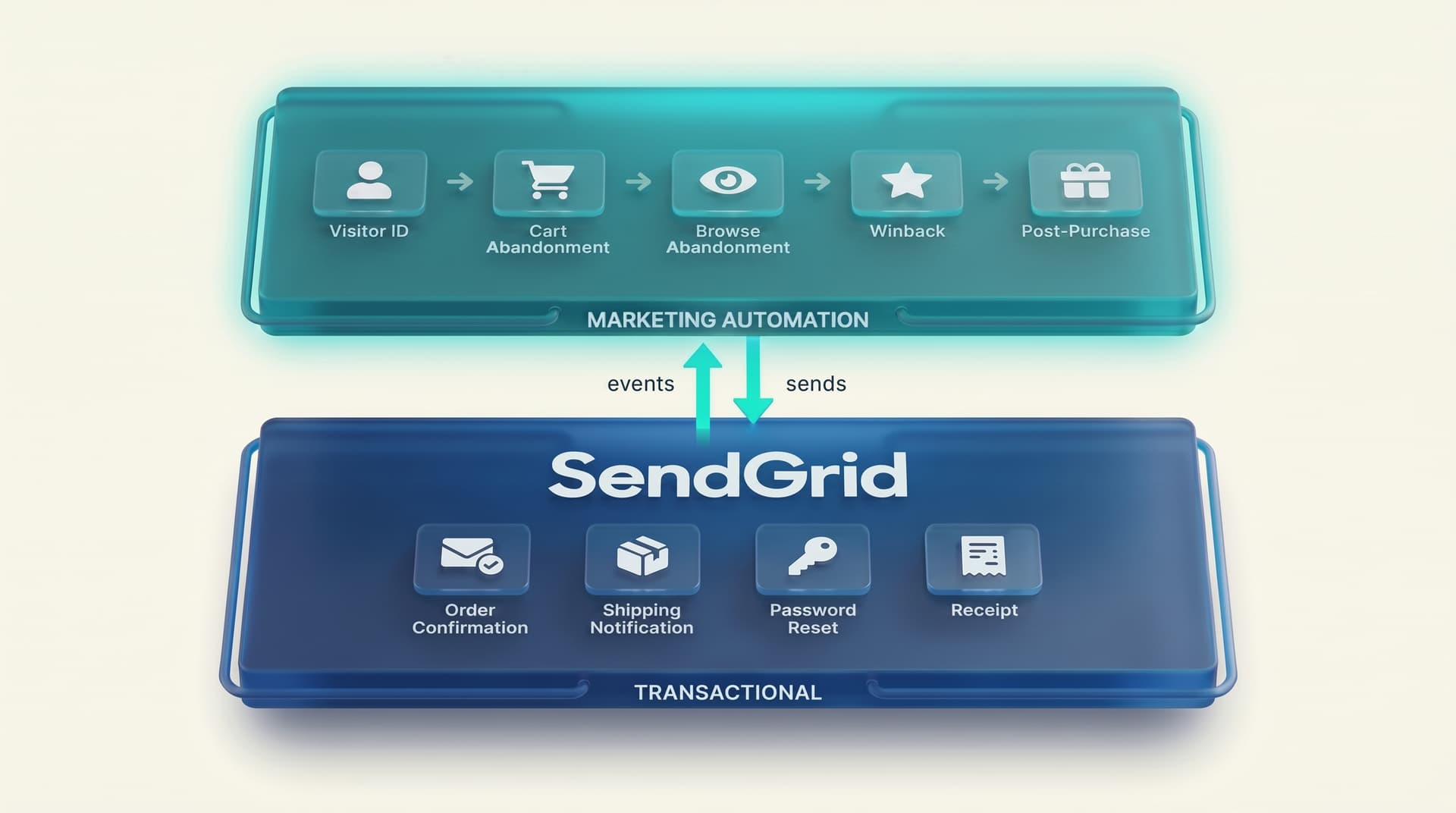
The architecture pattern that works in 2026 keeps SendGrid in place and adds a second tool that owns marketing automation. The two tools do not compete. They divide the work along a clean seam.
SendGrid owns the send layer. It handles outbound infrastructure, IP reputation, transactional templates, the order-and-shipping email stream, suppression list management, bounce processing, and unsubscribe compliance. The store's existing SendGrid API keys, templates, dedicated IPs, and authentication records stay in place. Nothing about the current SendGrid setup needs to move.
The automation layer owns the marketing side. It handles identity resolution for anonymous and paid traffic, behavioral event ingestion from WooCommerce, the flow logic for cart abandonment, browse abandonment, post-purchase sequences, and winback campaigns, cross-channel sequencing across email, SMS, and on-site, and the segmentation that decides which audiences see which flows.
The two layers connect through one of two patterns. The first pattern sends marketing email through SendGrid by configuring the automation layer to relay marketing sends to the existing SendGrid sender. SendGrid handles the actual delivery, the automation layer handles the trigger logic. The second pattern sends marketing email through the automation layer's own dedicated marketing IP, separate from the transactional IP on SendGrid, which protects the transactional reputation from marketing-send fluctuations. Both patterns are common. The right choice depends on how much the store wants its marketing email isolated from its transactional reputation.
Geysera is one example of an automation layer built specifically for the WooCommerce-plus-existing-ESP pattern, designed to work with SendGrid, Mailchimp, Klaviyo, or HubSpot without requiring migration off any of them. It is not the only option, and it is not the point of this guide. The point is that the architecture exists and works, and that the post-July-2025 SendGrid stack does not require switching ESPs to add marketing automation.
The two-tool model is the same pattern covered in Klaviyo Alternatives for WooCommerce in 2026 and in the WooCommerce email marketing 2026 pillar. The SendGrid cohort is the one where the model maps most cleanly, because SendGrid never tried to be the marketing tool, which means there is no overlap to untangle.
The default reaction to the July 2025 free-plan retirement was "should I migrate off SendGrid." For most WooCommerce stores running SendGrid for a real reason (headless build, technical team, high transactional volume, dedicated IP), migration is the wrong answer to the wrong question. The question is not which ESP. The question is what is missing from the marketing side of the stack. SendGrid is still the right transactional answer for the cohort that chose it in 2024. The thing that needs to change is not the ESP. It is the assumption that the ESP is supposed to do marketing automation. It was never supposed to. The 2026 stack acknowledges that, adds a second tool for the marketing side, and keeps the send layer where it works. — Bob Thordarson, Geysera CEO
Deliverability: keeping SendGrid's strengths while adding marketing flows
The deliverability story for a SendGrid-plus-automation-layer stack depends on which connection pattern the store uses, but the basics are the same as for any modern email setup.
Sender authentication has to be in place on the sending domain. That means SPF records that authorize SendGrid (and any other relay) to send for the domain, DKIM keys for SendGrid's signing, and a DMARC policy that the store actually monitors. Google and Yahoo's February 2024 bulk-sender requirements made DMARC effectively mandatory for any domain sending more than 5,000 messages per day to Gmail or Yahoo addresses. Most WooCommerce stores cross that threshold quickly. The Twilio SendGrid sender authentication docs walk through the DNS configuration.
Dedicated IP versus shared IP matters more in a two-tool stack than in a single-tool stack. On a shared IP, the deliverability of the store's transactional email depends on the behavior of every other SendGrid customer on the same IP pool. That is fine for low-volume transactional. For a store running marketing campaigns through the same IP, the variability of marketing send volumes can affect transactional inbox placement, which is the deliverability outcome stores care about most. The conventional pattern is to put marketing email on a separate IP from transactional, either by paying for two dedicated IPs on SendGrid or by routing marketing through the automation layer's own marketing IP.
Suppression list management is the other place a two-tool stack needs care. Both layers need to honor a single suppression list. If a recipient unsubscribes from a marketing flow run by the automation layer, that unsubscribe needs to suppress further marketing sends without suppressing transactional sends. SendGrid supports list-level and global suppressions, and a well-built automation layer integrates with SendGrid's suppression API to keep the two layers consistent.
A Business Bloomer Club discussion of SendGrid alternatives noted that SendGrid's free plan capped sends at 100 a day and advised choosing a relay on daily limits, scalability, branding needs and budget. The same framing applies post-free-plan-retirement.
Integration patterns for technical and headless WooCommerce stores
There are three working patterns for WooCommerce stores connecting to SendGrid in 2026. The right choice depends on whether the store is running classic WordPress, a headless frontend, or a fully custom architecture.
The first pattern is SMTP via a WordPress mail plugin. The official sendgrid/wordpress GitHub plugin is effectively abandoned. Its last commit was May 6, 2021, and Twilio does not list the WordPress plugin among its officially supported integrations on the current product site. The practical replacement is a general-purpose SMTP plugin pointed at SendGrid's SMTP endpoint. Gravity SMTP, WP Mail SMTP, and FluentSMTP all support SendGrid as a provider and handle the SMTP-versus-API tradeoff without requiring custom code. This is the right pattern for classic WooCommerce stores running on standard WordPress hosting where the goal is reliable transactional delivery without engineering effort.
The second pattern is direct SendGrid API integration. WooCommerce stores running custom plugins, headless frontends, or non-WordPress checkouts can call the SendGrid REST API directly from server-side code. The transactional template features, dynamic substitution, and event webhook stream are all API-accessible, and SendGrid maintains official client libraries in Node.js, PHP, Python, Ruby, Go, Java, and C#. The Twilio SendGrid documentation covers the API patterns in detail. This is the right pattern for technical teams who want fine-grained control over send logic, template versioning, and event handling.
The third pattern is the two-tool architecture covered above: SendGrid for transactional, an automation layer for marketing. The automation layer handles the WooCommerce event ingestion (order placed, cart abandoned, browse abandoned, customer returned), the flow logic, and the trigger decisions. Marketing sends either route back through SendGrid for delivery or use the automation layer's own send infrastructure. For stores that already have SendGrid running and want to add cart, browse, winback, and visitor-identification flows, this is the lowest-friction path.
The pattern most WooCommerce stores end up on by 2026 is the third one. It preserves the SendGrid investment, adds the marketing capability that SendGrid does not natively provide, and avoids the 22-38% deliverability drop that improperly executed ESP migrations cause in the first two weeks.
When to migrate off SendGrid (and when not to)
Not every WooCommerce store on SendGrid in 2026 should keep SendGrid. The decision rests on four variables: send volume, technical depth, marketing maturity, and the reason SendGrid was chosen in the first place. The table below maps the common scenarios.
| Scenario | Recommendation | Why |
|---|---|---|
| Headless or custom WooCommerce build with engineering team in-house | Stay on SendGrid, add automation layer | The API-first integration is the reason the store chose SendGrid. Migrating loses that flexibility. The gap is marketing automation, not transactional. |
| High transactional volume (>100K sends/month), dedicated IP, warm reputation | Stay on SendGrid, add automation layer | The deliverability moat is real and rebuilding it on another ESP requires IP warm-up that risks 22-38% inbox-placement drop in the first two weeks. |
| Small store, < 1,000 sends/month, no real marketing program | Migrate to a marketing-first ESP | The post-free-plan SendGrid pricing does not advantage this cohort and the marketing-first ESPs ship more useful out-of-the-box flows. |
| Store hit by July 2025 pause, transactional still works, marketing never started | Upgrade SendGrid to $20 plan, add automation layer | The architecture is right, the marketing layer was the missing piece all along. |
| Store on SendGrid Marketing Campaigns trying to build cart/browse/winback flows manually | Keep SendGrid for transactional, move marketing flows to automation layer | The custom-build effort on SendGrid Marketing Campaigns exceeds the cost of running a purpose-built marketing layer. |
| Marketing-first store with low transactional volume, no headless requirement | Migrate fully to Klaviyo, Mailchimp, or alternative | If SendGrid's transactional strengths do not matter, the marketing-first ESP is the right tool for the whole stack. |
| Agency-managed store with mixed traffic, dedicated marketing manager | Add automation layer, keep SendGrid | The split-stack model gives the marketing manager a dedicated marketing surface without disturbing the agency's existing transactional plumbing. |
The pattern across the table is consistent. If the reason for SendGrid was transactional excellence, headless flexibility, or volume economics, the right answer is almost always to keep it and add a layer. If the reason was "it was free," which describes the cohort the July 2025 retirement disrupted, the right answer is either to pay for the $20 plan and add a marketing layer, or to migrate to a marketing-first ESP that better matches the actual usage pattern.
For most stores in the WooCommerce paid-acquisition cohort that this series covers, the right answer is option one. Migration is expensive and deliverability rebuilds are risky. The actual gap is marketing automation, not the ESP.
Frequently asked questions
Is SendGrid no longer free for WooCommerce stores?
Correct. Twilio retired the Free Email API and Free Marketing Campaigns plans on July 26, 2025, after a 60-day notice announced May 27, 2025. Accounts that did not upgrade had sending paused and contacts above 100 deleted. The current paid floor is $20 per month for 50,000 emails on the Email API plan. Stores hit by the pause can resume sending by upgrading their plan and re-importing contacts manually if any were lost above the 100-contact cap.
Does the SendGrid WordPress plugin still work in 2026?
The official sendgrid/wordpress plugin on GitHub has not received a commit since May 6, 2021 and is effectively unmaintained. It still functions in basic SMTP mode against current WordPress versions, but Twilio does not feature it among officially supported integrations on the current product site. The recommended replacement is a general-purpose SMTP plugin such as Gravity SMTP, WP Mail SMTP, or FluentSMTP pointed at SendGrid's SMTP endpoint, which gives equivalent transactional delivery with active maintenance.
Can SendGrid do marketing automation for WooCommerce?
Technically yes, practically no. SendGrid Marketing Campaigns provides a generic automation builder, lists, segments, and dynamic content, but it does not ship native ecommerce flow templates for cart abandonment, browse abandonment, post-purchase sequences, or winback. Building those flows on SendGrid requires weeks of custom configuration, and SendGrid does not do visitor identification at all. Most WooCommerce stores in 2026 that need marketing automation alongside SendGrid add a dedicated automation layer rather than retrofitting SendGrid Marketing Campaigns.
What is the best WooCommerce SendGrid setup in 2026?
The best setup depends on the store's architecture, but the common pattern is SendGrid for transactional email plus a separate automation layer for marketing flows. For classic WordPress stores, a general-purpose SMTP plugin handles the SendGrid integration. For headless and custom builds, direct SendGrid API integration handles the transactional layer. For marketing, an automation layer that integrates with SendGrid handles cart, browse, winback, and post-purchase flows. The setup avoids ESP migration risk and preserves SendGrid's deliverability advantage.
SendGrid vs Mailgun for WooCommerce — which is better?
For pure transactional, both work well. SendGrid has the larger send volume (148B+ emails per month per Twilio) and broader ISP relationships, which slightly favors deliverability for high-volume stores. Mailgun has a simpler pricing model and better European data residency options. Neither is a marketing automation tool, so the choice is on the transactional side. WooCommerce stores running paid acquisition usually need both transactional infrastructure and marketing automation, and the marketing automation choice is the higher-leverage decision.
How do I add cart abandonment emails on top of SendGrid?
SendGrid does not ship a native cart abandonment flow. The three options are: build the flow manually inside SendGrid Marketing Campaigns using custom event ingestion and the automation builder (weeks of setup), migrate to a marketing-first ESP that ships cart abandonment out of the box (high deliverability risk), or add an automation layer alongside SendGrid that owns the cart flow and either relays sends through SendGrid or uses its own send infrastructure (lowest-friction path). For the WooCommerce paid-acquisition cohort, the WooCommerce abandoned cart email setup guide walks through the broader options and the abandoned cart email sequence guide covers timing and email count.
Should I migrate from SendGrid to Klaviyo or Mailchimp?
Usually no. If the reason SendGrid is on the stack is transactional excellence, headless flexibility, or volume pricing, migration loses those advantages and introduces deliverability risk. The gap that prompts the migration question is almost always marketing automation, and the gap can be closed by adding a dedicated automation layer without disturbing the SendGrid integration. The exception is the small store with low transactional volume and a marketing-first orientation, where a marketing-first ESP genuinely fits the whole stack. The decision table above maps the scenarios.
Is the WooCommerce.com 2018 SendGrid guide still accurate?
Largely no. The article currently ranking #1 on Google for "woocommerce sendgrid" was published May 22, 2018 and references 12,000 free emails per month from SendGrid. That offer ended on July 26, 2025. The article also recommends the official SendGrid WordPress plugin, which has not received a commit since May 2021 and is unmaintained. The integration patterns and pricing references are all out of date. The 2026 stack pattern of SendGrid for transactional plus an automation layer for marketing is not covered in the 2018 article at all.
Continue the series
This is post 4 of 17. The series covers the full WooCommerce email marketing stack across pillar, ESP-cohort, comparison, and use-case posts.
- Previous: The Modern Ecommerce Email Stack: Why Two Tools Beat One in 2026 — the architectural argument for splitting the send layer from the orchestration layer, with the WooCommerce-specific mapping
- Pillar: WooCommerce Email Marketing 2026: The Complete Stack — the full landscape this guide sits inside
- Companion: Klaviyo Alternatives for WooCommerce in 2026 — the comparison post for stores asking the parallel migration question on the Klaviyo side
- Next: WooCommerce + HubSpot 2026: Closing the Ecommerce Automation Gap — the HubSpot cohort post: why a world-class CRM still runs shallow on ecommerce flows, and how to add them without migrating
If you run a WooCommerce store on SendGrid and want to add cart, browse, winback, and visitor-identification flows without migrating ESPs, the Geysera for WooCommerce overview covers the automation-layer pattern in product detail.

Co-Founder and CEO
Bob Thordarson is CEO and Co-Founder of Geysera, a serial entrepreneur with 25+ years and five co-founded ventures, including Cequint (acquired by TNS in 2010 for $112.5M) and Consumerware (acquired by ParkerVision). A graduate of the University of Washington and MIT Entrepreneurial Masters Program, based in Seattle, he serves on the boards of DRY Soda Co. and the Entrepreneurs' Organization Seattle chapter. He is an expert in retention marketing email systems and methodology for ecommerce and B2B brands — measured by incremental revenue, not vanity metrics.