Klaviyo Alternatives in 2026: 10 Options Compared (Plus the Layer-on-Top Option)
The 2026 shortlist of Klaviyo alternatives — Omnisend, Brevo, Drip, ActiveCampaign, Mailchimp, MailerLite, HubSpot, AutomateWoo, FunnelKit, FluentCRM — compared on 2026 pricing, ecommerce integration depth, and migration risk. Plus a third option: keep your existing ESP and add an automation layer on top, with no migration.
This is post 2 of 17 in the WooCommerce Email Marketing in 2026 Series. Previous: WooCommerce Email Marketing 2026: The Complete Stack
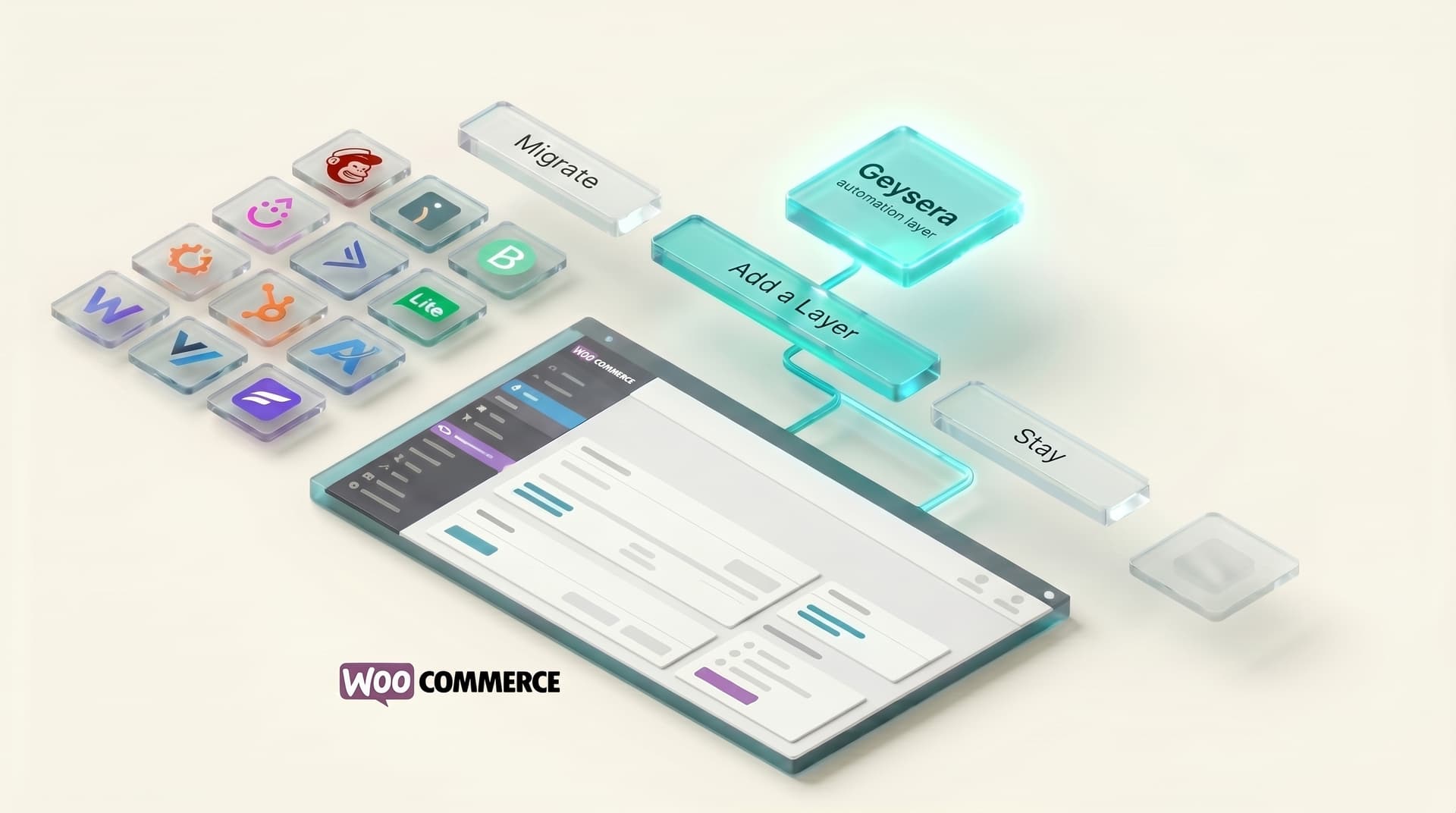
A Klaviyo alternative is any email marketing platform, or automation layer, that handles the cart, browse, post-purchase, and winback flows an ecommerce store needs without committing to Klaviyo's per-profile pricing model. The strongest 2026 alternatives split into three categories: ecommerce-first ESPs (Omnisend, Drip, Brevo), broader marketing platforms with WooCommerce integration (ActiveCampaign, HubSpot, Mailchimp, MailerLite), and WordPress-native plugins (AutomateWoo, FunnelKit, FluentCRM). A fourth option, which most evaluations miss entirely, is an automation layer that runs on top of your existing ESP.
Searches for "Klaviyo alternatives" grew 243% quarter-over-quarter in early 2026 (DataForSEO, May 2026). The driver is not feature parity. Klaviyo's flows are still mature. The driver is a 2025 billing change that quietly increased the bill for tens of thousands of ecommerce stores. Klaviyo now charges for all active profiles in your database, not just contacts you actively email, and existing customers received only a 25% price-increase cap during the transition. New customers got no cap at all.
This guide is the WooCommerce-specific shortlist, with 2026 pricing, integration depth, and a section most "Klaviyo alternatives" lists skip: the case for not migrating in the first place.
KEY STATS
- Searches for "klaviyo alternatives" grew 243% quarter-over-quarter in early 2026, with monthly volume of 320 and a $51.67 CPC (DataForSEO, May 2026)
- Klaviyo billing shifted in 2025 from "contacts emailed" to "all active profiles," capped at a 25% increase for existing customers but uncapped for new accounts (Sender, Mailsoftly, Omnisend pricing analyses, 2026)
- A 5,000-contact list on Omnisend costs roughly half what the same list costs on Klaviyo, per ecommerce email marketer Chase Dimond's 2026 platform guide (Dimond discloses that he is a paid Omnisend partner)
- Improperly executed ESP migrations cause a 22-38% drop in inbox placement during the first two weeks, and some programs never fully recover (Mailflow Authority 2026, MarTech 2026)
- Roughly 40% of ESP migrations fail before the first email sends, per the same Mailflow Authority analysis
- Klaviyo's WooCommerce extension still requires identified subscribers to fire flows, but 80-95% of paid Meta and Google traffic to a typical WC store never identifies, making those visitors invisible to any Klaviyo-style flow
- Data sourced from DataForSEO May 2026 keyword trend pulls, Mailflow Authority 2026 ESP migration analysis, MarTech 2026 lessons-learned series, Chase Dimond's 2026 ecommerce email guide, and 2026 pricing pages of the ten alternatives reviewed below
What's in this guide:
- Why "Klaviyo alternatives" is the wrong question for most WooCommerce stores
- What changed in 2026 — the pricing shift driving the search trend
- Criteria for evaluating a Klaviyo alternative on WooCommerce
- The 10 best Klaviyo alternatives for WooCommerce in 2026
- The third option: an automation layer on top of your existing ESP
- Decision framework: migrate, layer, or stay?
- Deliverability and migration risk you can't ignore
- Frequently asked questions
Why "Klaviyo alternatives" is the wrong question for most stores
Most stores searching for a Klaviyo alternative are not asking the question they actually need to answer. The visible question is "what should I move to." The real question, almost every time, is "what should I do about my flows and my bill."
Those two questions have different answers. A move from Klaviyo to Omnisend or Drip solves the bill problem and changes the flow architecture in the same step. A move from Klaviyo to AutomateWoo or FluentCRM ends per-contact pricing entirely, but it ties the entire email program to WordPress hooks. A move from Klaviyo to nothing, meaning you leave Klaviyo in place and add an automation layer that fires the flows it cannot, solves the bill problem only partly but avoids a migration entirely.
The mistake most evaluations make is treating "switch ESPs" as one decision. It is at least three decisions stacked. There is the cost decision, which is what the search trend is about. There is the flow-architecture decision, which is what mature ecommerce email is about. And there is the deliverability decision, which is what the migration risk is about. According to Mailflow Authority's 2026 analysis, roughly 40% of ESP migrations fail before the first email sends, and improperly executed migrations cause a 22-38% drop in inbox placement during the first two weeks. Some senders never fully recover their pre-migration inbox rates.
That changes the calculus on a "switch to a cheaper alternative" decision. The cheaper bill is only cheaper if the migration succeeds, if the new flows ship in a reasonable window, and if your sender reputation survives the cutover. None of those three are guaranteed.
The rest of this guide treats the shortlist seriously. These are the alternatives worth considering if migration is the right call. But it also names the option most evaluations skip: keeping the ESP you already have and adding a separate orchestration layer for the flows it does poorly. For broader context on the WooCommerce email landscape this decision sits inside, the WooCommerce email marketing 2026 stack guide covers the full architecture.
What changed in 2026 — the pricing shift driving the search trend
The 243% quarterly search lift in "klaviyo alternatives" is not a feature complaint. It is a pricing complaint. According to public ESP pricing analyses from Sender, Mailsoftly, and Omnisend, Klaviyo's billing model changed in 2025. Instead of charging based on contacts a store actively emailed, Klaviyo began charging for every active profile in the database. Stores with large dormant segments, accumulated over years of paid acquisition, saw their bills increase even when their actual send volume stayed flat.
Existing customers received a 25% increase cap during the transition window. New customers received no cap. Within two quarters, the search behavior shifted. Both "klaviyo pricing" and "klaviyo alternatives" climbed in volume; the alternatives query carried higher commercial intent and a higher CPC ($51.67 per the May 2026 DataForSEO pull). The market was actively shopping.
Chase Dimond, co-founder of the ecommerce agency Structured and, by his own disclosure, a paid Omnisend partner, summarized the new economics this way:
"Klaviyo prices by active profiles in your list. The curve gets steep fast. […] The hidden cost isn't the subscription; it's the operator. Brands running Klaviyo well are paying either a $70-120K in-house manager or a $3-10K/mo agency to operate the platform." — Chase Dimond, Co-founder, Structured (Chase Dimond — Klaviyo Guide 2026)
Two forces stacked together push mid-market WooCommerce stores to look elsewhere: uncapped per-profile pricing plus the operator cost that Klaviyo's complexity demands. The pricing curve is steep enough that a 25,000-contact list now runs roughly $400 per month on Klaviyo, a 20x increase from a 500-contact list. The contact-count pricing model is also not unique to Klaviyo. ActiveCampaign moved to billing for all contacts, including unsubscribed and bounced, in November 2025. But Klaviyo's combination of premium price point and DTC market concentration made it the lightning rod.
There is one other 2026 development worth naming. Klaviyo and Anthropic expanded their partnership to bring agentic marketing workflows into Claude, signaling that Klaviyo is investing aggressively in AI-driven personalization. For brands with the engineering capacity and budget to operate that, the value proposition holds. For everyone else, the question is whether the premium is buying capability that the store can actually use.
Criteria for evaluating a Klaviyo alternative
The right Klaviyo alternative depends on five things, not one. Most listicles compare on price alone and produce a ranking that is useless to anyone making the actual decision.
1. WooCommerce integration depth. A native, first-party WooCommerce integration that surfaces order data, customer lifetime value, product taxonomy, and stock state without sync delays is qualitatively different from a Zapier-bridged integration that polls every fifteen minutes. Mature ecommerce flows live or die on the freshness and richness of the WC data the ESP can see.
2. Ecommerce flow library. Cart abandonment, browse abandonment, post-purchase, winback, and the welcome series should all exist as first-class flows with WooCommerce-specific triggers, not generic email automations that require a developer to wire to WC events. Drip, Omnisend, and Klaviyo lead on this dimension. Mailchimp and Brevo are weaker. HubSpot's ecommerce flows are generic.
3. Pricing model. Per-active-profile (Klaviyo, ActiveCampaign as of Nov 2025), per-subscriber (Omnisend, Drip, Mailchimp), per-send-volume (Brevo), and flat-rate self-hosted (FluentCRM, AutomateWoo) all produce different bills at the same list size. A store with a large dormant list pays very differently across these models.
4. Deliverability and sender reputation portability. Switching ESPs forces a sender-reputation rebuild. Some ESPs handle the warmup well (Klaviyo, Drip, ActiveCampaign on shared IPs). Some are weaker (transactional-first platforms not designed for marketing send patterns). For broader detail on the 2026 deliverability environment, see the deliverability numbers behind whether your emails actually arrive.
5. Operator cost. Chase Dimond's framing matters: an ESP that requires a $70-120K in-house manager or a $3-10K/mo agency to operate is not cheap, no matter what the subscription says. A simpler platform that one generalist can run produces better outcomes for a smaller store than a sophisticated platform that nobody operates well.
The ten alternatives below are evaluated against all five.
The 10 best Klaviyo alternatives in 2026
| # | Alternative | Pricing model | Best fit | WC integration |
|---|---|---|---|---|
| 1 | Omnisend | Per-subscriber | DTC stores wanting Klaviyo-class flows at half the cost | Native, deep |
| 2 | Brevo (Sendinblue) | Per-send-volume | Stores with large dormant lists; budget-conscious | Plugin + API, solid |
| 3 | Drip | Per-subscriber | $1M-$50M ecommerce, RFM/behavior depth | Native, deep |
| 4 | ActiveCampaign | Per-contact | Stores needing CRM + email under one roof | Native, solid |
| 5 | Mailchimp | Per-subscriber | Sub-$500K GMV; ease of setup priority | Official plugin |
| 6 | MailerLite | Per-subscriber | Lean teams; visual editor priority | Plugin |
| 7 | HubSpot | Per-contact (tiered) | B2B/B2C hybrid stores, subscription DTC | Third-party plugins |
| 8 | AutomateWoo | Flat annual | WC-native stores avoiding per-contact pricing | Native (Automattic-owned) |
| 9 | FunnelKit Automations | Flat annual | WC stores prioritizing cart and funnel automation | Native, deep |
| 10 | FluentCRM | Flat annual | Self-hosted purists; unlimited contacts | Native (WordPress-resident) |
CITE: Across the ten alternatives, three pricing models dominate in 2026: per-subscriber/per-active-profile (Omnisend, Drip, Mailchimp, ActiveCampaign, Klaviyo, MailerLite, HubSpot), per-send-volume (Brevo), and flat-annual self-hosted (AutomateWoo, FunnelKit, FluentCRM). The flat-annual WordPress-resident plugins are the only ones that fully escape contact-count billing. Pricing data from each vendor's May 2026 pricing page and independent reviews from Sender, EmailToolTester, Omnisend, and Mailsoftly.
1. Omnisend — the ecommerce-first incumbent
Omnisend is the most directly comparable alternative to Klaviyo on WooCommerce. It was built ecommerce-first, its WC integration is native and deep (abandoned cart, welcome, browse abandonment, and post-purchase flows fire reliably out of the box), and its pricing is meaningfully lower at the contact tiers where Klaviyo's bill accelerates.
The free plan covers 250 contacts and 500 emails per month. The Standard plan starts at $16 per month for 500 contacts and 6,000 emails (Omnisend pricing page, May 2026). SMS was restructured on May 4, 2026: new Pro subscribers no longer receive bundled SMS credits and are billed $0.007 per message as a volume-based add-on.
For a 5,000-contact ecommerce list, Omnisend costs roughly half of Klaviyo per Chase Dimond's 2026 guide, while still bundling email, SMS, and web push under one quota rather than billing each separately. The flow library is genuinely competitive. It is not a Klaviyo clone, but it is close enough that most mid-market stores will not notice gaps for their first eighteen months. The native WC integration is the reason this is the default Klaviyo alternative in 2026.
2. Brevo (formerly Sendinblue) — the volume-based pricing alternative
Brevo's pricing model is the meaningful differentiator from every other entry on this list. Brevo charges by send volume, not by contact count. A WooCommerce store with a large dormant list (common for any store that has run paid acquisition for more than two years) pays based on what it actually sends rather than what it stores.
The free plan covers 300 emails per day with no contact-count limit (Brevo pricing page, 2026), which is unusual in the category. Paid plans start at $9 per month for 5,000 emails monthly on the Starter tier; the Business plan adds A/B testing, advanced segmentation, and removes Brevo branding. WooCommerce integration is via plugin and API, with abandoned cart, post-purchase, and welcome flows supported.
Brevo's gap is the ecommerce flow depth. It will not match Omnisend or Drip on out-of-the-box DTC sophistication. For stores whose primary pain is "my Klaviyo bill is climbing because I have 80,000 contacts I never email," Brevo is the right answer. For stores whose primary pain is "my flows are not converting," it is not.
3. Drip — the mid-market ecommerce specialist
Drip sits in the same ecommerce-first category as Omnisend but targets a higher-AOV, more sophisticated buyer. Pricing starts at $39 per month for 2,500 contacts and scales to $89 per month for 5,000 contacts and $154 per month for 10,000 contacts (Drip pricing page, 2026). The platform is best suited to ecommerce stores generating $1M-$50M in revenue with dedicated email operators, per multiple 2026 reviews.
Drip's WooCommerce integration pulls deep historical data and supports RFM (Recency, Frequency, Monetary) analysis out of the box. The platform auto-tracks conversions, customer lifetime value, and product purchases, then lets you tag and segment based on those signals. Independent reviewers rate Drip 7.7/10 to 8.1/10 for revenue attribution and behavioral automation.
Drip's gap is the same as its strength. It is built for stores that want depth. A 5K-list store with one generalist running email will not extract Drip's full value. Above 10K contacts with a dedicated operator, Drip competes head-to-head with Klaviyo on capability while sitting below it on per-contact cost.
4. ActiveCampaign — the CRM-plus-email play
ActiveCampaign is the strongest fit for WooCommerce stores that want their email automation and their CRM under one roof. The visual workflow builder is genuinely usable, and the platform connects natively to WooCommerce, Shopify, BigCommerce, and Magento. ActiveCampaign's tag-based segmentation system is more flexible than most ESPs for stores that need both ecommerce flows and sales-pipeline tracking.
Pricing is per-contact. At 2,500 contacts, the four tiers run $39, $95, $149, and $255 per month; at 5,000 contacts, they are $79, $145, $205, and $375 (ActiveCampaign pricing page, 2026). The Starter plan caps you at five automation actions per workflow, which is insufficient for a full abandoned cart sequence. The Plus plan is the realistic floor for ecommerce.
The 2026 caveat is meaningful. As of November 2025, new ActiveCampaign accounts are billed for all contacts including unsubscribed, bounced, and unconfirmed. The pricing structure that drove WC stores away from Klaviyo now applies here too, with no 25% cap. For new evaluations, factor the full database into the cost projection, not just the engaged contacts.
5. Mailchimp — the easiest setup, the shallowest automation
Mailchimp is included here because it remains the most-installed marketing-email integration on WooCommerce. StoreLeads' 2026 State of WooCommerce report puts the installation share at 225,139 stores, and it is what most stores are leaving when they search for a Klaviyo alternative. The Mailchimp for WooCommerce plugin is free, the setup takes under an hour, and the brand familiarity is unmatched.
The catch is that Intuit, Mailchimp's parent, positions the platform downmarket. Ecommerce automation in Mailchimp is intentionally shallow. Cart abandonment is template-driven rather than behavior-driven. Browse abandonment effectively does not exist. Winback is a generic segment-and-blast process. Pricing also scales fast above 2,000 contacts, where the per-subscriber rate climbs sharply.
For stores under $500K GMV that are running their first real ecommerce email program, Mailchimp is a reasonable starting point. For stores that have already tried Mailchimp and outgrown its automation depth, the better question is not whether to switch to Klaviyo but whether to add an automation layer that closes Mailchimp's gaps without forcing a migration. That option is covered below.
6. MailerLite — the lean-team option
MailerLite is the lowest-friction option on this list. Paid plans start at $10 per month for up to 500 subscribers with unlimited emails (MailerLite pricing page, 2026). The visual editor is widely regarded as the most accessible in the category, and the platform supports 130+ integrations including WordPress, WooCommerce, Shopify, Slack, and Google Analytics.
MailerLite's ecommerce tracking is limited to WooCommerce and Shopify, but the integration is competent. Abandoned cart, welcome, and basic post-purchase flows are supported. The automation depth sits below Omnisend or Drip. MailerLite is built for "good-enough" simplicity rather than DTC sophistication.
The right fit is a lean team or solo founder running email themselves, on a store under $1M GMV, who wants linear pricing and a visual editor that one person can master in an afternoon. For larger stores or those running serious paid acquisition, MailerLite ceiling caps below where the program needs to go.
7. HubSpot — the B2B/B2C hybrid play
HubSpot is rarely a primary recommendation for pure DTC WooCommerce, but it is the right answer for a specific cohort: B2B/B2C hybrid stores, subscription DTC, and brands that chose HubSpot for CRM-plus-marketing unification before they added a storefront. The strength is the unified contact database and the depth of B2B nurture workflows. The weakness is that HubSpot's ecommerce automation is generic and bolted-on rather than purpose-built.
The WooCommerce integration is community-maintained through MakeWebBetter, Outfunnel, and Unific, not a first-party HubSpot integration. Cart abandonment, browse abandonment, and post-purchase flows all require manual workflow construction; none ship as native ecommerce flows. Pricing is tiered (Marketing Hub Starter, Professional, Enterprise) with per-contact billing on top of the platform fee.
For the right cohort, HubSpot's unified data model is genuinely valuable. For everyone else, the operator cost and the third-party integration risk make this a difficult ESP to use as a primary ecommerce email tool.
8. AutomateWoo — the Automattic-owned WooCommerce plugin
AutomateWoo is the WooCommerce-native automation plugin owned by Automattic, the parent company that also maintains WooCommerce itself. The same-parent ownership matters: AutomateWoo accesses WC data directly without sync delays, the integration stability is among the highest in the category, and the long-term maintenance commitment is more credible than third-party plugins.
Rodolfo Melogli, who has worked with WooCommerce since 2011 and runs the Business Bloomer education site, made the case for WC-native tooling in a case study Metorik published about his stack:
"Metorik doesn't just plug into WooCommerce — it understands WooCommerce. That's the real magic." — Rodolfo Melogli, Founder, Business Bloomer (Metorik case study)
The same logic generalizes from analytics to automation. AutomateWoo, FunnelKit Automations, and FluentCRM are three plugins built natively on WordPress hooks. They see the cart, the customer, the product taxonomy, and the order history directly. A generic SaaS ESP routes the same data through a Zapier-style sync that adds latency, brittleness, and a layer of mapping that always drifts during product-catalog changes.
Pricing is a flat annual license, currently $99 per year for the core plugin, with no per-contact escalation. For a store with 50,000 dormant contacts, the unit economics flip dramatically against Klaviyo or Omnisend. The flow library covers cart abandonment, follow-up, review request, winback, and segmentation, all triggered on native WC events.
The gap is that AutomateWoo is a WordPress plugin, not a full ESP. It does not handle sender infrastructure, IP reputation, or deliverability at scale. Most stores running AutomateWoo route the actual send through SendGrid, Postmark, Amazon SES, or a similar transactional service. The architecture is "WordPress orchestrates, transactional service delivers." It works well at sub-100K send volumes. Above that, the sender-infrastructure piece needs more attention than most plugins can provide.
9. FunnelKit Automations — the WooCommerce funnel specialist
FunnelKit Automations (formerly WooFunnels) is the WC-native automation plugin that has gained the most ground against AutomateWoo since 2024. Like AutomateWoo, it runs inside WordPress, accesses WC data natively, and prices on a flat annual basis rather than per contact. The differentiator is automation depth around revenue-driving flows: cart abandonment, post-purchase upsells, and funnel-style multi-step sequences.
Pricing runs from $249 to $499 annually depending on tier (FunnelKit pricing page, 2026). The platform is opinionated about funnels (order bumps, one-click upsells, post-purchase offers) in a way that AutomateWoo is not. For stores running structured funnel commerce on WooCommerce, FunnelKit is the closest native equivalent to what Shopify stores get out of the box with PostScript, ReConvert, and similar plugins.
The same architectural caveat as AutomateWoo applies: FunnelKit handles orchestration; you still need a separate sender for marketing-volume delivery.
10. FluentCRM — the unlimited-contacts WordPress option
FluentCRM is the strongest 2026 entry in the "escape per-contact pricing entirely" category. It is a 100% self-hosted WordPress plugin that handles email marketing, automation, and basic CRM functionality, with a flat annual license and no contact ceiling. A store with 250,000 contacts pays the same FluentCRM license as a store with 2,500.
The trade-off is platform risk in a different direction. With Klaviyo or Drip, you are dependent on the vendor's continued health, pricing decisions, and uptime. With FluentCRM, you are dependent on your own WordPress hosting, your own deliverability infrastructure, and your own ability to maintain a self-hosted email program. Adrian Tobey, founder of Groundhogg (the WC-adjacent self-hosted CRM), made the case for the architecture in a 2024 Open Channels FM interview:
"I see not daily, but maybe once or twice a week, I'll see an SOS from someone who got kicked off of HubSpot or Kajabi or ActiveCampaign or for God knows what reason. […] Self-hosting prevents you from being put in that situation." — Adrian Tobey, Founder, Groundhogg (Open Channels FM, 2024)
The Groundhogg position is the maximal version of the self-hosted argument. FluentCRM is its more moderate sibling. For technically confident stores with engineering capacity, it is a credible Klaviyo alternative with completely different unit economics. For stores without engineering capacity, the operational burden quickly outweighs the per-contact savings.
The third option: an automation layer on top of your existing ESP
Every entry above assumes the decision is "which ESP do I switch to." That framing is incomplete. There is a third option that most "Klaviyo alternatives" lists do not name: keep the ESP you have and add a separate automation layer that handles the flows your ESP does poorly.
An automation layer is software that sits between your WooCommerce store and your ESP, orchestrates behavior-triggered flows (cart, browse, post-purchase, winback, visitor identification), and hands the send back to your ESP's existing infrastructure. The ESP continues to do what it does well: list management, IP reputation, sender authentication, deliverability. The layer adds the flows the ESP does poorly without forcing a migration.
For WooCommerce stores currently on Mailchimp, this means keeping Mailchimp as the sender and adding the cart, browse, and winback automation Mailchimp does not handle well. For stores on Klaviyo, the layer's wedge is visitor identification: Klaviyo only fires flows for identified subscribers, but 80-95% of paid Meta and Google traffic to a typical WC store never identifies, making those visitors invisible to any Klaviyo-style flow. For stores on HubSpot or SendGrid, the layer adds ecommerce-specific automation those platforms were never designed to handle, including post-purchase sequences that drive repeat revenue from existing customers.
Geysera was built around this pattern specifically because the standard advice, "migrate to Klaviyo," was leaving most WooCommerce stores worse off after the migration than before. We do not want to be your ESP. We do not want your sender reputation, your list, or your IP. We want your existing Mailchimp or Klaviyo or HubSpot or SendGrid stack to keep doing the parts it already does well, and we want to be the part that fires the right email at the right moment. That distinction sounds small. In practice it changes everything about the risk profile of upgrading your email program. — Bob Thordarson, Geysera CEO
The layer-on-top model does not replace the alternatives above. It changes the question. The question stops being "which ESP do I migrate to" and starts being "what am I trying to fix, and can I fix it without migrating at all."
Decision framework: migrate, layer, or stay?
For a WooCommerce store evaluating a Klaviyo alternative in 2026, the decision reduces to three questions in order.
Question 1: What is the actual problem?
If the problem is the bill (Klaviyo's per-active-profile pricing is climbing), the answer might be a migration to Brevo (volume-based), AutomateWoo (flat annual), or FluentCRM (flat annual, self-hosted). Or it might be aggressive list hygiene on Klaviyo to reduce the active-profile count without changing platforms.
If the problem is the flows (Klaviyo can do them but your team is not operating it well), a migration helps only if the new tool fits the team you have. Dimond's advice is to match the tool to the operator:
"If you're still running email yourself or with one generalist, stay on Omnisend — the complexity tax of Klaviyo isn't worth it until you have someone whose entire job is email." — Chase Dimond, Co-founder, Structured (Chase Dimond — Klaviyo Guide 2026)
If the problem is gaps (browse abandonment, anonymous visitor recovery, cross-flow orchestration that Klaviyo does not handle), the answer is often the layer-on-top option. The gaps are not about the ESP. They are about what fires the right email at the right moment.
Question 2: Can your deliverability survive the migration?
A 22-38% drop in inbox placement during weeks one and two of a migration is the documented industry pattern, not a worst case. For a store generating $50,000 per month in email-attributed revenue, a two-week 30% drop costs roughly $7,500 in lost sales. That is before counting the long tail of sender-reputation damage that some programs never fully recover from. If your program cannot absorb that, the migration is the wrong move regardless of the cheaper alternative.
Question 3: What is the operator capacity?
A migration is not a configuration project. It is a multi-week operator project that requires segment hygiene, sender-warmup discipline, flow rebuilding, and deliverability monitoring. If your team does not have someone whose actual job is email, the migration cost is invisible until it shows up as a 30% drop in revenue that nobody flagged.
The decision matrix is simple. If you have a clear problem, deliverability headroom, and operator capacity, migrate. The shortlist above is where to start. If you have the problem but not the headroom or capacity, add a layer instead of migrating. If your problem is fundamentally about flow operation rather than platform capability, neither migrating nor adding a layer will fix it. Hire or contract the operator first.
Deliverability and migration risk you can't ignore
The single most under-discussed risk in any "Klaviyo alternative" decision is what happens to your sender reputation during the cutover. According to Mailflow Authority's 2026 ESP migration analysis, corroborated by MarTech's 2026 lessons-learned series, the pattern of failed migrations is consistent: a store moves its full list to the new platform on day one, sends a campaign on day two, and watches inbox placement collapse 22-38% over the following two weeks.
The mechanics are not mysterious. Sender reputation is built over months at a specific IP and domain combination. A new ESP means a new IP pool, often a shared one with unknown other senders. Gmail, Yahoo, and Microsoft inbox placement systems treat the unfamiliar sender conservatively until the new IP earns trust. A migration that ignores warmup discipline (staged sends, most-engaged segments first, careful monitoring for complaint rates and bounces) pushes the new sender into the spam folder before the program ever stabilizes.
The 2024 Google and Yahoo bulk-sender requirements, expanded through 2025 and 2026, tightened the environment further. SPF, DKIM, and DMARC are non-negotiable. The complaint rate must stay below 0.3%. One-click unsubscribe must be in the email header. Bounce rate above 2% triggers permanent rejection from Gmail. The post-migration period is exactly when stores violate one or more of these thresholds, usually because they send to the largest possible segment immediately to "prove" the migration worked.
The implication for the Klaviyo alternatives evaluation is direct. The cheaper monthly bill on Brevo or AutomateWoo is only cheaper if your sender reputation survives the move. For an established WooCommerce store with a healthy Klaviyo program, the deliverability case for staying is often stronger than the cost case for leaving. For broader context on the 2026 sender environment, see the deliverability numbers behind whether your emails actually arrive and why open rates are no longer the durable engagement signal.
Frequently Asked Questions
What is the best Klaviyo alternative in 2026?
There is no single best alternative. Omnisend is the closest direct replacement for a typical DTC WC store, with native WooCommerce integration and roughly half of Klaviyo's per-contact cost at the 5,000-contact tier. Brevo wins for stores with large dormant lists because of its volume-based pricing. AutomateWoo and FluentCRM win for stores that want to escape per-contact pricing entirely.
Why is Klaviyo so expensive in 2026?
Klaviyo shifted in 2025 from billing based on contacts emailed to billing based on all active profiles in the database. A store with 100,000 total profiles but only emailing 30,000 actively now pays for all 100,000. Existing customers got a 25% increase cap during the transition. New customers got no cap. The cost curve is steep above 10,000 contacts, running roughly $175 per month for 10,000 contacts on email-only and $235 per month with SMS added per Chase Dimond's 2026 guide.
Is Omnisend really half the price of Klaviyo?
At the 5,000-contact tier, the gap is roughly that wide per multiple 2026 pricing analyses, including Chase Dimond's published comparison. Omnisend also bundles email, SMS, and web push under one quota rather than billing them separately, which widens the effective gap for stores running multi-channel flows. The exact ratio shifts at higher contact tiers; verify against current pricing pages before committing.
Can WooCommerce stores avoid per-contact email pricing entirely?
Yes, with two architectural choices. The first is WordPress-resident plugins like AutomateWoo, FunnelKit Automations, and FluentCRM, which price as flat annual licenses and have no contact ceilings. The trade-off is that these plugins do not handle sender infrastructure at scale, so you typically pair them with SendGrid, Amazon SES, or Postmark for delivery. The second is the layer-on-top model: keep your existing ESP for sends and add an automation layer for orchestration.
Should I migrate from Klaviyo to a cheaper alternative?
Maybe, but the standard advice underestimates the migration risk. ESP migrations cause a 22-38% drop in inbox placement during the first two weeks (Mailflow Authority 2026), and roughly 40% fail before the first email sends. For an established Klaviyo program, the deliverability case for staying is often stronger than the cost case for switching. The right question is whether your program can absorb a two-week revenue drop and whether your team has the operator capacity to run the cutover correctly.
What is an email automation layer and how is it different from a Klaviyo alternative?
An email automation layer is software that sits between your WooCommerce store and your existing ESP, orchestrates behavior-triggered flows (cart, browse, post-purchase, winback, visitor identification), and sends through the ESP's existing infrastructure. Unlike a Klaviyo alternative, the layer does not replace your ESP. It augments it. The architecture removes the migration risk because nothing about the existing sender reputation, IP, or list management changes during setup.
Does Klaviyo still handle WooCommerce well in 2026?
Yes, the Klaviyo WooCommerce extension is mature and the flow library is genuinely strong. The two real gaps are pricing (per-active-profile billing escalates fast) and visitor identification (Klaviyo cannot fire flows for the 80-95% of paid traffic that never identifies). Whether those gaps justify migrating depends on the store's specific economics. The alternatives above and the layer-on-top option both address one or both gaps without forcing a wholesale replacement.
How long does it take to switch from Klaviyo to an alternative?
A basic ESP migration is a 2-6 week project depending on flow complexity and list size. A complete migration including segment rebuilding, flow recreation, sender-warmup discipline, and post-migration monitoring runs 3-6 months for a mid-market WooCommerce store. Adding an automation layer on top of an existing ESP is typically 4-6 weeks and carries no sender-reputation risk because the existing sender stays in place.
Continue the Series
This is post two of The WooCommerce Automation Layer Series. The pillar establishes the playing field; this post handles the most-searched alternative question.
Reading next:
- Post 3: The Modern Ecommerce Email Stack: Why Two Tools Beat One — the conceptual companion to this post. Why the all-in-one ESP model is breaking and what the two-tool architecture looks like on WooCommerce.
- Post 4: WooCommerce + SendGrid in 2026: From Transactional-Only to Full-Funnel Without Migration — the first ESP-specific cohort post: how a WooCommerce store on SendGrid adds the marketing-automation layer (cart, browse, winback) without migrating.
- Post 5: WooCommerce + HubSpot in 2026: Closing the Ecommerce Automation Gap — the HubSpot cohort post: where the CRM's ecommerce automation falls short, and how to close the gap without leaving HubSpot.
- Post 6: Mailchimp for WooCommerce: Limits and What to Add Around It — the Mailchimp cohort post: the volume play, and what to add around the most-installed WooCommerce email integration.
- Post 7: Klaviyo for WooCommerce: The Visitor-ID Gap (and How to Close It) — the Klaviyo cohort post: keep Klaviyo's flows, and close the anonymous-visitor gap they cannot see.
Recently published in this series:
- WooCommerce Email Marketing 2026: The Complete Stack — the pillar post that establishes the four-ESP cohort map and the automation-layer model.
- Post 8: Mailchimp vs Klaviyo for WooCommerce in 2026 (and a Third Option: Keep Your ESP, Add a Layer) — the WooCommerce-specific head-to-head, where each tool wins, and the third option neither comparison guide mentions.
- Post 9: Top 10 WooCommerce Email Automation Tools in 2026 (ESP-Locked vs ESP-Agnostic) — the third-party tools ranked by ESP lock-in, and where an ESP-agnostic layer fits.
- Post 10: WooCommerce Email Notifications and Templates: The Complete 2026 Setup Guide — WooCommerce email setup and templates, plus the welcome series that converts first-time visitors.
- Post 11: WooCommerce Abandoned Cart Recovery: The 2026 Playbook — the recovery-rate playbook: the five levers that move recovered revenue, including the anonymous carts a plugin never sees.
Coming later in the series:
- WooCommerce + Mailchimp, WooCommerce + Klaviyo, WooCommerce + HubSpot, WooCommerce + SendGrid — one deep cohort post per ESP.
- WooCommerce abandoned cart, browse abandonment, post-purchase, and winback flows — one tactical post per flow.
Sources
- DataForSEO —
klaviyo alternativeskeyword trend data, May 2026 pull - Mailflow Authority — ESP Migration Playbook 2026
- MarTech — 10 Lessons From Real-World ESP Migrations
- Klaviyo Pricing 2026 — Sender Review
- Klaviyo Pricing 2026: Every Plan, Every Tier and What You Actually Pay — Retainful
- Klaviyo Pricing in 2026: Every Plan Explained — Omnisend
- Chase Dimond — What Is Klaviyo? A Complete Guide for Ecommerce Brands 2026
- Omnisend 2026 Pricing — Omnisend.com
- Brevo 2026 Pricing — Brevo.com
- Drip 2026 Pricing — Drip.com
- ActiveCampaign 2026 Pricing — ActiveCampaign.com
- MailerLite 2026 Pricing — MailerLite.com
- StoreLeads — 2026 State of WooCommerce Report (Mailchimp installation share, 225,139 stores)
- AutomateWoo — WooCommerce Marketplace
- FunnelKit Automations Pricing — FunnelKit.com
- FluentCRM — WordPress.org Plugin Directory
- Adrian Tobey on CRM Insights and the Future of WordPress — Open Channels FM, 2024
- Rodolfo Melogli — Business Bloomer Metorik case study
- Business Bloomer — WooCommerce: 8 Best Email Marketing Services (Rodolfo Melogli, 2019, updated 2020)
- Klaviyo (KVYO) Expands Anthropic Partnership to Bring Agentic Marketing Workflows to Claude (Yahoo Finance, 2026)
Want the Klaviyo-class cart, browse, and winback automation on your WooCommerce store without the per-active-profile bill or the migration risk? See how the Geysera automation layer works on your stack — Mailchimp, Klaviyo, HubSpot, or SendGrid, no migration required.

Co-Founder and CEO
Bob Thordarson is CEO and Co-Founder of Geysera, a serial entrepreneur with 25+ years and five co-founded ventures, including Cequint (acquired by TNS in 2010 for $112.5M) and Consumerware (acquired by ParkerVision). A graduate of the University of Washington and MIT Entrepreneurial Masters Program, based in Seattle, he serves on the boards of DRY Soda Co. and the Entrepreneurs' Organization Seattle chapter. He is an expert in retention marketing email systems and methodology for ecommerce and B2B brands — measured by incremental revenue, not vanity metrics.