The Modern Ecommerce Email Stack: Why Two Tools Beat One in 2026
The 2026 ecommerce email stack is two tools, not one. An ESP for sends and deliverability, plus an automation layer for identity, cross-channel orchestration, and the cart, browse, and post-purchase flows the ESP cannot see. This guide explains why the all-in-one model is breaking, what each layer does, and how the split-stack architecture maps to WooCommerce specifically.
This is post 3 of 17 in the WooCommerce Email Marketing in 2026 Series. Previous: Klaviyo Alternatives in 2026: 10 Options Compared (Plus the Layer-on-Top Option)
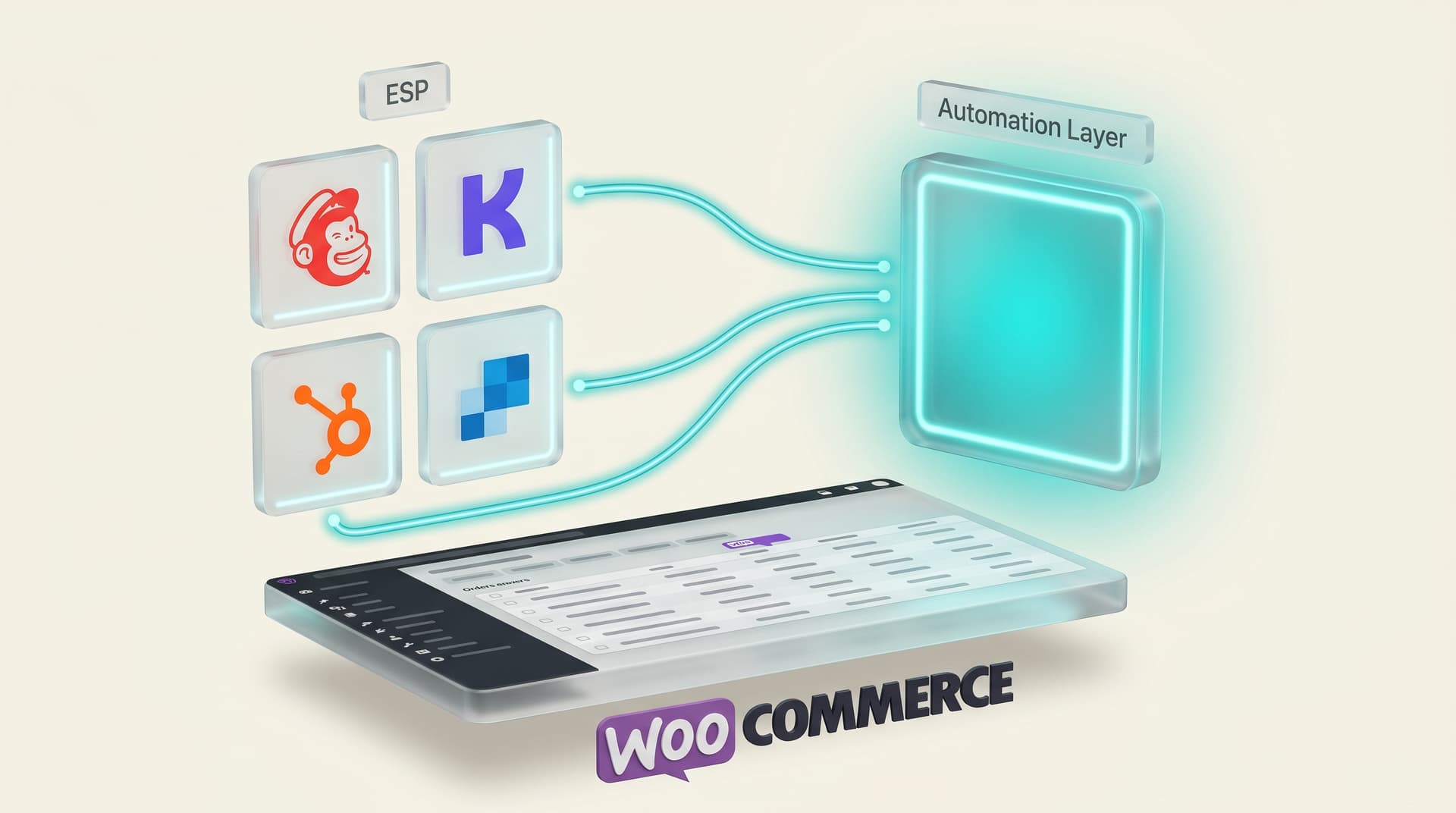
The modern ecommerce email stack is a two-tool architecture: an email service provider (ESP) that owns sends, deliverability, and the subscriber database, and an automation layer that owns identity resolution, cross-channel orchestration, and the cart, browse, and post-purchase flows that ESPs handle poorly. The two-tool model has replaced the all-in-one ESP that every 2010s playbook prescribed, because the all-in-one assumption no longer matches how ecommerce traffic, billing, and AI personalization actually work in 2026.
For ten years the default answer to "what email tool should I run on my WooCommerce store" was a single platform. Pick Klaviyo or Mailchimp or HubSpot or SendGrid, plug it into WooCommerce, run every flow, every campaign, every transactional message through one bill. The single-tool model was simple, well-documented, and good enough. The WooCommerce email marketing 2026 stack guide walks through the full landscape that single-tool assumption used to cover.
It is no longer good enough. Three forces broke the one-tool assumption in the last 24 months. Identity resolution opened a gap between paid acquisition spend and the email database. Per-active-profile pricing made the bill scale with the database instead of with usage. ESP migration risk became the most expensive single decision in any email program. The stack response has been the same response other parts of the marketing tooling stack already went through: split the all-in-one tool into a send layer and an orchestration layer, and let each one do the job it is actually good at.
This guide is the architectural argument for that split, with named tools, named gaps, and a WooCommerce-specific mapping at the end.
KEY STATS
- 80-95% of paid Meta and Google traffic to a typical WooCommerce store never identifies, which means ESPs only fire flows for the 5-20% of paid traffic that crosses the identity threshold (industry visitor-identification analyses, 2025-2026)
- Roughly 40% of ESP migrations fail before the first email sends, and improperly executed migrations cause a 22-38% drop in inbox placement during the first two weeks (Mailflow Authority 2026 ESP migration analysis)
- Klaviyo's 2025 billing change moved pricing from contacts emailed to all active profiles, with no cap for new accounts and a 25% increase cap for existing customers (Sender, Mailsoftly, Omnisend 2026 pricing analyses)
- The operator cost of running Klaviyo well is roughly $70-120K for an in-house manager or $3-10K per month for an outside agency, on top of the subscription (Chase Dimond, 2026 Klaviyo guide)
- Klaviyo and Anthropic expanded their partnership in May 2026 to bring agentic marketing workflows into Claude, signaling that even the dominant ecommerce ESP is layering AI capability on top of its core send infrastructure rather than absorbing it (Anthropic / Klaviyo joint announcement, May 2026)
- Searches for "klaviyo alternatives" grew 243% quarter-over-quarter in early 2026, with monthly volume of 320 and a $51.67 CPC (DataForSEO, May 2026)
- Data sourced from DataForSEO May 2026 keyword data, Mailflow Authority 2026 migration analysis, Sender / Mailsoftly / Omnisend pricing comparisons, Chase Dimond's 2026 ecommerce email guide, and the Anthropic / Klaviyo agentic commerce announcement
What's in this guide:
- What the modern ecommerce email stack actually is
- Why one-tool stacks are breaking in 2026
- The two-tool architecture in detail
- Five jobs that belong in the automation layer, not the ESP
- Real-world split-stack patterns running in 2026
- How the stack maps to WooCommerce specifically
- What this means for buyers right now
- Frequently asked questions
What the modern ecommerce email stack actually is
An ecommerce email stack is the set of tools a store uses to capture subscribers, decide what to send them, send it, measure what happened, and trigger the next thing. In the all-in-one era, one tool did all five jobs. In the modern stack, those jobs split into two roles.
The first role is the send layer. The send layer owns the subscriber database, the deliverability reputation, the IP warm-up, the unsubscribe handling, the bounce processing, the broadcast and campaign engine, and the regulatory layer (CAN-SPAM, GDPR consent records, suppression lists). The send layer is the part of the stack you cannot rebuild in a quarter without losing inbox placement and customer trust. It is also the part most ESPs do well. Klaviyo, Mailchimp, HubSpot, SendGrid, Brevo, MailerLite, ActiveCampaign, Omnisend, and Drip all ship reasonably good send infrastructure. Stores rarely move ESPs because the send layer broke.
The second role is the orchestration layer. The orchestration layer owns identity resolution (knowing which session belongs to which customer), behavioral triggers (an event on the WooCommerce store firing a flow), cross-channel sequencing (email + SMS + on-site message + push working as one campaign instead of four), AI-driven personalization at the recipient level, and the actual flow logic for cart abandonment, browse abandonment, post-purchase, and winback. The orchestration layer is where the revenue lift comes from. It is also the part most ESPs do least well.
The split is not new. Adtech split a decade ago into demand-side platforms and supply-side platforms. CRM split into transactional databases and reverse-ETL tooling. Analytics split into product analytics and business intelligence. The pattern is the same every time: the all-in-one tool tries to own both halves, falls behind on at least one, and a specialist enters the market with a better answer to the harder job.
In ecommerce email, the harder job is orchestration. The 2026 stack reflects that.
Why one-tool stacks are breaking in 2026
Three specific forces broke the one-tool assumption between 2024 and 2026. Each one independently weakens the case for the all-in-one ESP. Stacked together, they make the split-stack architecture the default for serious operators.
Force 1: The identity gap on paid acquisition
A WooCommerce store running $5K or more per month on Meta and Google ads has a structural identity problem. Roughly 80-95% of that paid traffic never identifies. No account creation, no email capture, no logged-in session, no first-party identifier the ESP can use to fire a flow. The ESP only sees the 5-20% who cross the identity threshold. The other 80-95% is invisible to every flow in the platform.
The ESP is not at fault. Cart abandonment flows, browse abandonment flows, and post-purchase sequences all depend on knowing who the visitor is. If the platform never receives an identifier, the flow has nothing to fire on. The identity gap is the structural reason ESPs underperform on cold paid traffic: the architecture assumes the visitor is already a known contact, and most paid visitors are not.
Closing that gap requires a separate identity-resolution layer that runs on the page, captures signals across sessions and devices, matches anonymous behavior to known contacts when they later identify, and feeds the resolved profile back to the ESP for flow triggering. According to industry visitor-identification analyses, stores that close this gap can move 30-50% more traffic into their addressable email program without changing their paid acquisition spend. That work does not belong inside an ESP. ESPs were built to send to known contacts, not to resolve identity on anonymous traffic.
Force 2: Per-active-profile pricing
Klaviyo's 2025 billing change moved the pricing model from "contacts you emailed" to "all active profiles in your database." Existing customers received a 25% increase cap during the transition. New customers received no cap at all. According to public ESP pricing analyses from Sender, Mailsoftly, and Omnisend, the change was not minor. Stores with large dormant segments accumulated from years of paid acquisition saw their Klaviyo bills increase even when their actual send volume stayed flat.
ActiveCampaign followed with a similar shift in November 2025, moving to per-contact billing that includes unsubscribed and bounced contacts. The signal is unambiguous. ESPs that own the subscriber database now charge for the privilege of holding that database, not for the work of sending to it. The full landscape of how the 2026 alternatives compare on pricing, integration depth, and migration risk is covered in Klaviyo alternatives for WooCommerce in 2026. The cost curve gets steep fast. A 25,000-contact list now runs roughly $400 per month on Klaviyo, a 20x increase from a 500-contact list of the same engagement profile.
The economic argument for the split stack follows directly. If the ESP charges per profile and the automation layer does not, the right move at scale is to keep the ESP smaller (active engaged contacts only, suppressed or pruned dormant segments) and run the more expensive identity, orchestration, and personalization work in a layer that bills on something other than profile count. Most stores never make this move because they have not separated the two jobs in their head. The ESP is the email tool, so the profile count gets dumped there by default. The 2026 stack treats the database as a thing to right-size, not a thing to maximize.
Force 3: Migration deliverability risk
The third force is the one most stores discover only when they try to switch. According to Mailflow Authority's 2026 ESP migration analysis, roughly 40% of ESP migrations fail before the first email sends. Improperly executed migrations cause a 22-38% inbox-placement drop during the first two weeks, and some senders never fully recover. The cost of getting it wrong is measured in weeks of suppressed revenue and months of rebuilding sender reputation.
That risk profile changes the calculus on switching. The cheaper bill at the new ESP is only cheaper if the migration succeeds, if the new flows ship in a reasonable window, and if sender reputation survives the cutover. None of those three are guaranteed, and the first one, basic migration completion, fails 40% of the time. The expected value of switching ESPs is much lower than the brochure price difference implies.
The split-stack architecture sidesteps the migration risk entirely. Adding an orchestration layer on top of the existing ESP changes the flow architecture without touching the send infrastructure. The IP reputation, the warmup state, the subscriber consent records, the suppression lists, all stay where they are. The orchestration layer changes what triggers when and across which channels, but it does not move the send.
For the broader 2026 deliverability environment underneath this argument, see the deliverability numbers behind whether your emails actually arrive in 2026. Migration is the single largest deliverability event most stores will ever cause for themselves.
The two-tool architecture in detail
The clearest way to see the modern stack is to list the responsibilities of each layer side by side. Most all-in-one ESPs claim both columns. In practice, they do the left column well and the right column unevenly.
| Responsibility | Send layer (ESP) | Orchestration layer |
|---|---|---|
| Subscriber database of record | ✅ Owns it | Reads, does not own |
| Deliverability and IP warmup | ✅ Owns it | Does not touch |
| Broadcast and campaign sends | ✅ Owns it | Triggers, does not send |
| Transactional sends | ✅ Owns it | Does not own |
| Unsubscribe / consent / suppression | ✅ Owns it | Respects, does not override |
| Identity resolution on anonymous traffic | Partial / weak | ✅ Owns it |
| Cross-channel sequencing (email + SMS + web + push) | Channel-by-channel inside the ESP | ✅ One orchestration brain |
| Behavioral triggers from WooCommerce events | Plugin-mediated, often delayed | ✅ Real-time, native |
| Cart, browse, post-purchase, winback flow logic | Built in but ESP-flavored | ✅ ESP-agnostic, WC-native |
| AI personalization at the recipient level | Emerging (Klaviyo + Anthropic, May 2026) | ✅ Designed for it |
| Database scale economics | Per active profile | Flat or per orchestrated event |
The modern ecommerce email stack splits responsibilities between two layers. The ESP owns the subscriber database, deliverability, and sends. The orchestration layer owns identity resolution, cross-channel sequencing, and the WooCommerce-native flow logic. Most all-in-one ESPs claim both columns, but the right column is where they consistently underperform, particularly on identity resolution for paid traffic and on cross-channel orchestration beyond email itself.
The most important row in the table is identity resolution. ESPs were built to send to known contacts. The 2026 ecommerce reality is that most paid traffic does not arrive as a known contact. Bridging that gap is not a configuration setting inside the ESP. It is a separate piece of architecture that has to run before the ESP can do its job on cold paid traffic.
The second-most-important row is cross-channel orchestration. Most ESPs ship some SMS capability, some push capability, some web personalization. None do all of them as a single sequenced campaign brain. A welcome series that has to fire email at hour 0, an SMS at hour 24 if the email did not open, a web personalization on next visit if neither converted, and a post-purchase nurture if a purchase happened: that is one campaign in the orchestration layer and four disconnected configurations across channel-specific ESPs.
Five jobs that belong in the automation layer, not the ESP
The architectural split sounds abstract until you list the specific jobs that move from the ESP into the orchestration layer. These are the jobs where ESPs underperform consistently enough that operators end up bolting on a second tool anyway, often without realizing they have built a split stack by accident.
1. Identity resolution on anonymous traffic. Capturing signals from anonymous sessions on the WooCommerce store, matching them to known contacts when those contacts later identify, and feeding resolved profiles back into the ESP for flow triggering. This is the single highest-leverage job in the stack, and almost no ESP handles it well because ESPs were not architected for unidentified traffic.
2. Cross-channel sequencing. Treating email, SMS, on-site message, and push as one campaign brain rather than four parallel tools. The orchestration layer decides what channel fires next based on what happened in the previous step, regardless of which channel that previous step lived in.
3. Behavioral triggers from on-site events. Cart abandonment, browse abandonment, viewed-product, added-to-wishlist, exit-intent, returning-visitor-with-items-in-cart. All of these are events on the WooCommerce store, not events inside the ESP. ESPs receive them via plugin sync (often delayed by minutes) or via webhook integration (often dropped on failure). The orchestration layer captures them directly on the page and fires in real time.
4. AI-driven personalization at the recipient level. Subject-line variation, send-time optimization, product recommendations, copy variation, all done per-recipient based on behavioral history rather than per-segment based on rules. Klaviyo's May 2026 expansion of its Anthropic partnership signals where the category is heading. The ESPs are layering AI on top of their send infrastructure precisely because the AI work does not belong inside the send infrastructure itself.
5. Post-purchase and winback timing logic. The hardest flow timing in ecommerce email is not the cart abandonment hour-2 send. It is the post-purchase sequence that has to coordinate with shipping events, with replenishment cycles, with category-specific consumption rhythms. That logic depends on order data, fulfillment data, and category metadata the ESP rarely sees in full. The orchestration layer reads the WooCommerce data model directly.
The pattern across all five is the same. Each job depends on data, timing, or cross-channel coordination the ESP either does not have or does not handle well. Each one is the kind of job that produces revenue lift when done right and produces nothing when done with the ESP's default configuration.
Real-world split-stack patterns running in 2026
The split-stack architecture is not theoretical. The pattern is already in production at thousands of mid-market and enterprise ecommerce stores, usually assembled piece by piece rather than designed as a unit. The most common patterns running on real stores in 2026 fall into four shapes.
Pattern A: ESP + SMS layer. The store runs Klaviyo or Omnisend for email and Postscript or Attentive for SMS. The SMS tool acts as a partial orchestration layer for the SMS-side of cross-channel flows, but identity resolution still lives mostly inside the ESP. This is the most common 2026 stack, and the most incomplete. It solves SMS-as-a-channel but leaves the identity gap and the orchestration gap unsolved.
Pattern B: ESP + on-site personalization tool. The store runs Mailchimp or Klaviyo for email and Privy, Justuno, or a similar tool for on-site popups, cart drawer messaging, and exit-intent. The on-site tool captures some anonymous behavior, but the integration back into the ESP is usually one-way and lossy.
Pattern C: ESP + full automation layer. The store runs its existing ESP (Mailchimp, Klaviyo, HubSpot, SendGrid) for sends and deliverability, and a dedicated automation layer for identity resolution, behavioral triggers, and cross-channel orchestration. This is the architecture this guide is describing, and the one Geysera is built around. The ESP keeps doing what it does well. The automation layer takes over the jobs ESPs do poorly.
Pattern D: Self-hosted CRM + transactional ESP. A smaller share of WooCommerce stores run a self-hosted WordPress-native CRM like Groundhogg or FluentCRM for orchestration and a transactional-only ESP like Amazon SES or Postmark for sends. Adrian Tobey, founder of Groundhogg, argued in a 2024 Open Channels FM interview that self-hosting protects stores from being kicked off SaaS platforms unexpectedly, something he says he sees once or twice a week. This is the most extreme version of the split-stack argument, and the version most resilient to ESP pricing or policy changes.
The common thread across all four patterns is the same architectural admission: one tool is not enough. The disagreements are about which second tool, and how much of the ESP's job to move into it. Pattern C is the version that requires the least disruption to an existing email program because the ESP keeps its current role unchanged.
How the stack maps to WooCommerce specifically
WooCommerce is the case where the split-stack argument is sharpest, because the WooCommerce data model is rich and the ESP integrations are uneven. A modern WC store carries orders, products, variations, stock levels, customer lifetime value, session data, cart contents, abandoned cart history, post-purchase sequence state, subscription state, refund history, fulfillment status, and tax metadata. Most of that data is not exposed to the ESP by the default integration.
According to public plugin documentation and integration testing through 2026, the major ESPs map to WooCommerce as follows:
| ESP | WC integration | What it sees well | What it misses |
|---|---|---|---|
| Klaviyo | Native WC plugin + Klaviyo Toolkit Plugin (Tribe Interactive) | Orders, products, customers, abandoned cart for identified contacts | Anonymous session behavior, cross-channel sequencing, real-time on-site events |
| Mailchimp | Official MC4WP / Mailchimp for WooCommerce plugin | Orders, basic product data, customers | Browse abandonment as native flow, advanced segmentation by LTV, real-time triggers |
| HubSpot | HubSpot for WooCommerce plugin | Contacts, deals, basic order data | Ecommerce-specific flow templates, deep product taxonomy, fast on-site triggers |
| SendGrid | Marketing Campaigns + WC custom integration | Transactional sends, basic broadcast lists | Behavioral triggers from WC events, ecommerce flow library, identity resolution |
| AutomateWoo | Native WP plugin (no external ESP) | Every WC event in real time | Send infrastructure at scale, deliverability tooling outside the host server, cross-channel beyond email |
| FunnelKit Automations | Native WP plugin (no external ESP) | Funnel and flow logic at WC level | Same gap as AutomateWoo on send infrastructure and cross-channel |
Across the major ESPs running on WooCommerce in 2026, the integration pattern is consistent. Klaviyo, Mailchimp, HubSpot, and SendGrid all see WC orders and customers but miss anonymous session behavior, real-time on-site events, and cross-channel sequencing. WC-native plugins like AutomateWoo and FunnelKit capture WC events in real time but lack the send-side infrastructure ESPs provide. The gap between the two columns is the role the automation layer fills.
The mapping makes the architecture argument concrete. The WooCommerce abandoned cart setup guide walks through one specific example of how this plays out on a single WC flow. No single tool in the WooCommerce ecosystem ships both the strong send-and-deliverability layer of a mature ESP and the strong WC-native identity-and-orchestration layer of a real automation tool. The all-in-one promise is unsatisfied at the tool level, not just at the architecture level. Stores that try to use Klaviyo or Mailchimp alone end up either limited on the orchestration side or operating with the identity gap unsolved. Stores that try to use AutomateWoo or FunnelKit alone end up limited on the send-and-deliverability side.
Every WooCommerce operator I have talked to in the last year describes the same problem in different words. They spend $5K, $20K, $100K a month driving paid traffic to their store. They have an ESP that they pay another four figures a month to operate. And when we walk through their flows together, 90% of their paid acquisition spend is hitting visitors the ESP cannot see, cannot fire on, and cannot follow up with. The gap between what they pay for paid traffic and what their ESP can actually do with it is the single largest line item I see in ecommerce email economics in 2026. The split stack exists because that gap exists. Closing the gap is not an ESP feature. It is a layer that runs in front of the ESP and tells it what to send and when. — Bob Thordarson, Geysera CEO
The agency view sharpens the same point. Patrick Garman, who owns and runs Mindsize, argued on the Open Channels FM payments and fulfillment episode that WooCommerce should separate orders, payments and fulfillments, because enterprise stores carry "a lot more red tape and process around everything they do." Enterprise-scale stores run specialized infrastructure at each layer because the cost of an under-built layer at scale is much higher than the cost of an extra integration. The split-stack pattern at the top of the WooCommerce market is the same pattern showing up at the mid-market, just driven by economics rather than scale.
The platform direction supports the architectural split as well. Beau Lebens, who leads WooCommerce at Automattic, laid out a design-forward, modernized platform when he took the role in January 2025, and in October 2025 he announced the first WooCommerce MCP for AI agents. On his Stripe Sessions 2026 panel on agentic commerce, he described partnering with specialized providers for the hardest transaction pieces. The platform is being built for specialized layers, not all-in-one tools.
What this means for buyers right now
The split-stack argument lands as three decisions for a WooCommerce store evaluating its email program in 2026. Each has a different risk profile and a different time horizon.
Decision 1: Migrate ESPs. Move from Klaviyo to Omnisend, or Mailchimp to Drip, or HubSpot to ActiveCampaign. Solves the bill if the new platform is cheaper, changes the flow architecture in the same step, accepts the 40% migration failure risk and the 22-38% inbox-placement risk during cutover. Right answer for some stores. Wrong answer for most. The full shortlist of when this is the right call is in Klaviyo alternatives for WooCommerce in 2026.
Decision 2: Add a layer. Keep the existing ESP. Add an automation layer that handles identity resolution, cross-channel orchestration, and the cart, browse, and post-purchase flow logic the ESP does poorly. Solves the orchestration gap without touching the send infrastructure. Avoids the migration risk entirely. The lowest-risk path for most mid-market WC stores. This is the pattern most of the rest of this series covers, by ESP cohort.
Decision 3: Stay. Do nothing. Acceptable if the store is sub-$500K GMV, has clean flows, has identified-contact-heavy traffic, and is not feeling the per-profile pricing curve. Not acceptable for stores spending $5K+ per month on paid acquisition with the identity gap unsolved. The gap compounds every month the spend continues.
The decision tree is simpler than most evaluation frameworks make it look. If the bill is the problem, evaluate migration carefully (Decision 1). If the flow architecture is the problem, the layer-on-top path is almost always cheaper, faster, and lower-risk (Decision 2). If neither is a problem yet but paid acquisition spend is climbing, the layer-on-top decision is the one that prevents the problem from getting more expensive next year.
For the broader cluster context, including the survey of all four major ESPs running on WooCommerce, the lifecycle flow architecture, and the AI-in-email forward-look, the WooCommerce email marketing 2026 pillar guide is the hub. Specific flows referenced above are covered in dedicated guides on the welcome series, abandoned cart recovery, and browse abandonment.
The next post in the series goes ESP-specific, starting with the SendGrid cohort: stores running SendGrid for transactional and asking what a full-funnel program looks like without migrating off the existing send infrastructure.
Frequently Asked Questions
What is an ecommerce email stack?
An ecommerce email stack is the set of tools a store uses to capture subscribers, decide what to send them, send it, and trigger the next thing based on what happened. The modern 2026 stack splits into two layers: an email service provider that owns sends and the subscriber database, and an automation layer that owns identity resolution, cross-channel sequencing, and the cart, browse, and post-purchase flow logic the ESP handles poorly.
Do I really need two tools instead of one?
For stores under $500K GMV with mostly identified contacts and low paid acquisition spend, one tool is often enough. For stores spending $5K or more per month on Meta and Google ads, the identity gap alone justifies the second tool. Roughly 80-95% of that paid traffic never identifies, so the ESP can only fire flows for the 5-20% that does. The automation layer captures the rest.
What does an automation layer do that my ESP cannot?
An automation layer owns five jobs ESPs underperform on: identity resolution for anonymous traffic, cross-channel sequencing across email and SMS and on-site message, real-time behavioral triggers from WooCommerce events, AI personalization at the recipient level, and post-purchase timing logic that reads the full WooCommerce order and fulfillment data model. ESPs were built to send to known contacts, not to resolve identity and orchestrate across channels.
Does the split stack work with Mailchimp, Klaviyo, HubSpot, and SendGrid?
Yes. The automation layer is designed to sit on top of whichever ESP is already running. Mailchimp keeps doing broadcasts. Klaviyo keeps doing flows for identified contacts. HubSpot keeps doing its CRM work. SendGrid keeps doing transactional sends. The automation layer handles the identity, orchestration, and cross-channel work each of those ESPs does poorly, and triggers sends through the ESP that already exists.
Doesn't adding a second tool add complexity instead of reducing it?
Slightly, yes, but the alternative is migrating ESPs entirely, which carries a 40% failure rate and a 22-38% inbox-placement drop during cutover according to Mailflow Authority 2026. Adding an orchestration layer keeps the existing send infrastructure unchanged. The integration surface is smaller than a migration, the deliverability risk is lower, and the time-to-first-improved-flow is weeks instead of quarters.
What does the split stack actually cost?
The math depends on the existing ESP bill. A store paying $400 per month for Klaviyo on a 25,000-contact list typically adds an orchestration layer in the $100-400 per month range, for a total stack cost in line with the all-in-one Klaviyo bill at a larger list size. The split stack also lets the store right-size the ESP database (suppress dormant segments) without losing the orchestration jobs those dormant contacts still need to be reached through other channels.
Where does AI fit into the modern stack?
AI-driven personalization at the recipient level lives in the orchestration layer, not the send layer. Klaviyo's May 2026 expansion of its partnership with Anthropic is the clearest signal. Even the dominant ecommerce ESP is layering AI work on top of its send infrastructure rather than absorbing it. The pattern matches the broader architectural split: send-and-database is one set of primitives, and AI orchestration is a separate set of primitives that runs on top.
Continue the Series
This is post 3 of 17 in the WooCommerce Email Marketing in 2026 series.
- Start with the pillar: WooCommerce email marketing 2026 — the complete stack
- Previous in series: Klaviyo alternatives for WooCommerce in 2026 — the complete shortlist
- Next in series: WooCommerce + SendGrid 2026 — from transactional to full-funnel without migration
If you want the WooCommerce-specific automation layer that sits on top of whichever ESP you already run, that is what Geysera is built for.
Sources
- DataForSEO —
klaviyo alternativeskeyword trend data andecommerce email stackvolume, May 2026 pull - Mailflow Authority 2026 ESP migration analysis — migration failure rates and inbox-placement impact
- Sender 2026 Klaviyo pricing analysis — per-active-profile billing breakdown
- Mailsoftly 2026 Klaviyo pricing comparison — billing model shift coverage
- Omnisend 2026 Klaviyo pricing analysis — competitive pricing comparison
- Chase Dimond — what is Klaviyo, complete guide for ecommerce brands 2026 — operator cost framing
- Anthropic / Klaviyo partnership announcement, May 2026 — agentic marketing workflows
- Beau Lebens — new leadership and the WooCommerce 2025 vision — platform direction
- Beau Lebens at Stripe Sessions 2026 on agentic commerce — composable platform direction
- Adrian Tobey on CRM insights and the future of WordPress — Open Channels FM, 2024 — self-hosted CRM and platform-risk argument
- Patrick Garman on Woo payments and fulfillment — Open Channels FM — WooCommerce order, payment and fulfillment architecture
- Groundhogg — Adrian Tobey's self-hosted WordPress CRM
- Mindsize — Patrick Garman's enterprise WooCommerce agency

Co-Founder and CEO
Bob Thordarson is CEO and Co-Founder of Geysera, a serial entrepreneur with 25+ years and five co-founded ventures, including Cequint (acquired by TNS in 2010 for $112.5M) and Consumerware (acquired by ParkerVision). A graduate of the University of Washington and MIT Entrepreneurial Masters Program, based in Seattle, he serves on the boards of DRY Soda Co. and the Entrepreneurs' Organization Seattle chapter. He is an expert in retention marketing email systems and methodology for ecommerce and B2B brands — measured by incremental revenue, not vanity metrics.