Ecommerce Email Marketing Strategy: From Zero to Revenue in 90 Days
Most ecommerce email strategies fail because they start with campaigns instead of flows.
This is post 10 of 12 in the Ecommerce Email Lifecycle Series. Previous: Re-Engagement Email Subject Lines & Examples.
An ecommerce email marketing strategy is a structured plan for building automated flows, campaigns, and segmentation that drive measurable revenue from a store's email list. This 90-day roadmap takes a new Shopify or WooCommerce store from zero email infrastructure to a fully operational system generating 15–25% of total revenue from email within three months.
Most email strategies fail before they start. The store owner signs up for Klaviyo, sends a few campaigns, sees modest results, and concludes that "email doesn't work for us." What they actually proved is that campaigns without flows don't work — which is true for everyone, not just them.
The brands that generate 25–40% of revenue from email didn't get there by sending more newsletters. They built a system: flows first, then campaigns, then segmentation, then optimization. In that order. This guide gives you the week-by-week plan.
Why Most Ecommerce Email Strategies Fail
Four mistakes account for the majority of failed email programs:
Starting with campaigns instead of flows. This is the most expensive error. A brand launches on Klaviyo, sends a welcome campaign and a few promotions, and measures the results. The numbers are underwhelming because campaigns generate just 2% of email revenue per send, while flows generate 37% from the same list (Klaviyo, 2024). Without flows running in the background, the majority of email revenue simply doesn't exist.
The second mistake is skipping segmentation. Sending the same email to your entire list means most subscribers get irrelevant content, which gets ignored, which hurts deliverability for everyone on the list. The damage compounds quickly.
Then there's the measurement problem. Open rates are unreliable since Apple MPP. Attributed revenue is inflated. Brands tracking opens and ESP-reported revenue think things are fine. Brands tracking revenue per recipient, repeat purchase rate, and incremental revenue know where they actually stand. The difference in clarity is enormous.
And the fourth: over-sending before the system is built. A store with no flows, no segmentation, and a 10K list sends four campaigns per week. Unsubscribes spike, deliverability drops, and the brand concludes email is broken. It wasn't — the approach was just backwards.
"Most of our clients are doing 20%, 25%, 30% of their revenue online from email." — Chase Dimond, Co-Founder, Structured Agency (Mayple)
Those numbers don't come from sending more campaigns. They come from building the lifecycle system first.
The 90-Day Ecommerce Email Roadmap
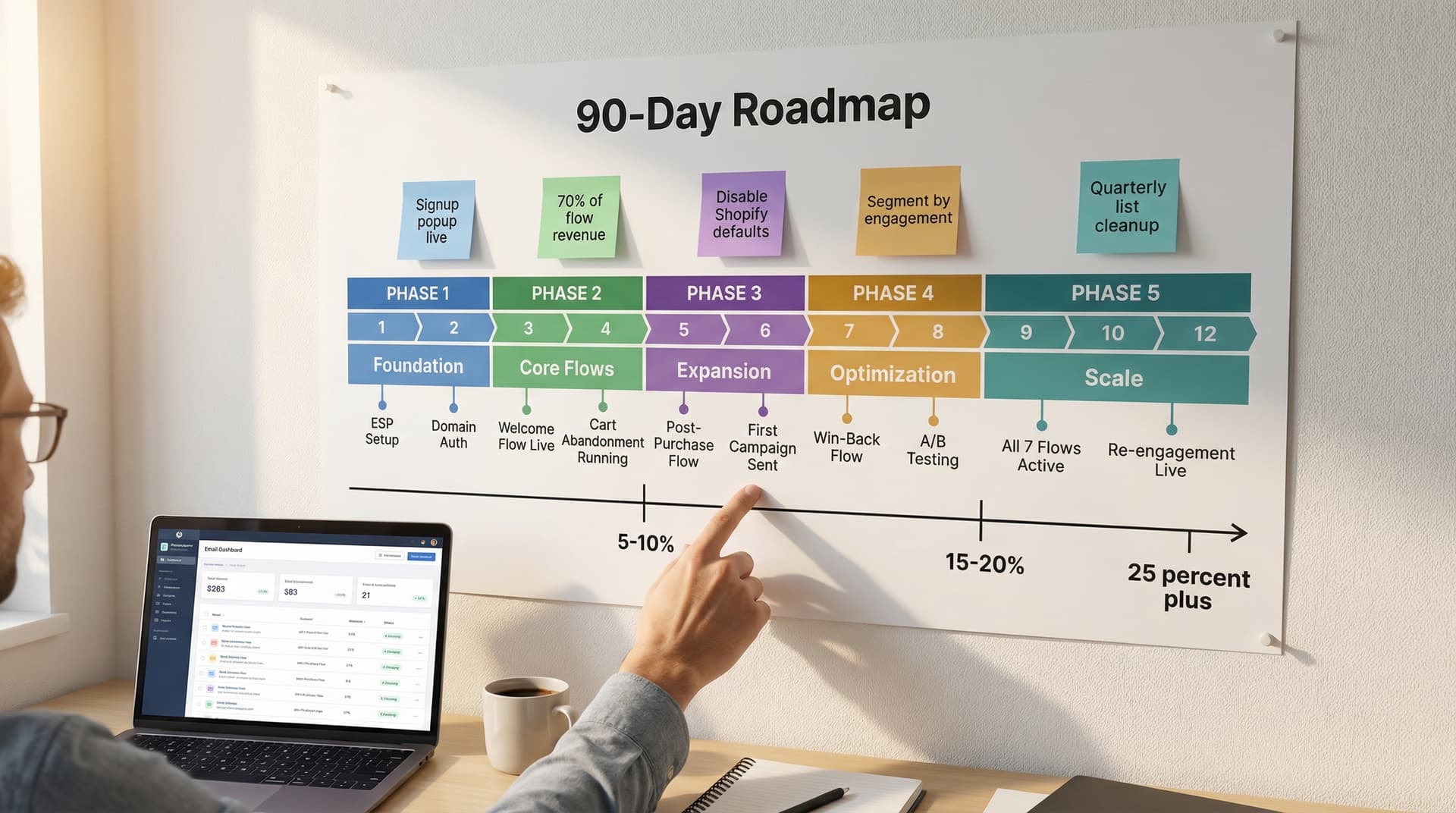
Weeks 1–2: Foundation
This is the infrastructure phase. Nothing sends yet. You're setting up the system that everything else will run on.
First, choose your ESP. For most Shopify stores, the decision is straightforward:
| Feature | Klaviyo | Omnisend | Mailchimp | Shopify Email |
|---|---|---|---|---|
| Best for | Scaling brands ($1M+) | Mid-market Shopify stores | Small stores, beginners | Very small stores |
| Flow builder | Advanced (conditional splits, A/B) | Good (visual builder) | Basic | Minimal |
| Shopify integration | Deep (real-time sync) | Strong | Moderate | Native |
| Segmentation | Strongest available (RFM, predictive) | Good | Limited | Basic |
| Pricing (10K contacts) | ~$150/mo | ~$115/mo | ~$100/mo | Free (basic) |
| SMS built-in | Yes | Yes | No | No |
If you're under $250K annual revenue with a small list, Shopify Email is fine for now. Between $250K and $1M, Omnisend gives you good automation at a reasonable price. Above $1M or when you need conditional splits and RFM segmentation, Klaviyo is the standard.
Then connect your ESP to Shopify or WooCommerce — this enables real-time data sync (purchase history, browsing behavior, cart events) which is what makes behavioral flows possible.
Domain authentication is next: SPF, DKIM, and DMARC records. Takes 15 minutes and tells ISPs that emails from your domain are legitimate. Skipping this step tanks your deliverability from day one.
If you have an existing list from a previous platform, import it — but don't import everyone. Remove bounces, spam complaints, and anyone who hasn't engaged in 6+ months. Starting with a clean list sets your sender reputation on solid ground.
Finally, get your signup form live. A popup with an incentive (10% off, free shipping, a content guide) is the baseline. Privy, whose pop-ups run on over 500,000 stores, is the usual starting tool; an offer or a gamified element like spin-to-win typically converts better than a plain form. Get the popup live in Week 1 so your list starts growing from the beginning.
Weeks 3–4: Core Flows
This is where revenue starts. Build the three highest-impact flows first — they capture roughly 70% of total flow revenue.
Welcome series (full guide): 3–5 emails over 7 days. Deliver the signup incentive, introduce the brand, show bestsellers, build social proof, create urgency on the expiring discount. Conditional split after Email 1 to exit purchasers into post-purchase.
Cart abandonment (full guide): 3 emails. Reminder at 30 minutes, objection handling at 24 hours, incentive (if margins support it) at 48 hours. Timing matters enormously — 30 minutes converts 3–5x better than 4 hours.
Browse abandonment (full guide): 2 emails. Reminder at 1–2 hours, social proof at 24 hours. Only triggers for identified subscribers (people whose email you already have).
By the end of Week 4, these three flows should be live and generating revenue. Don't optimize them yet — just get them running. You'll have data to optimize with by Week 7.
"If you're not optimizing your welcome experience, you're missing the easiest win in your program." — Jeanne Jennings, Founder, Email Optimization Shop (Email Optimization Shop)
Weeks 5–6: Revenue Expansion
With the core flows running, add the flows that drive retention and AOV.
Post-purchase flow (full guide): 5–7 emails spanning order confirmation through cross-sell recommendations. This is the flow that turns first-time buyers into repeat customers. Disable Shopify's default transactional emails and build branded versions in Klaviyo.
Cross-sell/upsell flow (full guide): Triggered 21–30 days after purchase. One complementary product recommendation per email. Dynamic product blocks from catalog data if your purchase history supports it.
First campaign. Now — and only now — send your first proper campaign. A product launch, a seasonal promotion, or a curated "staff picks" email. Send it to your engaged segment only (opened or clicked in last 30 days). This isn't about revenue yet — it's about establishing that you send campaigns in addition to flows.
Weeks 7–8: Optimization
You've been running core flows for a month. You have data. Now optimize.
Start by A/B testing subject lines on your highest-volume flows — welcome Email 1 and cart abandonment Email 1 are the two that move the most revenue. Run one test per flow at a time, minimum 500 recipients per variant before drawing conclusions.
Then review flow timing. Is your cart abandonment Email 1 at 30 minutes outperforming the industry default of 1 hour? Is your browse abandonment triggering too soon? Adjust based on your actual conversion data, not benchmarks.
This is also when to segment your campaign sends. Split by engagement level: engaged (clicked in last 30 days) gets your full campaign schedule, semi-engaged (opened in 30–90 days) gets a reduced schedule, and unengaged (no activity in 90+ days) gets no campaigns at all — they'll enter the re-engagement flow later.
Build the win-back flow during this phase too: 4 emails over 21 days for customers who haven't purchased in 60–120 days. This closes the lifecycle loop for lapsed buyers.
If you're considering SMS, Weeks 7–8 is the right time to add it. Don't layer SMS on top of a half-built email program — get flows running first, then add SMS to your highest-intent triggers (cart abandonment at 15 minutes, shipping notifications). Klaviyo and Omnisend both support SMS natively.
Weeks 9–12: Scale
By now you should have all seven flows running, a campaign calendar in place, and segmentation driving everything.
Build the re-engagement/sunset flow: 3 emails for subscribers who haven't clicked in 90+ days, followed by suppression for non-responders. This protects your deliverability for the entire list and reduces your ESP bill (Klaviyo charges by active profiles).
Establish a campaign calendar at 2–4 campaigns per month, segmented by engagement level. Mix promotional sends (product launches, sales) with content (educational guides, customer stories). Don't exceed what you can sustain consistently — erratic schedules confuse ISPs and subscribers. It's better to send two great campaigns per month than four mediocre ones.
Now that you have enough customer data, implement RFM segmentation. Your VIP segment (high frequency, high spend, recent purchase) gets early access and exclusive offers. Your at-risk segment (previously high frequency, declining recency) gets proactive outreach before they lapse far enough to enter win-back. This is where the data from the first 8 weeks starts paying off.
Set up monthly reporting that tracks revenue per recipient by flow, repeat purchase rate, click-through rate, list growth rate, and deliverability. Month-over-month comparison is how you find what's working and what needs attention going forward.
What to Measure at Each Stage
| Week | Key Metric | Benchmark | Why It Matters |
|---|---|---|---|
| 2 | Deliverability / inbox placement | 95%+ delivery rate | If emails aren't reaching inboxes, nothing else works |
| 4 | Flow revenue (total) | 5–10% of total store revenue | Confirms core flows are generating returns |
| 6 | Welcome series placed order rate | 8–15% | Validates signup → first purchase conversion |
| 8 | Repeat purchase rate | 20–25% (rising) | Post-purchase and cross-sell flows are driving retention |
| 10 | Campaign + flow revenue combined | 15–20% of total store revenue | The system is working as a whole |
| 12 | CLV by cohort | Higher than pre-email CLV | Proves email is building long-term customer value |
Don't panic if Month 1 numbers are modest. Email is a compounding channel — the flows build on each other, and customer data improves segmentation over time. Month 3 should show 15–25% of revenue from email. By Month 6 (with continued optimization), 25–40% is achievable.
Budget and Resource Planning
| Stage | ESP Cost | Time Investment | Total Monthly Cost |
|---|---|---|---|
| Weeks 1–4 (setup + core flows) | $0–$150/mo | 15–20 hrs/week | ESP + your time |
| Weeks 5–8 (expansion + optimization) | $50–$150/mo | 8–12 hrs/week | ESP + your time |
| Weeks 9–12 (scale) | $100–$300/mo | 5–8 hrs/week | ESP + your time |
| Ongoing (maintenance) | $100–$500/mo | 3–5 hrs/week | ESP + your time |
The initial buildout is front-loaded: Weeks 1–4 require the most time because you're building flows from scratch. After that, the system runs itself and your time shifts to optimization and campaigns.
"I think that you should try to get the first thousand customers without using paid methods." — Nik Sharma, CEO, Sharma Brands (Shopify)
Sharma's broader argument is that brands over-invest in paid acquisition and under-invest in the channels they own. Email delivers $36–$42 per dollar spent (Litmus, 2023), and unlike paid ads, the infrastructure you build (your list, your flows, your segmentation) keeps working after you stop actively spending on it. Ad spend disappears the moment you stop paying. A well-built email program keeps generating revenue indefinitely.
DIY vs agency vs managed service: If you're a founder or a small team, this 90-day plan is designed for DIY execution. It takes roughly 15–20 hours per week in Weeks 1–4 and drops to 3–5 hours per week for ongoing maintenance. If that time isn't available, an agency or managed service (like Geysera) can execute the full buildout in the same timeframe while you run the business.
There's a middle ground too: hire a freelance email specialist for specific pieces. A Klaviyo-certified freelancer can build your flow architecture in 2–3 weeks for $1,500–$3,000, then you maintain and optimize it yourself. A copywriter who specializes in ecommerce email can write your flow copy for $500–$1,500. This gets you professional-quality foundations without the ongoing agency fee.
Common Pitfalls
A few things that derail otherwise good email strategies:
Over-discounting erodes margin and trains customers to wait for sales. If your welcome flow offers 10%, your cart abandonment offers 15%, and your win-back offers 20%, you've created an escalation ladder that rewards inaction. Keep incentives consistent across flows and use free shipping or value-adds where possible instead of stacking percentage discounts.
Ignoring mobile costs you more than you think — 60%+ of ecommerce email opens happen on phones. Every email should be tested on a phone before it sends. And not cleaning your list kills deliverability silently. Run the re-engagement flow quarterly and suppress non-responders. Both of these are the kind of thing you know you should do but keep putting off. Don't.
Measuring attributed revenue instead of incremental leads to bad budget decisions. Your ESP will tell you email drove $X this month. The real contribution is lower, and that's the number you should use for investment decisions.
After 90 Days: What Comes Next
By Week 12, you have a working email program. Seven flows running, campaigns going out on a schedule, segmentation in place, metrics tracked monthly. Now what?
The next 90 days shift from building to optimizing.
Start with your first quarterly re-engagement cycle. Identify subscribers who haven't clicked in 90 days, send the 3-email re-engagement sequence, and suppress non-responders. Do this every quarter going forward — it's the single most important maintenance task for list health.
Then go deeper on A/B testing. You've tested subject lines by now. The next level is testing incentive types (free shipping vs percentage off in cart abandonment), flow timing (is 30 minutes still optimal, or has your audience shifted?), and email format (plain text vs designed for your win-back Email 1). Expand your segmentation beyond RFM too — build segments by product category interest, purchase frequency tier, and predicted CLV if Klaviyo's predictive analytics has enough data to power it. More precise segments mean more relevant emails and higher revenue per recipient.
The most important thing to do after 90 days is to prove the system works. Review your customer retention metrics — compare repeat purchase rate, time between purchases, and CLV for customers who entered your email program vs. those who didn't. That comparison is how you justify continued investment in email, and it's how you know the 90 days were worth it.
This 90-day plan works — but executing it while running a store is a different story. Geysera handles the full buildout: ESP setup, flow deployment, segmentation, and ongoing optimization. You get the results without the 15+ hours per week. See pricing and scope →
Frequently Asked Questions
How do I start email marketing for my ecommerce store?
Choose an ESP (Klaviyo for stores above $250K revenue, Omnisend or Shopify Email for smaller stores), connect it to your Shopify or WooCommerce store, authenticate your sending domain (SPF, DKIM, DMARC), and set up a signup popup. Then build your first three flows: welcome series, cart abandonment, and browse abandonment. These three capture 70% of flow revenue and should be live within your first month.
How long does it take to see revenue from email marketing?
Core flows (welcome, cart, browse) start generating revenue within the first week of going live, since they trigger on real-time customer actions. Expect 5–10% of total store revenue from email by end of Month 1, rising to 15–25% by Month 3 as you add post-purchase, cross-sell, and win-back flows. Full maturity (25–40%) typically takes 6 months of consistent optimization.
What's the best email marketing platform for Shopify?
Klaviyo for stores doing $500K+ in annual revenue — its deep Shopify integration, advanced segmentation, and flow builder justify the price. Omnisend for mid-market stores wanting good automation at a lower price point. Shopify Email for very small stores or brands just getting started who need basic welcome and cart flows at no extra cost.
How much revenue should email generate for an ecommerce store?
A well-optimized email program generates 25–40% of total store revenue. Brands with only basic flows (welcome + cart) typically see 10–15%. The gap is closed by building all seven lifecycle flows, segmenting campaign sends, and measuring by incremental revenue rather than attributed revenue.
What email flows should I set up first?
Welcome series, cart abandonment, and browse abandonment — in that order. These three capture roughly 70% of total flow revenue. After those are running, add post-purchase (Week 5–6), win-back (Week 7–8), cross-sell (Week 5–6), and re-engagement (Week 9–12). The full sequence is covered in the 7 essential flows guide.
How much does ecommerce email marketing cost?
ESP costs range from free (Shopify Email basic) to $150–$500/mo (Klaviyo at 10K–50K contacts). The bigger cost is time: 15–20 hours/week during the initial 4-week buildout, dropping to 3–5 hours/week for ongoing maintenance. Agency or managed-service alternatives typically cost $2,000–$5,000/mo but eliminate the time investment.
Should I hire an agency or do email marketing in-house?
If you have 15–20 hours per week available during the buildout phase and 3–5 hours per week ongoing, in-house execution of this 90-day plan is feasible. If that time isn't available (and for most founders, it isn't), an agency or managed service handles the buildout and ongoing optimization while you run the business. The key question: is your time worth more than the agency fee? For most stores above $500K revenue, the answer is yes.
Continue the Series
Previous: Re-Engagement Email Subject Lines & Examples
Next: Ecommerce Customer Retention: How Email Drives Repeat Revenue
Full series: Ecommerce Email Lifecycle Series
Sources
- Klaviyo: Ecommerce Email Marketing Benchmarks (2024)
- Chase Dimond / Mayple: Ecommerce Email Marketing Best Practices
- Jeanne Jennings / Email Optimization Shop: Welcome Emails Outperform
- Ben Jabbawy / Privy — Bold Commerce interview
- Nik Sharma / Shopify: Marketing Without Paid Methods
- Litmus: Email Marketing ROI (2023)

Co-Founder and CEO
Bob Thordarson is CEO and Co-Founder of Geysera, a serial entrepreneur with 25+ years and five co-founded ventures, including Cequint (acquired by TNS in 2010 for $112.5M) and Consumerware (acquired by ParkerVision). A graduate of the University of Washington and MIT Entrepreneurial Masters Program, based in Seattle, he serves on the boards of DRY Soda Co. and the Entrepreneurs' Organization Seattle chapter. He is an expert in retention marketing email systems and methodology for ecommerce and B2B brands — measured by incremental revenue, not vanity metrics.