Re-Engagement Email Subject Lines & Examples That Win Opens (2026)
50+ re-engagement subject lines sorted by strategy, 8 real-world email examples with teardowns.
This is post 9 of 12 in the Ecommerce Email Lifecycle Series. Previous: Re-Engagement Email Guide.
Re-engagement email examples and subject lines show proven approaches to winning back dormant subscribers who've stopped opening or clicking. The most effective re-engagement emails use curiosity-driven subject lines, value reminders, or direct "should we stop emailing?" asks — with top-performing subject lines achieving 20–30% open rates on audiences that had gone completely cold.
If you've read the re-engagement strategy guide, you know why this flow matters for deliverability, when to trigger it, and how to build it in Klaviyo. This post is the companion: the subject lines, the examples, the templates, and the testing framework. Everything you need to actually write the emails.
Why Subject Lines Are Everything in Re-Engagement
In most email flows, the subject line is important. In re-engagement, it's the entire game.
These subscribers haven't opened your emails in 90+ days. They've been scrolling past your name in their inbox for months. Whatever your previous subject lines were doing, it wasn't enough to get their attention. You need something that breaks the pattern — that makes them pause and think "wait, what's this?"
"If someone goes 30 days without opening your emails, 70% of those contacts will never open anything from you again." — Jay Schwedelson, CEO, Outcome Media; Founder, SubjectLine.com
Schwedelson puts the urgency plainly: "If someone goes 30 days without opening your emails, 70% of those contacts will never open anything from you again." By 90 days, the odds are worse. The subject line is your one shot to beat those odds. The body copy, the design, the CTA — none of it matters if the email doesn't get opened.
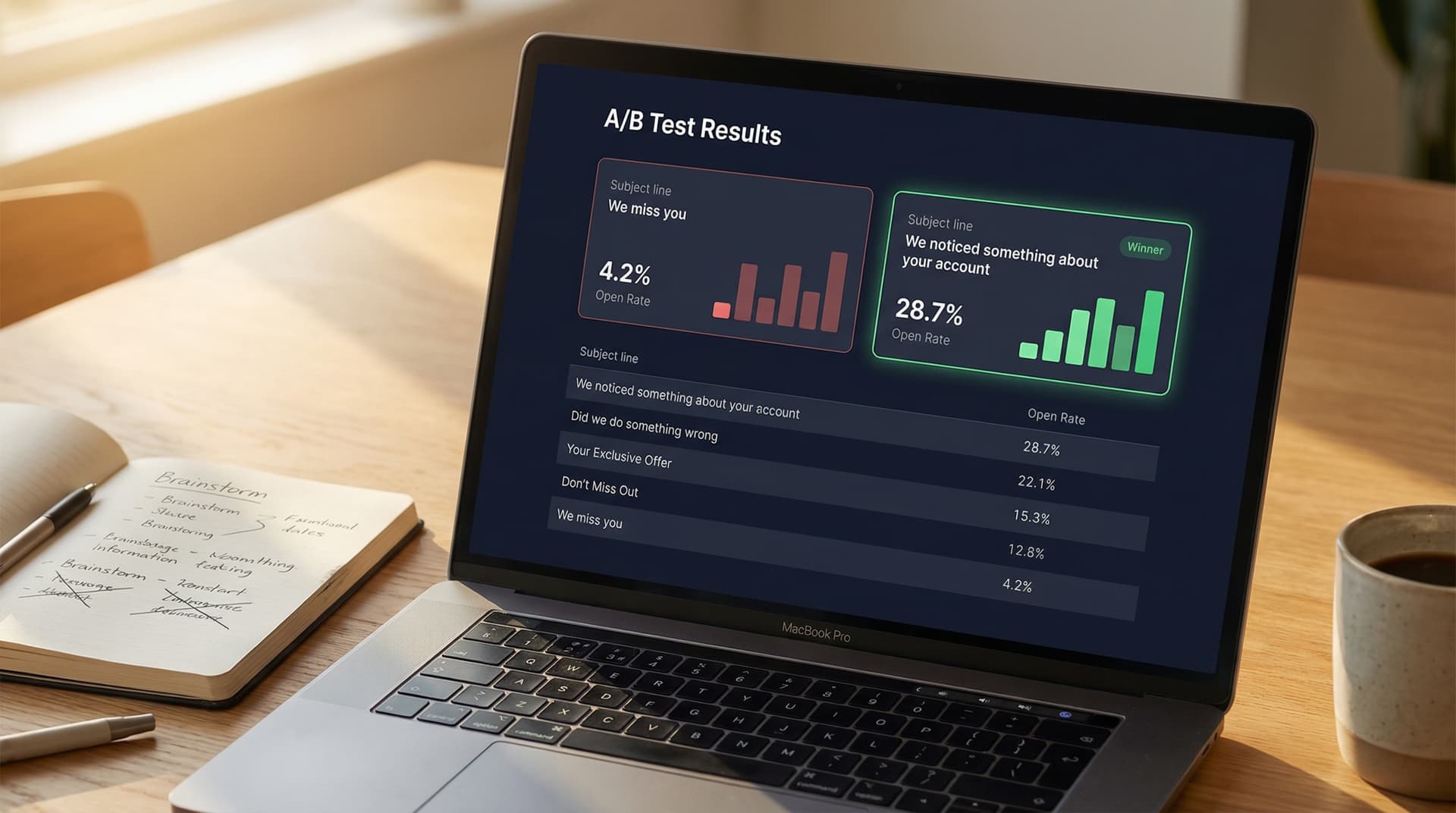
What works: curiosity, directness, and a little bit of discomfort. What doesn't work: "We miss you!" — because they've seen it before, from you and from every other brand that's ever tried to re-engage them. (If you're also building your win-back subject lines, the win-back examples post covers that — the strategies overlap but the audiences are different.)
50+ Re-Engagement Subject Lines by Strategy
Quick mapping — which category to use for which email:
| Sequence Position | Best Subject Line Categories |
|---|---|
| Email 1 (value reminder) | Curiosity, Value reminder |
| Email 2 (preference ask) | Value reminder, Humor |
| Email 3 (sunset warning) | Urgency, Direct ask |
Curiosity
Curiosity-driven subject lines outperform every other category for re-engagement because they create a reason to click that isn't guilt or obligation. In Jay Schwedelson's tests, subject lines that downplay urgency or importance lifted open rates by over 20%.
- We noticed something about your account
- Things have changed since you left
- [Name], something's different now
- Did we do something wrong?
- Oops — we might have messed up
- You haven't seen this yet
- There's something waiting for you, [Name]
- This might surprise you
- We need to tell you something
- A quick update on your account
Urgency
Urgency works best on Email 3 (the sunset warning) where there's a real consequence — you'll actually stop emailing them. Don't fake urgency on Emails 1 or 2; subscribers can tell, and it damages trust.
- Last chance to stay on our list, [Name]
- We're about to say goodbye
- Your subscription is about to change
- [Name], we're removing you in 7 days unless...
- This is our last email (unless you tell us otherwise)
- Final notice: your email preferences are changing
- We're cleaning our list — are you in or out?
- [Name], we need to hear from you by [date]
- Your access to [benefit] expires soon
- One click to stay. Otherwise, we'll say goodbye.
Value reminder
These remind the subscriber what they signed up for in the first place. They work best on Email 1 or 2 where you're trying to re-establish the value proposition before asking for a decision.
- Here's what you've missed this month, [Name]
- 3 things that happened while you were away
- Your favorites just got updated
- [Name], we launched something you'll want to see
- The best of [Brand] — what you missed
- new products since your last visit
- Your [category] picks have been refreshed
- What's trending on [Brand] right now
- [Name], our bestsellers just changed
- We've been busy — here's the highlight reel
Humor / personality
Humor in re-engagement is high-risk, high-reward. It can cut through where nothing else does, but only if it genuinely sounds like your brand. A forced joke in a re-engagement email feels desperate.
- Is your inbox too cool for us now?
- We get it, you're busy. But still.
- Did you ghost us, [Name]?
- This is starting to feel one-sided
- We're not mad, just disappointed 😅
- Remember us? We remember you.
- [Name], we're starting to worry
- Awkward question: are we boring you?
- Is it us? It's probably us.
- Plot twist: we have new stuff
Direct ask
Direct subject lines work best on Email 3 because they force a clear decision without trying to be clever. Some of the highest-performing re-engagement subject lines are also the simplest.
- Do you still want to hear from us?
- Should we stop emailing you, [Name]?
- Quick question — stay or go?
- [Name], one click to stay on our list
- We'd rather ask than assume
- Still interested? (No judgment either way)
- Keep getting emails, or we'll stop sending
- Your call, [Name]
- Yes or no: should we keep in touch?
- One question. Two options. Your call.
8 Re-Engagement Email Examples
Each example maps to a position in the 3-email sequence:
| Sequence Position | Best Example Approaches |
|---|---|
| Email 1 (value reminder) | Example 1 (product recs), Example 5 (content-led), Example 7 (account summary) |
| Email 2 (preference ask) | Example 3 (survey), Example 4 (incentive — use cautiously) |
| Email 3 (sunset warning) | Example 2 (opt-in/opt-out), Example 6 (minimalist text), Example 8 (final sunset) |
Example 1: Product recommendations for lapsed fashion subscribers
Subject line: "[Name], your style picks just got an update." Email shows a personalized grid of 4 new arrivals based on their previous browsing or purchase history. No mention of being inactive. No "we miss you." Just presents fresh products as if they're a normal subscriber — which reduces the awkwardness of re-engagement and lets the products do the talking. Works for fashion, beauty, and any brand with frequent new inventory.
Example 2: Clear opt-in/opt-out with two buttons
Subject line: "Should we keep emailing you, [Name]?" Minimal email with two prominent buttons: "Yes, keep me" and "No thanks." Nothing else — no products, no discount, no paragraph of copy. The simplicity is what makes it convert. Subscribers who are on the fence will click "yes" because it's easier than deciding whether to unsubscribe. Subscribers who are gone will click "no" or ignore it, and both outcomes are fine for your deliverability.
Example 3: Survey-based ("Help us send better emails")
Subject line: "Quick question — 30 seconds." One question: "What would make our emails better for you?" Three options: "Send less often," "Different products," "I'm not interested anymore." The survey framing makes this feel like the brand cares rather than the brand nagging. The click itself counts as engagement regardless of the answer, which resets the subscriber's ISP reputation. And the data you collect tells you whether the problem is frequency, relevance, or genuine disinterest.
Example 4: Incentive-driven ("Come back for 15% off")
Subject line: "[Name], here's 15% off — just for coming back." Discount code front and center with a countdown timer. Product grid of bestsellers below.
A word of caution: this approach works for one-time reactivation but can train subscribers to go inactive on purpose if they learn that silence produces discounts. Use it sparingly — for subscribers who've been inactive 120+ days where other approaches haven't worked. And as the re-engagement guide covers, discounts for subscribers who've never purchased have no proven ROI. This should only go to subscribers with a purchase history.
Example 5: Content-led ("Our top 5 posts you missed")
Subject line: "The 5 best things we published while you were away." Curated list of blog posts, guides, or videos with thumbnail images and one-line descriptions. No product pitch.
Kath Pay, author of Holistic Email Marketing and a 26-year veteran of the industry, argues that email is a "push channel… not a shove channel", meaning brands should push customer-centric value, not shove product pitches into inboxes. Content-led re-engagement emails embody that distinction. They work for brands with strong editorial programs (blogs, how-to guides, video series) because they re-establish value without asking for a purchase. If the subscriber lapsed because they felt over-sold, this approach addresses the actual problem instead of adding to it.
Example 6: Minimalist plain text ("Quick question")
Subject line: "Quick question, [Name]." Body is two sentences: "We noticed you haven't been opening our emails. Should we keep sending them, or would you rather we stop?" One link: "Keep emailing me."
Adam Kitchen of Magnet Monster puts deliverability first: "deliverability is paramount. Without optimising your sending infrastructure and sender reputation, your strategy counts for nothing as you'll never even reach the intended recipient." The minimalist text email embodies that philosophy — it prioritizes the deliverability signal (getting a click) over everything else. No design, no products, no distractions. Just a clear question and a clear response mechanism. These consistently outperform designed re-engagement emails for Email 3 because they feel personal.
Example 7: Account summary ("Here's what you're missing")
Subject line: "[Name], your account summary for [month]." Email shows: loyalty points balance (if applicable), items in saved/wishlist, new arrivals in categories they've browsed, and a personalized "your recommendations" block.
This approach works well for stores with customer accounts, wishlists, or loyalty programs. The "account summary" framing makes the email feel like a utility notification rather than a marketing message, which gets it opened by subscribers who've learned to ignore promotional emails. It's a Trojan horse re-engagement — the subscriber opens it to check their account status and re-engages in the process.
Example 8: Final sunset ("This is our last email")
Subject line: "This is our last email, [Name]." Body: "We've emailed you a few times and haven't heard back. We get it. Starting next week, we'll remove you from our regular email list. If you'd like to keep hearing from us, click below. No hard feelings either way." Single button: "Keep me on the list."
This is Email 3 in most re-engagement sequences, and it works because it's honest. The subscriber knows this brand has been emailing them. They know they haven't been opening. Being direct about the situation — "we noticed, and we're going to stop unless you tell us not to" — respects the subscriber's intelligence and forces the binary decision that the flow needs to work.
Re-Engagement Email Templates: 3-Email Sequence
These templates follow the sequence from the re-engagement guide. Adapt the tone to your brand.
Template 1: Value reminder (Day 0)
Subject: [Name], here's what's been happening
Preview text: A few things you might have missed.
Body:
Hi [Name],
It's been a while since you've clicked on one of our emails, so here's a quick catch-up:
[2–3 curated items: new products, popular content, or a "what's trending" roundup. Use strong product photography or content thumbnails.]
We'd love to have you back. No pressure — just wanted to make sure you knew what's new.
[CTA: "See what's new"]
Template 2: Preference ask (Day 3)
Subject: Too many emails? Let's fix that.
Preview text: Choose what you want to hear about (and how often).
Body:
Hi [Name],
We noticed you haven't been engaging with our emails lately. That's okay — maybe we're sending too much, or maybe the content isn't hitting right.
Here's what you can do:
[CTA button 1: "Update my preferences" → links to preference center] [CTA button 2: "I'm still interested — keep sending" → re-confirms opt-in]
Either way, we'd rather adjust than keep sending emails you don't want.
Note: This template uses two CTAs, which breaks the "one CTA per email" rule from earlier posts. It works here because both options serve the same goal — keeping the subscriber on terms they're comfortable with. The preference center and the "keep sending" button aren't competing actions; they're alternative paths to the same outcome.
Template 3: Sunset warning (Day 7)
Subject: Should we stop emailing you, [Name]?
Preview text: One click to stay. No hard feelings either way.
Body:
Hi [Name],
We've sent a few emails recently and haven't heard back. We don't want to clutter your inbox, so we're going to reduce our emails to you unless you tell us to keep going.
[CTA: "Yes, keep me on the list"]
If we don't hear from you in the next 7 days, we'll move you to our occasional updates list. You can always re-subscribe anytime.
After re-engagement: don't blast them immediately
One thing the re-engagement guide covers that's worth repeating here: subscribers who click "keep me on the list" should not immediately receive your full campaign schedule. Add them to a warming segment in Klaviyo that gets reduced sends for the next 30 days — maybe one campaign per week instead of three. A subscriber who barely re-engaged and then gets four promotional emails in the next seven days is going to go right back to ignoring you.
Subject Line A/B Testing for Re-Engagement
Testing subject lines in re-engagement is different from testing them in campaigns, because the metric that matters is different.
For campaigns, you optimize for clicks and conversions — the subject line gets people in the door, but the email content does the selling. For re-engagement, you optimize for opens. The open itself is the win. A subscriber who opens your re-engagement email has broken a 90-day streak of ignoring you. Whether they click through immediately matters less than the fact that they saw it and engaged.
That means your A/B test setup should measure open rate as the primary metric, not click rate. In Klaviyo, you can run A/B tests within flows by splitting traffic between two versions of the same email.
You need at least 500 recipients per variant for statistically meaningful results. If your inactive segment is smaller than 1,000, run the test across two quarterly cycles instead of splitting a single batch.
Start with curiosity vs. direct — these are the two highest-performing categories, and they represent fundamentally different philosophies. One tries to provoke an open through intrigue ("We noticed something about your account"), the other through honesty ("Do you still want to hear from us?"). Test them head-to-head over 1,000+ recipients and see which your audience responds to.
Once you have a winning approach, test personalization depth. Does adding the subscriber's name help? What about referencing their last purchased product or the specific number of days since they last engaged? "It's been 97 days since your last order, [Name]" is more specific than "It's been a while" — test whether that specificity moves the open rate. (Keep in mind Apple MPP inflates opens, so compare relative performance between variants rather than absolute numbers.) The same A/B framework works for cart abandonment subject lines if you're testing across flows.
One thing not worth testing: emojis on Email 3 (the sunset warning). Keep that email clean and direct. The decision point is too important for decorative optimization. Test emojis on Email 1 where the stakes are lower.
Subject lines get opens — but what happens after the open determines whether that subscriber stays active. Geysera designs re-engagement sequences that test subject lines against reactivation rates, not just opens. See how we measure what matters →
Frequently Asked Questions
What are the best re-engagement email subject lines?
Curiosity-driven subject lines ("We noticed something about your account," "Things have changed since you left") and direct asks ("Should we stop emailing you?") consistently outperform generic "we miss you" lines. Use the subscriber's name and reference specifics (last purchase, days inactive) for the strongest performance.
How do you write a re-engagement email?
Match the email's content to its position in the sequence. Email 1 reminds the subscriber what they're missing (new products, popular content). Email 2 asks about preferences or offers a survey. Email 3 is a direct sunset warning with a clear opt-in mechanism. Each email has one job and one CTA. The full 3-email sequence is in the re-engagement guide.
What's a good open rate for a re-engagement email?
20–30% is strong for re-engagement Email 1, given that these subscribers haven't opened anything in 90+ days. Email 3 (the sunset warning) often hits 15–25% because the subject line ("This is our last email") creates genuine urgency. Compare against your regular campaign open rates — re-engagement should be lower (the audience is colder) but higher than you'd expect for a completely disengaged segment.
How many re-engagement emails should I send before removing someone?
Three emails over 10 days. Email 1 (value reminder, day 0), Email 2 (preference ask, day 3), Email 3 (sunset warning, day 7). If the subscriber doesn't respond to any of the three, suppress them. Some brands run a quarterly single-email check ("Still want to hear from us?") for suppressed contacts as a last-resort reactivation attempt.
Should re-engagement emails include a discount?
Generally no. Re-engagement subscribers may have never purchased, so a discount has no proven return. Discounts also risk training subscribers to go inactive on purpose. Focus on value reminders, preference centers, and honest opt-in requests. Save discounts for win-back emails where the subscriber has a purchase history and the economics justify the incentive.
Continue the Series
Previous: Re-Engagement Email Guide
Next: Ecommerce Email Marketing Strategy: From Zero to Revenue in 90 Days
Full series: Ecommerce Email Lifecycle Series
Sources
- Jay Schwedelson's email tips, HubSpot recap
- Kath Pay: Holistic Email Marketing (Book)
- Magnet Monster: Email Marketing Deliverability Bible for Ecommerce Stores

Co-Founder and CEO
Bob Thordarson is CEO and Co-Founder of Geysera, a serial entrepreneur with 25+ years and five co-founded ventures, including Cequint (acquired by TNS in 2010 for $112.5M) and Consumerware (acquired by ParkerVision). A graduate of the University of Washington and MIT Entrepreneurial Masters Program, based in Seattle, he serves on the boards of DRY Soda Co. and the Entrepreneurs' Organization Seattle chapter. He is an expert in retention marketing email systems and methodology for ecommerce and B2B brands — measured by incremental revenue, not vanity metrics.