Ecommerce Customer Retention: How Email Drives Repeat Revenue
The average ecommerce store loses 70% of customers after their first purchase. Email is the most effective retention channel.
This is post 11 of 12 in the Ecommerce Email Lifecycle Series. Previous: Ecommerce Email Marketing Strategy: From Zero to Revenue in 90 Days.
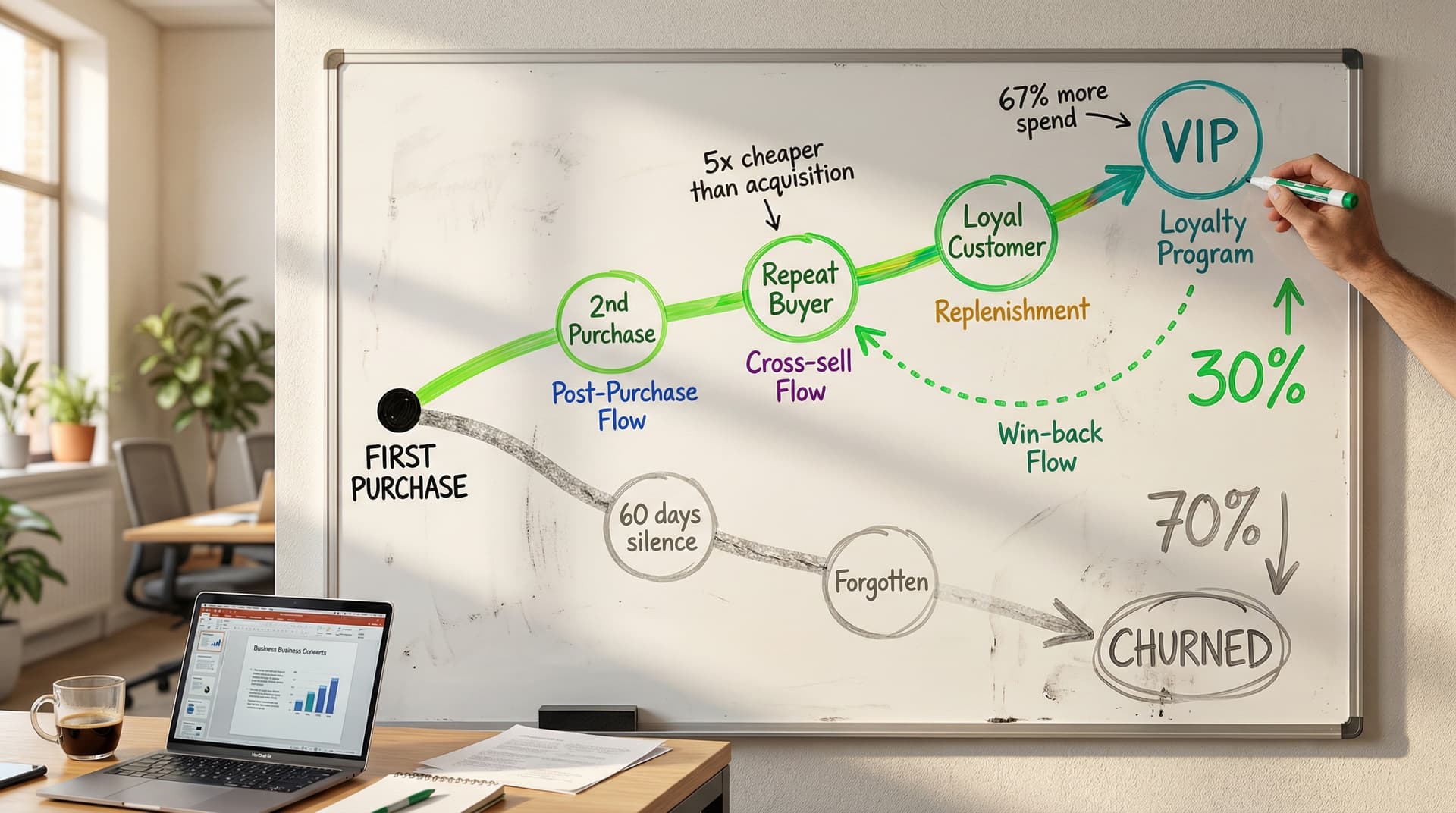
Ecommerce customer retention is the practice of turning first-time buyers into repeat customers through targeted email flows, loyalty programs, and personalized experiences. With an average ecommerce retention rate of just 30%, most stores lose 70% of customers after their first purchase — yet a 5% improvement in retention can increase profits by 25–95% (Harvard Business Review).
That 70% number should keep ecommerce founders up at night, because most of that churn is preventable with systems that already exist. The customer didn't leave because the product was bad. They left because nothing happened after the sale.
There was no follow-up, no check-in and no recommendation for what to buy next. The store spent $30–$50 to acquire that customer through paid ads, converted them into a buyer and then went completely silent, and two months later the customer has moved on while the store pays another $30–$50 to acquire someone new.
Email breaks that cycle when it works as a system that manages the relationship at every stage between first purchase and loyalty, rather than as a channel for more promotions.
The Economics of Customer Retention
The financial case for retention has been made a thousand times, but the numbers bear repeating because most ecommerce brands still allocate 80%+ of their marketing budget to acquisition.
Repeat customers spend 67% more than first-time buyers (Bain & Company, 2024), and acquiring a new customer costs 5–25x more than retaining one you already have (Harvard Business Review). The probability of converting an existing customer on any given offer is 60–70%, compared to 5–20% for someone who's never bought from you (Marketing Metrics). Every one of these numbers points in the same direction.
Here's what those numbers look like in practice. If you run an ecommerce store with 10,000 unique customers per year and a 30% retention rate, roughly 7,000 of them will never come back. At a $50 average acquisition cost, that's $350,000 in acquisition spend generating a single transaction per customer. The retention math isn't hypothetical — it's the difference between a business that scales and one that keeps buying the same customers over and over.
"A good ecommerce business will have 30 to 40 percent of its revenue coming from email." — Ezra Firestone, Founder, Smart Marketer (SmartMarketer.com)
Firestone's 30–40% benchmark is an email number, but the outcome it measures is repeat purchases, and the brands hitting it have built systems that keep customers buying rather than systems that only send emails.
Why Email Is the #1 Retention Channel
Every retention channel has trade-offs. Email has the fewest.
| Channel | Strengths | Weaknesses |
|---|---|---|
| Owned channel, rich content, deep automation, high ROI ($36–$42 per $1), works at scale | Requires list building, deliverability management | |
| SMS | High open rates (90%+), immediacy | Limited content, higher cost per message, smaller opt-in base |
| Push notifications | Real-time, no inbox competition | Requires app install, low opt-in rates |
| Loyalty programs | Incentivizes repeat behavior | Complex to build, can attract discount-seekers |
| Retargeting ads | Reaches non-subscribers | Rising costs, privacy restrictions, no ownership |
| Organic social | Brand building, community | Algorithm-dependent, low conversion rates |
Email wins for three reasons. First, it's an owned channel, so your list is always yours regardless of what Facebook does to its targeting or what Google does to cookies, and that stability matters more every year as paid channels get more expensive and less predictable.
Second, email is the only channel that can automate the entire customer lifecycle. No other channel runs seven behavioral flows simultaneously, each triggered by a specific customer action. SMS and push notifications supplement this, but email is the backbone that holds the system together.
And third, it's measurable in ways the other channels can't match, because revenue per recipient, repeat purchase rate and CLV by cohort let you prove email's retention impact with revenue data rather than engagement proxies.
The Retention Email Framework: 5 Stages
Retention takes more than one email. It's a system of flows that connects every stage between first purchase and loyalty (or churn). Each stage has a different goal and a different email approach.
Stage 1: Post-purchase nurture
This is where retention starts — or fails. The post-purchase flow covers everything from order confirmation through delivery follow-up, check-in, and review request. Its job is to make the customer glad they bought and confident in the product. A customer who feels taken care of after the sale is significantly more likely to buy again than one who gets a Shopify default receipt and then silence.
The post-purchase flow directly impacts repeat purchase rate, and stores with strong post-purchase sequences see 35–45% repeat rates vs. the 27% industry average. If you only build one retention flow, make it this one, because everything else in the retention system depends on a solid post-purchase experience as the foundation.
Stage 2: Cross-sell and upsell
Once the customer has used and (hopefully) loved their first product, the cross-sell flow introduces complementary products. "Customers who bought [X] also love [Y]" — timed 21–30 days after purchase, when the customer has formed an opinion about the product.
This stage increases average order value and purchase frequency simultaneously. A customer who buys moisturizer and then adds serum to their next order is both spending more and buying more often.
Stage 3: Replenishment reminders
For consumable products (supplements, skincare, food, coffee, pet supplies), the replenishment email is one of the highest-converting messages you can send. "Time for a refill?" arrives right before the product runs out, with a one-click reorder link.
Not every store needs this stage. Fashion brands, electronics stores and home goods sellers skip it because their products don't have a natural consumption cycle, but for brands whose products do, replenishment flows often have the highest RPR of any email in the program, because the customer already knows they need the product and you're making the reorder easy.
Stage 4: Loyalty and VIP treatment
This stage is a segmentation strategy more than a single email flow, in which your highest-value customers (top 10–20% by CLV or purchase frequency) get different treatment than everyone else.
What that looks like in practice depends on your brand. Some stores give VIPs early access to new products. Others offer exclusive discounts or invite top customers into a private community. A few have the founder personally email their top 50 customers. In Klaviyo, the execution side is straightforward: build a VIP segment based on RFM scoring or predictive CLV, then route those contacts to premium branches within your flows or separate VIP-only campaigns.
"At OLIPOP, we try to let customers lead the way. Customer experience for us is very intertwined with retention." — Eli Weiss, then Director of Customer Experience, OLIPOP (Ecommerce Fastlane)
Weiss's approach at OLIPOP, where the subscription program passed 6,000 subscribers in under a year, centered on making the customer feel heard rather than marketed to. The program pushed flavor exploration (the "forever flavor") and flexible subscription management, not automated discounts. The lesson for VIP treatment is that making customers feel like they matter does more for loyalty than points do.
Stage 5: Win-back before churn
The final retention stage catches customers who are slipping away. The win-back flow triggers when a customer hasn't purchased in 60–120 days (depending on your product cycle) and runs a 4-email escalation sequence: soft reminder, social proof, incentive, and final warning.
One more purchase is the smaller goal; the larger one is pulling the customer back into the active lifecycle before they cross into permanent churn. A customer who responds to a win-back email and buys again re-enters the post-purchase flow, and from there they're back in the cross-sell and replenishment cycle, so every reactivation feeds the next stage.
One flow that isn't in this 5-stage framework but protects all of it: re-engagement/sunset. Re-engagement targets dormant subscribers (not lapsed buyers — that's win-back's job) and removes inactive contacts who hurt your deliverability. If your deliverability degrades, every retention email in stages 1–5 becomes less effective because fewer emails reach the inbox, so treat re-engagement as the maintenance that keeps the retention system running.
Where SMS fits in
SMS works as a supplement at specific retention stages. Cart recovery at 15 minutes (before Email 1), shipping notifications (tracking links via text), and replenishment reminders are the three highest-value SMS touchpoints. Don't try to run the full retention framework over SMS, because the content limitations and higher per-message costs don't support it. Build email as the backbone, then add SMS to the touchpoints where immediacy matters most.
Retention Metrics That Matter
Five metrics tell you whether your retention program is working. Track them monthly and compare trends over time — the trajectory matters more than any single snapshot.
Customer retention rate is the percentage of customers who make at least one repeat purchase within a defined period (usually 12 months). Calculate it: ((Customers at end of period – New customers acquired during period) / Customers at start of period) × 100. Industry average for ecommerce is 30%. Goal: 40%+.
Repeat purchase rate measures the percentage of customers who've bought more than once, ever. This is simpler than retention rate and more immediately actionable. Pull it from Klaviyo or your Shopify analytics. If it's below 25%, your post-purchase and cross-sell flows need work.
Time between purchases tells you how long the average customer takes to come back. This metric directly informs your flow timing — when to trigger cross-sell, when to trigger replenishment, when to trigger win-back. If you don't know this number, you're guessing on all your flow timing.
Customer lifetime value (CLV) is the total revenue a customer generates over their entire relationship with your brand. Track it by cohort (customers acquired in January vs. February vs. March) to see whether your email program is increasing CLV over time. If January cohort CLV is $120 and June cohort CLV (after you built all 7 flows) is $180, that's your proof that the system works.
Revenue per email (RPR) measures how much each email generates per recipient. It's the most useful flow-level metric because it lets you compare performance across flows and identify which ones need optimization. Full RPR benchmarks here.
Segmentation Strategies for Retention
Retention email works best when it's personalized to the customer's stage, value, and behavior. That means segmentation.
RFM segmentation
"It's easy to get a customer once. It's hard to get a customer twice. And the better you can do that, the more successful your e-commerce business will be." — Ezra Firestone, Founder, Smart Marketer (Smart Marketer Podcast)
Drew Sanocki, the operator behind the Karmaloop turnaround, applies RFM analysis to ecommerce email. RFM creates segments based on three dimensions:
- Recency: How recently did the customer purchase? (Recent = higher value)
- Frequency: How often do they buy? (More frequent = higher value)
- Monetary: How much have they spent total? (Higher spend = higher value)
Combining these gives you actionable segments: VIPs (high on all three), at-risk customers (previously high frequency, declining recency), new customers (recent but low frequency), and lapsed customers (low recency regardless of historical frequency). Each segment gets a different email strategy.
In Klaviyo, you can build RFM segments using profile properties and predictive analytics. For Recency, use "Has placed order in last X days." For Frequency, use "Has placed order at least X times over all time." For Monetary, use "Total revenue is greater than $X." Combine these conditions into segments: VIP = placed order in last 30 days AND 3+ orders AND $300+ total revenue. At-risk = placed order in last 90 days AND 3+ orders AND no order in last 45 days (declining recency despite historical frequency). Klaviyo's higher-tier plans also offer a built-in Predicted CLV property that can simplify this further.
Engagement-based segments
Layer email engagement on top of purchase behavior. A customer who buys regularly but never opens your emails is different from one who opens every email and buys occasionally. Engagement segments determine campaign frequency:
- Highly engaged (clicked in last 14 days): full campaign schedule, first to see new products
- Engaged (clicked in last 30 days): standard campaign schedule
- Fading (last click 30–60 days ago): reduced schedule, more value-driven content
- Disengaged (no clicks in 60–90 days): approaching re-engagement trigger
Product-based segments
For stores with diverse catalogs, segment by purchase category. A customer who buys skincare wants skincare recommendations, not supplement suggestions. In Klaviyo, you can build these segments using "Has placed order where Items → Product Category equals [X]" conditions. Product-based segments make cross-sell flows dramatically more relevant — and relevant recommendations convert 2–3x better than generic ones.
At-risk identification
The most valuable retention segment is the one you build before customers churn. Using Klaviyo's predictive analytics (available on higher-tier plans), identify customers whose predicted CLV is declining or whose predicted churn risk is rising. Route these contacts to a proactive retention branch — a personal email, an exclusive offer, a "we noticed you haven't ordered lately" message — before they lapse far enough to trigger the automated win-back flow.
Retention Benchmarks by Ecommerce Vertical
What "good" looks like depends heavily on what you sell.
| Vertical | Avg. Retention Rate | Avg. Repeat Purchase Rate | Avg. Time Between Purchases | Key Retention Lever |
|---|---|---|---|---|
| Fashion/Apparel | 25–30% | 20–25% | 60–90 days | New arrivals, seasonal drops |
| Beauty/Skincare | 35–45% | 30–40% | 45–60 days | Replenishment, routine building |
| Supplements/Health | 40–50% | 35–50% | 30–45 days | Subscription, auto-refill |
| Electronics | 15–20% | 10–15% | 120–180 days | Accessories, upgrades |
| Food/Beverage | 35–45% | 30–45% | 21–30 days | Subscription, variety packs |
| Home Goods | 20–25% | 15–20% | 90–120 days | Room-by-room cross-sell |
A few patterns worth noting. Consumable categories (supplements, food, skincare) have the highest retention rates because the product creates a natural reorder cycle. Fashion has moderate retention but is highly dependent on new arrivals — brands with frequent drops retain better than those with static catalogs. Electronics has the lowest retention because the product lasts for years, which means cross-sell (accessories, upgrades) matters more than replenishment.
If your retention rate is 10+ points below your vertical's average, the gap is usually in your post-purchase and cross-sell flows, not in your product. For additional industry-level email performance data, see our 2026 email marketing benchmarks by industry.
Building a Retention-First Email Program
Most ecommerce email programs are acquisition-first, focusing on campaigns to drive new purchases and treating flows as an afterthought, and a retention-first program flips the priority.
The shift looks like this: instead of spending 80% of your email team's time writing campaigns and 20% on flows, move to 60% flows and 40% campaigns, so the flows drive retention automatically while the campaigns supplement with timely promotions and brand building.
Budget allocation follows the same principle. If you're spending $5,000/mo on paid acquisition and $500/mo on your ESP, the ratio is off. A well-built retention system generates more revenue per dollar spent than any paid channel. Increasing email investment from $500 to $1,500/mo (upgrading your ESP plan, hiring a specialist to optimize flows, adding SMS) typically produces 3–5x the incremental revenue of the same $1,000 added to paid ads.
Team structure matters too. In acquisition-first organizations, the email person typically sits on the marketing team and spends most of their time writing campaigns. In a retention-first organization, email is a retention function. The person who owns flows (the automated retention system) should have authority to change flow logic, adjust timing, and run tests without needing campaign-cycle approval. Some brands split the role: one person owns flows (the system), another owns campaigns (the moments). At smaller stores, it's the same person — but the priority allocation should still favor flows over campaigns.
To calculate whether the retention investment is working, track this simple equation quarterly: retention email revenue (total revenue from all flows + campaigns to existing customers) minus email costs (ESP fees + time/agency costs) = retention email ROI. Compare this against your customer acquisition cost for the same period. If you're spending $5,000/mo on email and generating $50,000 in retention revenue, that's a 10:1 return. If your paid acquisition is running at 3:1, the argument for shifting budget toward retention writes itself.
The 90-day strategy roadmap covers the full buildout plan. If you're reading this post first, start there for the week-by-week execution guide.
Retention isn't one email flow — it's the system connecting post-purchase, cross-sell, win-back, and re-engagement into a single revenue engine. Geysera builds and manages that system, measured by repeat purchase rate and CLV growth. See the retention system →
Frequently Asked Questions
What is a good customer retention rate for ecommerce?
The industry average is approximately 30%, meaning 70% of customers never make a second purchase. "Good" depends on your vertical: supplements and food brands should target 40–50%, beauty/skincare 35–45%, fashion 25–30%, electronics 15–20%. If you're more than 10 points below your vertical average, focus on your post-purchase and cross-sell flows first.
How do you calculate ecommerce customer retention rate?
((Customers at end of period – New customers acquired during period) / Customers at start of period) × 100. Use a 12-month window. Example: you started January with 5,000 customers, acquired 3,000 new ones during the year, and ended December with 6,500. Retention rate = ((6,500 – 3,000) / 5,000) × 100 = 70%. That's excellent — most ecommerce stores are closer to 30%.
What's the best way to retain ecommerce customers?
Build the 5-stage retention email system: post-purchase nurture, cross-sell/upsell, replenishment reminders (for consumables), loyalty/VIP treatment, and win-back before churn. Each stage catches customers at a different point in the lifecycle. The stores with the highest retention rates run all five stages as automated flows, not manual campaigns.
Why is customer retention more profitable than acquisition?
Repeat customers spend 67% more than first-time buyers and cost a fraction of what new customers cost to acquire (5–25x less). But the real advantage is compounding: a second purchase makes a third more likely, which makes a fourth more likely, which eventually produces advocacy. You pay the acquisition cost once. The retention revenue keeps building.
What email flows drive the most customer retention?
Post-purchase (the foundation — turns one-time buyers into repeat customers), cross-sell (increases AOV and frequency), replenishment (highest conversion rate for consumables), and win-back (recovers lapsing customers before they churn). The 7 essential flows guide covers how all seven flows connect.
What is RFM segmentation and how does it help retention?
RFM segments customers by Recency (when they last purchased), Frequency (how often they buy), and Monetary value (how much they spend). It creates actionable groups: VIPs, at-risk customers, new buyers, and lapsed customers. Each segment gets a different email strategy — VIPs get exclusive access, at-risk customers get proactive outreach, new buyers get onboarding, lapsed customers get win-back. The result is more relevant emails and higher retention across every segment.
How does email compare to other retention channels?
Email delivers the highest ROI ($36–$42 per dollar spent) with the most automation capability. SMS has higher open rates but a smaller audience and higher per-message cost. Loyalty programs incentivize repeat behavior but are complex to build. Retargeting ads reach non-subscribers but face rising costs and privacy restrictions. Most stores should build email as the retention backbone and layer SMS and loyalty on top once the email system is mature.
Continue the Series
Previous: Ecommerce Email Marketing Strategy: From Zero to Revenue in 90 Days
Next: Cross-Sell & Upsell Emails: How to Increase AOV After the First Purchase
Full series: Ecommerce Email Lifecycle Series
Sources
- Harvard Business Review: The Value of Keeping the Right Customers
- Bain & Company: Prescription for Cutting Costs (Repeat Customer Economics)
- Marketing Metrics: Selling to Existing vs. New Customers
- Ezra Firestone, Smart Marketer: Ezra Firestone's Secret to E-Commerce Success
- Eli Weiss, Ecommerce Fastlane: OLIPOP's Best-in-Class Customer Retention Strategy
- Drew Sanocki, Drop Dead Copy Podcast: Advanced Ecommerce Email Marketing

Co-Founder and CEO
Bob Thordarson is CEO and Co-Founder of Geysera, a serial entrepreneur with 25+ years and five co-founded ventures, including Cequint (acquired by TNS in 2010 for $112.5M) and Consumerware (acquired by ParkerVision). A graduate of the University of Washington and MIT Entrepreneurial Masters Program, based in Seattle, he serves on the boards of DRY Soda Co. and the Entrepreneurs' Organization Seattle chapter. He is an expert in retention marketing email systems and methodology for ecommerce and B2B brands — measured by incremental revenue, not vanity metrics.