Ecommerce Email Marketing: The Complete Strategy Guide for 2026
Most ecommerce brands run a welcome email and a cart flow they built years ago, then stop. Here's the complete system — flows, metrics, and the mistakes costing you the most.
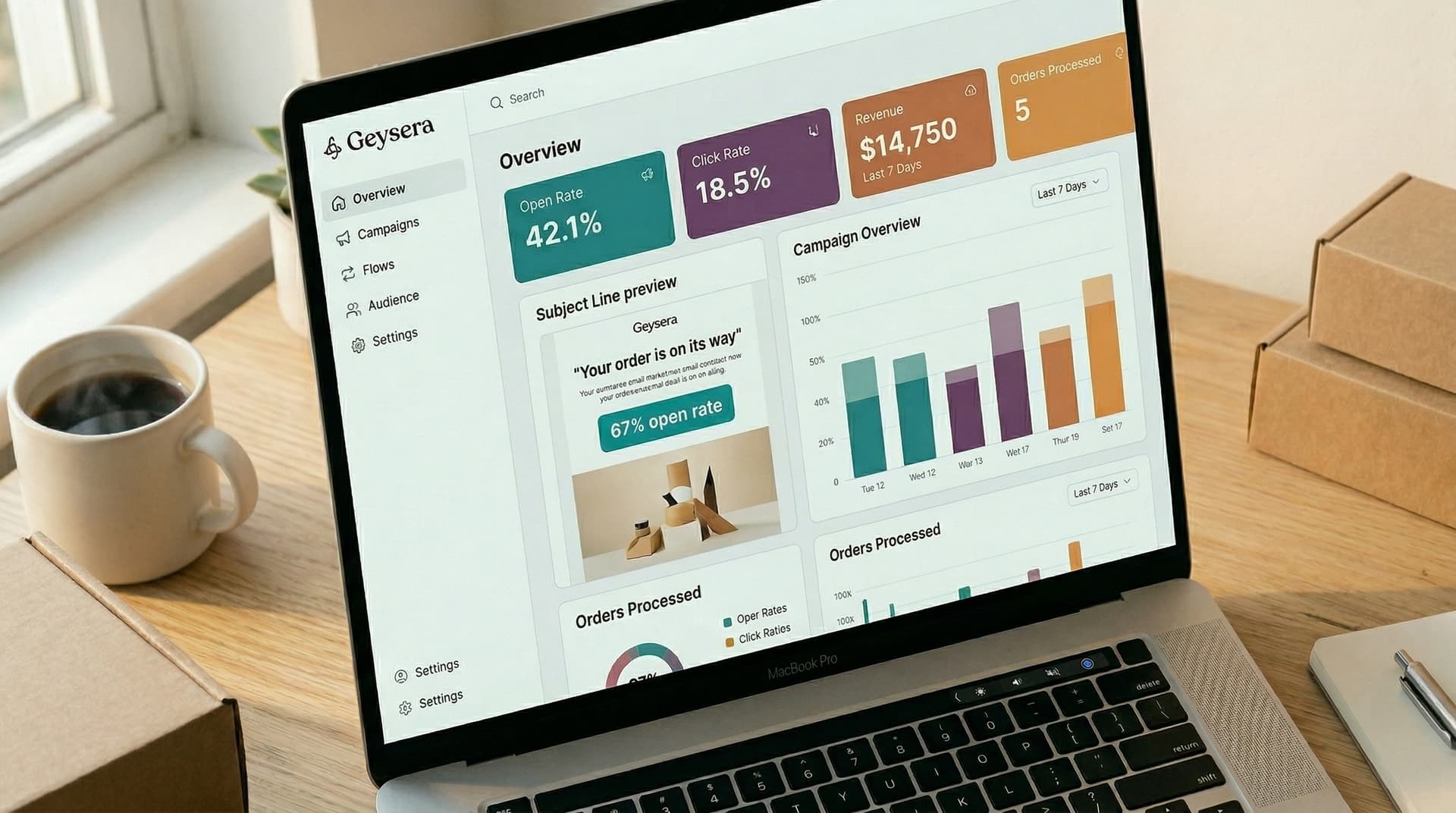
Ecommerce email marketing is the practice of using automated email flows and targeted campaigns to drive revenue from an online store's subscriber list. Unlike generic email marketing, it is built around the customer lifecycle, from first signup through repeat purchase. In Litmus's 2026 survey, 37% of marketers got $20–$36 back for every $1 spent on email, and another 25% got $36–$45.
That's the definition. Here's the reality.
Most ecommerce brands have email "set up." They have a welcome email. They have a cart abandonment flow they built two years ago. They send a campaign when there's a sale. And they look at attributed revenue once a month and assume things are fine.
Across the brands in BS&Co's 2026 attribution benchmarks, email's share of total store revenue ranged from 17% to 67%.
The gap isn't about tools. Almost every brand has access to Klaviyo, Omnisend, or an equivalent platform capable of running a sophisticated email program. The gap is strategic. It's the difference between having email flows and having the right flows, built in the right order, measured by the right metrics, working together as a system rather than a collection of disconnected automations.
This guide covers what that system looks like. Not the theory — the architecture. The seven flows that make up a complete ecommerce email lifecycle, how they interact, what to measure, and the mistakes that cost brands the most revenue.
If you're evaluating whether your email program is actually performing — or building one from scratch — this is the starting point.
This is the first post in our Ecommerce Email Lifecycle Series — a 12-part guide covering every flow, strategy, and measurement framework you need to build a complete email program. Start here, then go deeper on any flow that matters to your business.
What's in this guide:
- What makes ecommerce email different from every other kind
- Why it matters more in 2026 than at any point in the last decade
- The 7 essential flows that make up a complete lifecycle (with links to dedicated guides for each)
- Campaigns vs. flows and how to balance them
- Segmentation — why sending to your full list is the most expensive mistake
- Metrics — what to track, in what order
- Tech stack — Klaviyo vs Omnisend vs Mailchimp
- Common mistakes — the seven that cost brands the most revenue
What Makes Ecommerce Email Marketing Different
Email marketing for ecommerce is not the same discipline as email marketing for SaaS, media, nonprofits, or B2B. The mechanics are different, the economics are different, and the customer relationship is different in ways that change almost every decision you make.
In SaaS, email drives product adoption. In media, it drives readership. In ecommerce, email does one thing above all else: it drives transactions. Repeat transactions.
That single difference shapes what you automate, when you send, what you measure, and how you think about the subscriber relationship.
Three things make ecommerce email marketing distinct:
1. Behavioral triggers are the primary revenue driver.
In ecommerce, campaigns (one-to-many broadcasts) make up most of the send volume, but flows earn far more per send. Automated flows — emails triggered by specific customer actions like browsing a product, abandoning a cart, or completing a purchase — generate nearly 41% of all email revenue from just 5.3% of total sends (Klaviyo, 2026).
Klaviyo's 2026 benchmarks put flow revenue per recipient at nearly 18x the campaign figure.
2. The product catalog is the content engine.
SaaS email teams write thought leadership. Media email teams curate content. Ecommerce email teams have something neither of those has: a product catalog with images, prices, reviews, and inventory data that can populate emails dynamically.
This means ecommerce email can be personalized at a level that other industries can't easily match. A browse abandonment email can show the exact product someone viewed. A cross-sell email can recommend items based on purchase history. A replenishment email can arrive precisely when a consumable product is running low. The product catalog makes all of this possible without manual content creation for every send.
3. The lifecycle is measurable in transactions.
In SaaS, customer lifecycle stages are often ambiguous — when exactly does a "trial user" become an "engaged user"? In ecommerce, the lifecycle is defined by purchases. A first-time buyer is a first-time buyer. A repeat customer is a repeat customer. A lapsed customer hasn't purchased in 90 days. These stages are unambiguous, and each one maps directly to an email flow designed to move the customer to the next stage.
That clarity makes ecommerce email easier to build than almost any other kind. You know exactly who to target, when, and why.
Why Ecommerce Email Marketing Matters More in 2026 Than Ever
If you built an ecommerce business in the last decade, you probably built it on paid acquisition. Facebook ads, Google Shopping, influencer partnerships. That model worked — until it didn't.
Three forces have made email the most important channel in ecommerce:
The economics have shifted permanently.
SimplicityDX found that merchants lost $29 on every new customer in 2022, up from $9 in 2013, a 222% rise it put down to acquisition costs and product returns. Against that, 83% of the marketers in Litmus's 2026 survey reported at least $10 back for every $1 spent on email.
This isn't a trend that reverses. As ad platforms mature and competition for attention increases, the cost of renting an audience will keep rising. The value of owning one — your email list — compounds.
Privacy changes have weakened every channel except email.
Apple's Mail Privacy Protection (MPP), which we covered in depth here, broke open rate tracking. But that's a measurement problem, not a channel problem. Email still reaches the inbox. It still drives purchases. The subscribers are still there.
The channels that actually lost capability are the ones ecommerce brands depended on most. iOS 14.5 gutted Facebook's targeting. Safari blocks third-party cookies by default and Firefox confines each one to the site that set it, though Google kept them in Chrome. Every platform that depends on tracking users across the web has become less effective at targeting and attribution.
Email doesn't depend on third-party data. It's a first-party channel. Your list, your data. No algorithm change can take that away from you.
Retention has become the growth strategy.
Acquiring a new customer costs 5–25x more than retaining an existing one (Harvard Business Review). In a Bain & Company and Mainspring survey of online shoppers from December 1999, the average apparel customer spent 67% more in months 31 to 36 of the relationship than in the first six months. A 5% improvement in customer retention can increase profits by 25–95%.
The math has been clear for years. What's changed in 2026 is that enough brands have felt the pain of rising ad costs that retention has gone from "nice to have" to "how we stay profitable." And the primary tool for retention at scale is still email.
"Your email revenue is going to be your most profitable revenue. It's people that are on your list that you're going to be able to convert." — Chase Dimond, Co-Founder, Structured Agency (Mayple interview)
Most of Dimond's clients generate 20–30% of their total online revenue from email. That number doesn't come from sending more campaigns — it comes from building the lifecycle system that captures revenue at every stage of the customer relationship.
The 7 Essential Ecommerce Email Flows
Every ecommerce email program is built on the same seven automated flows. They map to the customer lifecycle — from the moment someone subscribes to the point where they've gone quiet and you need to decide whether to win them back or let them go.
Some brands run one or two of these. A full lifecycle program runs all seven.
Here's the map:
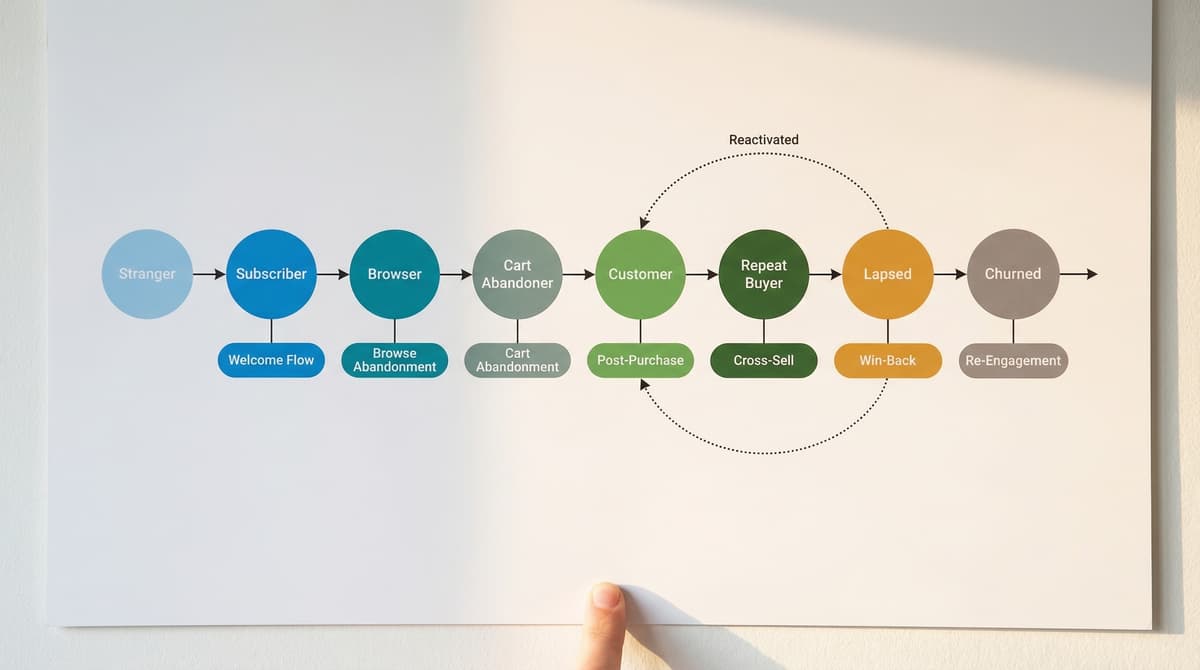
Each stage has a flow. Each flow has a job.
| Flow | Trigger | Goal | Build Priority |
|---|---|---|---|
| Welcome series | Joins email list | Convert subscriber → first buyer | 1st |
| Browse abandonment | Views product, doesn't cart | Bring back interested browsers | 3rd |
| Cart abandonment | Carts product, doesn't buy | Recover abandoned revenue | 2nd |
| Post-purchase | Completes purchase | Turn one-time → repeat buyer | 4th |
| Cross-sell / upsell | Has purchased | Increase AOV and frequency | 6th |
| Win-back | No purchase in 60–120 days | Re-activate lapsed buyers | 5th |
| Re-engagement / sunset | No opens/clicks in 90+ days | Reactivate or clean list | 7th |
1. Welcome Series
Trigger: Subscriber joins your email list. Job: Convert subscribers into first-time buyers.
In Omnisend's 2026 benchmarks, welcome automations open at 35.53% and convert 2.11% of recipients, and Klaviyo's 2026 data puts the welcome series second only to cart abandonment in revenue per recipient ($5.75 against $6.77). It's the first impression and the first sale opportunity. Most brands should run a 3–5 email series over 7 days: deliver the signup incentive, introduce the brand, surface your bestsellers, build social proof, then create urgency.
→ Welcome email best practices for ecommerce
2. Browse Abandonment
Trigger: Subscriber views a product page but doesn't add to cart. Job: Re-engage interested browsers and move them toward purchase.
Klaviyo puts the browse abandonment conversion rate at 0.96%, 9.6x the 0.10% of the average email campaign (Klaviyo, 2022). Browse emails operate on lower intent than cart abandonment, but they reach a wider pool, because far more shoppers view a product than add one to a cart. The trick is relevance without surveillance. Show the product they viewed, add social proof, keep the tone helpful rather than pushy.
→ Browse abandonment: the complete strategy guide
3. Cart Abandonment
Trigger: Subscriber adds a product to cart but doesn't complete checkout. Job: Recover abandoned revenue.
Seven out of ten shopping carts get abandoned (Baymard Institute puts the average at 70.22%). Cart emails reach the shoppers with the highest intent: Omnisend's 2026 benchmarks put them at a 1.72% conversion rate, and Klaviyo's at $6.77 revenue per recipient, the most of any flow. A three-email sequence works well (reminder at 30 minutes, social proof at 24 hours, incentive at 48 hours), and Rejoiner's 2025 report puts the best first send at 30 minutes after abandonment.
→ Abandoned cart email: the ultimate guide
4. Post-Purchase
Trigger: Customer completes a purchase. Job: Turn first-time buyers into repeat customers.
The post-purchase flow covers everything from order confirmation through delivery follow-up, review requests, and cross-sell recommendations. It's the most neglected flow in ecommerce email, which is frustrating because it's also the one that most directly affects whether someone buys from you again.
→ Post-purchase email: the flow that drives repeat revenue
5. Cross-Sell / Upsell
Trigger: Customer has purchased; product data informs recommendations. Job: Increase average order value and purchase frequency.
Cross-sell emails recommend complementary products. Upsell emails promote premium versions or larger quantities. Both work best 14–30 days after the initial purchase, when the customer has received and used the product. Dynamic product blocks driven by purchase history outperform generic "you might also like" recommendations.
→ Cross-sell and upsell emails
6. Win-Back
Trigger: Customer hasn't purchased in 60–120 days. Job: Re-activate lapsed buyers before they churn.
Win-back emails target customers who previously purchased but haven't returned. The best sequences escalate gradually: a soft reminder, then social proof, then an incentive, then a final-chance warning. The metric that matters here isn't open rate, it's reactivation rate: the percentage of lapsed customers who actually make another purchase.
7. Re-Engagement / Sunset
Trigger: Subscriber hasn't opened or clicked in 90+ days. Job: Reactivate dormant subscribers or clean them from your list.
Re-engagement is different from win-back. Win-back targets lapsed buyers. Re-engagement targets inactive subscribers — people who stopped engaging with your emails entirely. If re-engagement fails, the sunset flow removes them. This isn't a failure; it's hygiene. Inactive subscribers hurt your deliverability for everyone else on your list.
How These Flows Work Together
These seven flows aren't independent. They're a system, and they only work well when they're built to hand off to each other. A subscriber enters through the welcome series. If they browse without buying, browse abandonment picks them up. If they cart without buying, cart abandonment takes over. When they purchase, post-purchase nurtures the relationship. Cross-sell expands it. Win-back recovers it when it fades. Re-engagement cleans up what can't be saved.
The priority order for building: welcome → cart abandonment → browse abandonment → post-purchase → win-back → cross-sell → re-engagement. In Omnisend's 2026 report, cart abandonment and welcome emails alone drove 76% of all automation-generated orders. Build those before optimizing the rest.
Ezra Firestone, whose businesses include Smart Marketer, BOOM! by Cindy Joseph and oVertone, reports that email and SMS account for 40% of sales across them. His advice on where to start is worth listening to:
"If you do nothing else that I show you today, do your post-purchase flow well. […] And one way to do that, which no one is doing, is to send pre-arrival emails." — Ezra Firestone, Founder, Smart Marketer (Klaviyo Blog)
→ The 7 essential ecommerce email flows — detailed guide
Campaigns vs. Flows: When to Use Each
Flows are the foundation. Campaigns are the amplifier.
Flows run automatically, triggered by behavior. They're always on, always relevant, and they generate nearly 18x more revenue per recipient than campaigns. If your flows aren't built, that's where your time should go first.
Campaigns are one-to-many broadcasts: product launches, seasonal sales, content announcements, brand stories. They're good for driving urgency and reaching your full list, but they require manual effort for every send.
The balance for most ecommerce brands: 2–4 campaigns per month, layered on top of a complete set of automated flows. The flows handle the lifecycle. The campaigns handle the moments.
"It's time to put the 'marketing' back into email marketing. Adopting a holistic approach to email marketing will help you break through barriers, serve your customers better and drive stronger results for your company." — Kath Pay, Founder & CEO, Holistic Email Marketing (Holistic Email Marketing)
Pay's point is that email strategy isn't about individual sends — it's about the system. A holistic approach means every flow, every campaign, and every segment works together as a lifecycle. The mistake brands make is treating campaigns as their email strategy. Campaigns are supplementary. The strategy is the lifecycle system — and that system is built with flows.
Email Segmentation for Ecommerce
Sending the same email to your entire list is the most expensive mistake in ecommerce email marketing. Not because the send costs money, but because irrelevance costs engagement. Lost engagement costs deliverability. And poor deliverability costs revenue across every email you send, including the ones that are actually relevant.
Segmentation fixes this.
RFM Segmentation
The most powerful segmentation framework for ecommerce is RFM — Recency, Frequency, Monetary value. Drew Sanocki, who helped turn Karmaloop around as its CMO, applies RFM analysis to ecommerce email. The framework segments customers into groups based on:
- Recency: How recently did they purchase?
- Frequency: How often do they purchase?
- Monetary: How much do they spend?
A customer who purchased last week, buys monthly, and has a high AOV gets a very different email experience than someone who bought once six months ago. RFM makes that distinction actionable.
Behavioral Segments
Beyond RFM, behavioral segmentation uses real-time actions to determine what someone receives:
- Engaged subscribers (opened or clicked in last 30 days) get your full campaign schedule
- Semi-engaged (opened in 30–90 days) get a reduced schedule
- Unengaged (no activity in 90+ days) get re-engagement only
- Recent purchasers are excluded from discount-heavy campaigns (they already converted at full price)
- VIP customers (top 10% by spend) get early access, exclusive offers, personal outreach
Product-Based Segments
For stores with diverse catalogs, segmenting by product interest or purchase category ensures cross-sell recommendations are relevant. A customer who buys skincare doesn't want emails about supplements. A customer who bought running shoes is interested in running socks, not dress shoes.
The bottom line: segmentation isn't a feature you turn on. It's a strategic decision about who gets what, when, and why. Every flow and every campaign should have segmentation logic built in.
Measuring Ecommerce Email Performance
The metrics most brands track are the wrong ones — or at least, they're tracking them in the wrong order.
Open rates are unreliable since Apple MPP. Attributed revenue is almost certainly inflated. The number your ESP shows you for "email revenue this month" gives you credit for purchases that would have happened anyway.
"For success, you're better off focusing on metrics that are as far down the funnel as you can measure — ideally email conversions, revenue, and other business-centric metrics." — Chad S. White, GVP of CRM Strategy, Zeta Global (Inboxroad interview)
In the same interview he calls open rates "a great list health metric" that is "often misused as a success metric." On his own blog he describes universal control groups, which withhold campaigns from a small slice of the audience, as what many consider "the purest way to measure the lift generated by your marketing efforts." That distinction — attributed vs. incremental — is the most expensive blind spot in ecommerce email.
Here's the hierarchy that matters, in order:
Revenue metrics (start here)
Revenue per recipient (RPR) is the single most useful email metric: how much revenue each email generates per person who received it. As a benchmark, flows earn nearly 18x what campaigns earn per recipient (Klaviyo, 2026). After RPR, look at incremental revenue (what email actually caused, not what it took credit for) and revenue by flow type. Cart abandonment usually leads, but post-purchase and welcome often surprise people.
Engagement metrics
Click-through rate is the most reliable engagement metric now that Apple MPP has made open rates unreliable. Klaviyo's 2026 benchmarks put the average click rate at 1.69% for campaigns and 5.58% for flows. Conversion rate and placed order rate matter too, but need AOV context to be meaningful.
Health metrics
Are your emails reaching the inbox? About one in eight marketing emails didn't in 2025 (Validity, 2026). Spam complaint rate needs to stay below 0.1% for Gmail. Above that, your entire program suffers. List growth rate (net new subscribers minus unsubscribes and bounces) tells you whether you're building or shrinking.
Strategic metrics
Repeat purchase rate, customer lifetime value, time between purchases. These are the numbers that tell you whether your email program is building something durable or just generating activity. Email's primary job is to improve repeat purchase rate. Everything else is a means to that end.
Most brands track these in the wrong order. They start with opens (broken), check attributed revenue (inflated), and never get to the metrics that actually drive decisions.
Building Your Ecommerce Email Tech Stack
The platform you choose matters less than how you use it. That said, the three dominant platforms for ecommerce email in 2026 serve different needs:
| Platform | Best For | Flow Builder | Shopify Integration | Segmentation | Pricing (10K contacts) |
|---|---|---|---|---|---|
| Klaviyo | 500+ paying customers | Advanced (conditional splits, A/B, branching) | Deep (real-time sync, predictive analytics) | Strongest available (RFM, predictive, behavioral) | ~$150/mo |
| Omnisend | Mid-market Shopify stores | Good (visual builder, pre-built workflows) | Strong (native Shopify app) | Good (purchase-based, behavioral) | ~$132/mo |
| Mailchimp | Small stores, beginners | Basic (limited branching) | Moderate (third-party connector) | Limited (list-based, basic tags) | ~$135/mo |
Klaviyo is the default recommendation once a Shopify store has about 500 paying customers and six months of order history, the point where its predictive analytics switch on. Its segmentation, flow builder, and Shopify integration are ahead of the other options by a margin that matters once you're past the basics. In our view the price premium pays for itself, because the platform makes advanced automation accessible without requiring a developer.
Omnisend is a strong option for Shopify stores that want good automation without Klaviyo's learning curve or price. Its pre-built workflows get brands up and running faster.
Mailchimp works for very small stores or brands just getting started, but most outgrow it quickly once they need conditional flow logic or advanced segmentation.
Beyond the ESP, most ecommerce email stacks include Shopify or WooCommerce (the commerce data source), a review platform like Yotpo or Judge.me (for social proof in emails), a signup tool like Privy or Justuno (for list building), GA4 (for attribution context), and a deliverability monitor like GlockApps or InboxReady.
The integration between your commerce platform and your ESP is the connection that makes everything else work. Real-time data sync is what enables behavioral triggers, dynamic product content, and purchase-based segmentation. Without it, you're sending blind.
Common Mistakes That Cost Ecommerce Brands the Most Revenue
The same mistakes appear in almost every email program we audit. They're not exotic. They're foundational, and they're expensive.
Running incomplete flows. Most brands have a welcome email and a cart abandonment flow. They're missing post-purchase, browse abandonment, win-back, cross-sell, and re-engagement. Each missing flow is a leak in the lifecycle, a point where customers fall through with no system to catch them.
Measuring attributed revenue instead of incremental. Your ESP says email drove $200K this month. But last-click attribution gives email 100% credit for purchases that involved multiple touchpoints. The real contribution is lower. If you're making budget decisions based on attributed revenue, you're making them on inflated data.
No segmentation strategy. Sending the same campaign to your entire list means sending irrelevant emails to most of it. Irrelevant emails get ignored. Ignored emails train ISPs that your messages aren't worth delivering. The damage compounds from there.
Ignoring deliverability. About one in eight marketing emails missed the inbox in 2025 (Validity, 2026). If you haven't authenticated your sending domain (SPF, DKIM, DMARC), if your spam complaint rate is above 0.1%, or if you're sending to a list full of inactive subscribers, you have a deliverability problem that's silently cutting the revenue of every email you send.
Over-sending campaigns, under-investing in flows. In Omnisend's 2026 report, automations drove 30% of email revenue from 2% of sends. Flows earn that share only when they're built, optimized, and maintained. The highest-ROI use of your email team's time is almost always improving flows, not sending another campaign.
Leading with discounts. Training your customers to wait for a discount before purchasing is one of the most expensive habits in ecommerce. It erodes margin and creates a Pavlovian relationship where subscribers learn that ignoring your emails eventually produces a better offer. Use incentives as the last step in a sequence, not the first.
Not cleaning your list. A 100K email list with 30% dead weight performs worse than a 70K list of engaged subscribers. Inactive subscribers drag down your deliverability metrics, which reduces inbox placement for everyone, including your best customers. Regular list hygiene isn't optional. It protects the revenue your good emails generate.
What a Complete Ecommerce Email Program Looks Like
Email averaged 33.4% of store revenue across the BS&Co portfolio, measured with Klaviyo's default last-touch attribution. Here's how a basic program differs from a full lifecycle program:
| Component | Basic program | Full lifecycle program |
|---|---|---|
| Flows | Welcome + cart abandonment | All 7 lifecycle flows, optimized quarterly |
| Campaigns | Sporadic, full-list blasts | 2–4/month, segmented by engagement and purchase history |
| Segmentation | None or basic (purchasers vs non) | RFM + behavioral + product-based |
| Metrics | Open rate + attributed revenue | RPR + incremental revenue + CLV |
| Deliverability | Unchecked | Monitored, authenticated, list cleaned quarterly |
| Tech stack | ESP + Shopify (default settings) | ESP + Shopify + review platform + analytics |
In the full lifecycle program, the parts feed each other. Segments decide who gets each campaign, and RPR and incremental revenue show which flow to fix next. The basic program runs on the same ESP and store platform, left on default settings.
Running only a welcome email and a cart flow? Geysera builds the full lifecycle and shows you the incremental revenue each flow adds. See the breakdown →
Frequently Asked Questions
What is ecommerce email marketing?
Ecommerce email marketing is the practice of using automated email flows and targeted campaigns to drive revenue from an online store's subscriber list. It differs from generic email marketing because it's built around the customer purchase lifecycle — from first signup through repeat purchase — using behavioral triggers like browse abandonment, cart abandonment, and post-purchase sequences.
How much revenue should email generate for an ecommerce store?
BS&Co's 2026 attribution benchmarks put email at 33.4% of total store revenue on average, with individual brands ranging from 17% to 67% under Klaviyo's last-touch attribution. Chase Dimond reports that most of his clients generate 20–30% of total online revenue from email. To raise that share, build all seven lifecycle flows, segment sends, and measure by incremental revenue rather than attributed revenue.
What are the most important ecommerce email flows?
The seven essential flows are: welcome series, browse abandonment, cart abandonment, post-purchase, cross-sell/upsell, win-back, and re-engagement. Build welcome and cart abandonment first, since in Omnisend's 2026 report those two alone drove 76% of automation-generated orders. Browse abandonment comes third. Post-purchase and win-back come next to close the retention loop.
How is ecommerce email marketing different from regular email marketing?
Ecommerce email marketing is driven by behavioral triggers tied to the purchase lifecycle — product views, cart additions, purchases, and lapsed activity. Regular email marketing typically relies on scheduled campaigns. In ecommerce, automated flows generate nearly 41% of email revenue from just 5.3% of sends (Klaviyo, 2026), making behavioral automation the primary revenue driver rather than broadcast campaigns.
What's the best email platform for ecommerce?
Klaviyo is the default recommendation once a Shopify store has about 500 paying customers and six months of order history, which is when its predictive analytics switch on. Its Shopify integration and RFM segmentation also lead the field. Below that point, Omnisend covers the core flows for less. Mailchimp works for very small stores but most outgrow it quickly.
How often should an ecommerce store send marketing emails?
Most ecommerce brands should send 2–4 campaigns per month, on top of their automated flows. The exact frequency depends on your product and audience — a fashion brand with weekly new arrivals can send more often than an electronics brand. The key is segmenting by engagement level: send more to engaged subscribers, less to those showing fatigue.
What is a good open rate for ecommerce emails?
Klaviyo's 2026 benchmarks put the average open rate at 31% for campaigns and 32.2% for flows, but open rates are unreliable since Apple MPP. Six months after MPP launched, Omeda measured total open rates up nearly 18 points, from 22.6% to 40.5%. Click-through rate (1.69% for campaigns and 5.58% for flows in Klaviyo's 2026 benchmarks) and revenue per recipient are more reliable performance indicators in 2026.
Continue the Series
This guide gives you the complete picture. The rest of this series goes deep on each piece.
If you're building from scratch, start with the flows in priority order. If you already have flows running, find the one you haven't built yet or the one that's underperforming, and start there. Every flow you add closes a gap in the lifecycle where customers are currently falling through.
The Ecommerce Email Lifecycle Series:
- Ecommerce Email Marketing: The Complete Strategy Guide - (you are here)
- The 7 Essential Ecommerce Email Flows — How all seven flows connect and what to build first
- Welcome Email Best Practices — First impressions that convert
- Post-Purchase Email — The flow that turns one-time buyers into repeat customers
- Post-Purchase Templates — Copy and timing for every stage
- Win-Back Email Guide — How to re-activate lapsed customers
- Win-Back Email Examples — Real examples and templates that work
- Re-Engagement Email Guide — Saving dead subscribers (or knowing when to let go)
- Re-Engagement Examples & Subject Lines — Copy that wins opens from cold lists
- 90-Day Ecommerce Email Strategy — From zero to revenue in three months
- Ecommerce Customer Retention — How email drives repeat revenue
- Cross-Sell & Upsell Emails — Increasing AOV after the first purchase
Already have a complete email program? See how it compares to what we build. See Geysera's approach →
Sources
- Litmus: State of Email 2026
- Klaviyo: Email Marketing Benchmarks 2026
- Klaviyo: 2026 Abandoned Cart Benchmark Report
- Omnisend: Email Marketing Benchmarks 2026
- Omnisend: 2026 Ecommerce Marketing Report
- Baymard Institute: Cart Abandonment Rate Statistics
- Rejoiner: Abandoned Cart Email Statistics (2025)
- SimplicityDX via Marketing Dive: Brands Losing a Record $29 for Each New Customer Acquired (2022)
- Harvard Business Review: The Value of Keeping the Right Customers
- Bain & Company and Mainspring: The Value of Online Customer Loyalty (survey, December 1999)
- Chase Dimond on Ecommerce Email Best Practices (Mayple)
- Ezra Firestone: Tips to Grow Your Email & SMS Revenue (Klaviyo Blog)
- Kath Pay: Holistic Email Marketing
- Chad S. White on Email Marketing Rules (Inboxroad Interview)
- Chad S. White: Universal Control Groups (Email Marketing Rules)
- Validity: 2026 Email Deliverability Benchmark Report

Co-Founder and CEO
Bob Thordarson is CEO and Co-Founder of Geysera, a serial entrepreneur with 25+ years and five co-founded ventures, including Cequint (acquired by TNS in 2010 for $112.5M) and Consumerware (acquired by ParkerVision). A graduate of the University of Washington and MIT Entrepreneurial Masters Program, based in Seattle, he serves on the boards of DRY Soda Co. and the Entrepreneurs' Organization Seattle chapter. He is an expert in retention marketing email systems and methodology for ecommerce and B2B brands — measured by incremental revenue, not vanity metrics.