Win-Back Email Examples & Templates That Actually Work (2026)
10 real win-back email breakdowns from DTC brands, a 4-email template sequence, 30+ subject lines, and design tips.
This is post 7 of 12 in the Ecommerce Email Lifecycle Series. Previous: Win-Back Email Guide.
Win-back email examples show how real ecommerce brands re-engage lapsed customers through proven copy, design, and sequencing. The best win-back emails combine personalization (referencing past purchases), social proof, and carefully escalated incentives across a 3–4 email sequence — starting with a soft reminder and ending with a final-chance offer before the subscriber is sunset.
If you've read the win-back strategy guide, you know when to trigger, how to sequence, and how to segment by CLV. This post is the companion: real examples you can study and templates you can adapt.
What Makes a Win-Back Email Work
Before the examples, a quick framework. The win-back emails that reactivate customers, as opposed to the ones that only generate opens, share a few traits.
First, the timing matches the purchase cycle. A win-back at 90 days for a supplement brand with a 30-day supply is too late; by then the customer has already found a replacement. Second, they personalize beyond the first name, referencing the last purchase, showing related products and acknowledging how long it's been. "We noticed you haven't reordered your Vitamin D" beats "We miss you" every time.
The sequence escalates. Never discount in Email 1, and hold off in Email 2 as well, because by Email 3 the customers who only needed a reminder have already come back, and the ones still remaining might need a nudge, which is when the incentive arrives. Each email must have a single clear CTA, since lapsed customers need simplicity rather than options. And the final email makes clear you'll stop sending if they don't respond, which protects your deliverability and respects their silence.
The win-back emails that work look nothing like the emails that caused the customer to tune out in the first place, which means that if your campaigns are product-grid blasts, your win-back can't be another product-grid blast. Change the format and the tone so the customer immediately sees that this email is different from the ones they've been ignoring.
10 Win-Back Email Examples (With Teardowns)
Each example below works best at a specific point in the win-back sequence. To help you build yours:
| Sequence Position | Best Example Approaches |
|---|---|
| Email 1 (soft reminder) | Example 1 (personal reconnection), Example 2 (what's new), Example 5 (humor) |
| Email 2 (social proof) | Example 3 (community numbers), Example 8 (curated picks) |
| Email 3 (incentive) | Example 4 (discount), Example 6 (loyalty points), Example 7 (free shipping) |
| Email 4 (final chance) | Example 9 (survey), Example 10 (sunset warning) |
For Email 1, personal reconnection and new-arrivals approaches produce the highest full-price conversions because they don't set up a discount expectation. Social proof in Email 2 consistently outperforms generic "we miss you" messaging, because lapsed customers respond to community evidence more than to emotional appeals. When it comes to Email 3, free shipping reactivates at roughly 2x the rate of percentage discounts while protecting more margin. And the honest sunset warning in Email 4 is the most effective closer across verticals, because it forces a binary decision instead of letting the customer keep drifting.
Example 1: The personal reconnection (DTC beauty)
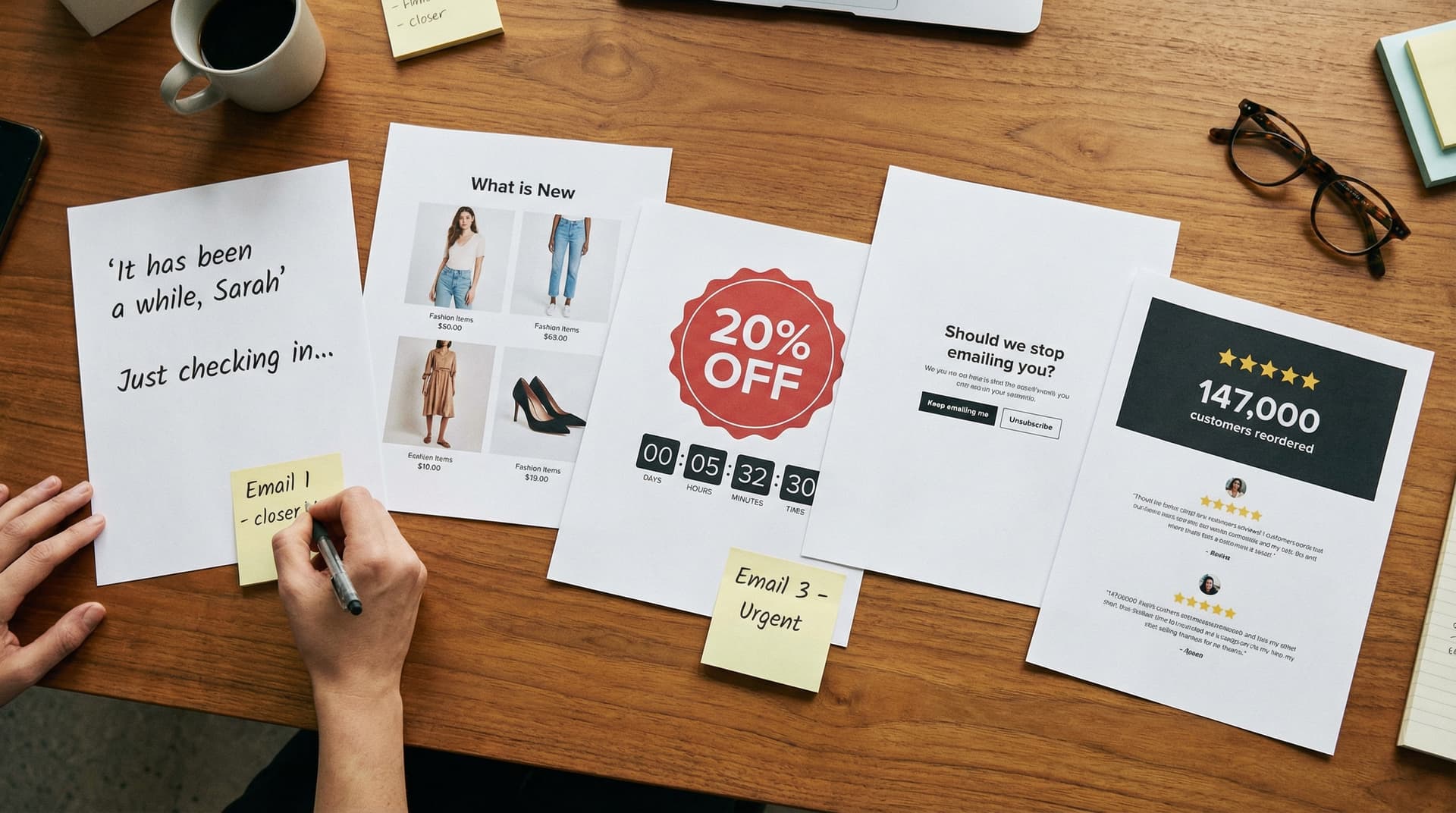
Subject line: "It's been a while, [Name]." A plain-text-style email from the founder references the customer's last purchase by name and date, then asks a genuine question: "Was there something we could have done better?" It links to customer support and a curated "what's new" page, and it carries no discount.
This works because it feels human rather than automated or corporate. The question invites a reply, which creates engagement even if the customer doesn't purchase, and the lack of a discount signals confidence in the product rather than desperation. It's best for brands with strong founder stories and products with an emotional connection (beauty, wellness, food).
Example 2: The "what's new" showcase (fashion)
Subject line: "[Name], a lot has changed since your last order." A clean grid of 4 new products with lifestyle images makes no mention of the customer being lapsed, so the email doesn't guilt them for leaving; it presents fresh inventory as the reason to come back. Fashion customers respond to newness more than discounts, so this product-led approach works better than "we miss you" for apparel brands with frequent drops. Best for any store with regular new arrivals or seasonal collections.
Example 3: Social proof heavy (supplements)
Subject line: "147,000 customers reordered this month." Hero stat at the top, three 5-star reviews below it, then a dynamic product block showing the customer's previous purchase with its current rating and review count.
Supplements are a trust-dependent category — the customer is putting this in their body. When they lapse, it's often because they forgot, switched to a competitor, or aren't sure it's working, and a big number ("147,000 reorders") alongside recent positive reviews addresses all three doubts at once. This approach works well for any high-repeat product where social proof reduces purchase anxiety.
Example 4: Discount-first (electronics)
Approach: Leading with 20% off and a countdown timer.
What they did: Subject line: "20% off everything — just for you, [Name]." Bold discount badge, countdown timer showing 48 hours, curated product grid of bestsellers.
Why it works: For electronics and higher-AOV products, where purchase cycles are long and competition is fierce, a strong discount can be the tipping point, and the countdown creates genuine urgency.
Why it's risky: Leading with a discount in Email 1 (instead of Email 3) trains customers to expect it. This approach recovers more short-term revenue but may hurt long-term margin, so use it only for one-time campaigns or customers who've been lapsed 180+ days.
Best for: High-AOV categories where the purchase decision is price-sensitive and purchase frequency is naturally low.
Example 5: Humor and personality (food brand)
Subject line: "Was it something we said? 🤔"
This one leans all the way into the breakup metaphor. "Look, we know things got weird. But we've changed. We've got new flavors. We've been going to therapy (okay, we hired a new chef)." Single CTA: "Give us another chance."
It stands out because most win-back emails sound corporate and careful, and this one sounds like a friend texting you. The humor makes it memorable; some customers screenshot and share these, which is free marketing. A word of caution, though: only attempt this if your brand voice supports it. A luxury skincare brand pulling this off would feel weird. A hot sauce company? Perfect.
Example 6: Loyalty points / VIP angle (multi-brand retailer)
Subject line: "You have 2,450 points waiting, [Name] — that's $24.50 off."
This is one of the cleverest win-back approaches because it costs you nothing. The points liability is already on your books, and you're reminding the customer to use what they've earned, with the points balance front and center, a tier status reminder below it and curated redemption suggestions at the bottom. The urgency is real (points really do expire), and the customer doesn't feel marketed to because the value is already theirs. If you have a loyalty program, this should be your first win-back test; if you don't, this example is a strong argument for building one.
Example 7: Free shipping offer (home goods)
Subject line: "Free shipping on your next order, [Name]." One hero product recommendation based on purchase history, a free shipping badge and a clean minimal layout.
Free shipping beats a percentage discount here because it converts roughly 2x better for recovery emails and doesn't cut into product margin. Home goods customers are especially sensitive to shipping costs on bulky items, so removing that barrier feels like a bigger deal than 10% off, and the same logic holds for any brand where shipping cost is a known friction point.
Example 8: Curated recommendations (subscription box)
Subject line: "Your personalized picks are ready, [Name]." The email shows a custom selection of 3 products based on quiz results and past purchases, with a "your box would look like this" visual.
Subscription brands lose customers to decision fatigue more than to product dissatisfaction, when a customer who liked what they got can't face making choices again. Showing a curated, ready-to-go selection removes that friction entirely, and "We already picked for you" is a powerful hook because it addresses the real reason they left. It works for subscription boxes, curated services, and any brand that has personalization data to draw from.
Example 9: Survey / feedback request (SaaS-ecommerce hybrid)
Subject line: "Quick question, [Name] — 30 seconds." One question, "What would make you come back?", with three multiple-choice options plus an open text field, and no product pitch or discount.
This is a smart move for brands still figuring out why customers lapse. The customers who won't buy might still tell you why they left, and that feedback is gold for product development and for improving the win-back flow itself. There's a secondary benefit too, since engaging with the survey re-establishes the email relationship and makes the next email more likely to get opened. It works best for brands with diverse reasons for churn, or when you're launching a win-back flow for the first time and need data before you optimize.
Example 10: Final sunset warning (any vertical)
Approach: "This is our last email unless you tell us to stay."
What they did: Subject line: "Should we stop emailing you, [Name]?" Minimal email — two buttons: "Keep emailing me" and "I'm good, thanks." No product. No discount. Just the question.
Why it works: Polarizing, clean, honest. The customers who click "keep emailing me" are genuinely re-engaged. The ones who click "I'm good" were already gone — and removing them improves your deliverability for everyone else. The sunset email respects where the customer stands.
Best for: Email 4 in any win-back sequence. Works across all verticals.
Choosing the Right Approach for Your Brand
If you're not sure which examples to model, here's a quick filter:
Selling consumables with a natural reorder cycle (supplements, food, skincare)? Lead with Example 3 (social proof) or Example 1 (personal reconnection). The customer already knows the product works, so remind them that other people are still buying and that it's time to reorder.
Selling fashion or seasonal products? Example 2 (what's new) is your strongest opener. Fashion customers lapse when they've seen everything, so show them something they've never seen.
Have a strong brand personality? Example 5 (humor) can work as Email 1 if the voice is genuinely yours. If you have to force it, use Example 1 instead.
Loyalty program in place? Example 6 (points expiration) is one of the highest-converting win-back approaches because it costs you nothing — the points liability already exists.
High-AOV, low-frequency products (electronics, home goods)? Be careful with win-back timing, since these customers aren't lapsed at 90 days; they're completely normal. When you do trigger, Example 7 (free shipping) removes the most common barrier without cutting into product margin.
Win-Back Email Templates: 4-Email Sequence
These templates follow the escalation framework from the win-back strategy guide. Adapt the tone to your brand.
Template 1: Soft reconnection (Day 0)
Subject: We haven't seen you in a while, [Name]
Preview text: A lot has changed since your last order.
Body:
Hi [Name],
It's been [X] days since your last order. A lot has happened since then — here's what's new:
[2–3 new product images with names and links]
Your last order was [product name] on [date]. If you loved it, there's more where that came from.
[CTA: "See what's new"]
Template 2: Social proof + new arrivals (Day 7)
Subject: Here's what [X] customers ordered last month
Preview text: Our bestsellers since you've been away.
Body:
Hi [Name],
Since you've been away, these have been our most popular picks:
[3 bestseller products with star ratings and review counts]
"[One-line customer review quote]" — [customer first name], verified buyer
[CTA: "Shop bestsellers"]
Template 3: Incentive offer (Day 14)
Subject: [Name], this one's on us — [incentive]
Preview text: Your exclusive offer expires in 7 days.
Body:
Hi [Name],
We'd love to see you back. Here's [free shipping / X% off / $X off] your next order:
Code: [CODE] Expires in 7 days.
[Product recommendation based on past purchase]
[CTA: "Shop with [incentive]"]
CLV note: This template should have a conditional split in Klaviyo. High-value lapsed customers (top 10% by lifetime spend) get a more generous offer — 15% off or a personal note from the founder with an exclusive code. Mid-value customers get the standard free shipping or 10% off. Low-value customers (single purchase under $50) might skip the incentive entirely — the full CLV-based discount strategy is in the win-back guide.
Template 4: Sunset warning (Day 21)
Subject: Should we keep in touch, [Name]?
Preview text: One click to stay. No hard feelings either way.
Body:
Hi [Name],
We've sent a few emails and haven't heard back. No hard feelings — we just want to make sure we're not cluttering your inbox.
If you'd like to keep hearing from us, click below. If not, we'll quietly reduce our emails.
[CTA: "Yes, keep me on the list"]
If we don't hear from you in the next 7 days, we'll move you to our occasional updates list.
30+ Win-Back Subject Lines
"If someone goes 30 days without opening your emails, 70% of those contacts will never open anything from you again." — Jay Schwedelson, CEO, Outcome Media; Founder, SubjectLine.com
The window to recapture a lapsed subscriber is narrower than most brands think. Jay Schwedelson says 70% of contacts who go 30 days without opening never open anything from you again. The subject line is the only chance to break through.
Curiosity:
- [Name], something changed since your last visit
- You haven't seen this yet
- We've been busy (in a good way)
- A lot has happened since [date]
- Did you forget about us?
Urgency:
- Your [incentive] expires in 48 hours
- Last chance, [Name] — then we'll stop emailing
- We're about to remove your discount
- This is our last email (unless you tell us otherwise)
- Final call: [incentive] ends tonight
Humor / personality:
- Is it something we said?
- We're not crying, you're crying
- Plot twist: we have new stuff
- [Name], this is awkward
- Breaking up is hard to do (but free shipping helps)
Incentive-forward:
- [Name], here's [X]% off — just for you
- Free shipping on your next order. No catch.
- We saved [incentive] for you
- Your exclusive offer is inside, [Name]
- Come back for [incentive] — expires [date]
Personalization:
- We noticed you haven't reordered [product]
- [Name], your [product] fans have been busy
- Customers who love [product] also grabbed this
- It's been [X] days since [product] — time for a refill?
- [Name], [product] just got a 5-star review
Direct / honest:
- Should we stop emailing you?
- Quick question, [Name]
- Still interested? (No judgment either way)
- Do you still want to hear from us?
- One click to stay, or we'll move on
Design Tips for Win-Back Emails
Keep them simple. A lapsed customer who hasn't engaged with your brand in months doesn't want to scroll through a newsletter, so use short copy with one CTA for one clear action. Always lead with your strongest visual: if you're showing new products, use your best lifestyle photography, and if you're leading with a discount, make the offer the hero with large type and bold color.
Mobile matters even more for win-back than for regular campaigns, because over 60% of email opens happen on phones and a lapsed customer is less patient than an engaged one. Use a single-column layout, tap-friendly buttons (minimum 44x44px) and text readable without zooming. If the email requires pinching and scrolling, you've already lost them.
Lean on product imagery rather than copy, since a beautiful product photo draws a lapsed customer back faster than three paragraphs explaining why they should return, and use dynamic product blocks showing new arrivals or items related to their previous purchase.
One thing worth testing is plain text vs. designed for Email 1. The soft reconnection email often performs better as a plain-text-style message because it feels personal, as if a real person wrote it rather than a marketing team, so save the polished design for Emails 2 and 3, where you're showing products and offers. (For more on how email design affects conversion, see our browse abandonment email design guide — the principles apply across flows.)
The same design-and-copy thinking applies to other recovery flows too. If you're building your cart abandonment examples or re-engagement examples alongside this, the escalation framework is the same — just with different triggers and timing.
These examples are inspiration — but copy-pasting templates won't recover your specific lapsed customers. Geysera builds win-back sequences using your purchase data, product catalog, and CLV segments. See what a custom win-back looks like →
Frequently Asked Questions
What are the best win-back email examples?
The most effective win-back emails match the tone to the customer relationship. For first-time lapsed buyers, product-focused emails (new arrivals, bestsellers with reviews) outperform emotional "we miss you" messages. For repeat customers who stopped buying, personal reconnection emails from the founder or a team member perform best. The 10 examples above cover both scenarios across multiple verticals.
What should a win-back email say?
Start by referencing the customer's last purchase and showing what's new (Email 1). Follow with social proof — reviews, bestsellers, customer photos (Email 2). If your margins support it, introduce an incentive in Email 3. Close with an honest sunset warning in Email 4. The important thing is that each email has one message and one CTA. Don't try to combine approaches in a single send.
How do you write a win-back email subject line?
Match the subject line to the email's position in the sequence. Early emails use curiosity and personalization ("A lot has changed since your last order, [Name]"). Later emails use urgency and directness ("Should we stop emailing you?"). Personal beats generic here, and it does not need much data. Jay Schwedelson calls "made for you" framing "the best type of personalization 'cause you don't need any data at all."
What discount should I offer in a win-back email?
Don't offer a discount in the first email — most recoveries happen at full price. If you offer one in Email 3, free shipping converts roughly 2x better than percentage discounts. If you use a percentage, make it conditional on cart value ("$10 off orders over $75"). Segment by CLV so high-value customers get a more generous offer. See the full discount strategy in the win-back guide.
How long should a win-back email sequence be?
Four emails over 21 days is standard: soft reminder (day 0), social proof (day 7), incentive (day 14), sunset warning (day 21). Some brands run 3 emails if they skip the incentive. Going beyond 4 emails rarely improves results and risks annoying the customer into a spam complaint rather than a purchase.
Continue the Series
Previous: Win-Back Email Guide
Next: Re-Engagement Email: The Complete Guide to Saving Your Dead Subscribers
Full series: Ecommerce Email Lifecycle Series
Sources
- Michael Galvin — Inbox Army email experts directory
- Jay Schwedelson — about
- Adam Kitchen / Magnet Monster: Email Marketing Deliverability Bible

Co-Founder and CEO
Bob Thordarson is CEO and Co-Founder of Geysera, a serial entrepreneur with 25+ years and five co-founded ventures, including Cequint (acquired by TNS in 2010 for $112.5M) and Consumerware (acquired by ParkerVision). A graduate of the University of Washington and MIT Entrepreneurial Masters Program, based in Seattle, he serves on the boards of DRY Soda Co. and the Entrepreneurs' Organization Seattle chapter. He is an expert in retention marketing email systems and methodology for ecommerce and B2B brands — measured by incremental revenue, not vanity metrics.