Abandoned Cart Email vs. SMS: Which Actually Recovers More Revenue in 2026?
SMS converts at 15-20%. Email converts at 5-10%. Easy call — until you check your SMS list. Most stores can only text 20-40% of abandoners, while email reaches everyone. Email still drives more total recovered revenue for most brands. The real play in 2026 is both: SMS at 15 minutes for speed, email at 1 hour for depth, alternating through 72 hours. Full timing playbook, cost per recovery math, and the TCPA rules that can cost you $1,500 per non-compliant text.
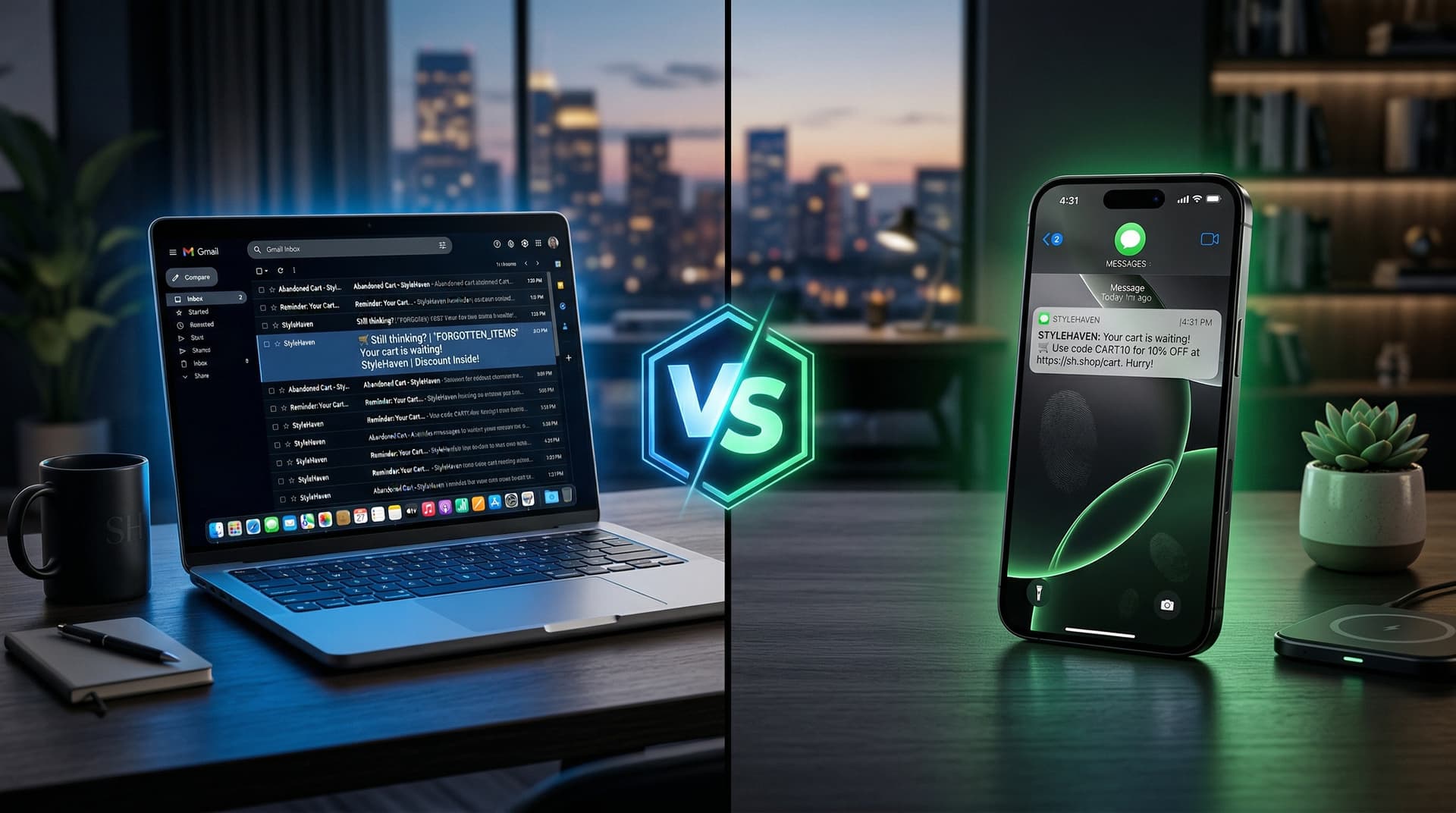
SMS converts higher. Email costs less. The real answer is both, but the details matter more than the headline.
The short version
- SMS abandoned cart messages convert at 15-20%. Email converts at 5-10%. SMS wins on raw conversion.
- SMS gets opened in 90 seconds. Email takes 90 minutes. That speed gap matters when the customer's intent is fading.
- Email costs roughly $0.003-0.01 per message. SMS costs $0.01-0.025. At scale, email is 3-5x cheaper per send.
- But cost per send is the wrong comparison. Cost per recovered cart is what matters, and SMS often wins that math despite higher per-message cost.
- Stores using both channels together see ~30% higher customer lifetime value than stores using one channel alone.
- SMS requires explicit opt-in under TCPA. You can't text people who only gave you an email address. This limits your SMS audience to a fraction of your email list.
- The 2026 playbook: SMS at 15 minutes, email at 1 hour, email at 24 hours, final SMS at 48 hours.
The question "should I use email or SMS for cart recovery?" was reasonable in 2021. In 2026, it's the wrong question. The brands recovering the most abandoned cart revenue use both. The question that matters is: in what order, with what timing, and with what content for each channel?
This guide compares the two channels on every metric that matters -- conversion, cost, speed, reach, compliance -- and then gives you the combined playbook that actually works. We also cover the compliance rules that determine who you can text in the first place, because getting this wrong carries penalties of $500-$1,500 per message.
Related reading: Browse abandonment flow guide
This post is part of our Abandoned Cart Email Ultimate Guide series.
Abandoned cart emails and SMS serve the same goal — recovering lost purchases — but they work differently. Email delivers higher revenue per message with richer content, while SMS gets faster open rates. The most effective recovery stacks combine both channels.
The head-to-head comparison
| Metric | SMS | |
|---|---|---|
| Open rate | ~45% | 98% |
| Average response time | 90 minutes | 90 seconds |
| Conversion rate | 5-10% | 15-20% |
| Cost per message | $0.003-0.01 | $0.01-0.025 |
| Unsubscribe rate per message | 0.1-0.3% | 1.5-3.5% |
| Subscriber tolerance | 3-7 emails/week | 1-2 texts/week |
| Consent requirement | Implied or single opt-in (varies) | Explicit written consent (TCPA) |
| Audience reach | 90%+ of customers | 20-40% of customers (opt-in dependent) |
| Content capacity | Unlimited (images, links, long copy) | 160 characters (SMS) or MMS |
| Best for | Detailed reminders, social proof, education | Quick nudges, time-sensitive alerts |
Sources: CartBoss, Omnisend, Klaviyo, Sendlane, Postscript
According to Omnisend (2025), SMS marketing messages achieve a 98% open rate compared to roughly 45% for email.
The speed advantage shows up in conversion data too:
According to CartBoss (2026), abandoned cart SMS messages convert at 15–20%, while abandoned cart emails convert at 5–10%.
According to Klaviyo (2025), stores using both email and SMS for cart recovery see approximately 30% higher customer lifetime value than those using a single channel.
The numbers make SMS look like the obvious winner. 98% open rate. 15-20% conversion. Responses in 90 seconds. But there's a catch that most "SMS vs email" comparisons gloss over: reach.
The reach problem with SMS
Your email list is probably 5-10x larger than your SMS list. Getting an email address is easy -- it happens at checkout, during account creation, through pop-ups, with lead magnets. Getting SMS consent is harder because it requires a separate, explicit opt-in with specific legal language.
So yes, SMS converts at 15-20%. But if you can only text 2,000 of your 20,000 cart abandoners because the rest never opted in to SMS, your email sequence (which reaches all 20,000) generates more total recovered revenue even at a lower conversion rate.
The math:
| Scenario | Audience | Conversion | Recovered carts |
|---|---|---|---|
| Email only (10,000 abandoners) | 10,000 | 7% | 700 |
| SMS only (2,000 opted-in) | 2,000 | 17% | 340 |
| Both channels combined | 10,000 email + 2,000 SMS | Varies | 850-950 |
Email's lower conversion rate applied to a much larger audience still produces more total recoveries than SMS's higher rate on a smaller pool. The combined approach wins because it captures both: the SMS-opted-in customers get the fastest, highest-converting touchpoint, and everyone else gets email.
This doesn't mean SMS isn't worth building. It is -- especially as your SMS list grows. But it does mean email is not optional. It's the foundation. SMS is the accelerator.
Is SMS or email better for abandoned cart recovery?
Email generates more revenue per message and allows richer content -- product images, reviews, detailed copy. SMS has higher open rates (98% vs. ~45%) and faster response times (90 seconds vs. 90 minutes). The best results come from using both in a coordinated sequence: SMS for speed and urgency, email for depth and reach. Stores running both channels see roughly 30% higher recovery rates than stores using either channel alone.
When SMS beats email
There are situations where SMS is clearly the better first touch:
High-AOV carts ($150+). The higher the cart value, the more the speed advantage of SMS matters. A customer who abandoned a $300 cart 10 minutes ago is more likely to respond to a text than to check their email. The financial payoff per recovery justifies the higher per-message cost.
Flash sales and limited inventory. If the product is actually selling out, SMS delivers the urgency in real time. An email sent at the 30-minute mark might arrive after the item is gone. A text at 15 minutes catches the customer while stock exists.
Mobile-first audiences. If your customer base skews young (18-34), they're more responsive to text than email. Gen Z checks text messages before email. For brands targeting this demographic, SMS as the first touchpoint in a cart recovery flow often outperforms email-first.
Repeat customers. Someone who has bought from you three times and abandoned a cart probably doesn't need a multi-paragraph email with reviews and social proof. A quick text -- "Hey [Name], your [Product] is waiting. Finish your order: [link]" -- is enough.
When email beats SMS
First-time visitors. Someone who has never bought from you needs more persuasion than a 160-character text can deliver. They need to see the product image, read a review, understand your return policy. Email gives you the space to address their concerns. A text from a brand they've never purchased from can feel intrusive.
Complex or considered purchases. A laptop, a mattress, a subscription commitment -- these products require information that doesn't fit in a text message. Email can include product comparisons, buying guides, customer testimonials, and detailed images. SMS can link to these things, but the friction of clicking from a text to a mobile page is higher than reading content directly in an email.
Audiences who haven't opted into SMS. This is the pragmatic answer: email beats SMS when SMS isn't available. And for most stores, 60-80% of their cart abandoners haven't opted into text marketing.
When you need multiple touchpoints. A three-email sequence tells a story: reminder, persuasion, incentive. Three text messages in three days feels aggressive and will spike your unsubscribe rate. Email tolerates higher frequency. SMS doesn't.
The combined playbook for 2026
The stores seeing the best results in 2026 aren't choosing between channels. They're running a combined flow that uses each channel for what it does best:
15 minutes after abandonment: SMS (if opted in)
Short. Personal. One link.
"Hey [Name], you left the [Product] in your cart. Grab it before it's gone: [cart link]"
This catches the customer while they're still on their phone, probably within the same session. 98% open rate. 90-second average response time. This is the fastest recovery touchpoint you can deploy.
For customers not opted into SMS, skip to the 1-hour email.
1 hour after abandonment: Email 1
The standard cart reminder. Product image, cart contents, direct link back. This is the email described in detail in our flow timing guide. For SMS-opted customers, this reinforces the text they already received. For everyone else, this is the first touchpoint.
24 hours after abandonment: Email 2
Social proof, reviews, objection handling. The longer format of email is perfect for this. You can include star ratings, customer photos, return policy details -- none of which fit in a text message. This email does persuasion work that SMS fundamentally can't.
48 hours after abandonment: Final SMS (if opted in)
This is where the incentive lives for your SMS audience. A short, direct text with a discount code or free shipping offer:
"[Name], still want the [Product]? Here's free shipping on us: [link with code]. Expires tonight."
The combination of urgency (expires tonight) and incentive (free shipping) in a channel with a 98% open rate makes this the most effective final push in the sequence.
72 hours after abandonment: Email 3
The email closer for everyone. Incentive, cart expiration, or last-chance framing. This reaches the 60-80% of your audience that doesn't have SMS. For the full email 3 breakdown, see our flow timing guide.
Why this order works
SMS goes first and last because speed matters most at the beginning (catching fading intent) and a direct channel matters most at the end (cutting through inbox noise for the final push). Email handles the middle because it has the content depth for persuasion that SMS lacks.
The customer who's opted into both channels gets four touchpoints across two channels over three days. The customer who's email-only gets three emails. Both paths are complete recovery sequences.
Cost comparison: per message vs. per recovery
The per-message cost comparison favors email:
| Channel | Cost per message | Messages per recovery | Cost per recovered cart |
|---|---|---|---|
| $0.003-0.01 | 3-5 | $0.01-0.05 | |
| SMS | $0.01-0.025 | 1-2 | $0.01-0.05 |
The surprise: cost per recovered cart is roughly similar. SMS costs more per send but converts at a higher rate, so you need fewer messages per recovery. Email costs less per send but converts at a lower rate, requiring more messages.
Where cost does matter is at scale. A store sending 50,000 cart abandonment emails per month spends $150-500 on email. The same store sending 10,000 SMS messages spends $100-250. Add both together and total spend is $250-750/month for a combined flow that might recover $15,000-50,000 in revenue.
The ROI math is not close. Even at the higher end of costs, cart recovery returns 20-100x what it costs to run. The debate about SMS being "more expensive" than email is about pennies when the revenue at stake is thousands.
Platform pricing for SMS
- Klaviyo: ~$0.012 per SMS. Included in plans alongside email. Combined email+SMS flows in one interface.
- Postscript: ~$0.01 per SMS. Shopify-focused. Separate from email platform.
- Omnisend: SMS bundled with email plans. Pricing varies by volume.
- Sendlane: Combined email+SMS. Unified customer profiles.
- Attentive: Enterprise SMS platform. Higher per-message cost, more sophisticated targeting.
If you're already on Klaviyo or Omnisend for email, adding SMS to your existing cart flow is the lowest-friction option. (For a step-by-step Klaviyo setup, see our Klaviyo abandoned cart email flow guide.) The customer data is already there. The flow builder already supports both channels. You're adding a channel, not a platform.
Compliance: the rules you can't ignore
This is the section most "SMS vs email" articles skip, and it's the one that can cost you the most money.
TCPA (US)
The Telephone Consumer Protection Act governs text marketing in the United States. The key requirements:
You need prior express written consent before sending marketing texts. This means a checkbox, a web form, or a keyword opt-in with specific disclosure language. Giving you their phone number at checkout is not consent to receive marketing texts.
The consent language must include: the brand name, that messages are automated, that consent is not required for purchase, message frequency disclosure, and instructions to reply STOP.
Abandoned cart texts are limited to one message per cart event and must be sent within 48 hours of abandonment.
As of April 2025, consumers can revoke consent in any reasonable manner (not just by texting STOP), and you must honor revocation within 10 business days.
Penalties: $500-$1,500 per non-compliant message. This is per message, not per campaign. Send 1,000 non-compliant texts and you're looking at $500,000-$1.5M in potential liability.
GDPR (EU/UK)
Stricter than TCPA. Requires explicit, informed, freely given consent. Pre-checked boxes don't count. Consent must be separate from terms of service. You must prove consent was given. Right to be forgotten applies.
CASL (Canada)
Similar to GDPR. Express consent required. Must identify the sender and include unsubscribe mechanism. Consent records must be maintained.
Practical implications
The compliance requirements mean your SMS list will always be smaller than your email list. Building it takes intentional effort: dedicated opt-in forms, keyword campaigns, checkout opt-in checkboxes with proper disclosure.
The brands with the largest SMS lists (20-40% of their customer base) are the ones that made SMS opt-in a deliberate part of their acquisition funnel, not an afterthought. Pop-ups offering early access or exclusive deals in exchange for phone numbers. Post-purchase flows that invite SMS opt-in. Dedicated landing pages for text clubs.
If your SMS list is under 10% of your email list, building it should be a priority before optimizing your SMS cart recovery flow. The best flow in the world doesn't matter if nobody's opted in to receive it.
Building your SMS list for cart recovery
Your cart recovery SMS can only reach people who opted in before they abandoned. You can't retroactively text someone who left a cart just because you have their phone number from a previous order. The consent has to be in place before the trigger event.
Tactics that actually build SMS lists:
Checkout opt-in checkbox. "Text me order updates and exclusive offers." This catches people at the moment they're most engaged with your brand. Conversion rate on checkout opt-in: 10-25% depending on placement and incentive.
Pop-up with SMS incentive. "Get 15% off your first order -- enter your phone number." These convert at 3-8% of site visitors and build your SMS list alongside your email list.
Post-purchase SMS invitation. After the first order, invite the customer to join your text list for exclusive access or early drops. They've already bought, so trust is established.
Keyword campaigns. "Text CART to 55555 for exclusive deals." Works well on social media, packaging inserts, and in-store signage.
The faster your SMS list grows, the more revenue your combined cart recovery flow generates. This is a compounding investment. Every new SMS subscriber is another person who gets the fastest, highest-converting recovery touchpoint in your flow.
Platform comparison for combined email + SMS cart recovery
Not all platforms handle the email-SMS combination equally. Here's how the main options compare for running a unified abandoned cart flow:
Klaviyo
The strongest option for Shopify stores that want email and SMS in one flow builder. You can build a single abandoned cart flow that branches: SMS to opted-in subscribers at 15 minutes, email to everyone at 1 hour, with conditional splits by channel preference, cart value, and customer history. SMS pricing at ~$0.012/message is mid-range. The advantage is unified customer profiles -- one view of the customer across both channels, with shared suppression logic so you don't over-message.
Omnisend
Purpose-built for ecommerce with email, SMS, and push notifications in a single workflow. Cookie-based cart tracking catches more abandoners than platforms that only track logged-in users. The interface is more accessible than Klaviyo for teams without a dedicated email specialist. SMS pricing is competitive and bundled with email plans.
Postscript + Klaviyo (or other ESP)
Postscript is a dedicated SMS platform that integrates with Klaviyo, Shopify, and other tools. The advantage: deeper SMS-specific features like conversational SMS, AI-powered responses, and advanced segmentation. The disadvantage: you're managing two platforms instead of one, and the customer data lives in two places. Best for stores that want best-in-class SMS and are willing to handle the integration complexity.
Sendlane
Built specifically for ecommerce retention. Unified email and SMS with strong abandoned cart automation. The pitch is simpler than Klaviyo with comparable functionality for most DTC use cases. Worth evaluating if you find Klaviyo's interface overwhelming.
Attentive
Enterprise-grade SMS platform. The most sophisticated SMS targeting and personalization. Higher per-message cost, longer implementation. Best for brands doing $10M+ in revenue who need SMS at scale with advanced segmentation. Overkill for most stores under $5M.
What I'd recommend
If you're on Shopify and already using Klaviyo for email, add Klaviyo SMS. Unified data, single flow builder, no integration to maintain. If you're on Shopify and want to go deep on SMS specifically, pair Postscript with your email ESP. If you're on WooCommerce, Omnisend handles both channels well within a single platform.
The platform decision matters less than the decision to use both channels. A simple combined flow on any of these platforms will outperform a sophisticated single-channel flow on the best platform money can buy.
SMS abandoned cart conversion rate benchmarks by platform (2026)
The platforms running SMS cart recovery report performance differently. Some publish flow-specific benchmarks for abandoned cart messages, which are the most useful numbers to plan against. Others report only at the channel level, mixing campaigns with automations. A few don't publish first-party network data at all and rely on third-party studies. Here's what each major platform actually publishes for SMS abandoned cart performance.
Klaviyo SMS abandoned cart benchmarks (2026)
Klaviyo dominates the ecommerce email market and offers SMS as a unified channel, but their published abandoned cart benchmarks are almost entirely email-focused. The widely-cited 3.33% abandoned cart conversion rate and $3.65 revenue per recipient are email numbers, not SMS. Klaviyo intentionally avoids reporting SMS conversion rate as a primary benchmark; their stated reason is that SMS conversion windows vary by account configuration, so they use revenue per recipient instead.
What Klaviyo does publish for SMS at the flow level (combining abandoned cart, browse abandonment, welcome, and post-purchase): SMS flows generate roughly 8x higher revenue per recipient than SMS campaigns. Top-10% performers exceed $5 RPR. Top-10% SMS campaigns hit a 27.5% click rate against a 14.18% average. Flows make up 7.6% of SMS sends but drive 45.2% of total SMS revenue.
According to Klaviyo (2026), "Flows represent 7.6% of sends but drive 45.2% of total SMS revenue."
For abandoned cart specifically, Klaviyo's industry-by-industry email data is the more useful reference. Their analysis of 143,000+ abandoned cart flows shows food and beverage leading at 52.16% open rate and 3.66% conversion rate, apparel at 3.42% conversion, and electronics underperforming at 2.8%. All email numbers, not SMS.
If you're running SMS abandoned cart on Klaviyo, your real benchmarks come from inside your own account. The platform's public numbers don't tell you what good looks like for SMS abandoned cart specifically.
Postscript SMS abandoned cart benchmarks (2026)
Postscript publishes the cleanest SMS-specific abandoned cart data of any platform. Their 2025 SMS Marketing Benchmarks (covering Jan 1, 2025 through Dec 15, 2025) report:
- 9.1% average conversion rate on abandoned cart automations across all industries
- 18.4% average click-through rate
- $8.11 average earnings per message
By industry: beauty conversion runs 8.2% with $6.29 EPM. Apparel runs 8.5% conversion, 15.5% CTR, and $5.92 EPM. Health and wellness EPM ranges from $6.67 to $20.22. Top performers across categories see EPM in the $4.36 to $13.79 range.
According to Postscript (2025), "The average conversion rate on Abandoned Cart automations across all industries is 9.1%."
According to Postscript (2025), "Abandoned cart messages garner 9.6% conversion rates and 18.4% clickthrough rates, and earn $8.46 per message."
Postscript skews toward mid-market Shopify brands. Their numbers are honest about what an average store can expect; they don't cherry-pick top performers as representative. If you're benchmarking a Shopify-based abandoned cart SMS flow, Postscript's published numbers are the closest match to what your account should produce.
Attentive SMS abandoned cart benchmarks (2026)
Attentive serves enterprise brands and reports the highest abandoned cart SMS numbers in the industry. Their published cart-abandonment-reminder benchmarks:
- 19% average conversion rate across all industries
- 33% average click-through rate
- $8.00 average revenue per send
Their analysis of 25 billion SMS messages sent in 2024 found cart-abandoned messages reach a 24.6–39.4% conversion rate for the highest-performing message variants, nearly 4x the all-flow average. Real-time triggers sent within 5 minutes of cart abandonment push CTR to 36% versus a 9.2% baseline.
According to Attentive (2025), "Cart Abandonment Reminders have an average CTR of 33%, average CVR of 19%, and average Revenue/Send of $8.00."
According to Attentive (2025), "Sending an SMS within 5 minutes of a user action like cart abandonment boosts click-through rates to 36%, compared to the 9.2% industry average."
The Attentive 19% versus Postscript 9.1% gap is real, not a discrepancy. Two drivers: Attentive's brand mix skews enterprise (larger, more established brands with stronger conversion mechanics across the funnel), and Attentive's content runs heavier AI personalization than the Postscript average. Both numbers are first-party platform data. If your store is enterprise-scale, Attentive's numbers are realistic. If you're mid-market, plan against Postscript's.
Omnisend SMS abandoned cart benchmarks (2026)
Omnisend reports SMS at the channel level rather than breaking abandoned cart out separately. Their 2025 Ecommerce Marketing Report combines abandoned cart, browse abandonment, welcome, and post-purchase into one bundle they call "automated SMS." For that bundle:
- 0.77% automated SMS conversion rate (per send, not per click)
- 20.32% click-to-sent rate
- $0.74 revenue per send
- 147% higher click rate than SMS campaigns
For their cart recovery workflows specifically, which combine email, SMS, and push in a multi-channel sequence, Omnisend reports 44.57% conversion. That's the multi-channel workflow rate, not SMS-only. Quoting it as an SMS benchmark would overstate what SMS alone delivers.
According to Omnisend (2025), "Click rates for SMS automations were 147% higher than campaigns, and conversion rates were 118% better."
If you're running cart recovery on Omnisend, the platform's strength is multi-channel coordination: email, SMS, and push firing in one workflow with shared suppression. Their reported numbers reflect that integrated approach, which makes platform-to-platform SMS-only comparison harder. Use Postscript's 9.1% as your SMS-only reference. Expect Omnisend's combined workflow to recover more total carts than SMS alone, fewer per channel.
Yotpo SMS and SMSBump abandoned cart benchmarks (2026)
Yotpo SMS is the rebranded SMSBump platform after Yotpo's 2020 acquisition. The two are now one product. Yotpo's network-level benchmarks live in a gated 2024 report titled "Message Delivered." The freely available 2024-in-review summary publishes directional numbers:
- 78% year-over-year increase in SMS-attributed revenue across the Yotpo network
- Flows generated 54% of total SMS revenue from 14% of marketing budget
- 50x ROI on multi-message campaigns combining SMS and email
For abandoned cart specifically, Yotpo's strategy guides reference 19% or higher conversion as industry guidance and quote a 15–25% recovery rate range, but those numbers aren't Yotpo-network-only. They're industry composites Yotpo cites in its content. Legacy SMSBump KPI articles list 30% click-through rate as a good benchmark for SMS broadly and 45% conversion as the high end across all SMS message types. Both are undated and lack methodology disclosure, so use them carefully.
According to Yotpo (2024 in review), "Yotpo SMS helped brands drive a 78% year-over-year increase in SMS-attributed revenue."
The honest read: Yotpo doesn't publish a public abandoned-cart-SMS conversion rate from their network. Their gated benchmark report likely contains it. If you're on Yotpo SMS, request the gated benchmark report from your account team or use Postscript's 9.1% as a directional planning number. Yotpo's brand mix is similar enough to Postscript's that the order of magnitude should hold.
Sendlane SMS abandoned cart benchmarks (2026)
Sendlane doesn't publish a first-party network benchmark for SMS abandoned cart. Their blog content cites third-party studies rather than Sendlane-customer data. The most-quoted statistic in their content:
According to a Barilliance study cited by Sendlane, "messages sent within an hour of a customer abandoning their cart have a 20.3% conversion rate."
That number is Barilliance's, not Sendlane's network data. It's directionally consistent with Attentive's 19% but doesn't tell you anything specific about Sendlane platform performance.
Sendlane publishes one customer case study where recovery rate climbed from 1.8% to 34% after setting up SMS cart abandonment automation. That's a single-store outlier, not a platform benchmark. Useful as a "what's possible" reference, not a planning number.
If you're evaluating Sendlane for SMS abandoned cart, the lack of published network data is a yellow flag, not a red one. The platform handles email and SMS in a unified flow builder and integrates well with Shopify. For benchmark planning, Postscript and Attentive's published numbers are better references than Sendlane's third-party citations.
Drip SMS abandoned cart benchmarks (2026)
Drip is primarily an email platform that expanded SMS recently. Like Sendlane, they don't publish first-party SMS abandoned cart benchmarks. Their published cart abandonment stats are aggregations of third-party research (Baymard Institute, Klaviyo, and others), not Drip-customer data.
The closest SMS-specific number Drip publishes:
According to Drip (2026), "If you effectively use a 60-minute delay, you can potentially recover up to 16.4 orders for every 100 SMS messages you send to customers."
That 16.4% recovery rate is a third-party stat Drip references, not their network data. For email, which is Drip's core competency, they publish: cart abandonment emails see open rates above 40% and an average conversion rate of 18.64%. The 18.64% number is high relative to Klaviyo's 3.33% and reflects Drip's curated source data rather than network measurement.
Drip works for stores already using their email platform that want to add SMS without changing tools. It's not the platform to choose if you're optimizing primarily for SMS abandoned cart performance, and the absence of published SMS network data reflects that prioritization.
Industry-wide SMS conversion rate benchmarks (2026)
Putting the platform-level numbers side by side highlights how much variation there is across the SMS ecosystem:
| Platform | SMS abandoned cart conversion | Click-through rate | Revenue per send | Source |
|---|---|---|---|---|
| Postscript | 9.1% (all industries, 2025) | 18.4% | $8.11 EPM | Postscript 2025 SMS Marketing Benchmarks |
| Attentive | 19% (all industries) | 33% | $8.00 RPS | Attentive cart abandonment benchmarks |
| Klaviyo | Not published as SMS-specific | 14.18% (SMS campaigns) | $5+ RPR (top 10% SMS flows) | Klaviyo 2026 SMS Marketing Benchmarks |
| Omnisend | 0.77% (automated SMS, all flows) | 20.32% (per send) | $0.74 RPS | Omnisend 2025 Ecommerce Marketing Report |
| Yotpo (incl. SMSBump) | Not publicly published | Not publicly published | 78% YoY revenue growth | Yotpo 2024 In Review |
| Sendlane | No first-party data | No first-party data | No first-party data | Cites Barilliance 20.3% |
| Drip | No first-party data | No first-party data | No first-party data | Cites 16.4% recovery (third-party) |
The Postscript 9.1% versus Attentive 19% gap is the most important pattern in this table. Three things drive it:
- Brand mix. Attentive's customer base skews enterprise. These brands have larger SMS lists, more sophisticated personalization, and stronger overall conversion mechanics. Postscript skews mid-market Shopify, where the average store has less optimization in place.
- Message personalization. Attentive runs heavier AI-driven content variation. Their 24.6–39.4% top-variant conversion rates reflect that. Postscript's 9.1% is closer to a baseline of "send a templated abandoned cart text and see what happens."
- Definition of conversion. Both platforms count purchases attributed to SMS within their conversion window, but the windows differ. Attentive's reporting tilts toward longer attribution periods, Postscript's toward shorter, which inflates Attentive's number relative to Postscript on a like-for-like basis.
For most stores planning SMS abandoned cart strategy, the honest planning number sits between 9% and 12%: the Postscript range plus a small lift for personalization. Hitting 19% requires either enterprise-scale optimization or a brand that's genuinely outperforming the average. Don't budget for Attentive numbers unless your operation matches Attentive's customer profile.
Across the ecosystem in 2025–2026, abandoned cart SMS conversion rates range from 9% (Postscript average) to 19% (Attentive average), with revenue per send between $0.74 (Omnisend automated SMS) and $8.11 (Postscript abandoned cart specifically). A good number for your store is anything above 9% if you're on Postscript or its mid-market peers, anything above 19% if you're on Attentive or other enterprise platforms. Below 5% conversion suggests something is wrong: timing too late, message too generic, or no incentive in the second touchpoint. Above 25% is exceptional and usually requires AI-personalized content or a hand-curated VIP segment.
Email vs SMS recovery rate by industry (2026)
Recovery rate varies more by industry than by channel. Beauty and apparel respond strongly to both. Electronics underperform on both because consideration cycles are longer than the 24–72 hour cart recovery window. The cross-industry table, where data exists:
| Industry | Email cart recovery (Klaviyo) | SMS cart recovery (Postscript) | Combined approach typical |
|---|---|---|---|
| Beauty | 3.33% conversion / open rate near average | 8.2% conversion / $6.29 EPM | 9–12% combined |
| Apparel | 3.42% conversion / 51.43% open / 6.25% click | 8.5% conversion / 15.5% CTR / $5.92 EPM | 10–14% combined |
| Home & furniture | $6 RPR average / $64.52 RPR top 10% | Not separately published | RPR-based planning; SMS data gap |
| Electronics | 2.8% conversion / $6 RPR average / $66.89 top 10% RPR | Not separately published | SMS adds ~5–8% incremental |
| Food & beverage | 3.66% conversion / 52.16% open / 6.63% click | Not separately published | Fastest combined recovery (highest open/click) |
According to Klaviyo (2024), "The food and beverage industry drove the highest average open rate for abandoned cart flows at 52.16%, with an above-average click rate of 6.63% and an above-average conversion rate of 3.66%."
A few patterns worth calling out:
Beauty and apparel are the strongest verticals for both channels. Beauty runs an 80.92% cart abandonment rate (highest of any vertical) but converts strongly when it does recover: 3.33% on email, 8.2% on SMS. Apparel matches that pattern. Both verticals have impulsive purchase cycles that respond well to recovery touchpoints.
Electronics is the weakest cart recovery vertical. Email conversion sits at 2.8% and SMS data is sparse, but the available signals point to SMS underperforming the 9.1% all-industry average in this category. The reason: a customer abandoning a $1,200 laptop isn't going to be reactivated by a 60-minute SMS reminder. The consideration cycle is days or weeks, not hours.
Home and furniture is mid-pack on email but data-thin on SMS. Klaviyo publishes RPR averages around $6 with top-10% performers at $64.52 per recipient. The high top-10% number reflects high AOV: when home and furniture recoveries do convert, the order is large. SMS conversion rates for this vertical aren't publicly published. Expect performance similar to apparel given comparable purchase consideration patterns.
Food and beverage is the fastest-recovering vertical on email at 52.16% open rate, 6.63% click rate, and 3.66% conversion, all above the all-industry averages. The category benefits from low consideration cost (a $30 hot sauce reorder doesn't require deliberation) and frequent repurchase patterns. SMS data isn't separately published for this vertical, but the pattern likely holds given how reactive food and beverage shoppers are to short-cycle prompts.
For planning purposes, the email columns are reliable. The SMS columns have gaps that reflect what platforms publish, not gaps in actual performance. If your vertical is missing an SMS conversion number, default to Postscript's 9.1% all-industry average and adjust based on whether your category typically over-performs (beauty, apparel, food) or under-performs (electronics) the mean.
Geysera coordinates email and SMS recovery in a single managed flow — so each message hits the right channel at the right time, without overlap. See how it works →
Frequently asked questions
Is SMS or email better for abandoned cart recovery? Together, they're better than either alone. Stores using both see ~30% higher CLV. If you have to pick one, start with email because your reach is 5-10x larger. Add SMS once you've built a meaningful opt-in list.
How many texts should I send for an abandoned cart? Two at most. One at 15 minutes (reminder) and one at 48 hours (final push with incentive). SMS tolerance is much lower than email. Three texts about the same cart will spike your unsubscribe rate.
Can I text someone who abandoned a cart if they gave me their phone number at checkout? Not for marketing purposes -- not unless they explicitly opted into marketing texts with proper TCPA disclosure. Their phone number on the order form is for transactional communication (shipping updates, order confirmation), not marketing.
What should an abandoned cart text message say? Keep it under 160 characters. Include the customer's name, the product name, and a direct link back to their cart. Example: "Hey Sarah, your Blue Wool Sweater is still waiting. Complete your order: [link]." That's it.
How much does SMS cart recovery cost? $0.01-0.025 per message depending on platform and volume. For a store sending 5,000 cart abandonment texts per month, that's $50-125. The typical ROI from SMS cart recovery is 800%+.
Do I need a separate platform for SMS? Not necessarily. Klaviyo, Omnisend, and Sendlane all support SMS alongside email in a single flow. Postscript and Attentive are dedicated SMS platforms that integrate with your email ESP. If you're already on Klaviyo or Omnisend, adding SMS within the same platform is the simplest path.
What is a good SMS abandoned cart conversion rate in 2026? Anywhere from 9% to 19%, depending on your platform and brand size. Postscript's all-industry 2025 average is 9.1%. Attentive's enterprise-skewed average is 19%. For mid-market Shopify stores, 9–12% is realistic. Above 25% is exceptional and usually requires AI-personalized content or a VIP segment.
What is Klaviyo's SMS abandoned cart conversion rate? Klaviyo doesn't publish an SMS-specific abandoned cart conversion rate. The widely-cited 3.33% conversion / $3.65 RPR numbers are email, not SMS. For SMS at the flow level, Klaviyo reports top-10% performers exceed $5 revenue per recipient and a 27.5% click rate, and that flows make up 7.6% of SMS sends but drive 45.2% of SMS revenue. For abandoned cart SMS specifically on Klaviyo, your benchmarks come from inside your own account.
What is Postscript's SMS abandoned cart conversion rate? 9.1% across all industries in 2025, with an 18.4% click-through rate and $8.11 earnings per message. By vertical: beauty runs 8.2%, apparel runs 8.5%. Postscript publishes the cleanest SMS-specific abandoned cart benchmarks in the industry.
What is Attentive's SMS abandoned cart conversion rate? 19% average with a 33% click-through rate and $8.00 average revenue per send. The highest-performing message variants in their 2024 analysis of 25 billion messages reach 24.6–39.4% conversion. Attentive skews enterprise, so these numbers are realistic for established brands with sophisticated SMS programs and less realistic for mid-market stores still building their SMS list.
How much revenue does SMS abandoned cart recovery generate per send? Between $0.74 and $8.11 depending on platform and reporting methodology. Postscript's 2025 abandoned cart EPM is $8.11. Attentive's average revenue per send for cart abandonment reminders is $8.00. Omnisend's automated SMS revenue per send is $0.74 (this number bundles abandoned cart with browse abandonment, welcome, and post-purchase, so it's lower than abandoned-cart-specific figures from other platforms). Top performers across the ecosystem reach $13–$20 per message in high-AOV verticals.
Should I send SMS and email for cart abandonment, or just one? Both. Stores running coordinated email + SMS see roughly 30% higher recovery than stores running either channel alone. Email reaches everyone in your full opt-in audience. SMS reaches the 20–40% who opted into texts but converts at 2–3x the rate. The combined approach captures both: SMS-opted customers get the fastest, highest-converting touchpoint; everyone else gets email. Skipping SMS leaves recovery revenue on the table for the customers who would have responded fastest. Skipping email leaves the majority of your audience unreached.
What's the average click rate on SMS abandoned cart messages? 15–33% depending on platform. Postscript reports 18.4% (all industries, 2025). Attentive reports 33% (skews enterprise). Apparel and beauty cluster around 15–17% on Postscript. Real-time triggers sent within 5 minutes of cart abandonment push CTR up to 36% in Attentive's analysis of 25 billion messages.
Back to the pillar: Abandoned Cart Email: The Ultimate Guide
Next in the series: Why Customers Abandon Carts (And How to Fix Each Reason)
This guide is the hub of a 13-part series on abandoned cart email. Each spoke post goes deeper on a specific topic:
- Abandoned Cart Email: The Ultimate Guide to Recovering Lost Revenue in 2026
- Abandoned Cart Email Subject Lines That Actually Get Opened
- Cart Abandonment Rate by Industry: 2026 Benchmarks
- The Perfect Abandoned Cart Email Flow: Timing and Sequence
- 40+ Abandoned Cart Email Examples from Top DTC Brands
- Abandoned Cart Email vs. SMS: Which Recovers More Revenue? (you are here)
- Why Customers Abandon Carts (And How to Fix Each Reason)
- Abandoned Cart Email Discounts: When to Offer and When to Hold Back
- How to Set Up Abandoned Cart Emails in Klaviyo + Shopify
- Abandoned Cart Email Design: Templates, Layout, and CTA Best Practices
- Browse Abandonment vs. Cart Abandonment vs. Checkout Abandonment: The Complete Email Recovery Playbook
- WooCommerce Abandoned Cart Email: Complete Setup and Plugin Guide for 2026
- Mailchimp Abandoned Cart Email for WooCommerce: Setup and Plugin Guide (2026)
Sources
- CartBoss — Email vs SMS Abandoned Cart Statistics
- Omnisend — 2025 Ecommerce Marketing Report
- Omnisend — 2025–2026 Ecommerce Benchmarks
- Klaviyo — 2026 SMS Marketing Benchmarks by Industry
- Klaviyo — Abandoned Cart Benchmark Report
- Klaviyo — SMS Pricing and Benchmarks
- Postscript — 2025 SMS Marketing Benchmarks
- Postscript — SMS Statistics & Conversion Rates
- Postscript — SMS Marketing Benchmarks (blog)
- Attentive — Cart Abandonment Journeys Best Practices
- Attentive — Marketing Benchmarks Report Highlights (25B messages)
- Yotpo — 2024 In Review: How SMS and Email Drove Brand Growth
- Sendlane — Cart Abandonment SMS
- Sendlane — Email + SMS Platform Data
- Drip — 21 Cart Abandonment Statistics 2026
- MotoCMS — Email vs SMS for Abandoned Cart Recovery 2026
- ActiveProspect — TCPA Text Message Compliance Guide 2026
- Bloomreach — TCPA and CTIA Compliance for SMS
- Dialzara — AI SMS vs Email for Cart Recovery

Co-Founder and CEO
Bob Thordarson is CEO and Co-Founder of Geysera, a serial entrepreneur with 25+ years and five co-founded ventures, including Cequint (acquired by TNS in 2010 for $112.5M) and Consumerware (acquired by ParkerVision). A graduate of the University of Washington and MIT Entrepreneurial Masters Program, based in Seattle, he serves on the boards of DRY Soda Co. and the Entrepreneurs' Organization Seattle chapter. He is an expert in retention marketing email systems and methodology for ecommerce and B2B brands — measured by incremental revenue, not vanity metrics.