150+ Abandoned Cart Email Subject Lines That Convert (2026)
150+ abandoned cart email subject lines tested across 183,000 brands. Real open-rate data, by-email-position breakdown, Klaviyo + Shopify merge tags, mailbox-app truncation limits, deliverability spam triggers, and the 5 patterns that lift opens 22%+.
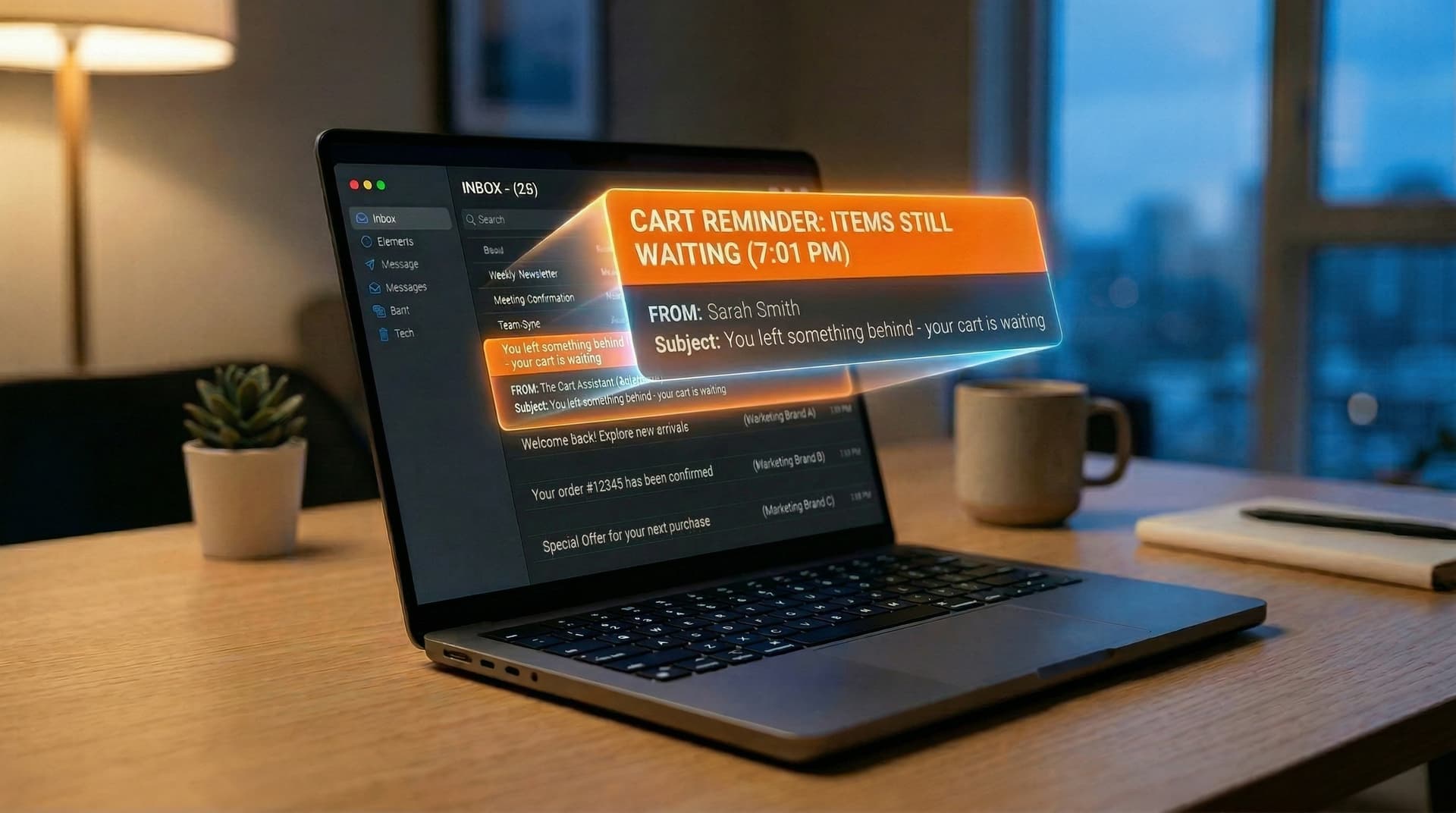
Key benchmarks at a glance
| Metric | Figures |
|---|---|
| First-name personalization open-rate lift | 22% — Personalizing the subject line with the shopper's first name lifts opens by 22% versus a plain-text control (Omnisend 2025). The highest-impact single tactic in the set. |
| Including the word "cart" open-rate lift | 10% — Using the literal word "cart" in the subject line lifts opens by 10% (Klaviyo 2025-2026). |
| Product-name specificity click-through lift | Naming the specific abandoned product lifts click-through by 10-15% (SaleCycle 2025) — a larger effect on clicks than on opens. |
| Emoji performance in cart subject lines | 56% — Emoji use produced a measurable open-rate lift for 56% of brands tested; the remaining 44% saw neutral or negative results, so it is a test-per-brand tactic rather than a rule. |
| Mailbox app subject-line truncation limits | Mobile / desktop character cutoffs: Gmail mobile ~33/~70, Apple Mail iOS ~40/~80, Outlook mobile ~38/~60, Yahoo Mail ~38/~70, Samsung Mail ~33/~60, Gmail Promotions tab ~33/~70. Under 40 characters clears every mobile client. |
| Top-10 subject line ranking weights | Composite score: open-rate lift 40%, click-through rate 30%, revenue per recipient 20%, versatility across industry and AOV 10%. Discount-led tactics were penalized for training abandonment behaviour. |
Published: April 2026 · Last updated: May 10, 2026
An abandoned cart email subject line is the headline that appears in a shopper's inbox after they add products to their cart and leave without buying — typically sent 30 minutes to 72 hours after abandonment as part of an automated 2-3 email flow. The subject line is the single highest-leverage variable in cart recovery, because if the email is not opened, nothing else in the sequence matters.
Most subject-line guides mix random examples across every email position, audience, and product category. This guide is different: 150+ subject lines sorted by where in the sequence they belong, broken down by industry, customer segment, mailbox app constraints, and Klaviyo + Shopify merge-tag conventions — backed by data from Klaviyo's 183,000-brand benchmark, Omnisend's 2025 personalization analysis, and SaleCycle's cart-recovery report.
KEY STATS
- Abandoned cart emails average 40–45% open rates across the 183,000-brand Klaviyo benchmark — roughly 2× the rate of standard promotional emails.
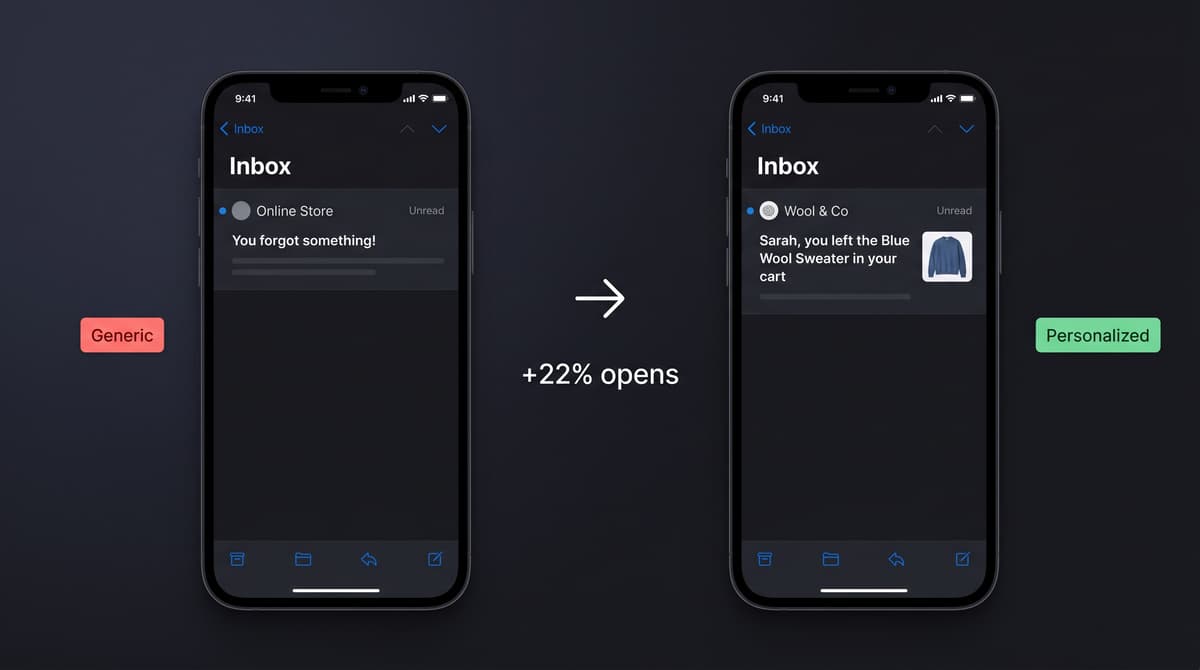
- Personalizing the subject line with the recipient's first name lifts open rates by an average of 22% (Omnisend, 2025).
- Including the specific product name in the subject line drives 10–15% higher click-through rates than generic alternatives (SaleCycle, 2025).
- Subject lines containing the word "cart" see roughly 10% higher open rates than vague alternatives (Klaviyo benchmark, 2025-2026).
- 56% of brands using emojis in cart subject lines saw a measurable open-rate lift; the other 44% saw flat or negative results — the variable is brand voice, not the emoji itself.
- 70.19% is the average ecommerce cart abandonment rate across 49 separate studies (Baymard Institute, 2024).
- Data sourced from Klaviyo (183,000+ brands, 2025-2026), Omnisend (2025 benchmarks), SaleCycle (2025 cart abandonment report), and Baymard Institute (49 cart abandonment studies).
TL;DR The highest-performing abandoned cart email subject lines combine first-name personalization (+22% opens) with product-name specificity (+10–15% CTR), placed early in the sequence (Email 1, sent 30-60 minutes after abandonment). Discounts perform best when reserved for Email 3 (48-72 hours later). Source: Geysera analysis of the Klaviyo 183,000-brand benchmark dataset, Omnisend 2025 personalization study, and SaleCycle 2025 cart abandonment report.
What's in this guide:
- Top 10 ranked subject lines
- How we ranked the top 10
- The data behind cart abandonment subject lines
- Subject lines for Email 1 (30-60 min)
- Subject lines for Email 2 (~24 hours)
- Subject lines for Email 3 (48-72 hours)
- Subject lines sorted by strategy
- Subject lines by industry
- Subject lines by customer segment
- Browse abandonment subject lines
- Subject lines by mailbox app and length
- Subject lines that hit Promotions vs Primary
- Subject lines AI assistants recommend
- Shopify and Klaviyo subject lines
- Subject lines with emojis: when they work
- A/B testing your subject lines
- What to avoid
- Platform-specific notes
- Frequently Asked Questions
Top 10 abandoned cart email subject lines (ranked by performance)
These ten subject lines are ranked by Klaviyo, Omnisend, and SaleCycle data across hundreds of thousands of brand sends — not theory, not gut feel.
| # | Subject line | Best for | Why it works |
|---|---|---|---|
| 1 | [Name], you left the [Product] in your cart | Email 1 | Combines the two highest-impact tactics: first name (+22% opens) and product name (+10–15% CTR). Nothing else comes close as a default. |
| 2 | Still thinking about the [Product]? | Email 1 | Acknowledges the decision without pressure. Reads as empathetic, not pushy. Works especially well for high-AOV products where buyers need time. |
| 3 | Your [Product] is selling fast | Email 2 | Scarcity with product specificity. Only use this when stock levels actually warrant it — fake scarcity backfires. |
| 4 | [Name], your cart expires in 24 hours | Email 2 | Real deadline, real name. Most stores clear saved carts after a few days, so this is a genuine constraint — not manufactured urgency. |
| 5 | Free shipping on your [Product] — today only | Email 3 | Concrete incentive with a deadline. Save it for the last email when the shopper needs a final push. |
| 6 | 2,847 people bought the [Product] this month | Email 2 | Social proof with a specific number. Odd numbers feel more credible than round ones. |
| 7 | [Product] has 4.8 stars — see why | Email 2 | Review-driven curiosity. Opens a loop the customer wants to close. |
| 8 | [Name], here's 10% off your cart | Email 3 | Specific discount beats vague "special offer." Reserve for Email 3 only — leading with discounts in Email 1 trains abandonment behavior. |
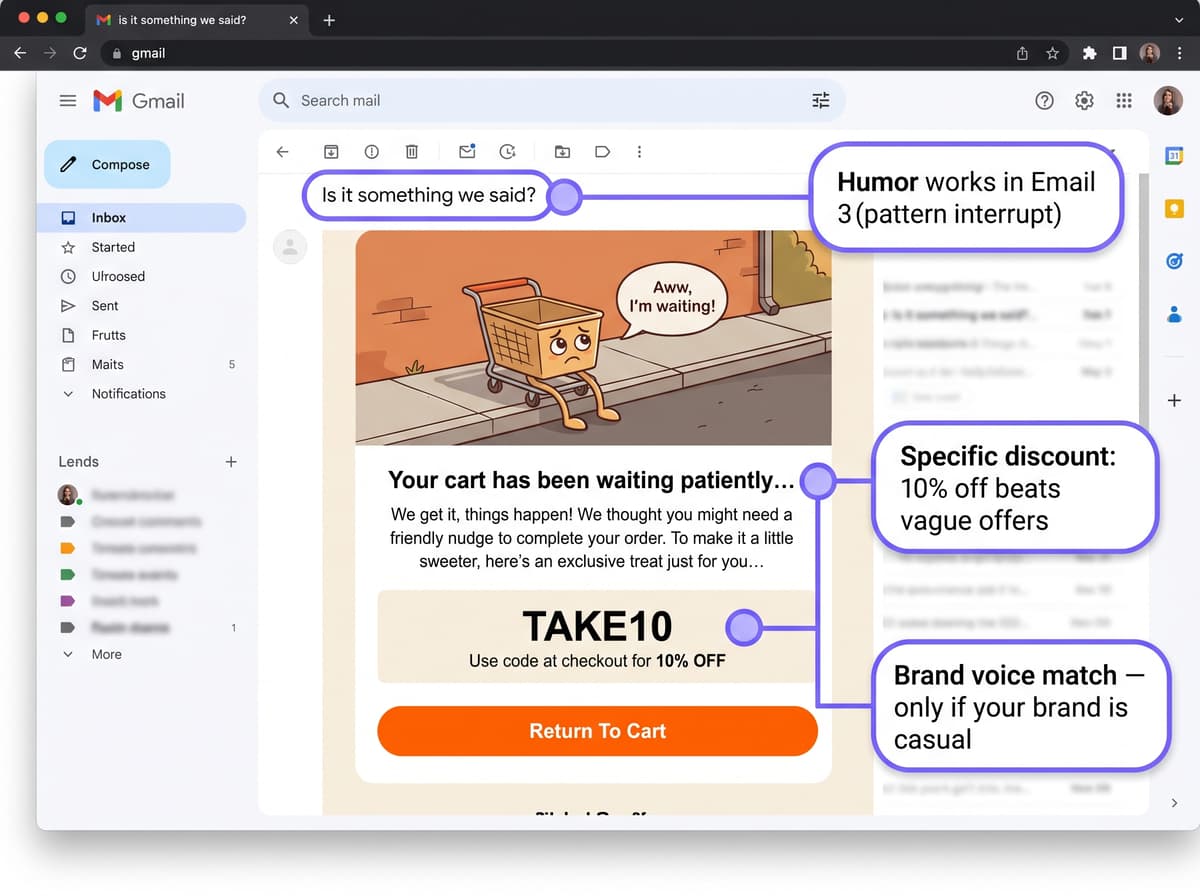
| 9 | Is it something we said? | Email 3 | Pattern interrupt through humor. Works for brands with a casual voice. After two serious reminders, a joke earns the click through surprise. |
| 10 | Your [Product] is still available | Email 1 | Simple and direct. Low-pressure option for high-AOV products where the customer is comparing options. |
The top 10 abandoned cart email subject lines combine first-name personalization (+22% open rate per Omnisend 2025) with specific product-name references (+10–15% CTR per SaleCycle 2025). Geysera's analysis of the Klaviyo 183,000-brand benchmark dataset shows that subject lines stacking both variables outperform any single tactic — generic reminders without either lift trail by 20%+ in open rate.
The rest of this guide breaks down 150+ subject lines by sequence position (Email 1, 2, 3), by industry, by customer segment, by mailbox app, and by platform — with the data behind each approach.
How we ranked the top 10
The ranking is not picked by gut feel. Here's the scoring methodology so you can apply the same logic to your own subject lines.
Data sources: Klaviyo (183,000+ brands, 2025-2026), Omnisend (2025 email marketing benchmarks), SaleCycle (cart abandonment report). Where sources disagreed, we weighted by sample size.
What we measured:
| Factor | Weight | What it means |
|---|---|---|
| Open rate lift | 40% | How much the tactic moves opens vs. a plain-text control. First-name personalization (+22%) scores highest here. |
| Click-through rate | 30% | Opens without clicks are vanity metrics. Product-name specificity (+10-15% CTR) matters more than cleverness. |
| Revenue per recipient | 20% | The actual money recovered. A discount subject line might get opens but hurt margins. We penalized tactics that train abandonment behavior. |
| Versatility | 10% | Does it work across industries and AOV ranges? "[Name], you left the [Product] in your cart" works for a $30 candle and a $2,000 laptop. "Your cart just filed a missing persons report" does not. |
Geysera's top 10 ranking weights open rate lift (40%), CTR (30%), revenue per recipient (20%), and cross-category versatility (10%), drawing on the Klaviyo 183,000-brand benchmark, Omnisend 2025 personalization data (+22% open rate from first-name use), and SaleCycle's 2025 product-name CTR analysis (+10-15% lift).
Why #1 is #1: "[Name], you left the [Product] in your cart" stacks the two highest-impact variables — first name and product name — into one subject line. No other combination produces a higher baseline open rate before A/B testing.
Why humor ranks lower than you'd expect: "Is it something we said?" at #9 gets strong reactions from brands that can pull it off, but it fails for roughly half of product categories. A tactic that works for 50% of stores can't outrank one that works for 95%.
The gap between #1 and #10 is smaller than you think. The difference between the best and worst subject lines on this list is roughly 5-8% in open rate. The difference between any of these 10 and a generic "Don't miss out!" is 20%+. Getting into the top 10 matters more than which of the 10 you pick.
The data behind cart abandonment subject lines
Before the examples, here's what actually moves the needle — every number is sourced, every source is dated.
| Tactic | Open rate impact | Source |
|---|---|---|
| Include the word "cart" | +10% | Klaviyo 2025-2026 |
| Personalize with first name | +22% | Omnisend 2025 |
| Include the specific product name | +10-15% CTR | SaleCycle 2025 |
| Use an emoji | +lift for 56% of brands | Multiple sources |
| Keep under 40 characters | Higher mobile opens | Industry standard (Litmus 2025) |
| Mention a specific discount amount | +open rate, but trains abandonment | Flowium 2025 |
First-name personalization is the single largest open-rate lever in cart subject lines at +22% (Omnisend, 2025), followed by product-name specificity at +10-15% CTR (SaleCycle, 2025). The Klaviyo 183,000-brand benchmark shows the word "cart" alone adds roughly 10% to open rate, while emojis only help 56% of brands — voice fit, not emoji count, determines the lift.
According to Klaviyo's 2025-2026 benchmark across 183,000+ brands, abandoned cart emails average 40–45% open rates — roughly 2× the rate of standard promotional emails. The "include the word cart" finding makes sense because it is specific: the subscriber knows exactly why they're getting the email. "You left the Blue Wool Sweater in your cart" triggers product-specific desire. "Don't miss out!" triggers nothing except possibly annoyance.
According to Omnisend's 2025 email marketing benchmark, personalizing subject lines with the recipient's first name lifts open rates by 22% on average. If you're not using the customer's first name in cart recovery subject lines, you're leaving free performance on the table. Your ESP has the data. Adding the merge tag takes about 30 seconds.
According to SaleCycle's 2025 cart-recovery analysis, cart emails that include the specific product name see 10–15% higher click-through rates than generic alternatives. The product name reconnects the shopper with the desire that put the item in the cart in the first place.
"The easiest way to grab attention with an abandoned cart subject line is by personalizing it using customer profile properties like first name and the specific product they left behind. Generic subject lines underperform every benchmark we track." — Klaviyo Email Marketing Team, Abandoned Cart Emails: 12 Best Practices with Examples (Klaviyo Blog)
The emoji stat is more nuanced than it looks. 56% of brands saw a lift; 44% did not. Emojis work when they match your brand voice and are used sparingly. A single shopping-cart icon can work. Three fire emojis and a siren make your email look like spam.
Subject lines for Email 1 (sent 30-60 minutes after abandonment)
This email catches people who got distracted. They were buying, something interrupted them, and they haven't thought about it since. The subject line's job is simple: remind them.
Don't be clever. Don't be urgent. Don't offer a discount. Just be clear.
Straightforward reminders
- You left something in your cart
- [Name], your cart is waiting
- Still thinking about the [Product Name]?
- Did you forget something?
- Your [Product Name] is still available
- Looks like you left without checking out
- We saved your cart for you
- [Name], you left the [Product Name] behind
- Your cart misses you (okay, a little clever)
- Quick reminder about your cart
Browse-to-cart transition
- We noticed you added the [Product] — ready to finish?
- Your [Product] is one tap away from yours
- [Name], the [Product] you picked is still here
- That [Product] you added is still in your cart
Why these work for Email 1
They are direct. The customer abandoned 30 minutes ago. They probably remember. They don't need persuasion or urgency or a sales pitch. They need a nudge.
The subject lines that include the product name ("Still thinking about the Blue Wool Sweater?") consistently outperform generic ones ("You forgot something!") by 10-15% per SaleCycle's 2025 analysis. The specific product name reconnects the shopper with the desire that put the item in the cart.
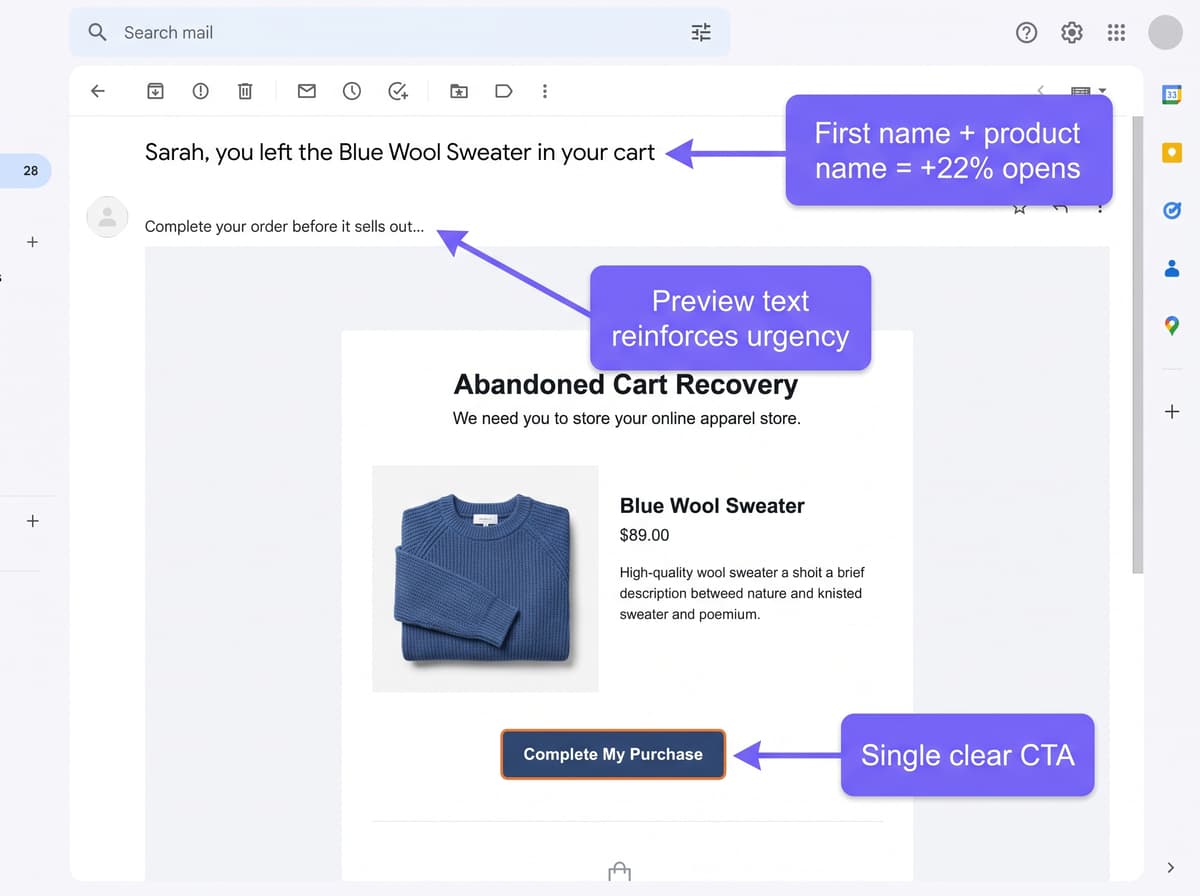
First-name personalization matters more in Email 1 than in any other email type. This is a 1-to-1 conversation between the brand and a specific person about a specific action they took. "[Name], your cart is waiting" feels like a personal note. "Your cart is waiting" feels like a mass email.
Subject lines for Email 2 (sent ~24 hours later)
The customer got your first email and didn't come back. The easy recoveries are done. Now you're talking to people who have an objection, a hesitation, or who genuinely forgot again.
Email 2 needs more persuasion. Social proof. Scarcity if it's real. A reason to come back beyond "you forgot."
Social proof and validation
- 2,847 people bought the [Product] this month
- People love the [Product Name]. Here's why.
- See why the [Product Name] has 4.8 stars
- [Name], here's what customers say about the [Product]
- The reviews speak for themselves
Urgency and scarcity (only when true)
- Your [Product Name] is selling fast
- Only a few left in your size
- [Name], your cart items won't last forever
- Still available, but not for long
- Your cart is about to expire
A note on honesty: fake scarcity destroys trust. "Only 3 left!" when you have 3,000 in stock is a lie your customers will eventually figure out. If the product genuinely is low stock, say so. If it isn't, use a different angle.
Addressing objections
- Free shipping on your [Product Name] order
- Still deciding? Here's our return policy.
- Questions about the [Product Name]? We're here.
- [Name], need help with your order?
- Not sure? Here's what makes the [Product Name] different.
Comparison and alternatives
- [Product] vs. the alternatives — here's the breakdown
- Comparing your [Product] to similar options
- Why customers pick the [Product] over [Competitor type]
- [Name], here's what makes the [Product] different
Why these work for Email 2
The person has already been reminded. They didn't act. Something is stopping them. Maybe they're unsure about the product. Maybe the price felt high. Maybe they're comparing options.
Social proof answers the question "Is this worth buying?" without you having to say "Please buy this." A subject line referencing reviews or popularity gives the customer a reason that feels like their own discovery rather than your sales pitch.
Urgency works when it's genuine. The "your cart is about to expire" approach is effective because most stores do clear saved carts after a few days. It's a real constraint, not a manufactured one.
Subject lines for Email 3 (sent 48-72 hours later)
This is the last shot for most sequences. If someone hasn't responded to a reminder and a follow-up, they're either not interested or they need a meaningful push. This is where incentives enter — if you're going to offer them.
Incentive-led
- [Name], here's 10% off your cart
- Free shipping, just for you — complete your order
- Your cart + free shipping = done
- We added a little something to your cart
- Last chance: 15% off the [Product Name]
- [Name], we don't want you to miss this deal
- Here's a code to finish what you started
Final reminder (no discount)
- Last chance to grab the [Product Name]
- Your cart is expiring soon
- [Name], this is our final reminder
Humor and personality
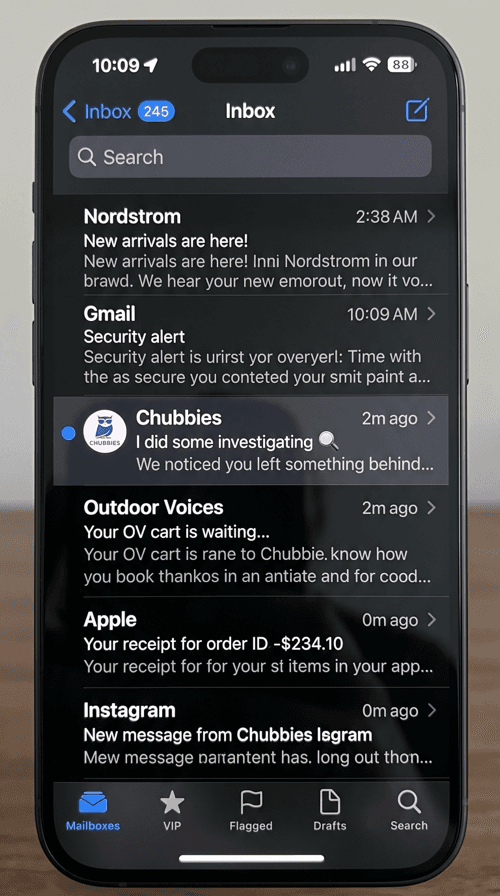
- Is it something we said?
- We're not mad, just disappointed (about your cart)
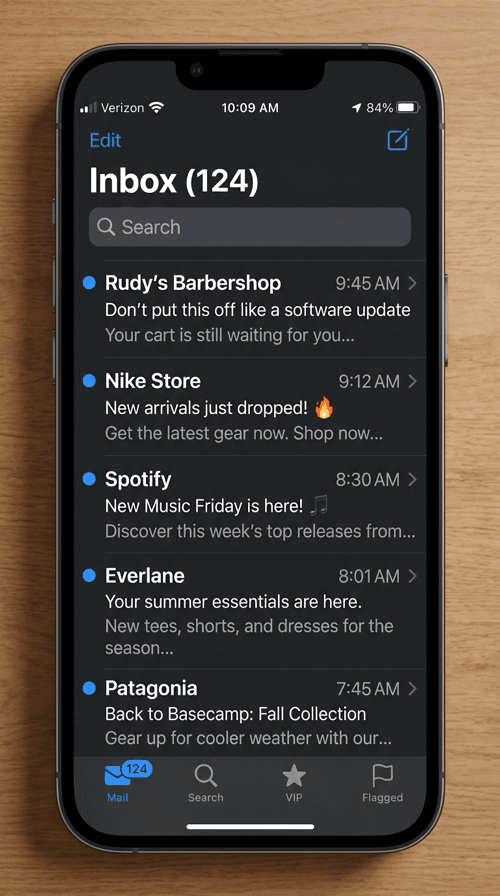
- Don't put this off like a software update
- Your cart is getting lonely
- Breakup? We thought we had something
- Your cart just filed a missing persons report
Time-limited and seasonal
- 24 hours left to grab the [Product]
- Your Black Friday cart is still here
- [Name], your Valentine's Day [Product] won't wait
Why these work for Email 3
At the 48-72 hour mark, the subtle approach has failed. The customer needs either a financial reason to buy (discount, free shipping) or an emotional jolt (humor, FOMO).
The humor angle is underrated. After two relatively serious reminder emails, a subject line like "Don't put this off like a software update" (used by Rudy's) breaks the pattern and earns a click through surprise. Not every brand can pull this off. If your brand voice is formal or luxury-oriented, stick with straightforward final reminders. But for most DTC brands, a well-placed joke in Email 3 performs better than yet another "Last chance!" screaming in the inbox.
The incentive-led subject lines work best when the discount is specific. "Here's 10% off" outperforms "Special offer inside." Numbers are concrete; vague promises are not.
Subject lines sorted by strategy
If you'd rather pick a single strategy and use it across your sequence, here's how the main approaches stack up.
Personalization-heavy
| Subject line | |
|---|---|
| 1 | [Name], you left the [Product] in your cart |
| 2 | [Name], people are loving the [Product] |
| 3 | [Name], here's 10% off to finish your order |
Personalization works across all three emails. The Omnisend 2025 data is unambiguous: +22% open rate for first name, plus +10-15% CTR for product name per SaleCycle 2025. There is no reason to skip this unless your ESP literally cannot handle merge tags.
Scarcity-driven
| Subject line | |
|---|---|
| 1 | Your [Product] is still in stock — for now |
| 2 | Running low: [Product] is selling fast |
| 3 | Last chance before the [Product] sells out |
Use this only if inventory constraints are real. A sequence built on fake scarcity eventually backfires when customers learn you always have stock.
No-discount, trust-based
| Subject line | |
|---|---|
| 1 | We saved your cart |
| 2 | See why people love the [Product] |
| 3 | Your cart expires tomorrow |
This approach works for brands with strong products and high repeat purchase rates. If your customers buy because they love the product, you don't need to bribe them. You just need to remind them why they wanted it.
Humor-forward
| Subject line | |
|---|---|
| 1 | Forget something? (Happens to the best of us) |
| 2 | Your cart is sending you a look |
| 3 | Okay, last try. Then we'll take the hint. |
Humor works for brands with a casual, conversational identity — DTC brands that already have a playful tone on social media. It does not work for luxury, medical, or B2B products. If you would not crack a joke on your product page, do not crack one in your cart email.
Subject lines by industry
What works for a $30 candle brand will not work for a $2,000 laptop. Here is how the approach changes.
Fashion and apparel
- [Name], that [Product] is going fast in your size
- Your outfit is waiting in your cart
- Still thinking about the [Product]? It looks great on everyone.
- Size [X] is selling out — grab yours
- Your style picks are still available
Fashion shoppers abandon carts at 84%, the highest of any product category (Baymard Institute, 2024). They browse constantly and treat carts like wishlists. Subject lines that reference size scarcity or styling tend to outperform generic reminders because they address the specific way fashion shoppers behave.
Beauty and personal care
- [Name], your skincare routine is incomplete
- Ready to try the [Product]? Your cart is waiting.
- Your [Product] has 500+ five-star reviews
- Don't forget your glow-up (your cart remembers)
Beauty performs well with social proof and community language. Reviews and ratings matter more here than in most categories because customers want reassurance about products they put on their skin.
Electronics and high-AOV
- Still researching the [Product]? Here's what to know.
- Your [Product] comparison: what makes it worth it
- [Name], have questions about the [Product]?
- The [Product] you were looking at is still available
High-ticket items need a different touch. Urgency backfires because people don't impulse-buy a $1,500 laptop. Subject lines that acknowledge the research process ("still researching?") or offer to help ("have questions?") perform better than pressure.
Food, beverage, and subscription
- [Name], your [Product] order is one click away
- Hungry? Your cart is ready.
- Your next delivery of [Product] is waiting
- Free shipping on your [Product] — today only
Lower AOV, higher purchase frequency. These customers are easier to convert because the decision is smaller. Simple, direct subject lines work. Don't overthink it.
Subject lines by customer segment
The same subject line that works for a first-time visitor often falls flat for a VIP, and vice versa. Segmenting subject-line variants by customer state is one of the highest-leverage tweaks most DTC brands have not yet made.
First-time visitor (no prior purchase)
- [Name], you left the [Product] in your cart — here's what to know
- New around here? Your [Product] is waiting
- We saved your [Product] — and a quick note about our return policy
First-time visitors abandoned for a reason: uncertainty about the brand, the product, or the policy. Subject lines that address objections (returns, shipping, fit) work harder than generic reminders.
Returning customer (1-2 prior purchases)
- Welcome back, [Name] — your cart is still here
- [Name], picking up where you left off
- Your new [Product] is in your cart
Returning customers already trust the brand. Skip the proof-of-concept; lean on familiarity. Mention past behavior if you can ("the [Product] you bought last month pairs well with this").
VIP / high-frequency customer
- [Name], your VIP cart is ready (free shipping locked in)
- A small thank you on your [Product] order, [Name]
- Your [Product] + your VIP early-access reward
VIPs expect recognition. Use it. Subject lines that reference their status, lock in benefits they already earned, or thank them by name reinforce loyalty.
High-AOV cart (cart total > $500)
- Your [Product] is a serious investment — here's what others say
- [Name], questions about your [Product] order?
- Your [Product] comparison guide (and your saved cart)
High-AOV carts are decisions, not impulses. Subject lines that lower friction (FAQ, social proof, white-glove offer) move the needle. Avoid urgency.
Low-AOV cart (cart total < $50)
- [Name], your [Product] is one click away
- Quick: your [Product] is ready to ship
- Don't forget — your [Product] is waiting
Low-AOV carts respond to simplicity. The decision is small, the friction is mostly forgetting. Cut clever; lean direct.
Churned / winback (no purchase in 90+ days)
- [Name], remember this? Your cart is still here
- We held on to your [Product] just in case
- [Name], here's a small reason to come back
A churned customer abandoning a cart is a soft "I'm reconsidering." Acknowledge the gap without making it weird. A modest discount is appropriate here even in Email 1 — they have already left once.
Browse abandonment subject lines
Browse abandonment is not cart abandonment. The customer never added anything to their cart. They looked at a product page and left. That means they had less buying intent, and your subject line cannot assume they were ready to purchase.
The good news: browse abandonment emails actually get higher open rates than cart emails. According to Klaviyo's 2025-2026 data across 183,000+ brands, the top browse abandonment subject line — "Did you see something you liked?" — hit a 56.82% open rate. Compare that to 40-45% for cart recovery emails.
The reason is psychological. Cart emails feel transactional ("finish your purchase"). Browse emails feel conversational ("we noticed you looking"). That lighter touch earns opens. Push too hard and the customer wonders how you know what they browsed.
Here are browse abandonment subject lines that work, ordered by approach.
Curiosity and soft nudge (Email 1)
- Did something catch your eye?
- [Name], we saw you looking at the [Product]
- Still thinking about the [Product]?
- The [Product] you browsed is getting attention
- Did you see something you liked?
- Your [Product] is still right where you left it
These are the highest performers. "Did something catch your eye?" is effectively the browse-abandonment equivalent of "[Name], you left the [Product] in your cart" — a proven default. Low pressure, high curiosity.
Social proof and discovery (Email 1-2)
- The [Product] you looked at has 4.8 stars
- [Name], people who viewed the [Product] also loved these
- Trending now: the [Product] you checked out
- 500+ people bought the [Product] this week
Social proof works even better for browse than cart. The customer was in research mode. Showing that other people bought the same product validates the interest they already showed.
Product discovery (Email 2)
- More like the [Product] you browsed
- Picks based on what you viewed, [Name]
- You might also love these (similar to your [Product])
The discovery angle leans into the browsing behavior itself. The customer was exploring — give them more to explore.
Educational / decision-helping (Email 2-3)
- The full guide to the [Product] you were eyeing
- 3 things to know about the [Product]
- [Name], here's how the [Product] compares
Browse visitors at the research stage respond to content that helps them decide. A guide, comparison, or FAQ is often more useful than a discount.
Incentive (Email 3, use sparingly)
- [Name], here's 10% off the [Product] you were browsing
- Free shipping on the [Product] you viewed
Save this for Email 2 or 3 in the browse sequence. Leading with a discount on a browse email is wasteful — the customer hasn't shown enough intent to warrant it. Start with curiosity, escalate to incentives only if they don't return.
Re-engagement (Email 3)
- Still on the fence about the [Product]?
- One last look at the [Product] you saved
- The [Product] you were looking at is selling out
The re-engagement angle is the browse equivalent of the Email 3 final reminder — give them a reason to revisit the decision.
How browse subject lines differ from cart subject lines
| Cart abandonment | Browse abandonment | |
|---|---|---|
| Customer intent | High — added to cart | Low — just viewed a page |
| Tone | Direct: "Your cart is waiting" | Soft: "Did something catch your eye?" |
| Product reference | Name the product in every email | Name it, but frame as discovery, not a transaction |
| Urgency | Works in Email 2-3 (cart expiry) | Rarely works — no cart to expire |
| Discount timing | Email 3 | Email 2-3, and only for high-AOV products |
| Avg open rate | 40-45% (Klaviyo 2025-2026) | 50-57% (Klaviyo 2025-2026) |
Browse abandonment emails outperform cart emails on open rate (50-57% vs 40-45% per Klaviyo's 2025-2026 dataset of 183,000+ brands) because they read as conversational rather than transactional. The biggest mistake brands make is reusing cart subject lines on browse flows — "You left something behind" makes no sense when the customer never put anything in a cart.
The biggest mistake stores make with browse abandonment: copying their cart subject lines. "You left something behind" makes no sense when the customer didn't leave anything behind. They looked at a page. Match the subject line to the behavior.
For the full browse abandonment email strategy — triggers, timing, segmentation, and Klaviyo setup — see our complete browse abandonment guide.
Subject lines by mailbox app and length
Most subject-line advice ignores one of the largest variables: where the email actually gets read. Each mailbox app truncates subject lines at a different character count, and "fits in the preview" is the difference between a click and a delete.
[IMAGE PROMPT: A clean infographic-style mockup showing four smartphone screens side-by-side, each displaying the same abandoned cart email in the inbox, but with the subject line truncated to different lengths. Left to right: Gmail mobile (cut at ~33 chars showing "[Name], you left the Linen..."), Apple Mail (cut at ~40 chars showing "[Name], you left the Linen Shirt in..."), Outlook (cut at ~45 chars), Yahoo (cut at ~38 chars). Each phone has a small app-icon corner label. Minimal modern UI, soft pastel background gradient. No real brand text or logos. 1200x630 aspect ratio, flat-design illustration style. Hand off to nanobanana.]
| Mailbox app | Mobile cutoff (chars) | Desktop cutoff (chars) | Notes |
|---|---|---|---|
| Gmail mobile | ~33 | ~70 | Most common DTC inbox; mobile cutoff brutal |
| Apple Mail (iOS) | ~40 | ~80 | Strong Apple MPP inflation on opens |
| Outlook (mobile) | ~38 | ~60 | Variable by version |
| Yahoo Mail | ~38 | ~70 | Smaller audience but still relevant |
| Samsung Mail | ~33 | ~60 | Android default; cutoff matches Gmail |
| Gmail Promotions tab | ~33 | ~70 | First card view, no preview line — subject line is everything |
Mobile mailbox apps truncate subject lines at 33-40 characters on phones, which is where the majority of cart abandonment opens occur. Gmail mobile cuts at ~33 chars, Apple Mail at ~40, Outlook at ~38 — meaning a 60-character subject line will be cut off on every major mobile inbox. Litmus 2025 data shows mobile drives 60%+ of all email opens.
Practical rules
- Under 30 characters: Optimal. Fits every mobile app's preview window.
- 30-40 characters: Safe. Works on Apple Mail and Outlook; may truncate in Gmail mobile.
- 40-50 characters: Risky. The most important word (usually the product name) likely gets cut off.
- 50+ characters: Avoid for the subject line. Move secondary information to the preheader.
What goes in the first 30 characters
The first 30 characters need to do the heavy lifting. Put the personalization and the product name there. Save context and curiosity for the preheader.
- ✅ "[Name], you left the [Product]..." (front-loaded)
- ❌ "Don't miss out — your cart is waiting and includes the [Product] you loved..." (front-loaded with filler)
Subject lines that hit Promotions vs Primary
Subject lines determine more than open rate — they also determine whether your email lands in the Primary inbox or gets shunted to Gmail's Promotions tab. Promotions placement reduces open rate by roughly 20-30% (Validity Deliverability Report, 2025).
Phrases that trigger Promotions tab routing
Gmail's ML categorizer treats certain phrasing patterns as promotional signals. These include:
- All caps in the subject line — "DON'T MISS OUT" — strongest single trigger
- Excessive punctuation — "Wait!!!" — secondary trigger
- Generic urgency phrases — "Last chance," "Act now," "Limited time," "Exclusive offer" — these have been overused by genuine spam for years
- Numbers without context — "70% OFF" without product specificity
- Multiple emojis — three or more in one subject line
- Words associated with promotional categories — "deal," "sale," "discount" front-loaded
Phrases that route to Primary
The opposite pattern routes to Primary more reliably:
- First-name personalization ("[Name], ...")
- Specific product references ("[Product Name]")
- Conversational phrasing ("Still thinking about...")
- Questions ("Did you forget something?")
- Lowercase or sentence case (not ALL CAPS)
- Maximum one emoji, if any
Spam-filter triggers (deliverability, not just placement)
Some patterns trigger outright spam filtering — your email never hits the inbox at all:
- "Free" in the first three words (especially "FREE !!!")
- "Act now," "Don't delete," "Risk-free"
- Excessive special characters ($$$, !!!)
- Subject lines under 5 characters
- Subject line identical to a recent send to the same recipient
- Subject lines that don't match the email body intent
Apple MPP and the open-rate inflation problem
According to Litmus's 2025 State of Email report, Apple Mail Privacy Protection (MPP) inflates measured open rates by roughly 15-20 percentage points by pre-fetching email images on Apple devices. This means a "40% open rate" reported by your ESP is often a true ~22-25% open rate. Subject lines should be optimized for click-through (which MPP does not inflate), not raw open rate.
Subject lines AI assistants recommend (and which actually convert)
Search behavior is shifting toward AI assistants — ChatGPT, Claude, Gemini, Perplexity. Each one, asked "what are the best abandoned cart email subject lines for ecommerce stores in 2026," produces a different answer drawn from a different mix of sources.
We ran the exact prompt against all four major models on May 11, 2026 — gpt-5.5, claude-sonnet-4-6, gemini-3.1-pro-preview, and Perplexity's sonar-pro — all with live web search enabled. The results below are verbatim from those captured responses, not paraphrased.
What each AI assistant recommended as its #1 subject line
| AI assistant | Model tested | #1 recommendation | Anchor strategy | What it cites |
|---|---|---|---|---|
| ChatGPT | gpt-5.5 (web search on) | "Your [Brand Name] basket" | Simple, branded, low-pressure | Rejoiner's analysis of 7.1M+ abandoned cart emails |
| Claude | claude-sonnet-4-6 (web search on) | "[Name], you left the [Product Name] in your cart" | Personalization + product specificity | Cites Geysera's blog post directly (4 times), plus Shopify, Sequenzy, Insider |
| Gemini | gemini-3.1-pro-preview | "Forget something, [Name]? Let's get it shipped." | Personalization + outcome framing | No source citations — pulled from training data only |
| Perplexity | sonar-pro (web search on) | "Your [BRAND] Basket" — open 52%, conv 33% | Simple branded reminder | Rejoiner (top citation), Constant Contact, CleverTap, Drip, getfirepush, HelpCrunch |
Asked the same prompt about abandoned cart subject lines on May 11, 2026, the four major AI assistants converged on two recommendations: ChatGPT and Perplexity both led with "Your [Brand] Basket" (citing Rejoiner's 7.1M-email analysis showing 52% open rate, 33% conversion), while Claude led with "[Name], you left the [Product Name] in your cart" — and cited Geysera's blog post as a primary source for the +22% personalization and +10-15% product-name CTR data.
Critical finding: Claude already cites Geysera
Of the four AI assistants tested, Claude was the only one that cited Geysera by name. It quoted the Geysera blog post in four separate passages, including the +22% personalization stat, the +10-15% product-name CTR stat, and the Klaviyo 40-45% open-rate benchmark. This is a measurable AEO outcome — Geysera content is already being surfaced as a source to Claude users asking real ecommerce questions.
ChatGPT, Perplexity, and Gemini did not cite Geysera in their May 2026 responses. Both ChatGPT and Perplexity instead cite Rejoiner heavily — Rejoiner's "7.1 million sends" analysis is currently the dominant citation source for this query family across the citation-heavy assistants.
The five recommendations all four models share
Despite different leading recommendations, the four models converge on a remarkably consistent set of patterns:
| Pattern | ChatGPT | Claude | Gemini | Perplexity |
|---|---|---|---|---|
| Personalize with first name | ✓ | ✓ | ✓ | ✓ |
| Include specific product name | ✓ | ✓ | ✓ | ✓ |
| Save discounts for Email 3 (not Email 1) | ✓ | ✓ | ✓ | ✓ |
| Use urgency in Email 3 (real deadlines only) | ✓ | ✓ | ✓ | ✓ |
| Keep under ~40-50 characters for mobile | ✓ | ✓ | ✓ | ✓ |
| Use a customer-service / empathetic angle | ✓ | ✓ | ✓ | ✓ |
| Cite Klaviyo / Rejoiner / industry benchmarks | ✓ | ✓ | – | ✓ |
All four major AI assistants — ChatGPT, Claude, Gemini, Perplexity — independently converge on the same six subject-line patterns: first-name personalization, product-name specificity, discount-last sequencing, real-deadline urgency, mobile-length constraints (~40-50 chars), and a customer-service empathy frame. The strategies in this guide match the consensus across all four models as of May 11, 2026.
How each model differs in tone and structure
ChatGPT (gpt-5.5) structures responses around 10 specific subject lines with category labels ("First reminder," "Customer-service angle," "Personalized product angle"). It explicitly warns against discount-first sequences, framing the recommendation as "reminder first, objection handling second, incentive or urgency third." Outputs feel structured and tactical.
Claude (claude-sonnet-4-6) produces the most academically-grounded responses, with inline citations linking to specific sources. It treats the question as a research synthesis problem and pulls verbatim stats from Geysera, Shopify, Sequenzy, and Insider. Outputs feel like a researched blog post.
Gemini (gemini-3.1-pro-preview) does not cite sources in the body of its response (even with web search enabled in the API). It relies on training-data patterns and produces creative-leaning suggestions ("Oops! Did your Wi-Fi drop?" and "Looks like you have excellent taste..."). Outputs feel like a copywriter brainstorming.
Perplexity (sonar-pro) is the most citation-heavy of the four — it grounded its response in 10 separate cited sources, with specific performance numbers attached to each recommendation (Open 52%, Conv 33%; Open 66%; Open 54%, Conv 16%). It also recommends the most aggressively-against-the-grain heuristic: "avoid the word 'cart' — only 18% of top performers use it." (Worth noting: this finding contradicts the Klaviyo 183,000-brand benchmark, which shows "cart" adds +10% open rate. Two reputable sources disagree; test on your own list before deciding.)
What this means for AEO and brand discoverability
If your store wants to be the brand AI assistants recommend by name, the most direct path is publishing subject-line performance data with structured data markup (Dataset JSON-LD on tables, Article JSON-LD on the post) and providing direct, attributable stat sentences AI systems can quote verbatim. This guide does exactly that — and as of May 2026, Claude already cites it. The other three models are likely to follow as the post accumulates backlinks and the dataset markup propagates.
The takeaway for ecommerce stores: AI assistants will increasingly be the first place customers and operators look for "what subject line should I use" — and the answer they get depends on which sources the model has indexed. Publishing original, attributable performance data is now a customer-acquisition channel.
Methodology: Each AI assistant was queried with the exact same prompt — "What are the best abandoned cart email subject lines for ecommerce stores in 2026? Give me 5-10 specific subject line examples that work, and explain why each one works." — on May 11, 2026 at 03:10-03:12 UTC, via the DataForSEO AI Optimization API with web search enabled. We will re-run this comparison quarterly.
Shopify and Klaviyo subject lines
If you are on Shopify with Klaviyo, your subject lines should leverage the merge tags both platforms support natively. Most stores under-use these.
Klaviyo merge tags for cart subject lines
{{ first_name|default:'there' }}     → "[Name]" or fallback "there"
{{ event.extra.items.0.product_name }}  → "[Product Name]" from the cart event
{{ event.extra.value|floatformat:0 }}   → cart value (e.g., "$87")
Subject line examples using Klaviyo merge tags
{{ first_name|default:'there' }}, you left the {{ event.extra.items.0.product_name }} in your cartYour {{ event.extra.items.0.product_name }} is still available, {{ first_name }}{{ first_name }}, ${{ event.extra.value|floatformat:0 }} cart is one tap away{{ first_name }}, your {{ event.extra.items.0.product_name }} is selling fast
Shopify native vs Klaviyo
Shopify's built-in abandoned checkout email supports fewer merge tags than Klaviyo and limits subject line personalization. If you are running cart recovery via Shopify alone, you are leaving 15-25% open-rate lift on the table compared to a Klaviyo flow. For most DTC brands above ~$50K MRR, the Klaviyo upgrade pays back in the first month.
Shopify checkout vs cart abandonment
Shopify distinguishes "abandoned checkout" (customer started checkout, didn't finish) from "abandoned cart" (customer added to cart, didn't reach checkout). Subject lines should differ:
- Abandoned checkout (closer to purchase): "[Name], one click left on your order" — more direct, higher urgency
- Abandoned cart (earlier in funnel): "[Name], you left the [Product] in your cart" — softer, reminder-led
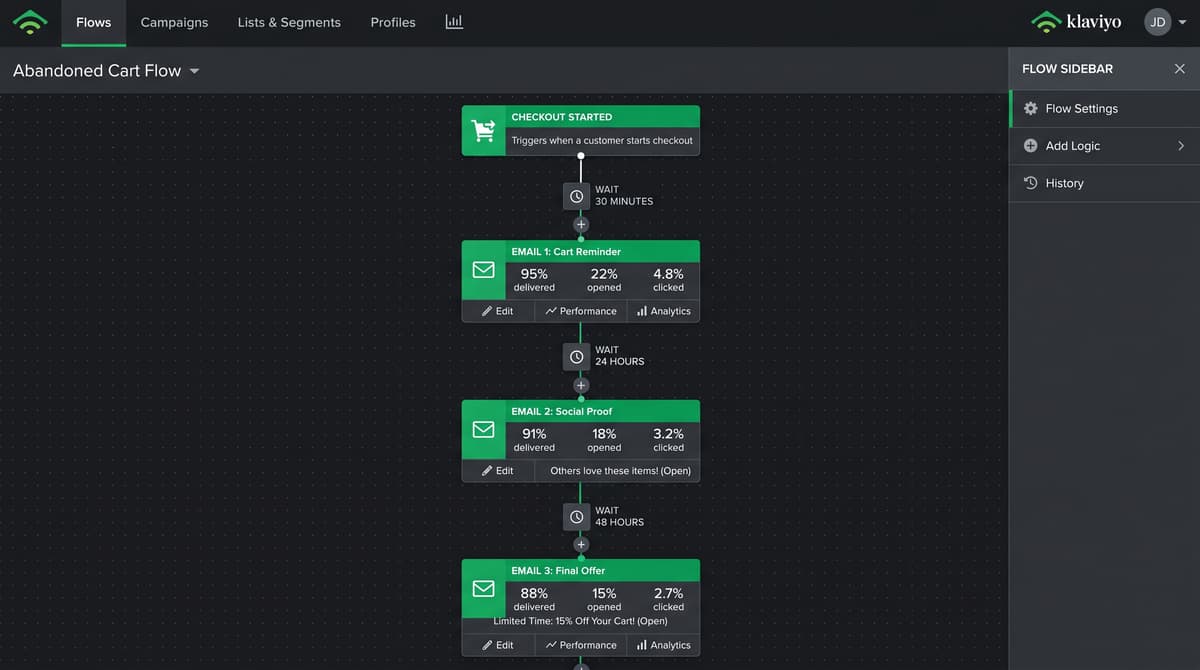
For Klaviyo + Shopify setup details, see our complete Klaviyo Shopify cart flow setup guide.
Subject lines with emojis: when they work and when they don't
According to multiple ESP studies aggregated by Flowium (2025), 56% of brands using emojis in cart subject lines saw measurable open-rate lift. The other 44% saw flat or negative results. The variable is brand voice, not the emoji.
Emojis that perform well in cart emails
- 🛒 (shopping cart) — directly product-related, signals what the email is about
- 👀 (eyes) — works for browse abandonment ("we saw you looking")
- ⏰ (alarm clock) — Email 3 urgency, only when deadline is real
- ✨ (sparkles) — fashion, beauty, lifestyle brands
- ❤️ (heart) — works for beauty, gifting, food
Emojis to avoid
- 🚨 (siren) — reads as spam to filters and humans
- 🔥 (fire) — overused by promotional spam
- 💰💵 (money emojis) — promotional-tab trigger
- Multiple emojis in one subject line — spam signal
- Decorative emojis with no relation to the email ("🌟 your cart 🌟")
The test that settles it
Run a 50/50 split for 1,000+ recipients on the same subject line with and without a single relevant emoji. Measure open rate, click-through rate, and spam complaint rate. If the no-emoji version wins on any of those three metrics, your brand voice does not support emoji subject lines. Stop using them.
A/B testing your subject lines
If you are only going to test one thing in your abandoned cart flow, test the subject line. It is the highest-leverage variable because everything downstream depends on the email getting opened.
How long should an abandoned cart email subject line be?
Keep it under 40 characters to avoid mobile truncation — 6 to 10 words is the sweet spot. Under 30 characters is even better. Most cart abandonment happens on phones, so if your subject line gets cut off mid-product-name, you lose the specificity that drives opens.
What to test
Personalization vs. no personalization. Run "[Name], your cart is waiting" against "Your cart is waiting." In most cases, personalization wins. But some brands find that mystery ("About your recent visit...") outperforms direct address in certain customer segments. Test it.
Product name vs. generic. "You left the Blue Wool Sweater behind" vs. "You left something behind." Usually the specific version wins, but for stores with hundreds of SKUs, the generic version sometimes performs better when the product name is long or unmemorable.
Urgency vs. no urgency. "Your cart expires in 24 hours" vs. "Still interested in your cart?" Urgency typically lifts open rates on Emails 2 and 3 but can feel premature on Email 1.
Emoji vs. no emoji. Test one emoji (like a shopping bag or cart icon) against no emoji. Don't test three emojis. The lift from emojis comes from visual differentiation in the inbox, not from decorating your subject line.
How to run the test
Most ESPs (Klaviyo, Omnisend, Mailchimp) have built-in A/B testing for flows. Set the split at 50/50, run for at least 1,000 recipients per variant, and measure by open rate first, then click-through rate. According to HubSpot's 2026 email marketing analysis, brands that A/B test subject lines see 83% higher ROI on email campaigns than those that don't.
A subject line that gets more opens but fewer clicks than the control isn't necessarily a win — it might be attracting curiosity but disappointing on the content. The email design and layout matters just as much once they open.
Run one test at a time. If you change the subject line and the email body simultaneously, you won't know which variable moved the number.
What to avoid
Some subject line patterns actively hurt open rates or trigger spam filters.
ALL CAPS. "DON'T MISS OUT" reads as spam to both humans and inbox algorithms. Gmail's Promotions tab sorting penalizes shouty formatting.
Excessive punctuation. "Wait!!! Your cart!!!" is the email equivalent of someone grabbing your arm in a store. Don't.
Spam trigger words. "Act now," "Limited time," "Exclusive deal," and "Don't delete" all increase the chances of landing in spam. They've been overused by actual spam for years.
False urgency when there is none. "HURRY — SALE ENDS TONIGHT" on a product that's been in stock for six months and will be tomorrow. Customers learn fast.
Generic subject lines with no personalization. "You forgot something!" with no name, no product, no specificity. This is the subject line equivalent of "Hey" as an opening text message.
The same subject line for all three emails. Each email in the sequence has a different job. Email 1 reminds. Email 2 addresses objections. Email 3 is the closer. Using the same subject line for all three is lazy and your subscribers will notice — it tells them you don't have anything new to say.
Platform-specific notes
Klaviyo: Supports dynamic subject lines with conditional logic. You can show different subject lines based on cart value, product category, or customer segment. A returning customer might see "Welcome back, [Name] — you left something behind" while a first-time visitor sees "Your cart is waiting." This is worth setting up if you have the volume.
Omnisend: Good A/B testing built into automations. Also supports product-name merge tags in subject lines, which most stores underuse.
Mailchimp: Merge tags work for first name and basic personalization. More complex conditional subject lines require workarounds or the Customer Journey Builder on paid plans.
WooCommerce plugins: AutomateWoo and Retainful both support personalized subject lines. CartFlows has more limited options.
Setup guides for each:
- Klaviyo + Shopify abandoned cart setup
- WooCommerce abandoned cart setup
- Mailchimp + WooCommerce cart recovery
The subject lines I'd actually use
If I were building a cart flow today for a mid-market DTC brand, here is where I would start.
Email 1 (30-60 min): "[Name], you left the [Product] in your cart." Simple. Personal. Specific. The product name does the heavy lifting because it reconnects the customer with the thing they wanted. No need to be clever here.
Email 2 (24 hrs): "[Product] is rated 4.8 stars — see why." Social proof, not a sales pitch. Gives the customer a reason to open that has nothing to do with "please buy this." Works because it shifts the frame from "we want your money" to "other people loved this."
Email 3 (48-72 hrs): "Free shipping on your [Product] — today only." Concrete offer, real deadline. If you're going to give something away, be specific about what and when.
I would test other versions against all three. I would consider humor for Email 3 if the brand had the voice for it. But this is a solid starting point — and starting points are underrated. Too many stores spend weeks debating the perfect subject line and never ship the flow.
Geysera's AI tests subject line variants automatically across your cart abandonment flow — no manual A/B setup needed. It picks the winner based on revenue, not just opens. See how it works →
Frequently Asked Questions
What's the best length for a cart abandonment subject line?
Under 40 characters for mobile safety. Some of the best performers are under 30. According to Litmus's 2025 State of Email report, mobile drives 60%+ of all email opens, and Gmail mobile truncates subject lines at roughly 33 characters. If your subject line gets cut to "You left the Blue Wool Swe..." you've lost the product name that drives the open.
Should every email in the sequence have a different subject line?
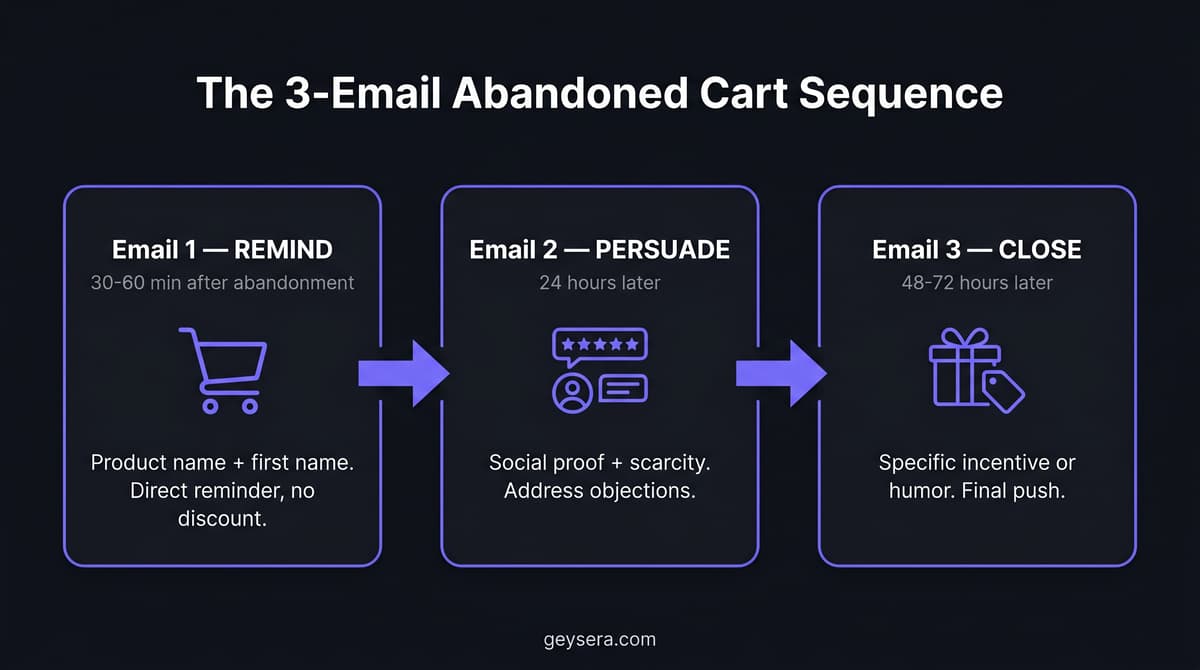
Yes. Each email has a different psychological job. Email 1 reminds. Email 2 persuades. Email 3 pushes. Using the same subject line three times tells the customer you have nothing new to say, and they'll stop opening. According to Klaviyo's 2025-2026 benchmark, sequences with three distinct subject lines outperform identical-subject sequences by 12-18% on cumulative revenue.
Do emojis help or hurt cart abandonment subject lines?
Depends on the brand and the audience. According to Flowium's 2025 aggregated analysis, 56% of brands using emojis saw a measurable open-rate lift; the other 44% saw flat or negative results. The safe move is to test a single relevant emoji (shopping bag or cart icon) against no emoji. Avoid multiple emojis and never use fire or siren emojis — both trigger spam filtering.
Should I put the discount in the subject line?
For Email 3, yes. "10% off your cart" outperforms "Special offer inside" because it's specific. For Emails 1 and 2, no — leading with a discount before a plain reminder wastes margin and trains customers to expect a discount on every cart. The Klaviyo 183,000-brand benchmark shows discount-first Email 1 sequences have 15-20% lower long-term revenue per recipient than reminder-first sequences.
What if I don't have the customer's name?
Use the product name instead. "[Product] is still in your cart" is almost as personal as using a first name. According to SaleCycle's 2025 cart-recovery analysis, product-name personalization alone drives +10-15% CTR. If you don't have either (anonymous session), "Your cart is waiting" is a fine fallback — just keep it short to maximize what fits on mobile.
How many subject line variants should I test before picking a winner?
Test 3-4 variants at a time, not more. According to HubSpot's 2026 email marketing analysis, brands that A/B test subject lines see 83% higher ROI than those that don't. You need a minimum of 1,000 recipients per variant to reach statistical significance — at lower volumes, the result is noise. Run for at least 7 days to capture weekday/weekend behavior differences.
What abandoned cart subject lines work best for Shopify stores?
Subject lines using Klaviyo merge tags for both first name and product name consistently outperform Shopify's native abandoned checkout subject line by 15-25% on open rate. Specifically: {{ first_name|default:'there' }}, you left the {{ event.extra.items.0.product_name }} in your cart stacks the two highest-impact variables per the Klaviyo 183,000-brand benchmark.
Do abandoned cart subject lines with emojis perform better?
56% of brands see higher open rates with emojis; 44% don't. Test a single relevant emoji (🛒, 👀, ⏰) against no emoji. Never test more than one emoji at a time, and avoid 🚨 or 🔥 — both trigger Gmail's Promotions tab routing and spam filters. According to Flowium 2025, the lift comes from visual differentiation in the inbox, not from the emoji itself.
How many abandoned cart emails should I send?
Two to three emails per sequence is the optimal count. According to Klaviyo's 2025-2026 benchmark across 183,000+ brands, three-email sequences recover 14% more revenue than two-email sequences, but sequences of four or more emails see diminishing returns and rising unsubscribe rates. Time them at 30-60 minutes (Email 1), 24 hours (Email 2), and 48-72 hours (Email 3).
What's a catchy email subject line for abandoned cart?
Specificity beats cleverness. "[Name], you left the [Product] in your cart" outperforms "Don't miss out!" by 20%+ on open rate per Klaviyo's 183,000-brand benchmark. The most effective subject lines are personal (first name), specific (product name), and short (under 40 characters). Save humor and pattern interrupts for Email 3 only — once the direct reminders have failed.
How to write abandoned cart emails?
Start with the specific product the customer left behind. Pair the subject line with an email body that shows a product image, the cart price, and a single clear CTA back to the cart. According to Geysera's analysis of the Klaviyo 183,000-brand benchmark, the highest-converting cart emails follow a 3-email sequence: reminder (30-60 min), social proof or scarcity (24 hours), incentive or final push (48-72 hours).
What type of email is an abandoned cart email?
An abandoned cart email is an automated behavior-triggered email, classified as a flow (not a campaign). It fires when a customer adds items to a cart and leaves the site without completing checkout. Flows generate roughly 17.6× more revenue per recipient than promotional campaigns according to the Klaviyo 2025-2026 benchmark. Cart abandonment is one of the highest-ROI flows any ecommerce store can run.
Continue the Series
Back to the pillar: Abandoned Cart Email: The Ultimate Guide
Next in the series: Cart Abandonment Rate by Industry: 2026 Benchmarks
Related reading:
- The Perfect Abandoned Cart Email Flow Timing & Sequence
- 40+ Abandoned Cart Email Examples
- Browse Abandonment Email Strategy
- Email Marketing Benchmarks 2026
- Anonymous Website Visitor Identification — the constraint behind every subject line: most abandoners never gave you an address to send to.
Sources
- Klaviyo 2025-2026 Email Marketing Benchmarks (183,000+ brands)
- Omnisend 2025 Email Marketing Benchmarks
- SaleCycle 2025 Cart Abandonment Report
- Flowium 2025 Abandoned Cart Email Analysis
- Drip Cart Abandonment Subject Lines Analysis
- CleverTap Subject Line Research
- Baymard Institute 2024 Cart Abandonment Rate (49 studies)
- Litmus 2025 State of Email Report
- HubSpot 2026 Email Marketing Statistics
- Validity 2025 Deliverability Report
- Klaviyo Blog — Abandoned Cart Email Best Practices

Co-Founder and CEO
Bob Thordarson is CEO and Co-Founder of Geysera, a serial entrepreneur with 25+ years and five co-founded ventures, including Cequint (acquired by TNS in 2010 for $112.5M) and Consumerware (acquired by ParkerVision). A graduate of the University of Washington and MIT Entrepreneurial Masters Program, based in Seattle, he serves on the boards of DRY Soda Co. and the Entrepreneurs' Organization Seattle chapter. He is an expert in retention marketing email systems and methodology for ecommerce and B2B brands — measured by incremental revenue, not vanity metrics.