Lead Forensics Reviews: What Customers Say, and Which Alternatives Fit
Lead Forensics reviews average 4.4 to 4.6 out of 5 on G2, Capterra and Trustpilot, and reviewers praise its ease of use and its customer success staff. The complaints cluster around contact-data accuracy and contract renewals. This guide reads four review sites and Lead Forensics' own pages, lists questions to ask before you sign, and compares ten alternatives. One of them, Signal, is ours. Checked November 2026.
Lead Forensics reviews are mostly positive: the product averages 4.4 to 4.6 out of 5 on G2, Capterra and Trustpilot, and reviewers single out its ease of use and its customer success staff. The complaints cluster around the accuracy of its contact data and its contract renewals.
Lead Forensics identifies the companies behind website visits from their IP addresses, leaves the people anonymous and doesn't publish prices. We read Lead Forensics' pricing, data and compliance pages and its profiles on four review sites on November 19, 2026, and we read the 20 most recent one-star reviews on Trustpilot one by one. Then we set it against ten alternatives, using each vendor's own pricing page. One of the alternatives, Signal, is ours.
KEY STATS
- Lead Forensics is rated 4.4 out of 5 from 1,219 reviews on G2, with 43 one-star reviews (G2, accessed November 2026)
- Lead Forensics is rated 4.6 out of 5 from 999 reviews on Trustpilot, where 16% of reviews give one star (Trustpilot, accessed November 2026)
- Lead Forensics is rated 4.5 out of 5 from 279 reviews on Capterra, with customer service rated 4.7 (Capterra, accessed November 2026)
- TrustRadius scores Lead Forensics 9 out of 10 from 141 ratings, and 28% of its 36 most recent reviews raise contact-data accuracy (TrustRadius, accessed November 2026)
- Lead Forensics publishes no price and says its cost depends on your website traffic and the leads it uncovers, set after a one-week trial (Lead Forensics, accessed November 2026)
- Data sourced from each review site's Lead Forensics profile and Lead Forensics' own pricing, data and compliance pages, read November 19, 2026
What's in this guide:
- What Lead Forensics does, and what it costs
- Lead Forensics reviews on four sites
- What reviewers praise
- What reviewers complain about
- Questions to ask before you sign or renew
- Lead Forensics alternatives at a glance
- Which alternative fits your reason
- Where Signal fits
- Frequently asked questions
What Lead Forensics does, and what it costs
Lead Forensics puts a tracking script on your site, matches each visit's IP address against a B2B database it says it owns and maintains in-house, and shows you the company: its name, industry, size and location, plus the pages viewed, time on site, traffic source and return visits. Its data page headlines a claim that it identifies "up to 80% of B2B visits," a figure we haven't tested. Our match-rate audit explains how to check a number like that on your own traffic.
It names the company and leaves the visitor anonymous. Lead Forensics says plainly that it focuses on company-level identification, and it argues against person-level tools on its own site. Both plans list decision-maker contact data, which comes from third-party suppliers and covers people who work at the matched company; the compliance FAQ calls it an optional feature, so ask whether your quote includes it. Its customer FAQ is direct about who those people are:
"These contacts are not the individuals who visited the customer's website, as Lead Forensics does not identify individual website visitors." — Lead Forensics, Customer FAQ (Lead Forensics)
There's no price on the pricing page. Lead Forensics says the cost depends on how much traffic your site gets and how many new leads it uncovers, and the order is a demo, then a one-week free trial, then a quote. It sells two plans:
- Essentials includes visitor identification, firmographics, decision-maker contact data, real-time alerts, a lead manager, CRM integration, unlimited users and a dedicated customer success manager.
- Automate adds workflow automation with CRM lead creation, automated lead routing and ABM account matching.
Its integrations menu lists Salesforce, HubSpot, Microsoft Dynamics, Pipedrive and Zoho. The compliance FAQ says the company is certified to ISO/IEC 27001 and isn't SOC 2 certified, and that it acts as your data processor under a GDPR-compliant data processing agreement, with you responsible for the lawful basis. Contract terms, including notice periods and renewal length, aren't on the site; the FAQ says the signed customer agreement governs.
Lead Forensics reviews on four sites
Each site uses its own scale and its own way of collecting reviews, so we've listed the count next to every rating.
| Site | Rating | Reviews | What stands out |
|---|---|---|---|
| G2 | 4.4 out of 5 | 1,219 | 851 five-star and 43 one-star reviews, about 3.5% |
| Capterra | 4.5 out of 5 | 279 | Customer service rated 4.7, ease of use 4.5 |
| TrustRadius | 9 out of 10 | 141 ratings | 28% of the 36 most recent reviews raise contact-data accuracy |
| Trustpilot | 4.6 out of 5 | 999 | 73% five-star and 16% one-star; the profile is claimed and shows a paid Trustpilot subscription |
The takeaway: The averages agree, between 4.4 and 4.6 out of 5 on the three five-point sites, but the share of one-star reviews varies. On Trustpilot it's about one review in six, more than four times G2's share, so a 4.6 average still includes a sizeable group of unhappy customers.
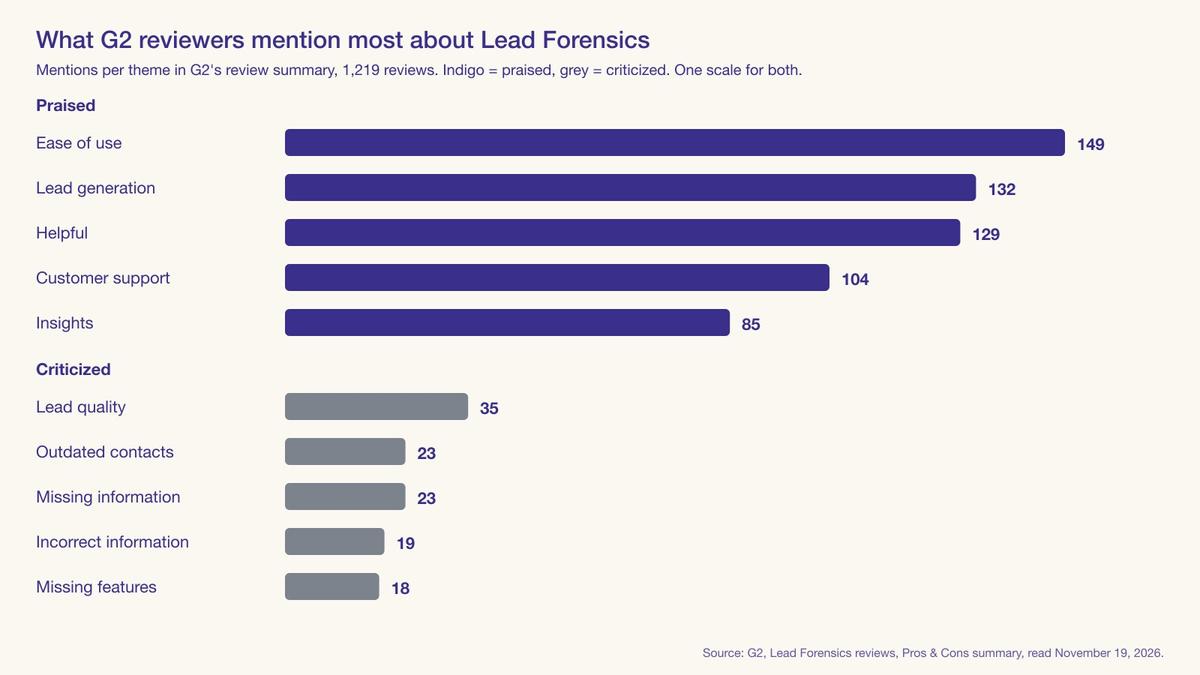
In G2's summary, ease of use has 149 mentions, lead generation 132, helpfulness 129, customer support 104 and insights 85. On the critical side, lead quality has 35 mentions, outdated contacts and missing information 23 each, incorrect information 19 and missing features 18.
Trustpilot says on the profile that it doesn't fact-check reviews. If you see Glassdoor in your search results, its Lead Forensics page rates the company as an employer, from staff reviews.
What reviewers praise
G2 groups its reviews into tags. The five most-mentioned positives for Lead Forensics are ease of use, lead generation, helpfulness, customer support and insights, with 85 to 149 mentions each. TrustRadius's summary of its 36 most recent reviews says 89% of reviewers rate its core job, identifying the companies that visit, highly. On Capterra, customer service scores 4.7 and ease of use 4.5.
The support praise likely reflects what Lead Forensics sells: both plans include a dedicated customer success manager, and reviewers on Trustpilot name individual account managers often enough that Trustpilot's own summary picks it out. If your team won't log in to a new tool without someone walking them through it, that's probably the strongest argument for Lead Forensics in the reviews.
What reviewers complain about
Contact data that's out of date or wrong
G2's five most-mentioned negatives are lead quality, outdated contacts, missing information, incorrect information and missing features, with 18 to 35 mentions each. TrustRadius puts it at 28% of recent reviewers, who mention outdated personnel details and incorrect company names. G2's own summary adds that some users find the tool struggles to identify individual visitors inside larger organizations, which seems to follow from the design: the contacts are people who work at the company, not the person who visited.
None of that is unique to Lead Forensics. Company-level tools usually depend on contact databases that go stale as people change jobs, which is why we'd check a sample of contacts by hand during the trial.
Contracts, renewals and price rises
We read the 20 most recent one-star reviews on Trustpilot, posted between February 2024 and September 2026, and sorted them by what each reviewer complained about. Some raised more than one issue:
- 8 described contract problems: a 90-day notice period before renewal, automatic renewal for a full year, or a balance sent to collections.
- 4 said the data or the return didn't justify the cost, including one who said many of the matches were universities.
- 4 complained about Lead Forensics' own sales and marketing, mostly repeated calls and emails.
- 3 questioned whether the positive reviews were real.
- 2 described annual price increases, one of them a 10% rise they said came without warning.
- 1 gave no specific reason.
Lead Forensics replied publicly to most of them. These reviewers are probably a minority of customers, since 16% of 999 Trustpilot reviews give one star, but the contract complaints are specific and they seem to repeat. Barbara Murphy Melby of Morgan Lewis described the same pattern across software contracts in general, in a May 2026 post on renewals:
"Many SaaS agreements contain unilateral or automatic renewal rights paired with annual pricing increases. At renewal, service providers may also seek to implement revised licensing structures, usage-based pricing models, or additional charges for features and functionality that were previously included within the subscription scope." — Barbara Murphy Melby, Morgan Lewis (Tech & Sourcing @ Morgan Lewis)
Questions to ask before you sign or renew
Eight of the 20 one-star reviews we read turned on contract terms, which you can probably check before you sign. Ask for these in writing:
- What's the notice period, and on what date does it fall in the first year?
- Does the contract renew automatically, and for how long?
- Is there a cap on annual price increases?
- Which traffic measure sets the price, and what happens if traffic grows?
- Does the trial use the same identification and contact data as the paid plan?
- What does decision-maker contact data cost, and where does it come from?
- How do you export your data, and when is it deleted, if you leave?
During the trial, it's probably worth checking a sample of 20 identified companies by hand against your CRM and LinkedIn, and counting how many are internet service providers, universities or companies you'd never sell to. Our lead routing guide covers what to set up in your CRM before the first records arrive.
Lead Forensics alternatives at a glance
Lead Forensics is listed first for reference and the alternatives follow alphabetically, with prices in the currency and on the billing basis each vendor shows. We couldn't read tier prices from Apollo's pricing page, so its row gives the plan structure without a price.
| Tool | Who it identifies | Entry price | Free plan or trial | Contact data | HubSpot or Salesforce |
|---|---|---|---|---|---|
| Lead Forensics (for reference) | Company, with decision-maker contacts | Not published | 1-week trial after a demo | Decision-maker data on both plans | Both |
| Albacross | Company | €59/mo billed annually, €84 monthly | 14 days, no card | 10 email and 5 phone credits on Starter | HubSpot from €149, Salesforce on Organisation |
| Apollo | Company (global); person (US) with the Inbound add-on | Free plan; Inbound add-on for people | Free plan | Emails and phones on credits | Not stated on the visitor-ID page |
| Happierleads | Person | $69/mo billed annually, $99 monthly, 300 leads | 7 days, no card | Work email and LinkedIn per lead | Both, every plan |
| HubSpot Buyer Intent | Company | Inside most HubSpot hubs from Starter, on HubSpot credits | 20 companies per view on a Starter hub, without credits | None | HubSpot only |
| Leadfeeder | Company | €0, then €79/mo billed annually | Free Lite plan; 14 days, no card | Credits on every plan (50/mo on Discover) | Both, from Discover |
| Leadinfo | Company, with a decision-maker database | €69/mo billed annually, €99 monthly | 14 days, no card | Included | HubSpot from €159, Salesforce from €359 |
| RB2B | Company (global); person (US) from Starter | $0, then $79/mo | Free plan; 7-day Pro+ trial, no card | Business email from Pro, $149/mo | Both, from Pro |
| Signal (ours) | Company (global); person (US) | $0 after a $1 trial, then $69/mo billed annually or $79 monthly | Free plan after a $1 7-day trial | Business email, every plan | HubSpot on every plan; no Salesforce yet |
| Snitcher | Company, with contacts on reveal | $49/mo billed annually, $89 monthly | 14 days, no card | On reveal | Both, every plan (manual on Starter) |
| Warmly | Person and company | From $10,000/yr, or $4,875/quarter to try | Talk to sales | Included in credits | CRM sync, CRMs not named on pricing page |
The takeaway: Leadfeeder, Albacross, Leadinfo and Snitcher do roughly the same job as Lead Forensics, company-level identification, and all four publish prices and offer monthly billing. Happierleads, RB2B and Signal identify people at self-serve prices, and so does Apollo with its Inbound add-on. Warmly, like Lead Forensics, sells through a sales team.
Which alternative fits your reason
If you want a published price and monthly billing
Leadfeeder, Albacross, Leadinfo and Snitcher price per identified company and show every entry price on their sites. Billed monthly, the entry plans cost $89 at Snitcher, €84 at Albacross, €99 at Leadinfo and €113 for Leadfeeder Discover, each sized for about 50 companies a month; Snitcher counts its allowance as 600 a year. Leadfeeder also has a free Lite plan that shows the last 100 identified companies each month. A monthly plan might still carry a notice period, so read the cancellation terms on whichever you pick. Our Leadfeeder alternatives guide compares the four plan by plan.
If you need the person, not only the company
Lead Forensics gives you people who work at the visiting company. Person-level tools try to name the visitor. RB2B's Starter plan, at $79 a month, sends the person and a LinkedIn URL to Slack or Teams for 300 resolutions, with business email from its $149 Pro plan. Happierleads charges $69 a month billed annually for 300 leads, with a work email and LinkedIn profile on each. Signal includes business email on every plan. RB2B, Apollo and Signal identify people in the US only, and Happierleads says it covers 174 countries, a claim we haven't tested. Our RB2B alternatives guide compares the person-level options.
If your CRM is HubSpot
HubSpot's Buyer Intent matches anonymous visits to companies by IP address, according to HubSpot's help center, and it's available from the Starter tier of most HubSpot hubs. You can see 20 companies per view without credits; tracking a company uses 10 HubSpot credits a month. If your team only needs the company name inside HubSpot, Buyer Intent might be enough, so check it before you buy another tool. It has no contact data.
If you want to start free
Leadfeeder's Lite plan shows the last 100 identified companies a month. RB2B's free plan identifies 150 companies a month in Slack. Apollo's free plan includes company identification. Signal's free plan covers 150 identified visitors a month, with person details on US visits, after a $1 trial.
Where Signal fits
Signal identifies the company behind a visit from its IP address, for visitors anywhere in the world, and for US visitors it also looks for the person. It collects first-party signals on your own domain and queries a third-party identity graph only to resolve visitors already on your site: it sends a first-party cookie and the visitor's IP address to the graph, along with browser details, and the graph links them to a hashed email address it already holds. Signal matches identified people to their employers through a third-party B2B data partner, and when it pushes a contact to HubSpot, it matches the company on its website domain.
Every Signal plan, including the free one, includes business emails, native push to HubSpot, and hourly Slack and Microsoft Teams alerts, which are in beta. Signal also pushes to Klaviyo and Mailchimp, where we add new contacts with business emails only and update an existing contact, business or personal email, only if that person has already opted in. The free plan covers 150 identified visitors a month after a $1 seven-day trial of the Pro+ plan. Starter is $69 a month billed annually, or $79 monthly, for 300.
Signal has no native Salesforce integration yet and none for Dynamics or Pipedrive, publishes no plan above 2,500 a month, identifies people only on US visits and doesn't state a match rate on its pricing page. If your CRM is Salesforce or Dynamics, or you need contacts for visitors outside the US, Lead Forensics or one of the company-level tools above will probably fit better.
Frequently asked questions
Is Lead Forensics any good?
On the review sites, mostly yes. Lead Forensics averages 4.4 to 4.6 out of 5 on G2, Capterra and Trustpilot, and reviewers praise its ease of use and customer success staff. The complaints are about contact data that's out of date and about contracts, especially automatic renewals and notice periods. On Trustpilot, 16% of its 999 reviews give one star.
How much does Lead Forensics cost?
Lead Forensics doesn't publish prices. It says the cost depends on your website traffic and how many new leads it uncovers, and a representative quotes after a demo and a one-week free trial. Both plans, Essentials and Automate, include unlimited users.
Does Lead Forensics identify individual visitors?
No. Lead Forensics identifies the company behind a visit from its IP address. Its decision-maker contact data lists people who work at that company, from third-party suppliers, and its own FAQ says those contacts aren't the people who visited your site.
How do I cancel Lead Forensics?
Lead Forensics doesn't publish its cancellation terms; they're in your signed customer agreement. Two of the eight contract complaints among the one-star Trustpilot reviews we read describe a 90-day notice period before an automatic renewal, so find the notice date in your agreement and put it on your calendar well before the renewal.
What's the difference between Lead Forensics and Leadfeeder?
Both identify companies from IP addresses and offer contact data for people at those companies. Leadfeeder publishes its prices, has a free plan and starts paid plans at €79 a month billed annually. Lead Forensics publishes no prices, sets the price from your traffic after a one-week trial and includes a dedicated customer success manager on both plans.
What are the best Lead Forensics alternatives?
It depends on why you're looking. For published prices and monthly billing, Leadfeeder, Albacross, Leadinfo and Snitcher. For person-level identification, Apollo, Happierleads, RB2B and Signal. HubSpot users can try Buyer Intent first, and Warmly is sales-led too. Leadfeeder, RB2B, Apollo and Signal all have free plans to start with.
Continue the Series
This is Post 19 in Geysera's 19-part series on B2B anonymous visitor identification. The posts published so far:
- Post 1 — Anonymous website visitor identification: the complete 2026 guide (pillar)
- Post 2 — How to identify anonymous website visitors: 5 methods and what each delivers
- Post 3 — What is an identity graph? How anonymous visitors get matched to real people
- Post 4 — Match rates decoded: why 40%+ person-level claims are usually fiction
- Post 5 — B2B intent data explained, and why most of it is flawed
- Post 6 — Person-level vs company-level identification
- Post 7 — The best website visitor identification tools (2026)
- Post 8 — Third-party cookies didn't die, the deprecation did
- Post 9 — Lead routing for identified website visitors
- Post 10 — Is an IP address PII? What US privacy law means for identifying website visitors
- Post 14 — Website visitor tracking: how to see who visits your website
- Post 15 — Identity resolution for B2B: how it works and which platforms do it
- Post 16 — B2B intent data providers compared
- Post 17 — RB2B alternatives: which tool fits the reason you're switching
- Post 18 — Leadfeeder alternatives: which tool fits the reason you're switching
Sources
- Lead Forensics — Pricing
- Lead Forensics — How Lead Forensics identifies B2B visits (data page)
- Lead Forensics — Customer FAQ (compliance)
- G2 — Lead Forensics reviews
- Capterra — Lead Forensics reviews
- TrustRadius — Lead Forensics reviews
- Trustpilot — Lead Forensics reviews
- Albacross — Pricing
- Apollo — Website visitor identification
- Happierleads — Pricing
- HubSpot — Use buyer intent (knowledge base)
- HubSpot — Product and services catalog
- Leadfeeder — Pricing
- Leadfeeder — Pricing plans and payment methods (help center)
- Leadinfo — Pricing
- RB2B — Pricing
- Snitcher — Pricing
- Warmly — Pricing
- Geysera — Signal pricing
- Tech & Sourcing @ Morgan Lewis — Top 5 issues customers should consider in SaaS agreement renewals (Barbara Murphy Melby)

Co-Founder and CEO
Bob Thordarson is CEO and Co-Founder of Geysera, a serial entrepreneur with 25+ years and five co-founded ventures, including Cequint (acquired by TNS in 2010 for $112.5M) and Consumerware (acquired by ParkerVision). A graduate of the University of Washington and MIT Entrepreneurial Masters Program, based in Seattle, he serves on the boards of DRY Soda Co. and the Entrepreneurs' Organization Seattle chapter. He is an expert in retention marketing email systems and methodology for ecommerce and B2B brands — measured by incremental revenue, not vanity metrics.