B2B Intent Data Explained — and Where It Breaks
B2B intent data promises to tell you which accounts are researching your category before they ever visit your site. Some of it does. This guide covers the four places intent signals actually come from, what the vendors disclose about their methods, what two European court rulings did to the ad-auction supply, and how to test a provider before you sign.
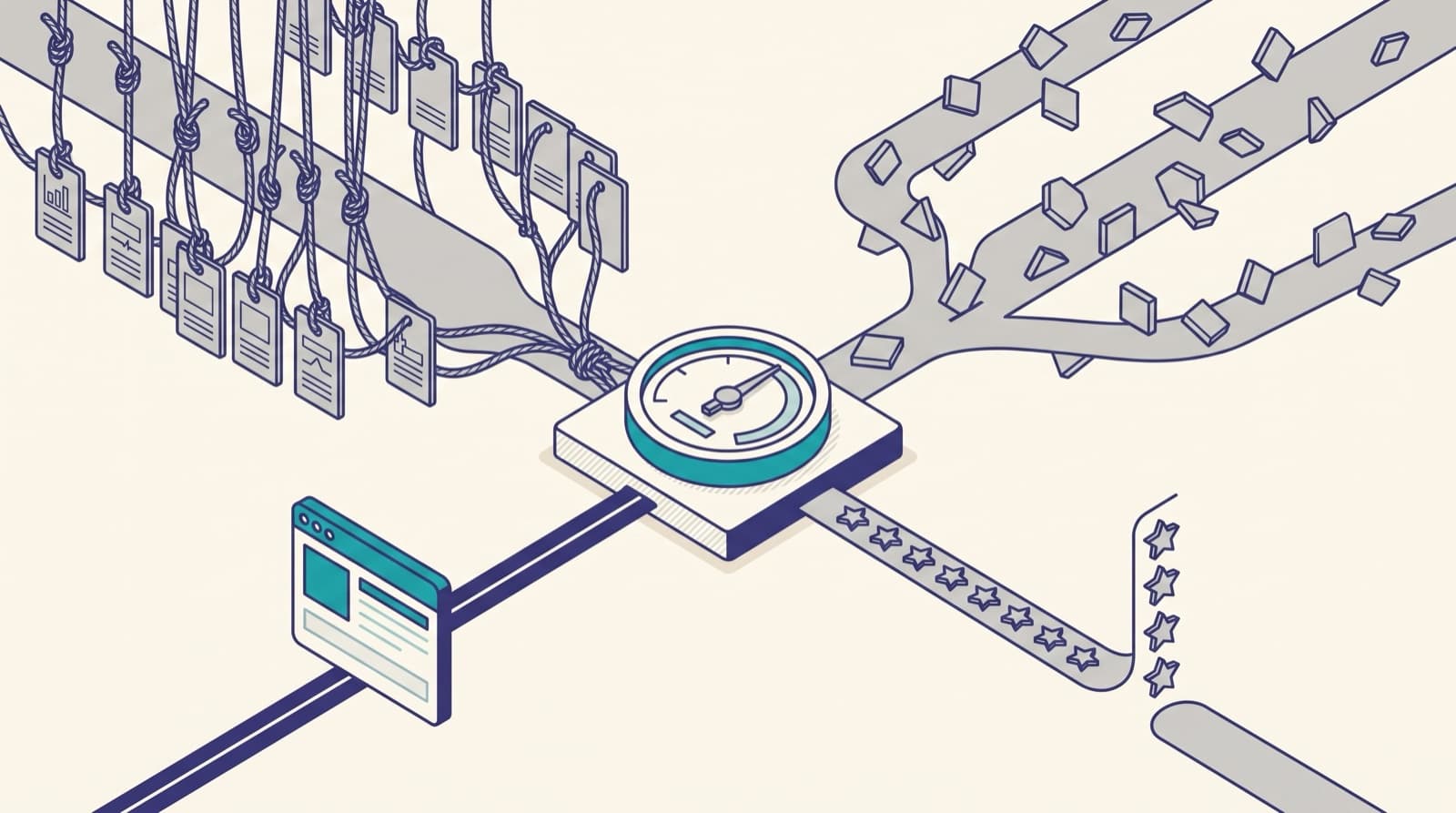
B2B intent data is information about which companies are researching a product category, assembled from content consumption somewhere other than your own website. It's sold as an early warning: a list of accounts said to be in-market before they ever arrive. What separates a useful feed from an expensive one is where the signal was collected.
KEY STATS
- In a category where companies switch providers about every five years, roughly 20% of the market is in-market in a given year and about 5% in a given quarter (Professor John Dawes, Ehrenberg-Bass Institute, for the LinkedIn B2B Institute)
- Bombora's Data Co-op spans more than 5,000 B2B websites, and Bombora states that over 70% of those sites are exclusive to it (Bombora, company documentation)
- Bombora's co-op spans 5,000+ sites, and Bombora places the consent obligation on the publishers in it: "Publishers are responsible for obtaining consent and providing the web visitor with the opportunity to opt out of the sale of their data" (Bombora, company documentation)
- The Court of Justice of the European Union ruled in March 2024 that the consent string passed in ad auctions can be personal data, and that IAB Europe is a joint controller for it
- The Belgian Market Court upheld a €250,000 fine against IAB Europe on May 15, 2025, while limiting its controller status to the consent string rather than downstream ad processing
- Buying the phrase costs more than reading about it: "intent data" runs a $151.43 average CPC and "b2b intent data" $121.54 (Google Ads via DataForSEO, September 2026)
- Data sourced from published academic research, vendor documentation, 2 European court rulings and Google Ads keyword data, compiled September 2026
Intent data is the one category in this series where I think the critics have overcorrected. There's a genre of post arguing the whole thing is a con, and the loudest example I found cites a false-positive rate above 80% without saying where the number came from. That's the same defect the genre is complaining about.
Third-party intent does something first-party data cannot do at all: it can tell you an account is researching your category before that account has ever loaded your site. If your sales cycle depends on getting there early, that's worth money.
What's in this guide:
- What is B2B intent data?
- Where intent data actually comes from
- The 95:5 problem
- What vendors disclose, and what they don't
- The criticism has the category's own problem
- What the courts did to third-party signals
- First-party signals against third-party intent
- How to test an intent vendor before you sign
- Frequently asked questions
What is B2B intent data?
Intent data answers a different question than visitor identification does. Identification asks who this visitor is, and Post 2 covers the five ways of answering it. Intent asks which accounts are showing buying signals, and it usually answers by watching behavior somewhere else — on publisher sites, on review sites, or in the plumbing of the advertising market.
Where "somewhere else" is decides what the signal can tell you. A signal collected on your own site is something you observed; a signal collected across a network of five thousand publishers is something a vendor inferred, then attributed to a company, then scored against a baseline. Each of those three steps can be done well or badly, and the vendor's marketing page will describe none of them.
The distinction matters more than it used to, because the two products increasingly ship in the same dashboard. We covered the overlap briefly in the pillar for this series, anonymous website visitor identification. This post is the version with the mechanics in it.
Where intent data actually comes from
Nearly every intent product resolves to one of four collection methods, and a few blend them. The method determines what the signal can support, so it's the first thing to establish on a vendor call.
| Source | How the signal is collected | What it can tell you | Main weakness |
|---|---|---|---|
| Publisher co-op | A tag on a network of B2B publisher sites records content consumption, mapped to a company | Which topics an account is reading about across many sites | You inherit the publishers' consent posture; the mapping to a company is an inference |
| Ad auction (bidstream) | Data exposed to bidders during programmatic ad auctions, including losing bidders | Very broad reach at low cost | No end-user consent is gathered in the auction itself; two European rulings now bear on it directly |
| Review sites | Traffic and comparison behavior on G2, TrustRadius and similar | Unusually late-stage and specific — someone comparing you to a named rival | Narrow; only covers categories with real review volume |
| First-party | Behavior on your own site, your emails, your product | Exactly what a known or resolvable visitor did, with a timestamp | Blind until the account arrives; no early warning at all |
The takeaway: These four are not interchangeable and shouldn't be priced as if they were. Publisher co-op and review-site data buy you reach and early warning at the cost of inference. First-party data buys you certainty about events you observed, with no visibility before the first visit. Bidstream buys the most reach for the least money and now carries the most regulatory exposure of the four.
Ask which of these four a vendor uses before you ask anything else. If the answer is a blend, ask for the proportions. A product that is 80% bidstream with a co-op partnership bolted on is a bidstream product.
The 95:5 problem
The arithmetic that constrains every intent product has nothing to do with data quality.
Research by Professor John Dawes of the Ehrenberg-Bass Institute, carried out for the LinkedIn B2B Institute, starts from how often businesses change providers — for services like banking, legal advice, software and telecoms, roughly every five years. Run that forward and about 20% of a market is in-market in a given year, and about 5% in a given quarter. The other 95% are not buying anything.
Dawes frames it with a category he studied directly:
"If I'm chasing clients in commercial banking then it's useful to realise that in any given year only one in 10 of them will be looking to appoint a new bank or switch their lead bank. In a quarter or a month, it's a tiny proportion." — Professor John Dawes, Ehrenberg-Bass Institute (Marketing Science)
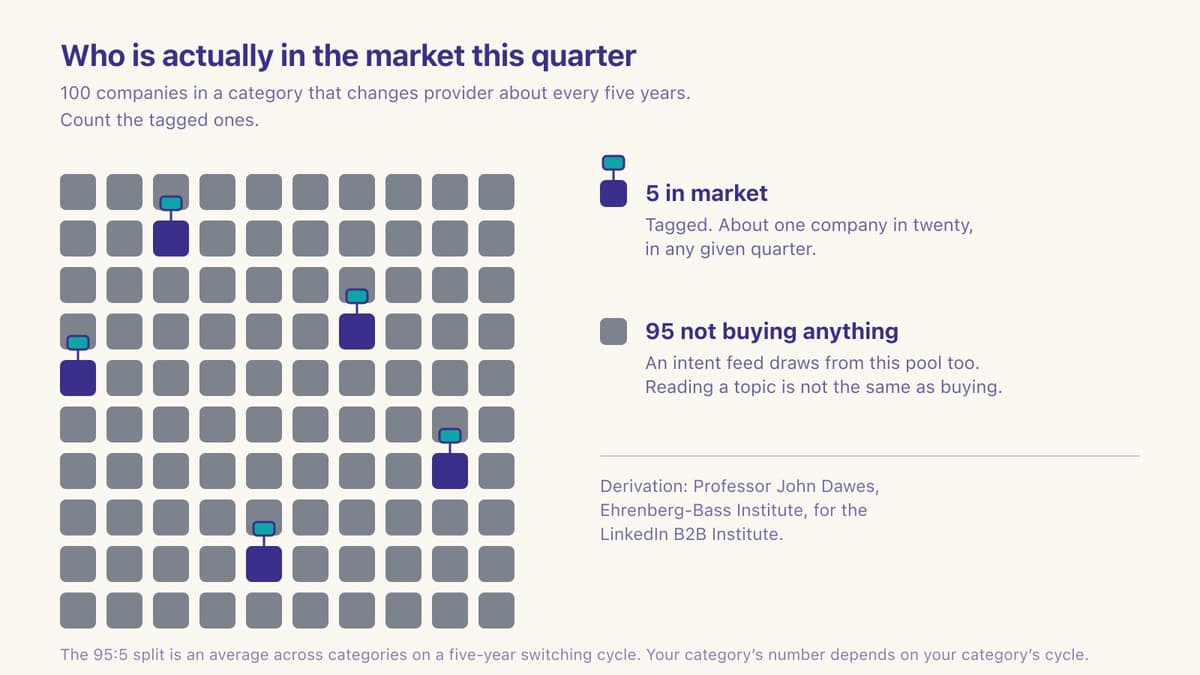
Note that his banking figure is one in ten a year, not one in five. The 95:5 shorthand is an average across categories with a five-year switching cycle, and your category's number depends on your category's cycle. Anybody quoting 95:5 at you as a law of nature has skipped that step.
What this does to an intent feed is straightforward. A vendor surfacing "accounts showing intent" is drawing from a pool where the large majority aren't in a buying cycle at all this quarter. Some of those accounts are reading your category because an analyst is writing a report, or a junior researcher is doing a class project, or a competitor is checking prices. A surge score can be perfectly well calculated and still mostly describe reading rather than buying.
"It is the case that a lot of companies haven't fully realised yet that most people are not in the market for any product at any given time. You need to target them with a long-term lens." — Jann Martin Schwarz, Global Head, LinkedIn B2B Institute (Marketing Science)
That's a more accurate frame than the pitch, and a good deal less exciting. It's a prioritization tool operating on a pool that's mostly out of market.
What vendors disclose, and what they don't
I went looking for the methodology behind the best-known score in the category, and found a published claim about supply sitting next to a scoring method Bombora doesn't document on its own pages.
Bombora publishes a real amount about its collection. Its Data Co-op covers more than 5,000 B2B websites, and the company states that over 70% of those sites are exclusive to it. That's a specific, checkable claim about supply, and it's more than most competitors disclose.
On consent, its own explainer places the obligation with the publisher rather than with Bombora: "Publishers are responsible for obtaining consent and providing the web visitor with the opportunity to opt out of the sale of their data." Read that twice before you sign, because it tells you where the risk sits. A co-op's compliance is the aggregate compliance of several thousand publishers you have no relationship with and cannot audit.
What I could not find on Bombora's own pages is the arithmetic of the Company Surge score. The specifics that circulate everywhere — a three-week consumption window compared against a twelve-week baseline, with 60 as the threshold that counts as a surge — appear in third-party reviews and glossaries rather than in Bombora's own documentation. The numbers may well be right. The most-cited methodology detail in this category still reaches buyers through intermediaries, and a buyer repeating it in a business case is repeating something the vendor did not publish.
When you can't find a method on a vendor's own site, you're being asked to trust a score rather than evaluate one. I ask for the documentation link on every vendor call now, and I've had two vendors fail to produce one.
The criticism has the category's own problem
I read the most widely shared critique in this space, a piece titled "Intent Data is a Lie." It claims a false-positive rate above 80%. It claims sales teams close 3–7% of accounts flagged as high intent. It attributes two further figures to Gartner. Not one of those numbers carries a citation, the Gartner attributions have no report name or date, and the underlying evidence is 52 unnamed respondents.
I'm not citing any of it, and neither should your business case. A post arguing that vendors publish numbers you can't check is not entitled to publish numbers you can't check. We got this wrong ourselves earlier in this series and had to correct a match-rate count across four posts.
Attribution to a company from a co-op tag is an inference. Consent in a publisher network is delegated to publishers. Bidstream has no consent step at all. A surge score is a comparison against a baseline, so a small firm with little baseline traffic can look like it's surging on very little activity. None of that needs an invented percentage.
What the courts did to third-party signals
The regulatory picture changed materially in the last two years, and it lands hardest on the ad-auction supply.
In March 2024 the Court of Justice of the European Union ruled that the TC String — the consent string passed through the advertising auction — can be personal data when it can be linked to an identifier such as an IP address, and that IAB Europe is a joint controller for the processing of that string. On May 15, 2025, the Belgian Market Court upheld the Belgian data protection authority's €250,000 fine against IAB Europe, while narrowing the scope: IAB Europe is a joint controller for the consent string itself, not for what individual participants do with data further down the chain.
Cognism's May 2026 case for co-op data over bidstream, by Ilse Van Rensburg, cites the UK ICO and the Belgian data protection authority as saying that collecting and using bidstream data violates GDPR, and the same page states that Cognism uses Bombora's co-op intent data to identify accounts showing increased research activity.
Two practical consequences for a buyer. First, bidstream-sourced intent about European visitors now sits on contested legal ground, and "our supplier handles compliance" is not a position anybody should accept without seeing the supplier named. Second, the narrowing matters as much as the fine — responsibility was pushed down to the individual participants in the chain, which includes any vendor selling you the output.
If your traffic is US-only this is background rather than foreground. Every serious B2B ICP I've worked with has some European traffic, so I'd treat it as foreground.
First-party signals against third-party intent
On the dimensions that decide a purchase, the two compare like this.
| Third-party intent | First-party identification | |
|---|---|---|
| Answers | Which accounts are researching the category | Who is on your site right now |
| Timing | Before the account visits you | Only once the account visits you |
| Evidence | An inference from behavior elsewhere | An event you observed and can replay |
| Granularity | Account and topic | Account, and in some cases a named person |
| Compliance surface | Publisher network or ad auction, audited by neither of you | Your own site and your own consent notice |
| Fails when | Baseline traffic is thin, or the reader isn't a buyer | The account hasn't arrived yet |
The takeaway: These solve different halves of the same problem and the sequencing is what matters. Third-party intent narrows a market down to accounts worth spending attention on. First-party identification tells you which of them showed up and what they read. Buying the second without the first costs you early warning. Buying the first without the second leaves you with a list nobody can act on.
That second failure is the common one. A feed of accounts showing topic surges is only useful if something routes it to a person who will do something about it, and most teams find that out after the invoice. We built Signal around first-party signals for exactly this reason, and we feed them into whatever system already runs your follow-up rather than sending anything ourselves. A first-party signal cannot tell you an account is in-market before it visits you, which is precisely what a co-op product is for.
I've never once been able to reconstruct why a third-party score moved. I can reconstruct a first-party signal to the exact page and the exact minute. — Bob Thordarson, Geysera CEO
How to test an intent vendor before you sign
Six checks. They take about an hour and they'll settle most evaluations.
- Ask which of the four sources the data comes from, and in what proportion. A blend is fine. A vendor that won't break down the blend is telling you something.
- Ask where the collection method is documented on their own site. If it isn't published, the score is a black box you're renting.
- Ask who obtains consent, in writing. For a co-op the answer will usually be the publishers. That may be acceptable; it should be explicit.
- Ask for the baseline period and the surge threshold. A score you cannot interpret is a score you cannot argue with when it's wrong.
- Ask what happens to European traffic, and get the sub-processor named. After May 2025 the chain of responsibility runs to the participants, which includes them and then you.
- Run a back-test before the contract. Give them ten accounts that closed last year and ten that never engaged, and ask what their data would have shown twelve months ago. Vendors with real historical data can do this. It is the single most useful hour in the evaluation.
That last one separates the market faster than anything else on the list. Everything else is a question about method; a back-test is a question about outcomes, run against accounts whose answers you already know.
Signal scores intent from the pages a visitor views on your own site.
Frequently asked questions
What is B2B intent data?
B2B intent data is information about which companies are researching a product category, gathered from content consumption outside your own website — typically a publisher co-op, an advertising auction, or review-site behavior. It's used to prioritize accounts before they visit you.
Is B2B intent data accurate?
It depends entirely on the collection method, and accuracy is the wrong frame. Attribution from a co-op to a company is an inference, and a surge score compares activity against a baseline rather than measuring purchase readiness. Treat it as prioritization, not prediction.
What is the difference between intent data and visitor identification?
Intent data tells you which accounts are researching your category somewhere else. Visitor identification tells you who is on your own site. The first is an inference bought from a third party; the second is an event you observed directly.
What is the 95:5 rule in B2B?
Research by John Dawes at the Ehrenberg-Bass Institute for the LinkedIn B2B Institute found that in categories where firms switch providers about every five years, roughly 20% are in-market in a year and about 5% in a quarter. The figure varies by category and cycle length.
Is bidstream intent data legal?
It's contested rather than settled. The CJEU ruled in March 2024 that the ad-auction consent string can be personal data, and the Belgian Market Court upheld a €250,000 fine against IAB Europe in May 2025 while narrowing its controller role. Responsibility runs to the participants in the chain.
Should I buy intent data or visitor identification first?
If nobody currently acts on the accounts already visiting your site, start with identification and routing — intent will only add volume to a queue nobody works. If your follow-up is already tight and your problem is finding accounts early, third-party intent is the piece that does what first-party data cannot.
Continue the Series
This is Post 5 in Geysera's 13-part series on B2B anonymous visitor identification.
- Post 1 — Anonymous website visitor identification: the complete 2026 guide (pillar)
- Post 2 — How to identify anonymous website visitors: 5 methods and what each delivers
- Post 3 — What is an identity graph? How anonymous visitors get matched to real people
- Post 4 — Match rates decoded: why 40%+ person-level claims are usually fiction
- Post 6 — Person-level vs company-level identification
- Post 8 — Third-party cookies didn't die. The deprecation did.
Sources
- Ehrenberg-Bass Institute: 95% of B2B buyers are not in the market for your products — Professor John Dawes, study for the LinkedIn B2B Institute
- Bombora — B2B intent data explained: privacy, compliance, and consent — Data Co-op size, exclusivity and consent placement
- Cognism — Bidstream intent data: why you should use co-op data instead — Ilse Van Rensburg, May 12, 2026
- Informa TechTarget — Why bidstream data is not a sustainable source of intent — October 2020; the publisher does not participate in programmatic exchanges
- Lewis Silkin — Belgian Market Court upholds €250,000 fine against IAB Europe — May 15, 2025 ruling
- DLA Piper Privacy Matters — Brussels Court of Appeal rules on IAB Europe and the TC String — scope of joint controllership
- Search volume and CPC: Google Ads via DataForSEO, United States, pulled 2026-09-03

Co-Founder and CEO
Bob Thordarson is CEO and Co-Founder of Geysera, a serial entrepreneur with 25+ years and five co-founded ventures, including Cequint (acquired by TNS in 2010 for $112.5M) and Consumerware (acquired by ParkerVision). A graduate of the University of Washington and MIT Entrepreneurial Masters Program, based in Seattle, he serves on the boards of DRY Soda Co. and the Entrepreneurs' Organization Seattle chapter. He is an expert in retention marketing email systems and methodology for ecommerce and B2B brands — measured by incremental revenue, not vanity metrics.