The Best Website Visitor Identification Tools (2026)
Every vendor-published "best website visitor identification tools" comparison on the first two pages of Google puts its own product first, seven out of seven, checked at source in November 2026. So this one ranks nobody. It publishes the four questions you can check from outside a vendor's sales process, the answers for fifteen tools checked against their own live pages, and the places where the tables already ranking for this query have gone stale.

Key benchmarks at a glance
| Metric | Figures |
|---|---|
| Tools surveyed | 15 — Website visitor identification tools in the table; 14 live pages fetched at source, ZoomInfo WebSights returned 404 |
| Vendors publishing a numeric match rate on their own pricing page | 2 — RB2B and Opensend; Snitcher claims a rate without a number, which is not checkable |
| Lowest published entry price | $49 — Snitcher, per month billed annually ($79 month to month), 0 to 50 company identifications per month |
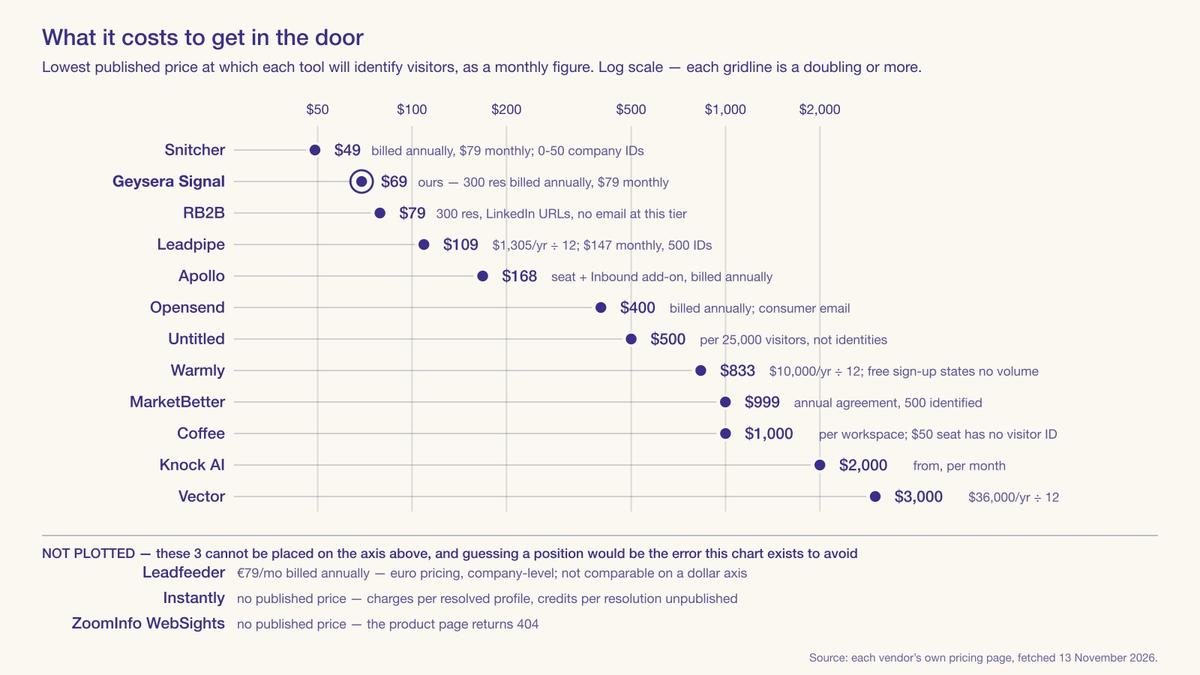
| Highest published entry price | $3000 — Vector Growth, $36,000 a year divided by twelve, sized by site traffic and ad spend; Knock AI from $2,000 a month is the highest monthly-billed price |
| Vendor-published visitor identification comparisons on the first two pages of Google that put the publisher's own product first | 7 — Out of seven found on 13 November 2026; five at a numbered first place, two first in an unnumbered list or table |
Website visitor identification tools are scripts that match anonymous traffic against an identity graph and return a company, or sometimes a named person, for some share of your visitors. They differ on three things: whether they resolve a person or only a company, what share of traffic they resolve, and whether they publish a rate you can check.
Before writing this I pulled the first two pages of Google for the query in the title, plus the sources its AI Overview cites, then fetched every comparison among them. On the two pages of results, seven are published by companies that sell a visitor identification product. All seven put their own product first. Much of the shortlist a buyer starts from was assembled by the people being shortlisted. So this post ranks nobody. It gives you the four questions instead, and the answers for fifteen tools, taken from their own live pages.
KEY STATS
- All seven comparisons on the first two pages of Google for this query that come from a company selling visitor identification put the publisher's own product first, five at a numbered first place (fetched at source, 13 November 2026)
- MarketBetter's twelve-tool table says it was "re-verified" in September 2026, yet four of its price cells disagree with the vendors' own pages, its own included, and it still recommends Koala, which shut down in September 2025 (MarketBetter; vendor pages, 13 November 2026)
- Google's AI Overview for this query quotes 30 to 65% at company level and 5 to 20% at person level without naming who measured either range (Google, 13 November 2026)
- Three lists on the first two pages still give a numbered entry to ZoomInfo WebSights, whose product page returned 404 on 3 September and again on 13 November 2026 (zoominfo.com)
- Published entry prices span $49 a month at Snitcher, billed annually, to $36,000 a year at Vector (vendor pricing pages, 13 November 2026)
- Only 2 of 15 vendors publish a numeric match rate on their own pricing page, and RB2B's top band of 35-45% is far higher than the 5-20% person-level range in Warmly's production data (vendor pricing pages, 13 November 2026; Warmly, 2026)
- Around 98% of website visitors are anonymous on arrival, a share that includes customers who are logged out (Twilio Segment, 2026)
- Data compiled from vendor pricing and product pages fetched directly on 13 November 2026, plus a live Google SERP pull for the primary query.
What's in this guide:
- Who writes the lists you are reading
- What Google's AI Overview does with them
- Four questions you can check from outside
- The question none of these pages answer
- What the field looks like when you check it
- Where the published tables have gone stale
- Where Signal lands, and where it doesn't
- How to run this yourself in an afternoon
- Frequently asked questions
Who writes the lists you are reading
Search for visitor identification tools and you'll get a page of comparison articles. Most of them look editorial. They carry selection criteria, comparison tables, pros and cons and a methodology note near the top, and not one of them hides who published it — the vendor's own logo sits in the header of every page in the table below. They share one structural feature anyway.
| Publisher | Publisher sells a product in this space | Their comparison's first entry |
|---|---|---|
| DelveAnt | yes, a CRM with visitor identification | 1. DelveAnt |
| Untitled | yes | 1. Untitled |
| MarketBetter | yes | 1. MarketBetter |
| Captiwate | yes | 1. Captiwate |
| Attribuly | yes | 1. Attribuly Capture |
| Snitcher | yes | Snitcher, first in a list it says is "grouped by kind, not ranked" |
| Factors.ai | yes | Factors.ai, first row of its comparison table |
The takeaway: Seven comparisons on the first two pages of Google for this query come from a company that sells visitor identification, and all seven put that product first, five at a numbered first place. The other lists have commercial interests too. MMG Design Studio deploys the RB2B and Leadfeeder tools it ranks first and sixth, and B2B SaaS Reviews discloses affiliate commissions. Every heading was read from the live page on 13 November 2026.
These are marketing pages doing their job. A vendor writing a category guide will almost always rank itself first, the way a shop recommends what it stocks. The risk is that a buyer who reads three of these pages believes they have triangulated across independent sources, when what they have actually done is read three sales pitches built to the same layout, drawing on the same handful of competitor claims, none of which any of the three re-checked before publishing.
What Google's AI Overview does with them
The AI Overview for this query cites six sources: G2, Leadfeeder's product page, Instantly's product page, Common Room's comparison, Articsledge, and RB2B's own list of tracking software. Common Room and RB2B both put their own product first, and neither page appears in the first two pages of organic results, which is why they sit outside the seven. The overview then reports match rates of 30 to 65% at company level and 5 to 20% at person level without saying who measured them. Both ranges match the production figures Warmly publishes, and Common Room's page sources them to its own guide.
Its shortlist names Leadfeeder, ZoomInfo GTM Workspace, RB2B, Instantly's Website Visitors product, and Albacross, Dealfront and 6sense as alternatives. The organic results also recommend products that no longer exist. Three of the lists on these two pages still give a numbered entry to ZoomInfo WebSights. I clicked it. zoominfo.com/products/websights returns 404, as it did when we first checked it on September 3. Two other lists on those pages, from B2B SaaS Reviews and Cleverviral, still recommend Koala as a live tool, though Koala shut down on September 30, 2025.
ZoomInfo WebSights keeps a row in the table below because those lists still send buyers to it.
Four questions you can check from outside
None of these need a demo, a sales call or a trial. All four can be answered from a vendor's own public pages in about ten minutes each.
1. Does it resolve a person, or only a company?
This is the largest single difference in the category and it's frequently blurred. A tool that tells you Acme Corp visited is doing a different job from one that tells you Dana Whitfield in procurement visited. Company-level resolution runs far higher, because it only has to map an IP address to an organization. The only published ranges with a stated base come from Warmly's production data across more than 1,600 organizations, 30 to 65% at company level and 5 to 20% at person level, and Warmly sells a tool at both levels. Person-level typically needs a US-heavy audience to work at all. We covered the split in full in person-level vs company-level identification.
Find the pricing page and look for the words "person" or "contact" attached to a specific tier, not to the homepage headline.
2. Does it publish a match rate you could check?
Most don't. Of the fifteen tools below, two publish a number where a buyer will actually look, and the rest either publish nothing or keep the figure on a blog post that the pricing page never links to. Leadpipe's pricing page carried "B2B: 30-40%+ on US traffic" in September and now says matches "depend on your traffic, geography, and signals." Instantly's Website Visitors page says you pay only for resolved profiles, but neither it nor the main pricing page says what a resolution costs. MarketBetter's guide publishes two different person-level ranges in one document, 8 to 41% in its short answer and 5 to 20% in the body and the FAQ further down the same page.
"Ultimately, the only number that really matters is what the tool identifies on your traffic, not what it identifies on someone else's. Ask for a trial and measure it yourself." — Sanjana Murali, Content Marketing Manager, Leadfeeder (Leadfeeder)
She's right, and she's a competitor. None of the 15 vendors in the table below, us included, publishes a rate measured on a buyer's own traffic.
3. What does one resolution actually cost?
Compare denominators before prices. Untitled bills on the unique visitors its tag processes in a month, identified or not, so its ladder doesn't compare to anyone else's on the same basis. Opensend publishes a per-identity rate directly, from $0.20 at its first tier down to $0.168 at its third on annual billing, and $0.25 at the first tier month to month. Coffee's $50 seat looks like the cheapest way into the category until you open the feature table and find that visitor identification doesn't appear on that tier at all. It starts at Venti, $1,000 per workspace a month. Snitcher's $49 is its annual rate, and the same tier costs $79 month to month. RB2B's Starter and Signal's Starter both cost $79 a month for 300 identified people, which makes them look identical until you notice that RB2B's $79 delivers LinkedIn URLs with no email attached. Signal also sells its Starter at $69 a month billed annually, which RB2B doesn't offer.
Divide the tier price by the resolutions included, then confirm what a resolution has to contain to be billed.
4. Where does the data land?
A feed you can't action gets canceled. The question is whether identified visitors arrive in the system your team already works in with an owner already attached to them, or whether they land in a Slack channel that nobody triages by week three, which is the failure mode that ends most trials in this category well before anyone gets around to arguing about the match rate.
The question none of these pages answer
Not one of the fourteen pricing pages I could read says anything useful about the legal basis for the data it sells you, and the vendor listicles on this SERP mostly skip it too. It matters more here than in most software categories, because the thing being delivered is a named human being who never asked to meet you.
Two facts a buyer should carry into the evaluation. The B2B exemption that used to keep business contact data outside California's privacy law expired on January 1, 2023, according to the IAPP, so a named person at a named company is personal information under CCPA and CPRA like any other. And person-level identification in this category is US-only for a reason that is legal before it is technical — if you have meaningful EU or UK traffic, the consent rules for tracking there are usually the constraint, not coverage.
Ask each vendor where the underlying identity data comes from, what the lawful basis is, and how an opt-out or a Global Privacy Control signal reaches them. We cover the consent architecture for the tracking layer separately in is it legal to track and identify website visitors, and it is worth a conversation with your own counsel before a purchase rather than after one.
What the field looks like when you check it
Every cell below came from that vendor's own live page on November 13, 2026. Where a page publishes nothing, the table says so rather than substituting an older figure.
The table is sorted by the lowest published paid price, cheapest first, on whichever billing the vendor offers; free tiers are in the cells. That is worth saying out loud, because sorting by price is a ranking when you are one of the cheap ones, and we are. Signal sits second at $69 billed annually, and on month-to-month billing it ties Snitcher and RB2B at $79. The per-unit column is question three, and it is the one we tell you to sort by instead. Per named person on annual billing, Apollo at $0.17 including its seat and Leadpipe at $0.22 beat Signal's $0.23, and Opensend's consumer email, at $0.20, is also cheaper. On monthly billing, Apollo at $0.21, RB2B's $149 tier at $0.25 and Opensend at $0.25 all beat our $0.26. In the rate column, "no" is the worse answer, and it is ours. The last column scores question four for every vendor, including us, and it is the column where we do worst.
| Tool | Entry price | Level | Publishes a rate on its pricing page | Per unit | Lands in |
|---|---|---|---|---|---|
| Snitcher | $49/mo billed annually, $79 monthly (0-50 company IDs) | company, person on reveal | no, claims "the highest identification rates in the industry" with no number | $0.98 per company ($1.58 monthly) | HubSpot, Salesforce, Pipedrive, Zoho, Dynamics, Attio, Close, Slack, Zapier, webhooks |
| Geysera Signal | free 150 identified visitors after a $1 trial, then $69/mo billed annually or $79 monthly (300) | person (US) + company | no, nothing published, nothing measured yet | $0.23 per person ($0.26 monthly) | HubSpot, Klaviyo, Mailchimp, Slack, Teams, webhooks; Salesforce listed as coming soon |
| RB2B | free 150 (company only), $79/mo (300, no email), $149 (600, with email), Pro+ from $199 | person (US) + company | yes, "15-20% Coverage", and "35-45%" on Pro+ | $0.26 at $79, no email; $0.25 at $149 | Slack and Teams on every plan; HubSpot, Salesforce, Zapier, webhooks from Pro |
| Leadfeeder | €0 free (last 100 companies a month, 7-day history), then €79/mo billed annually or €113 monthly (50 companies) | company; contacts from the €369 tier | no | €1.58 per company (€2.26 monthly) | HubSpot, Salesforce, Pipedrive |
| Leadpipe | $147/mo (500 IDs), or $1,305 a year | person + company (US) | no, says matches "depend on your traffic, geography, and signals" | $0.29 per ID ($0.22 on the annual price for the same 500 a month) | "260+ integrations", none named on the page |
| Apollo | free company-level (20 companies a month); person-level needs a seat plus the Inbound add-on, $49 + $119 a month billed annually ($65 + $149 monthly), labelled introductory, for 1,000 US contacts a month | person (US) + company | no | $0.17 per contact with the seat ($0.21 monthly) | Salesforce, HubSpot, Outreach, Salesloft, Marketo, Slack |
| Opensend | $400/mo billed annually, $500 monthly (2,000+ identities) | consumer email | yes, "typically identifies around 25-35%", consumer email not work email | $0.20 per identity ($0.25 monthly) | Klaviyo, Meta, Google, TikTok |
| Untitled | $500/mo billed annually, $600 monthly (25,000 visitors processed) | person | no | $0.02 per visitor processed, not per identity | Meta, Google, TikTok, Klaviyo, Mailchimp |
| Warmly | $10,000/yr or $4,875 a quarter; a separate free sign-up page states no volume | person + company | no | no unit defined for its credits | CRM sync, Slack, webhooks |
| MarketBetter | $999/mo on an annual agreement (500 identified visitors) | person + company | no | $2.00 per identified visitor, with enrichment and outreach bundled | Salesforce, HubSpot, Slack, Teams |
| Coffee | $1,000 per workspace a month (Venti); the $50 seat has no visitor ID | not stated | no | no volume published | HubSpot or Salesforce, Slack |
| Knock AI | from $2,000/mo (up to 10,000 credits, shared with enrichment) | company + person | no | about $0.20 per credit, period not stated | Slack, CRM sync, LinkedIn |
| Vector | $36,000/yr (Growth, sized by site traffic and ad spend) | person + company | no | no identified volume published | HubSpot, Salesforce, Slack |
| Instantly | no published price for this product; pay per resolved profile, company-only results free | company + contact | no | credits per resolution not published | its own campaigns, Slack |
| ZoomInfo WebSights | product page 404s | — | page gone | page gone | page gone |
The takeaway: Two of fifteen vendors publish a numeric match rate where a buyer will actually look. RB2B's 35 to 45% band on Pro+ sits well above the 5 to 20% person-level range in Warmly's production data, and Opensend's figure is for consumer email. The other thirteen, us included, publish no number there, and nothing is the worse answer. Entry prices run from $49 a month at Snitcher, billed annually, to $36,000 a year at Vector, a 61x spread.
Where the published tables have gone stale
The most detailed comparison table in this category is MarketBetter's twelve-tool guide. A banner at the top says it was updated in September 2026 and "re-verified match rates, pricing, and free tiers for all 12 tools." Five of its rows disagree with the vendors' own live pages as of this week.
| Row | MarketBetter's table | The vendor's live page, 13 Nov 2026 |
|---|---|---|
| Leadpipe | $98/mo | $147/mo (500 IDs), or $1,305 a year |
| Snitcher | $39/mo | $49/mo billed annually, $79 monthly |
| Warmly | $700/mo | $10,000/yr, or $4,875 a quarter |
| MarketBetter | "Custom"; its own short answer says "$99/user/mo flat" | $999/mo on an annual agreement, unlimited users |
| Koala | listed as a live tool and a quick pick | shut down on September 30, 2025 |
The takeaway: Three rows carry prices that disagree with the vendors' own pages, the fourth is the publisher's own product priced two different ways on one page, and the fifth recommends a company that closed in September 2025. The same page still publishes a match rate for ZoomInfo, whose WebSights page returns 404. The banner says all twelve tools were re-verified in September 2026, and these five rows show otherwise.
Every number in a comparison table has a date on it whether or not the table shows one, and this category re-prices often. We re-check every pricing page in the fifteen-row table above about every two months for our own competitive tracking. Between the September check and this one, four of the fourteen other vendors changed something a buyer would notice. Coffee moved visitor identification off its $50 seat and onto a $1,000 workspace tier, and Vector replaced a $399 monthly plan with annual contracts from $36,000, sized by your traffic and ad spend rather than by how many visitors it names. MarketBetter's pricing page, a "Book a call" form in September, now lists $999 a month. Leadpipe took its match rate off its pricing page.
Where Signal lands, and where it doesn't
We build one of these. Geysera Signal is in the table above, in the same rows under the same four questions.
It resolves person and company level, US traffic. Its free tier covers 150 identified visitors a month after a $1 trial, and Starter covers 300 for $79 a month, or $69 a month billed annually. It feeds HubSpot, Klaviyo, Mailchimp, Slack, Teams and webhooks, and it never sends anything itself — we do not email an identified visitor, your stack does.
And on question two, we fail. Signal publishes no match rate. We won't publish one until a customer test on real traffic validates it, and that test hasn't run yet. Declining costs us the single number every competitor leads with, on the query where buyers are comparing exactly that. I'd rather carry that cost than publish a number I'd have to defend by asking you to trust us.
Three more places Signal loses, and the first is the one that costs a deal. On question four we are behind our nearest competitors: RB2B, Snitcher and Leadfeeder all publish native Salesforce connections, and ours is still listed as coming soon, so a Salesforce shop should take one of them over us today. Person-level resolution is US-only, so if your traffic is mostly European this is the wrong tool and Leadfeeder or Snitcher are better answers. And we don't do phone or DNC validation at all, which Warmly and Apollo both do.
Our own pricing page carried a coverage claim of 35 to 45% against a 15 to 20% baseline until October, and I pulled it. Those are the same two bands RB2B publishes, and we had run no test of our own that produced them. Writing this piece is what made me go and look at our own page. — Bob Thordarson, Geysera CEO
How to run this yourself in an afternoon
Not every publisher does this. Salesmotion's guide, which doesn't appear on the first two pages for this query, covers eight tools and puts none of its own products on the list, which is probably why its advice lands in the same place Leadfeeder's does.
"The best approach is to run a pilot on your actual traffic and measure match rates against your target account list, not just overall identification volume." — Semir Jahic, CEO & Co-Founder, Salesmotion (Salesmotion)
The version below takes one afternoon.
- Open every candidate's pricing page and screenshot it with today's date. You now have something comparison tables never give you: a dated primary source. Four of the fourteen other vendors in this post changed a price, a tier or a published rate between September and November.
- Find the tier where person-level identification actually starts. It is often not the cheapest paid tier, and on several tools it isn't the one the homepage advertises. Apollo will identify the company on its free plan, but naming the actual person needs a paid add-on on top of an already-paid seat.
- Divide price by included resolutions, then ask what a resolution contains. A resolution that arrives without a validated email is not the same unit as one that does, and no vendor will make that comparison for you.
- Ask each vendor for their match rate in writing, and ask how it was measured. The measurement question matters more than the number. Demo accounts typically run several times higher than production traffic, and a vendor who can't describe the denominator is quoting you a number they don't control.
- Run two tools in parallel on your own traffic for two weeks before signing anything. This is the only step that produces a number about you rather than about someone else's demo account, and it's the trial Leadfeeder's own guide tells you to run.
Frequently asked questions
What is the best website visitor identification tool?
There isn't a single best one, and any list telling you otherwise was probably published by a vendor. The useful question is which tool resolves the level you need at a cost per resolution you can defend. For European traffic, company-level tools like Leadfeeder or Snitcher work better. For US person-level identification, prices spread widest, from $69 a month for Signal billed annually to $36,000 a year at Vector.
How much do visitor identification tools cost?
Published entry prices ran from $49 a month at Snitcher, billed annually, to $36,000 a year at Vector when we checked every vendor's live page in November 2026. Self-serve tools sit at the bottom whether they name a company or a person, and annual platforms that bundle enrichment, outreach or ad targeting sit at the top.
What match rate should I expect?
Warmly's production data across more than 1,600 organizations puts company-level identification at 30 to 65% and person-level at 5 to 20%. Warmly sells a tool at both levels, and we found no test by anyone who doesn't. Rates run higher for office-based enterprise visitors on static corporate IPs and lower for remote workers on residential connections. Treat any published figure above 60% without a stated methodology as a number you cannot check.
Is free website visitor identification software any good?
The free tiers in this category are real but narrow, and they usually drop the thing that makes the data actionable. RB2B's free 150 resolutions are company-level only, with no person-level identification or email addresses. Leadfeeder's free tier shows the last 100 companies a month with seven days of history, and Apollo's free plan identifies 20 companies a month. They are genuinely useful for testing whether the category works on your traffic before committing budget.
Why do vendors publish such different match rates?
Because they are frequently measuring different things and calling them the same name. A company-level rate and a person-level rate differ by a factor of three or more, and a vendor quoting the combined figure will look far better than one quoting person-level alone. A figure measured on a curated demo account also tells you little about your own site.
Is website visitor identification legal?
In the United States, yes, when it is done properly — but treat an identified visitor as personal data rather than as business information. California removed its carve-out for business contacts at the start of 2023, according to the IAPP, and both CCPA and CPRA have covered this data since. Most person-level vendors stay US-only because Europe is much harder ground.
Should I trust comparison articles about visitor identification tools?
Read them, then check the pricing pages yourself. All seven vendor-published visitor identification comparisons on the first two pages of Google put the publisher's own product first, and the most detailed comparison table in the category carries five rows that disagree with the vendors' live pages, one of them a company that shut down in 2025. The articles are useful for finding candidates and unreliable for ranking them.
Continue the Series
This is Post 7 in Geysera's 19-part series on B2B anonymous visitor identification.
- Post 1 — Anonymous website visitor identification: the complete 2026 guide (pillar)
- Post 2 — How to identify anonymous website visitors: 5 methods and what each delivers
- Post 3 — What is an identity graph? How anonymous visitors get matched to real people
- Post 4 — Match rates decoded: why 40%+ person-level claims are usually fiction
- Post 5 — B2B intent data explained, and why most of it is flawed
- Post 6 — Person-level vs company-level identification
- Post 8 — Third-party cookies didn't die, the deprecation did
- Post 14 — Website visitor tracking: how to see who visits your website
Sources
- 10 Best Website Visitor Identification Software (2026) — Sanjana Murali, Content Marketing Manager, Leadfeeder; the quoted passage and the trial advice
- 8 Best Website Visitor Tracking Tools for B2B (2026) — Semir Jahic, CEO & Co-Founder, Salesmotion; the quoted passage, from a list that contains none of its publisher's own products
- Best B2B Website Visitor Identification Software 2026 — MarketBetter, updated September 2026; the twelve-tool comparison table in Table 3
- Website visitor identification match rates — Warmly; production data from 9M+ monthly visits across 1,600+ organizations
- Vendor pricing pages fetched at source 4-5 September and again 13 November 2026: RB2B, Warmly, Leadpipe, Vector, Instantly, Knock AI, Untitled, Coffee, Opensend, Leadfeeder, Snitcher, MarketBetter, Apollo, Geysera
- Vendor-published comparisons read at source 13 November 2026: DelveAnt, Untitled, MarketBetter, Captiwate, Attribuly, Snitcher and Factors.ai
zoominfo.com/products/websights— returned HTTP 404 on 3 and 4 September and 13 November 2026- Google SERP and AI Overview for "website visitor identification tools", United States, pulled 13 November 2026 via DataForSEO
- Search volume and CPC: Google Ads via DataForSEO, United States, pulled 4 September 2026
- Anonymous visitor share: Twilio Segment, 2026

Co-Founder and CEO
Bob Thordarson is CEO and Co-Founder of Geysera, a serial entrepreneur with 25+ years and five co-founded ventures, including Cequint (acquired by TNS in 2010 for $112.5M) and Consumerware (acquired by ParkerVision). A graduate of the University of Washington and MIT Entrepreneurial Masters Program, based in Seattle, he serves on the boards of DRY Soda Co. and the Entrepreneurs' Organization Seattle chapter. He is an expert in retention marketing email systems and methodology for ecommerce and B2B brands — measured by incremental revenue, not vanity metrics.