Identity Resolution for B2B: How It Works and Which Platforms Do It
Identity resolution matches scattered identifiers, such as emails, cookies, device IDs, IP addresses and CRM records, to the person or company they belong to. This guide walks through the five steps most systems run, the difference between first-party and third-party resolution, the six kinds of identity resolution platform from CDPs to visitor identification tools, why B2B is harder than B2C, and seven questions to ask before you buy.

Identity resolution is the process of matching scattered identifiers, such as email addresses, cookies, device IDs, IP addresses and CRM records, to the one person or company they belong to, then merging them into a single profile. In B2B it does two jobs: cleaning up records you already hold, and naming website visitors you don't know yet.
Most of what I found ranking for this term is written for consumer brands and customer data platforms, where the problem is a shopper with three email addresses. B2B adds a second entity, the account, and a second source of identifiers, the anonymous visit. Accounts and people you already know sit in your CRM, a CDP or a warehouse, and traffic that never filled in a form needs a visitor identification tool.
KEY STATS
- Around 98% of website visitors are anonymous on arrival, a share that includes customers who are logged out, by Twilio Segment's estimate, which gives no method (Twilio Segment, 2026)
- Twilio Segment's identity resolution allows 1 user_id and 5 values of every other identifier on a profile by default, lets admins set each limit over a time period, and uses identifier priority to decide what happens when an event would push a profile past a limit (Twilio Segment documentation, accessed November 2026)
- ZoomInfo says its contributor network verifies 20 million email signatures a month and updates data on 4 million people and 1 million companies daily (ZoomInfo, accessed November 2026)
- People Data Labs' person dataset holds about 2.47 billion profiles, and the company releases an updated production dataset every month (People Data Labs, November 2026)
- LiveRamp says it maintains personal information on 245 million individuals in the U.S. in its deterministic identity graph (LiveRamp, 2025)
- Demandbase reported having around 3.7 billion IP addresses mapped to a company or classified as consumer at any given time (Demandbase, 2024)
- Warmly, which sells a competing tool, reports from its own customer data that person-level identification names 5-20% of website traffic, about 15% on US traffic and 3-8% on international traffic, using 20+ data providers (Warmly, 2026)
- Data sourced from vendor documentation, product pages and production data, checked November 2026
What's in this guide:
- What is identity resolution?
- How does identity resolution work? The five steps
- First-party vs third-party identity resolution
- Identity resolution platforms, by category
- Why B2B identity resolution is harder
- How to evaluate identity resolution software
- Where Signal fits
- Frequently asked questions
What is identity resolution?
Identity resolution takes records that look like different people and works out which of them are the same person. A contact in your CRM, a demo request from a Gmail address, a cookie on your pricing page and a logged-in user in your product can all be one buyer, and until something resolves them your systems usually count four people.
In B2B the work splits into two jobs that are often sold by different vendors:
- Known-record resolution unifies people and accounts you already have data on. A customer data platform (CDP) or your data warehouse does this from your own CRM, forms, product events and email clicks.
- Anonymous-visitor resolution attaches a name to someone who has given you nothing, using an outside database to look them up. Company-level tools resolve the employer behind an IP address. Person-level tools resolve the individual through a third-party identity graph.
An identity graph is the database the resolution runs against: every identifier stored as a node, and every connection between two of them stored as a claim that they belong together. Our identity graph explainer covers that structure and why it decays.
How does identity resolution work? The five steps
Every identity resolution system, from a CDP to a person-level visitor tool, runs some version of the same five steps. What changes between them is the identifiers going in and how strict the rules are at each step. For this post I read the identity resolution pages of eight platforms, from Twilio Segment to People Data Labs, and lined their terms up against these five steps.
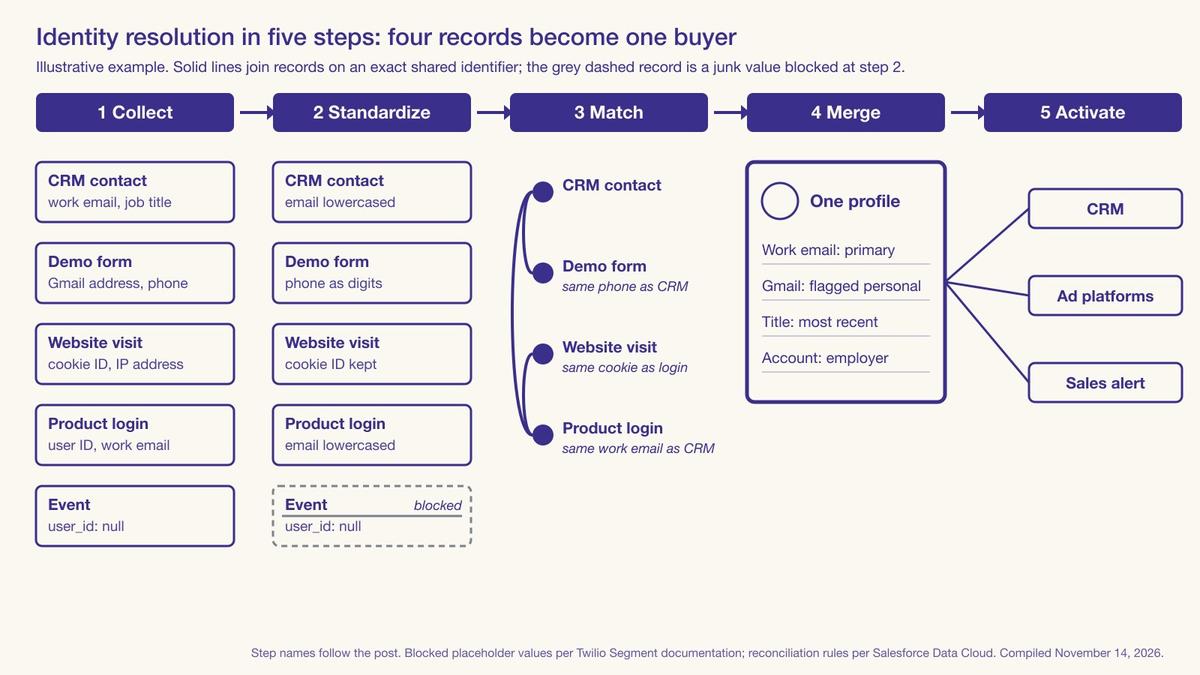
- Collect every identifier you can attach to an event or record. Logins give you user IDs, and forms and CRM contacts give you emails and phone numbers. The website adds cookie and device IDs, plus the IP address for anonymous visits.
- Standardize the values into one format so they can be compared: lowercase the emails, strip phone numbers to digits, settle "Acme Inc." and "ACME" on one company name. This step also throws out junk values. Twilio Segment's documentation recommends blocking placeholders such as -1, null and "anonymous", because a value shared by large numbers of unrelated visitors would otherwise merge them all into one profile.
- Match the records that belong to the same person. Deterministic matching joins records that share an exact, stable identifier such as an email address or login. Probabilistic matching scores weaker signals like name, IP address and device, and joins records above a threshold. Large systems first sort records into small groups that share a key, which People Data Labs and Amperity both call blocking, because comparing every record with every other one doesn't scale.
- Merge the matched records into one profile and decide which value wins when they disagree. Salesforce Data 360 (formerly Data Cloud) calls these reconciliation rules, and its training material says a value can be chosen by how often it appears, how recent it is, or which source it came from. Segment caps how many values of each identifier a profile can hold, and uses identifier priority to decide what happens when an incoming event would push a profile past that cap.
- Activate the unified profile by sending it where it gets used: the CRM, the ad platforms, the email tool, a sales alert. For identified website visitors, our guide to lead routing covers what happens after this step.
Systems usually go wrong at steps 3 and 4. Strict rules miss matches and leave duplicates. Loose rules merge two different people into one record, which People Data Labs calls a Frankenstein profile and describes as unusable. Hightouch, for one, lets you run strict rules first and loose ones only on what's left, and the product manager who leads its identity resolution work explains why:
"Other rules can be very lenient and therefore inaccurate but match a lot of records, such as matching on only names, or probabilistic matching on IP address, device ID, and user agent. Because of this, teams usually only want to use lenient merge rules as a fallback after more strict merge rules are applied." — Earl Lee, Product Manager, Hightouch (Hightouch)
For a sales team, a duplicate usually costs a second look. A false merge costs more, because a rep calls the right company about the wrong person's activity, which is why I'd set strict rules first if you're configuring them yourself.
First-party vs third-party identity resolution
First-party identity resolution runs only on data you collected yourself: your logins, your forms, your CRM, cookies set on your own domain. It's usually accurate because every connection came from something a person did on your property, and it's limited to people who already told you who they are.
Third-party identity resolution checks your identifiers against a database someone else built. That's the only way to resolve a visitor who has never filled in a form. ZoomInfo verifies and updates its data partly through a contributor network that reads email signatures, and People Data Labs buys data from private suppliers, adds publicly available sources, and publishes how it merges the two.
That's why B2B teams often run both. The CRM, CDP or warehouse handles your known customers. A visitor identification tool works on the anonymous traffic, which Twilio Segment puts at around 98% of visitors on arrival, a figure that includes logged-out customers. Such tools name only a minority of those visitors.
Identity resolution platforms, by category
I count at least six kinds of product sold as identity resolution software. The question I'd start with is what each one needs as input, because a platform that needs an email can't help with a visitor who never gave one.
| Category | Examples | Starts from | Resolves to | Fit for B2B |
|---|---|---|---|---|
| Packaged CDP | Twilio Segment, mParticle, Amperity, Salesforce Data 360 | Your own events and records: user IDs, emails, device IDs | One profile per known customer | Strong for logged-in users and product data; names nobody new |
| Warehouse-native | Hightouch, RudderStack Profiles | Tables already in your data warehouse | Profiles built inside your warehouse | Strong if you have a data team; same limit on strangers |
| Identity network | LiveRamp, Experian, TransUnion | Consumer personal data such as hashed emails and postal addresses, plus cookies and device IDs | A persistent person or household ID | Built mainly for consumer marketing and advertising |
| B2B data provider | ZoomInfo, People Data Labs | A known email, name, phone or company, sometimes an IP address | A full contact and company record | Strong for enrichment; ZoomInfo also sells WebSight BuyerID for anonymous US visitors |
| Company-level visitor ID | Demandbase, Leadfeeder (Dealfront) | An anonymous visit's IP address | The employer | Works on anonymous traffic; check whether person-level contacts are offered |
| Person-level visitor ID | RB2B, Warmly, Signal (ours) | An anonymous visit plus first-party signals on your site | A named person, mostly in the US | Works on anonymous traffic; coverage varies by vendor and country |
The takeaway: The first four categories resolve people you can already reach: a CDP or warehouse tool unifies your own records, an identity network links consumer data for advertising, and a B2B data provider enriches a contact you already have. The last two, plus add-ons such as ZoomInfo's WebSight BuyerID, are built to name anonymous website visitors, company-level from an IP address and person-level through a third-party identity graph, mostly in the US.
If your problem is duplicates in HubSpot or Salesforce, start with the CRM you already pay for. HubSpot automatically deduplicates contacts by email address and companies by domain name. Salesforce ships standard matching rules and duplicate rules on Professional edition and up, including ones for contacts and leads. For a small team that's usually enough, with a cleanup app from the CRM's marketplace for the backlog. A CDP tends to earn its cost once you have product events and several data sources to join.
Check one thing before you connect a visitor identification tool to HubSpot. HubSpot's documentation says companies created through its API aren't deduplicated by domain, so a tool that creates companies that way can add duplicates. Ask the vendor how it matches companies, and test it on a few records first.
I checked the vendors' own documentation on November 14, and two of the pages had moved. Segment's docs now redirect to twilio.com, and Hightouch's identity resolution docs sit behind a login, so its entry comes from the product page.
- Twilio Segment gives admins three rules, which block bad values, cap the number of values per identifier and rank identifiers by priority. By default user_id ranks first and email second.
- Salesforce Data 360 pairs match rules, which can be exact or fuzzy, with reconciliation rules that choose the surviving value.
- mParticle offers five identity strategies, from profile conversion, which keeps one profile when an anonymous user logs in, to profile isolation.
- Hightouch runs identity resolution inside your warehouse using deterministic and probabilistic rules you define, and says it never stores your data. RudderStack Profiles similarly generates SQL that stitches identifiers into a graph in the warehouse.
- Amperity describes configured rules that connect records when known identifiers support the match, and AI-assisted scoring for less certain matches.
- LiveRamp issues a maintained RampID for an individual it fully recognizes and a derived RampID for a touchpoint it hasn't yet matched to a full set of personal data.
People Data Labs gave me at least three different person counts across its own pages: nearly three billion on its enrichment API page, about 2.47 billion on its stats page, and nearly 2 billion person records in a December 2024 write-up of how the dataset is built. I used the stats page in the key stats above, because it's the one with an exact count.
For anonymous B2B traffic, our website visitor identification tools comparison scores 15 vendors in the last two categories against one rubric.
Why B2B identity resolution is harder
Consumer identity resolution has to work out which person a record belongs to. B2B has to work out the person and the account, and the link between them breaks every time someone changes jobs.
The account side mostly runs on IP addresses. According to Demandbase's 2024 account identification report, it has around 3.7 billion IP addresses mapped to a company or classified as consumer at any given time. IP matching works best on office networks. Warmly, a competitor of ours, puts company-level matching at 15-30% on mobile traffic in its customer data, which is part of why company-level and person-level identification cover different visitors.
On the person side, the same buyer often shows up with a personal email and a work email, and only one of them belongs in a sales sequence. Donny Flynn made the point in a dbt tutorial built around a fictional SaaS company:
"However, because this is a B2B use case, not all email domains are created equal. We want to make sure we flag personal emails so they’re treated differently than the corporate emails our sales team will reach out to (this makes sales outreach more productive, and ensures we aren’t contacting people more than once)." — Donny Flynn, then Customer Data Architect, Census (dbt Developer Blog)
Records also age. A work email that resolved correctly last year may now belong to someone who left, and the profile looks as confident as it did then. ZoomInfo reports that its contributor network updates data on 4 million people and 1 million companies daily, and People Data Labs ships a new production dataset monthly. Re-check any B2B profile that hasn't been refreshed in a year before a rep acts on it.
How to evaluate identity resolution software
Before a demo, I'd send a vendor these seven questions:
- What does it start from? If the answer is "an email or user ID", it unifies known records. If it's "a website visit", it resolves anonymous traffic. B2B teams usually need one of each, so check which one you're buying.
- What share of matches is deterministic? A probabilistic match is a guess with a score. Ask for the split, and read our explainer on how match rates are measured before comparing any vendor's headline number.
- Can you see and change the rules? You want to know which identifiers can merge two records, in what order, and how to undo a merge that's wrong.
- Where does the graph come from, and how often is it refreshed? A contributor network, public web data, licensed files and your own first-party data age at different speeds.
- How does it handle personal emails? In B2B a Gmail address and a work address for the same person usually need different treatment downstream.
- Where do profiles go? Check for a native integration with your CRM. A CSV export means someone uploads the file by hand.
- What are you charged for? Per resolved record, per profile stored and per seat produce different bills at the same traffic.
Where Signal fits
We built Signal as a person-level visitor identification tool, the last row in the table. It collects first-party signals on your own domain and queries a third-party identity graph only to resolve visitors already on your site, returning company and person details for US visitors. Signal matches each identified visitor to their employer through a third-party B2B data partner. We don't run our own company database. When Signal pushes a contact to HubSpot, it matches the company on its website domain, so an existing company record is updated rather than duplicated. We don't unify your existing CRM records, so if your problem is duplicates in a database you already own, a CDP or warehouse-native tool is the right buy.
Every account starts with a 7-day trial of our top self-serve plan, Pro+, for $1, then keeps a plan or drops to Free. Free covers 150 identified visitors a month at no charge. On annual billing, Starter is $69 a month for 300, Pro is $129 for 1,000 and Pro+ is $169 for 2,500. Every plan, Free included, pushes contacts natively to HubSpot, Klaviyo and Mailchimp, sends hourly Slack and Microsoft Teams alerts (in beta), and exports CSV. We don't have a native Salesforce integration yet. Identification covers US visitors, and our post on US privacy law and visitor identification covers what that means for your site.
We don't publish a person-level match rate for Signal's B2B identification. Run the audit in our match-rate post on your own traffic during the trial to see what we resolve on your visitors. Every Signal plan uses the same matching, so the rate you measure in the Pro+ trial carries over, though lower plans cap how many identified visitors you receive each month.
In July we costed building our own identity graph instead of querying one. Our estimate for data licensing, four to six engineers working 12 to 18 months, legal and infrastructure came to between $500,000 and $2 million for the first year, and we assumed roughly a third of a B2B graph goes stale every year after that. So Signal queries a third-party graph, and the part we build is the first-party layer on your domain. — Bob Thordarson, Geysera CEO
Frequently asked questions
What is identity resolution?
Identity resolution is the process of matching identifiers such as emails, cookies, device IDs, IP addresses and CRM records to the person or company they belong to, and merging them into one profile. In B2B it covers two jobs: unifying the records a company already holds about its customers, and attaching names to anonymous website visitors through an outside database.
How does identity resolution work?
It runs in five steps. Collect identifiers from every source, standardize them into one format, match records that belong to the same person using deterministic or probabilistic rules, merge the matches into one profile using rules that pick the surviving values, then send that profile to the CRM and other tools. Most errors happen in the matching and merging steps.
What is identity resolution software?
Identity resolution software is any tool that matches and merges identifiers into unified profiles. It includes customer data platforms such as Twilio Segment and Salesforce Data 360, warehouse-native tools such as Hightouch, identity networks such as LiveRamp, B2B data providers such as ZoomInfo, and website visitor identification tools that resolve anonymous traffic to a company or a person.
Who are the main identity resolution providers?
The main providers fall into six groups. Packaged CDPs include Twilio Segment, mParticle and Amperity. Warehouse-native options include Hightouch and RudderStack. Identity networks include LiveRamp, Experian and TransUnion. B2B data providers include ZoomInfo and People Data Labs. Company-level visitor identification includes Demandbase and Leadfeeder, and person-level visitor identification includes RB2B and Warmly.
What is the difference between identity resolution and a CDP?
Identity resolution is a process, and a customer data platform is one kind of product that runs it. A CDP collects your own customer events and records and resolves them into profiles you can send to other tools. It doesn't usually identify strangers, so B2B teams pair it with a visitor identification tool for anonymous website traffic.
Can identity resolution identify anonymous website visitors?
Yes, if it uses an outside database. Company-level tools look up the employer behind a visitor's IP address. Person-level tools query a third-party identity graph to name the individual, mostly for US visitors. Warmly, which sells a competing tool, reports that person-level identification names 5-20% of website traffic across its customers, using a waterfall of 20+ data providers. Resolution built only on your own data can't name a visitor who never logged in or filled out a form.
Continue the Series
This is Post 15 in Geysera's 19-part series on B2B anonymous visitor identification. The posts published so far:
- Post 1 — Anonymous website visitor identification: the complete 2026 guide (pillar)
- Post 2 — How to identify anonymous website visitors: 5 methods and what each delivers
- Post 3 — What is an identity graph? How anonymous visitors get matched to real people
- Post 4 — Match rates decoded: why 40%+ person-level claims are usually fiction
- Post 5 — B2B intent data explained, and why most of it is flawed
- Post 6 — Person-level vs company-level identification
- Post 7 — The best website visitor identification tools (2026)
- Post 8 — Third-party cookies didn't die, the deprecation did
- Post 9 — Lead routing for identified website visitors
- Post 10 — Is an IP address PII? What US privacy law means for identifying website visitors
- Post 14 — Website visitor tracking: how to see who visits your website
Sources
- Twilio Segment — Identity resolution: what it is and how it works
- Twilio Segment documentation — Identity resolution overview
- Twilio Segment documentation — Identity resolution settings
- Salesforce Trailhead — Unify your data (Data 360)
- mParticle documentation — IDSync components
- Hightouch — Identity resolution
- RudderStack documentation — Profiles overview
- Amperity — Identity resolution
- Amperity documentation — Stitch
- LiveRamp documentation — Interpreting RampID
- People Data Labs — Our data build process
- People Data Labs documentation — Datasets
- People Data Labs documentation — Person stats
- People Data Labs documentation — Person Enrichment API
- ZoomInfo — How does ZoomInfo get my information?
- ZoomInfo — Data (WebSight BuyerID)
- HubSpot Knowledge Base — Deduplicate records in HubSpot
- Salesforce Trailhead — Duplicate management
- Demandbase — Account identification
- Warmly — Website visitor identification match rates
- Geysera — Signal pricing
- Hightouch — Introducing IDR waterfalls and profile inspector (Earl Lee)
- dbt Developer Blog — Customer 360 view: identity resolution (Donny Flynn)

Co-Founder and CEO
Bob Thordarson is CEO and Co-Founder of Geysera, a serial entrepreneur with 25+ years and five co-founded ventures, including Cequint (acquired by TNS in 2010 for $112.5M) and Consumerware (acquired by ParkerVision). A graduate of the University of Washington and MIT Entrepreneurial Masters Program, based in Seattle, he serves on the boards of DRY Soda Co. and the Entrepreneurs' Organization Seattle chapter. He is an expert in retention marketing email systems and methodology for ecommerce and B2B brands — measured by incremental revenue, not vanity metrics.