B2B Intent Data Providers Compared: Where Each One's Data Comes From
An intent data provider sells signals showing which companies are researching a topic. This comparison sorts 15 providers, including Bombora, ZoomInfo, 6sense, Demandbase, HubSpot, G2, TrustRadius and Informa TechTarget, by where their data comes from, what they resolve to and how they are sold. Two of them run on Bombora's data and three more use it as an input, so two subscriptions can mean the same signal twice.
An intent data provider sells signals showing which companies are researching a topic, based on activity it mostly observes outside your own website. Providers differ most in where that activity comes from, such as a publisher co-op, their own media network, review sites or ad auctions, and in whether they resolve it to a company or a person.
We read the intent pages, help docs and pricing pages of 15 providers in November 2026 to build the table below. We didn't test any of them hands-on. Two of the 15 run on Bombora's data, three more use it as an input, and G2 can display it, which matters if your team already pays for Apollo, Cognism or 6sense.
KEY STATS
- Bombora tracks 25,300+ intent topics and scores each account by comparing its most recent three weeks of research against a 12-week baseline (Bombora, 2026)
- Every 6sense customer gets 12 Bombora intent topics at no extra cost, with the full catalog sold by subscription (6sense, accessed November 2026)
- Apollo switched its buying intent from LeadSift to Bombora in 2026, and lets an organization track 1 topic on Free, 6 on Basic or Professional and 12 on Organization (Apollo, 2026)
- Apollo labels Bombora scores of 75 to 100 as high intent, while 6sense counts 70 or higher as surging (Apollo and 6sense documentation, accessed November 2026)
- Informa TechTarget reports 58M+ permissioned members across 220 media properties as the source of its first-party intent data (Informa TechTarget, 2026)
- HubSpot's Research Intent draws on 200,000+ websites that run the HubSpot tracking code and opted in, comparing a company's last 30 days of research with the prior 30 (HubSpot, 2026)
- Data sourced from provider websites, help documentation and pricing pages, checked November 2026
What's in this guide:
- Intent data providers by source
- Bombora: the publisher co-op
- Which platforms use Bombora's data
- If you already have HubSpot or Apollo
- Platforms with intent built in: ZoomInfo, 6sense, Demandbase
- Publishers' own networks: Informa TechTarget, Foundry, NetLine
- Review-site intent: G2 and TrustRadius
- Aggregators: Intentsify and Madison Logic
- How to choose an intent data provider
- Where Signal fits
- Frequently asked questions
Intent data providers by source
Our explainer on B2B intent data argues that the first question to ask a provider is where its signal comes from. Bidstream is data passed to advertisers during programmatic ad auctions, which some providers mine for keywords. "Resolves to" means what the provider can attach a signal to, either a company or a named person.
| Provider | Main source of the signal | Resolves to | How it's sold | Public pricing |
|---|---|---|---|---|
| Bombora | Publisher co-op, read by Bombora's own tag on member sites | Account, with buying-group personas | Standalone feed by file or API, plus 100+ integrations | None found |
| ZoomInfo | Anonymized web activity from company IP addresses, through data partners | Account and person | Topics included in marketing plans; Streaming Intent is an add-on | No |
| 6sense | Its own publisher network, plus ad data and licensed networks; partner intent from Bombora, G2, TrustRadius and others | Account | Inside the 6sense platform | No |
| Demandbase | Bidstream plus curated content; imports Bombora, G2 and TrustRadius | Account | Platform fee plus a per-user fee; data also sold on its own | No |
| HubSpot Buyer Intent | Your own site's visitors, plus 200,000+ websites running HubSpot's tracking code that opted in | Company | HubSpot credits | Credit-based |
| Informa TechTarget Priority Engine | Its own 220 media properties | Account and person | Inside Informa TechTarget Portal | None found |
| Foundry | Its own publishing network and events, the public web, your site | Account and contact | By data volume and use case | No |
| NetLine | Content registrations across 15,000 publishers | Person | Pay per lead | Per lead, no price list |
| G2 Buyer Intent | Research on G2, Capterra, Software Advice and GetApp | Company | Part of each product's G2 plan | Couldn't check |
| TrustRadius (HG Insights) | Research on TrustRadius plus bidstream data HG buys | Account; opt-in contacts | Credits, two-year standard term | Credits only |
| Intentsify | Nine aggregated sources | Account, down to contacts for US audiences | Cost per lead or per thousand impressions | No |
| Madison Logic | Its own campaigns plus third-party data, including Bombora | Account and buying group | Free with a live media campaign | No |
| Apollo | Bombora | Company | Included in seat plans | Yes, $0 to $119 a seat a month, billed annually |
| Cognism | Bombora | Company | Pro plan | No |
| Leadpipe | Its own pixel network on 5M+ sites | Person and account | Bundled with visitor identification plans | Yes, $3,534 a year (about $295 a month) or $398 billed monthly, for the first plan with intent |
The takeaway: These 15 providers draw on six kinds of source: a publisher co-op, their own media network, review sites, ad auction data, pixel or tracking-code networks, or a blend. About half stop at the account, and the rest reach named people through registrations, opt-in programs or contacts matched afterward. Of the pricing pages we could read, only Apollo and Leadpipe show dollar prices.
Leadpipe also sells website visitor identification, as we do. Its first plan with intent costs $3,534 a year, about $295 a month, or $398 billed monthly, and bundles intent with 2,000 identified visitors a month. Leadpipe reports 72.9M unique people with intent a day.
Bombora: the publisher co-op
Bombora describes its co-op as hundreds of publishers and brands and thousands of B2B media sites, which run Bombora's own JavaScript tag. It says 86% of the data in the co-op is shared only with Bombora for the purpose of deriving intent. Members include Fortune, Inc. and Fast Company, alongside vertical publishers such as Law.com and Fierce Telecom.
Bombora tracks more than 25,300 topics and adds an average of 1,000 a quarter. Its Company Surge score compares an account's last three weeks of research on a topic with that account's own 12-week baseline. Because the score is relative to each account's history, we'd ask Bombora how it handles accounts with very little baseline reading, since a small change there could look like a surge. Results are account-level, with personas layered on to show which roles are doing the research.
Bombora calls itself "a data company not a platform," and says it can deliver Company Surge by flat file or API, or through more than 100 integrations. We found no pricing page.
Which platforms use Bombora's data
Apollo and Cognism run on it. Apollo's help center says its buying intent "is powered by Bombora," after a 2026 switch from LeadSift, though its older product page still named LeadSift when we checked. Cognism's Pro plan includes 12 Bombora topics.
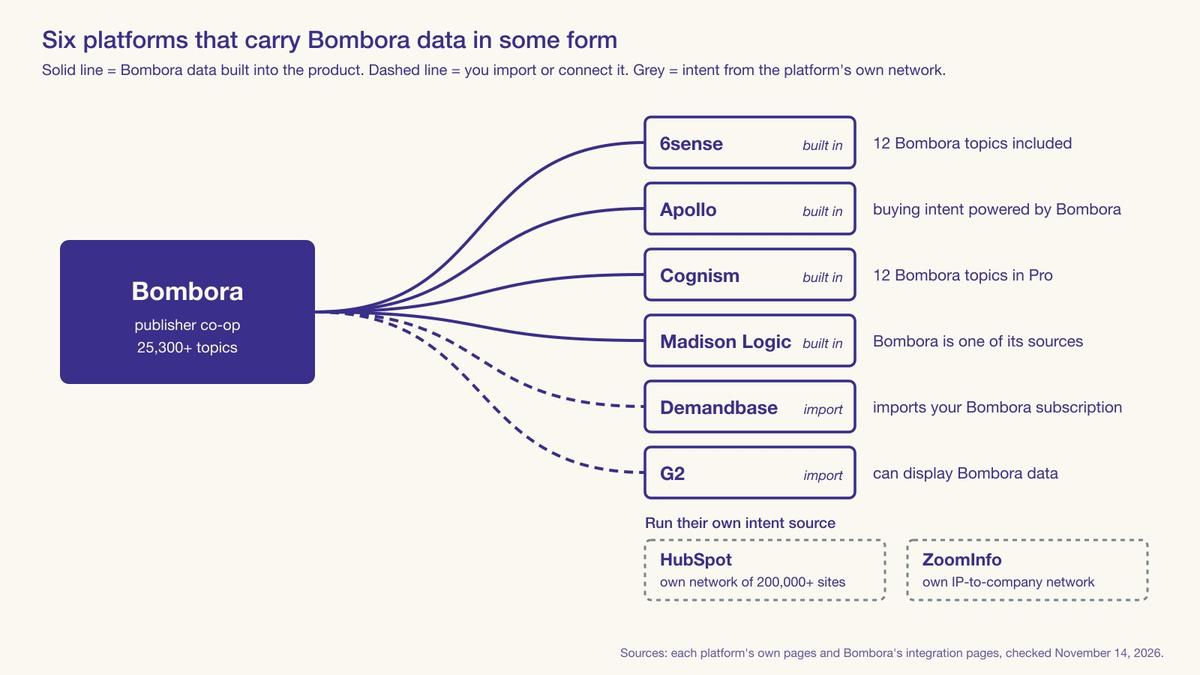
Three more use it as one input. 6sense includes 12 Bombora topics at no extra cost alongside its own network, and sells the full catalog separately. Demandbase can import Bombora Surge data automatically each time it updates. Madison Logic names Bombora as one of the sources its ML Insights draws on, noting that Bombora started as Madison Logic Data, a business it later spun off. G2's own signal comes from its review sites, but its documentation describes a Bombora integration that adds supplemental information to its Buyer Intent table.
So a team running Apollo for prospecting and Cognism for data can be looking at the same co-op's signal twice. 6sense and Demandbase both let you bring an existing Bombora subscription, and Intentsify can ingest intent subscriptions you already have, so ask before you buy a second source of the same data.
The same score also gets cut differently. 6sense counts a Company Surge score of 70 or above as surging, while Apollo labels 75 to 100 as high intent and 61 to 74 as medium. An account scoring 65 shows as medium intent in Apollo but doesn't appear as surging in 6sense, and one at 72 is surging in 6sense but only medium in Apollo.
Topic libraries often differ too. Cognism says admins choose from over 11,000 topics, while Bombora's own taxonomy page showed 25,378 when we checked. If a topic you need isn't in a reseller's library, buying from Bombora directly is probably the only way to get it.
If you already have HubSpot or Apollo
If your team uses Apollo or HubSpot, you may already pay for intent data without having chosen it.
In Apollo, buying intent comes from Bombora and is included in the seat price. An organization can track 1 topic on the free plan, 6 on Basic or Professional and 12 on Organization, which costs $119 a seat a month billed annually with a three-seat minimum. Apollo's help center adds that the people it surfaces at an intent account "may not be the individuals conducting the research," because the score belongs to the company.
In HubSpot, Buyer Intent is the overall feature, and it has two parts that are easy to confuse. The Visitors tab uses the HubSpot tracking code on your own site to identify companies by IP address, which HubSpot calls probabilistic. Research Intent looks outward, at a network of 200,000+ websites that run HubSpot's tracking code and opted in, and compares a company's last 30 days of research with the prior 30. You pick up to 20 topics from HubSpot's list, the data refreshes daily, and it's available on any plan that includes HubSpot credits, which it charges per company.
If you're on either, we'd test what you have before buying another feed. The table shows that most standalone providers quote on request, so a trial on data you already pay for is usually the cheapest comparison you'll get.
Platforms with intent built in: ZoomInfo, 6sense, Demandbase
These three mostly sell intent as one feature of a larger platform, though Demandbase also sells its data on its own.
ZoomInfo says its intent engine tracks 210 million IP-to-organization pairings and more than 6 trillion keyword-to-device pairings, sourced monthly across U.S. devices. It now advertises person-level intent alongside account-level signals. Its marketing plans include 25, 100 or unlimited topics, and Streaming Intent is an add-on priced on the number of keywords and the account universe you track. We found no dollar prices on ZoomInfo's pricing page.
6sense collects most of its keyword intent from its own publisher network through a web tag, adds ad data from its own demand-side platform and licensed networks, and layers partner intent on top. It resolves to the account, and ties activity to a known contact only when that person has already identified themselves through a form or your marketing automation cookie. Its intent score predicts the chance an account opens an opportunity in the next 90 days.
Demandbase says it has "direct access to the bidstream," combined with curated content, and supports 133 languages. Pricing is a platform fee plus a flat fee per user, quoted on request, and we couldn't find a figure for either.
Publishers' own networks: Informa TechTarget, Foundry, NetLine
These providers own or partner with the sites where the research happens, so they usually see registrations and reading directly.
Informa TechTarget's Priority Engine draws on 58M+ permissioned members across 220 media properties and describes its data as first-party, at both the account and person level. Priority Engine is now sold inside Informa TechTarget's Portal, and 6sense offers it as a partner intent source for customers with their own subscription. We found no public pricing.
Foundry reports 80M+ intent signals a week from its publishing network, events, the public web and the customer's own site, and says its data reaches the contact level. Pricing depends on data volume and use case.
NetLine's intent comes from content registrations across 15,000 publisher and media partners, with "over 125MM" professionals in its network. Because people register, the signal is person-level, and you pay per lead that downloads your content and meets your criteria.
Review-site intent: G2 and TrustRadius
Someone comparing two named products on G2 is usually closer to a decision than someone reading an article about the category. A Forrester analyst made the case for review sites and user communities, which he calls walled gardens, in 2023:
"Walled gardens are highly sought after by companies selling into the specific industries they cover, due to the exclusive nature of their signals and the relatively late-stage buying behavior captured." — Brett Kahnke, Principal Analyst, Forrester (Forrester)
G2 Buyer Intent covers research on G2, Capterra, Software Advice and GetApp, triggered by actions such as viewing your profile, comparing you with a competitor or browsing alternatives in your category. It reports company-level data, and since June 2022 it shows Buying Stage and Activity Level instead of a single score. Each G2-listed product needs its own subscription, which we'd factor in if you list several products. G2's pricing pages wouldn't load for us, so we can't report a price.
TrustRadius is now HG Customer Voice, part of HG Insights. HG's broader Buyer Intent product combines TrustRadius research with bidstream data HG buys, so the review-site signal and the bidstream signal arrive together unless you buy only the TrustRadius part. HG's pricing guide says a buyer intent data point costs 3 credits. Its standard contract runs two years.
Aggregators: Intentsify and Madison Logic
Aggregators combine several sources and typically sell the result with a service attached.
Intentsify says it aggregates more than 1.1 trillion signals a month from nine sources across 460,000 content sites and 90,000 topics. It resolves signals to accounts and buying groups, and for US audiences to named contacts with a business email and phone number. Its FAQ also says its identity graph aligns research to an organization without using personal information, so we'd ask which of its products uses which method. Lead programs are priced per lead and ad programs per thousand impressions.
Madison Logic combines engagement from its own campaigns, which it puts at 500M+ signals a month, with third-party content consumption, including Bombora. It says it isn't a standalone data provider, and any customer with a live media campaign gets its intent data free.
How to choose an intent data provider
We'd take these seven questions into each vendor call, starting with where the data comes from and ending with the contract:
- Which stage of research does it show? Publisher co-ops and own networks mostly show early research. Review sites show late-stage comparison. Your own website shows accounts that have already arrived.
- Whose data is it? If a platform's intent comes from Bombora, ask how many topics you get and whether you already pay for them through another tool.
- What does it resolve to? If you need people rather than accounts, ask whether the provider saw them directly, as registrations usually do, or matched them to the account afterward.
- What are the scoring rules? Get the baseline period and threshold in writing, along with how often the score refreshes. Bombora and HubSpot both publish their scoring windows, and the two don't match.
- Does it sync natively to your CRM and sales tools, or does it arrive as a file?
- Will it pass a back-test? Give the provider ten accounts that closed last year and ten that never engaged, and ask what its data would have shown twelve months earlier. Our explainer covers this test in more detail.
- What are the contract terms? Ask for the minimum, the term, and whether it auto-renews. HG's standard term is two years.
Steve Armenti, who runs a demand-generation agency, describes what happens in enterprise marketing teams once a contract is signed:
"This is where I see the most waste. Big intent contracts get auto-renewed. The data flows into a system nobody really audits. Sales reps complain that “the intent data isn’t useful,” which is sometimes a skill problem, and sometimes a real problem." — Steve Armenti, CEO and Founder, twelfth (MarTech)
Put a review date in the contract and measure the feed against pipeline before it renews.
Where Signal fits
Signal is our product, and it doesn't currently sell a third-party intent feed, so we left it out of the table. It identifies visitors to your own site, then lets you set custom intent scoring and tag their behavior. That covers the third stage in the first question above, the accounts already researching you.
If your sales cycle depends on reaching accounts before they visit, you'll probably need a third-party provider from the table, and Signal doesn't replace one. If most of your pipeline starts with a website visit, Signal's plans run from $0 at 150 identified visitors a month, after a $1 trial, to $169 a month for 2,500 on annual billing, which you can set against the quotes above. Our comparison of website visitor identification tools covers the alternatives.
Frequently asked questions
What are intent data providers?
Intent data providers sell signals showing which companies are researching a topic, based on activity outside your own website. Bombora runs a publisher co-op, Informa TechTarget and Foundry use their own media networks, G2 and TrustRadius use review-site research, and platforms such as 6sense, ZoomInfo and Demandbase build intent into larger sales and marketing products, often adding data from other providers.
Which intent data provider is best?
It depends largely on which stage of research you need to see. Publisher co-ops such as Bombora and media networks such as Informa TechTarget show early research. Review sites such as G2 show late-stage comparison between named products. If you already use Apollo or Cognism, your intent data comes from Bombora, so check what you have before buying another feed.
What is Bombora intent data?
Bombora intent data comes from a co-op of publishers and B2B media sites that run Bombora's tag. Bombora tracks more than 25,300 topics and flags accounts whose research on a topic over the last three weeks rises above their own 12-week baseline, a score it calls Company Surge. It resolves to the account, with personas added, and reaches buyers through platforms such as Apollo, Cognism and 6sense.
How much does intent data cost?
Most intent data providers don't publish prices. ZoomInfo includes topics in its marketing plans and prices its Streaming Intent add-on on keywords and accounts tracked, Foundry prices on data volume, and Demandbase on a platform fee plus a per-user fee, all quoted on request. Apollo includes Bombora intent in seat plans priced from $0 to $119 a seat a month on annual billing. HG Insights charges 3 credits per buyer intent data point.
Do intent data providers identify individual people?
About half of the 15 providers in this comparison stop at the company. Bombora, 6sense, G2 and HubSpot report account-level intent, and Apollo notes the people it surfaces may not be the ones doing the research. ZoomInfo, Informa TechTarget, Foundry, NetLine, Intentsify and Leadpipe reach named people, and TrustRadius offers opt-in contacts, mostly through content registrations, pixel networks or contacts matched to an account afterward.
What is the difference between first-party and third-party intent data?
First-party intent data is behavior you observe on your own website, emails or product. Third-party intent data is research a provider observes somewhere else, such as publisher sites, review sites or ad auctions. Third-party data can flag an account before it visits you, and first-party data shows what an identified visitor or account did once it arrived.
Continue the Series
This is Post 16 in Geysera's 19-part series on B2B anonymous visitor identification. The posts published so far:
- Post 1 — Anonymous website visitor identification: the complete 2026 guide (pillar)
- Post 2 — How to identify anonymous website visitors: 5 methods and what each delivers
- Post 3 — What is an identity graph? How anonymous visitors get matched to real people
- Post 4 — Match rates decoded: why 40%+ person-level claims are usually fiction
- Post 5 — B2B intent data explained, and why most of it is flawed
- Post 6 — Person-level vs company-level identification
- Post 7 — The best website visitor identification tools (2026)
- Post 8 — Third-party cookies didn't die, the deprecation did
- Post 9 — Lead routing for identified website visitors
- Post 10 — Is an IP address PII? What US privacy law means for identifying website visitors
- Post 14 — Website visitor tracking: how to see who visits your website
- Post 15 — Identity resolution for B2B: how it works and which platforms do it
Sources
- Bombora — Data Co-op
- Bombora — Intent
- Bombora — Intent topics we track
- Bombora — Topic taxonomy
- Bombora — Partners
- ZoomInfo — Intent data
- ZoomInfo — Pricing
- 6sense — Intent data
- 6sense documentation — Using Bombora Company Surge data within 6sense
- 6sense documentation — Intent model
- Demandbase — Intent
- Demandbase — Pricing
- HubSpot Knowledge Base — Configure research intent
- HubSpot Knowledge Base — Buyer intent FAQ
- Informa TechTarget — Portal and Priority Engine
- Foundry — Intent data
- NetLine — Intent discovery
- G2 documentation — Buyer Intent
- HG Insights — Buyer Intent
- HG Insights — Pricing guide
- Intentsify — Identity graph
- Intentsify — FAQs
- Madison Logic — AI info
- Apollo — Buying intent overview
- Apollo — Release notes 2026
- Apollo — Pricing
- Cognism — Pricing
- Leadpipe — Pricing
- Geysera — Signal pricing
- Forrester — Which type of intent data provider is best for your B2B business? (Brett Kahnke)
- MarTech — The intent data playbook is breaking down (Steve Armenti)

Co-Founder and CEO
Bob Thordarson is CEO and Co-Founder of Geysera, a serial entrepreneur with 25+ years and five co-founded ventures, including Cequint (acquired by TNS in 2010 for $112.5M) and Consumerware (acquired by ParkerVision). A graduate of the University of Washington and MIT Entrepreneurial Masters Program, based in Seattle, he serves on the boards of DRY Soda Co. and the Entrepreneurs' Organization Seattle chapter. He is an expert in retention marketing email systems and methodology for ecommerce and B2B brands — measured by incremental revenue, not vanity metrics.