The Browse Abandonment Discount Debate: When to Offer an Incentive — and When It Costs You More Than It Earns
Discounting in browse abandonment raises conversions and destroys LTV — sometimes both at once. Here's the framework for making the right call for your brand.
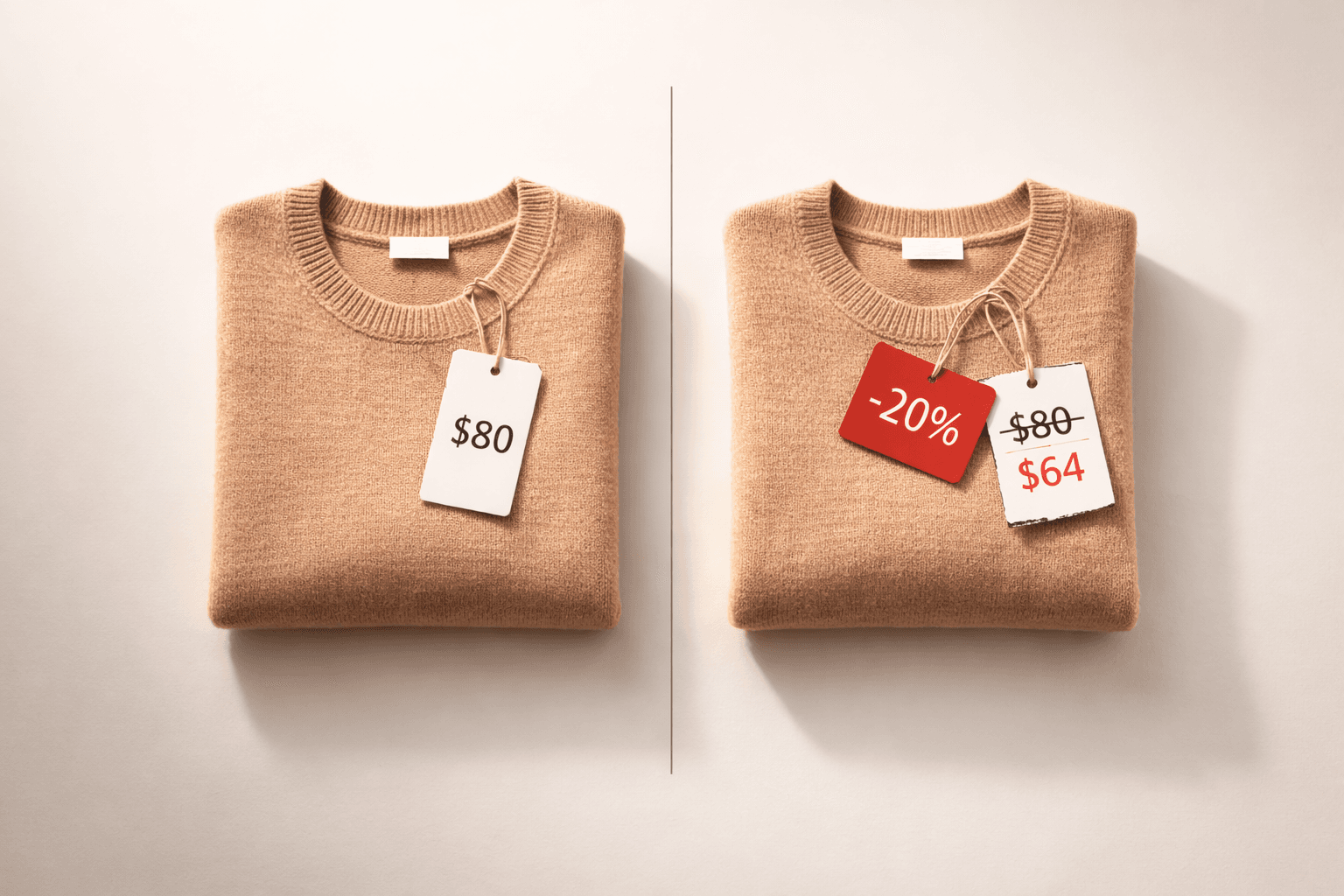
Discounting in browse abandonment is the most debated decision in retention email strategy. Here is the full argument from both sides and a framework for making the right call for your brand.
There is no single decision in browse abandonment email strategy that generates more disagreement among experienced practitioners than this one.
Offer a discount in your browse abandonment flow, and you will recover more immediate conversions. That is almost certainly true, and the data from thousands of A/B tests across DTC brands bears it out.
Also, offer a discount in your browse abandonment flow, and you will, over time, train a portion of your audience to abandon intentionally in order to receive one. You will erode your brand's full-price positioning. You will compress margins on customers who would have paid full price. And you will build a customer file increasingly composed of discount-seekers rather than brand loyalists — the segment with the lowest LTV, the highest churn rate, and the greatest drag on your unit economics.
Both of those things are true simultaneously.
This is not a debate where one side is right and the other is wrong. It is a debate where the correct answer depends on your brand, your product category, your customer acquisition model, your margin structure, and where you are in your growth trajectory. The job of this chapter is to give you the full argument from both sides — clearly, fairly, and without false resolution — and then a decision framework you can apply to your specific situation.
How We Got Here: The Discount Default and Why It Became the Default
The prevalence of discounting in browse and cart abandonment emails is not an accident. It is the product of a specific era in DTC growth — roughly 2015 to 2022 — when the economics of customer acquisition were fundamentally different from what they are today.
In that era, CAC was low, paid social was cheap, and the primary growth metric was new customer acquisition at volume. Margin per order was secondary to top-line revenue growth. Discounting in abandonment flows converted browsers into buyers at scale, and the converted buyers — even at reduced margin — were fed into a growth model that was primarily financed by investor capital rather than profitability.
Alex Greifeld, who has watched this model play out across more than a decade of DTC operator experience, describes the resulting dynamic with characteristic precision: brands that grew on easy-mode acquisition economics built email programs optimized for conversion rate, not for customer value. Discounting became the default because it worked in the short term, and the long-term costs — to brand positioning, to margin, to LTV — were obscured by growth metrics that didn't account for them.
The era that enabled that model is over. CAC is high. Paid social is expensive and attribution is broken. Profitability — not growth at any cost — is the operative metric for most DTC brands in 2026. In this environment, the discount default deserves a serious second look.
That said, discounting is not categorically wrong. It is a tool. Like any tool, the question is whether you are using it intentionally, in the right context, with a clear understanding of its costs and benefits — or whether you are using it by default because that is how your flow was set up three years ago and no one has revisited it since.
The Case for Discounting in Browse Abandonment
Let's give the conversion-first argument its full due before examining its costs. The practitioners who advocate for strategic discounting in browse abandonment flows are not being naive about the margin implications. They are making a specific claim that deserves to be taken seriously.
Argument 1: The Conversion Math Is Real
A browse abandonment email without an incentive converts at some baseline rate. The same email with a well-timed discount converts at a meaningfully higher rate — typically 15 to 30 percent higher for first-time buyer segments in price-sensitive categories.
If your browse abandonment flow processes 10,000 emails per month and your baseline conversion rate is 2 percent, that is 200 orders. A 25 percent lift from a well-timed 10 percent discount brings that to 250 orders. At an AOV of $80, that is an incremental $4,000 in monthly revenue.
The margin cost of 10 percent on 250 orders at $80 AOV is $2,000. The net gain — incremental revenue minus the discount cost — is $2,000 per month, assuming the 50 incremental orders would not have converted at full price.
That last assumption is where the argument gets complicated. Which brings us to Argument 2.
Argument 2: Some Browsers Were Never Going to Buy at Full Price
Not every browse abandoner is a full-price buyer who got distracted. Some portion of your browse abandonment audience has a genuine price sensitivity — they liked the product but the price was the actual barrier, not uncertainty, not distraction, not a missing piece of information. For this segment, a discount is not training them to wait for an offer. The offer is the reason they buy at all.
A customer acquired at 10 percent off who goes on to purchase twice more at full price and refers two friends is a more valuable customer than a full-price first purchase that never repeats. The discount was a customer acquisition cost, not a margin erosion.
The argument for targeted discounting in first-time buyer browse abandonment flows is strongest when it is framed this way: not as a margin sacrifice, but as a variable acquisition cost applied to a specific segment that would otherwise not convert.
Argument 3: Free Shipping and Non-Cash Incentives Are an Underused Middle Ground
Much of the discounting debate focuses on percentage-off promotions, which have the most direct and visible margin impact. But incentives exist on a spectrum, and the conversion lift from a well-framed non-cash incentive is often comparable to a 10 to 15 percent discount — at a fraction of the cost.
Free shipping for the first order. A gift with purchase. An extended return window. Early access to new arrivals. Enrollment in a loyalty program with meaningful points on the first purchase.
These incentives solve the same psychological problem that a percentage discount solves — reducing the perceived risk and increasing the perceived value of the first purchase — without explicitly cutting the price. They also avoid the most corrosive aspect of percentage discounts: training customers to expect a lower price as the brand's real price.
The Case Against Discounting in Browse Abandonment
The margin-protection argument is not reflexively anti-discount. It is a precise critique of discounting as a default behavior applied indiscriminately across browse abandonment flows without accounting for its systemic costs. Those costs are real, compounding, and often invisible in short-term conversion metrics.
Problem 1: You Are Training Intentional Abandonment
This is the most documented behavioral consequence of discount-heavy abandonment flows, and it is the most direct refutation of the "the conversion math is real" argument above.
Once a segment of your audience learns — through experience — that abandoning a browse session generates a discount email, some portion of them will start abandoning intentionally to receive it. They are not confused customers who need a nudge. They are rational actors who have learned the rules of your discount game and are playing it correctly.
The size of this segment varies by brand and audience sophistication, but research on cart abandonment — where the effect is better documented — consistently identifies it as a meaningful proportion of abandonment flow conversions. The customer who "converted" from your browse abandonment email with a discount code was not a lost sale you recovered. They were a full-price customer you discounted voluntarily because you built a system that incentivized them to wait.
Chase Dimond is direct on this point: brands that reflexively discount in abandonment flows are not recovering lost revenue — they are redistributing existing revenue at a lower margin. The conversion appears as a win. The LTV math tells a different story.
Problem 2: You Are Communicating That Your Full Price Is Negotiable
Every discount code in a browse abandonment email sends an implicit message: the price on the product page is not the real price. The real price is available if you leave and wait.
Over time, this erodes brand price integrity. The subscriber who received a 15 percent discount on their first order mentally anchors your brand's value at that discounted price. When they return to buy at full price, they experience the full price as a loss — paying more than they know is available — rather than as a neutral transaction. This is basic loss aversion, and it is working against you.
Feras Khouri, co-founder of New Standard Co. and operator of a boutique retention agency serving eight-to-nine figure brands including BYLT and Caraway, makes the case from the brand side: brands that have spent years building a premium or near-premium price positioning can quietly undermine that positioning through discount-heavy automation flows that subscribers experience as a consistent message — "this brand's prices are not serious" — even when the campaign calendar maintains full-price discipline.
The automation is doing the discounting damage in the background, invisible to the team managing the promotional calendar.
Problem 3: You Are Concentrating Your Customer File in the Wrong Segment
The long-term consequence of indiscriminate discounting in browse abandonment is a customer file increasingly skewed toward discount-acquired customers — the segment with the lowest LTV, the highest churn rate, and the greatest sensitivity to any future price change or competitor promotion.
Alex Greifeld frames this as a customer portfolio problem. A healthy customer file is diversified across acquisition sources, price sensitivities, and purchase behaviors. A discount-heavy acquisition and retention strategy — across welcome flows, browse abandonment, cart abandonment, and winback — concentrates the file in a single, lower-value segment and makes future revenue increasingly dependent on continued promotional activity to maintain purchase frequency.
The brand becomes addicted to its own discounting. Pulling back on promotional offers produces an immediate revenue decline, which creates organizational pressure to resume them. The floor for promotional activity keeps rising. The baseline revenue from full-price buyers keeps shrinking as a proportion of the total.
This is the long-term cost that doesn't appear in a monthly conversion report. It appears in a cohort analysis three years later, when the LTV gap between discount-acquired and full-price-acquired customers becomes impossible to ignore.
Problem 4: Manufactured Urgency Is a Trust Tax
A related problem that deserves its own treatment: the discount email that pairs a percentage discount with a false countdown timer or a fabricated "only 2 left in stock" warning.
Chad White, author of four editions of Email Marketing Rules and Group VP of CRM Strategy at Zeta Global, has written extensively on the long-term brand damage caused by manufactured urgency. His position is clear and worth restating: trust erosion from false scarcity is cumulative, real, and frequently invisible in short-term metrics.
The subscriber who notices that the "48-hour offer" from your browse abandonment flow resets every time they browse a product — and they will notice, because subscribers are not passive — does not simply file this away as a minor disappointment. They update their model of your brand. You become the brand that uses pressure tactics. The relationship shifts from one of genuine interest to one of strategic game-playing.
Even once, a countdown timer that resets erodes something that took multiple positive touchpoints to build. The short-term conversion lift from false urgency is a loan against the customer's trust, and trust-based loans compound against you.
If you are going to create urgency in a browse abandonment email — and there are legitimate reasons to — make it real. Actual low stock. An actual time-limited offer with a genuine expiration. A real event (a sale that begins tomorrow, a product launch that closes the window for pre-order pricing). Real urgency works because it's true. And it works without extracting a trust cost.
The Decision Framework: How to Make the Right Call for Your Brand
With both arguments fully stated, here is the framework for making the discount decision for your specific browse abandonment flow. It is organized as a series of questions, not a single prescription — because the right answer genuinely varies.
Question 1: Which segment is receiving this email?
The discount decision should never be made at the flow level for the entire browse abandonment audience. It should be made at the segment level, where the cost-benefit calculation is meaningfully different for different subscriber types.
First-time browsers who have never purchased: The case for a soft incentive — in Email 3, not Email 1 — is strongest here. These subscribers have no prior purchase history with you. A targeted first-purchase offer serves as a variable acquisition cost, not a margin erosion. Cap the discount at 10 to 15 percent. Make it time-bounded with a real expiration. And deploy it only after two touchpoints that attempted to convert without an incentive.
One-time buyers browsing again: Do not discount. They bought at full price once. They are back on their own initiative. A discount in this context is margin given away to a customer who demonstrated willingness to pay full price. Lead with product inspiration, cross-sell potential, and brand affinity instead.
Loyal buyers with 2+ purchases: No discount. These are your best customers. Discounting them in a browse abandonment flow is one of the more reliably margin-destroying mistakes in retention email. They are browsing because they like you. Let them browse. A warm, brief, low-pressure reminder is the right email. A discount is an insult dressed as a reward.
High-intent browsers (3+ product views): A targeted incentive in Email 3 — after two non-discounted touchpoints — is defensible for first-time buyer segment. The rationale: this subscriber has demonstrated serious interest. Something specific is holding them back. If the first two emails addressed the likely hesitations and still didn't convert, a genuine incentive is a reasonable final prompt.
Question 2: What is your margin structure?
A brand with 70 percent gross margins on a $150 product can absorb a 15 percent first-purchase discount and still have a healthy unit margin on which to build LTV. A brand with 35 percent gross margins on a $60 product that discounts 15 percent is operating at near-zero unit contribution on the first order, with no guarantee of a second.
Before setting any discount level in a browse abandonment flow, calculate the floor: what is the minimum margin per order that still makes the acquisition worthwhile given your expected LTV for this segment? Don't discount below that floor, regardless of what the conversion rate lift would be.
Thomas Lalas's Retention Economics framework provides the right lens: a customer is only valuable if the revenue they generate over their lifetime exceeds the cost of acquiring and serving them, including the cost of any discounts applied along the way. Model the full economics before setting the discount lever.
Question 3: What is your brand's pricing architecture?
Brands whose pricing architecture positions them as premium or near-premium — where the price is part of the brand signal, not just a function of cost-plus — have the most to lose from discounting in browse abandonment. The discount doesn't just reduce margin. It contradicts the brand promise.
Brands in commodity-adjacent categories — where price comparison is an expected part of the purchase decision and the product is not meaningfully differentiated from alternatives at a similar price — have less to lose. The discount, in this context, is simply competing at the price point the market has already established.
Know which category you're in before deciding how aggressively to discount.
Question 4: Have you exhausted non-discount alternatives?
Before reaching for a percentage-off incentive, work through the list of non-cash value additions that address the same psychological barriers:
Free shipping threshold: If the subscriber's hesitation is partly about total order cost including shipping, a free shipping offer on the first order solves the price concern without cutting the product price. It also trains less destructive behavior — the subscriber learns that buying earns perks, not that leaving earns discounts.
Extended return or free trial: For categories where purchase anxiety is driven by fear of making the wrong choice — apparel sizing, skincare formulation, sleep products — a generous return policy or risk-free trial period resolves the fear without touching the price. "Try it for 30 days. If it's not right, return it for free." No margin impact. High trust signal.
Gift with purchase: A meaningful gift-with-purchase — a travel-sized version of a complementary product, a useful accessory, a content package — adds perceived value without reducing the product's price anchor. The customer pays full price and receives more. This is a fundamentally different psychological transaction from "the product is worth less than it was priced."
Loyalty enrollment: If you have a points-based or tiered loyalty program, the browse abandonment email is a natural place to surface what the subscriber would earn on their first order. The incentive is forward-looking — what they gain by buying — rather than backward-looking — what they save by waiting.
Buy-now-pay-later framing: For higher-ticket products where total price is the barrier, surfacing Afterpay, Klarna, or similar payment options in the browse abandonment email can reduce purchase anxiety without reducing price. Breaking a $200 purchase into four $50 payments changes the cognitive framing of affordability without changing the revenue to you.
Question 5: Are you measuring the right outcomes?
The most common reason brands default to discounting in browse abandonment without questioning it is that they are measuring conversion rate — and discounting unambiguously lifts conversion rate.
The outcome that matters is not conversion rate. It is Revenue Per Recipient adjusted for margin, measured over the customer's first 90 to 180 days — long enough to see whether the discount-acquired customer returns and at what price.
Nikita Vakhrushev, founder and CEO of Aspekt Agency and publisher of the Retention Secrets newsletter, makes the diagnostic case: if your browse abandonment conversion rate goes up when you add a discount but your 90-day LTV for browse-abandonment-acquired customers stays flat or declines relative to customers acquired without discounts, the discount is not creating value — it is relocating it, from the customer's future full-price purchases to a discounted first transaction.
Build the measurement infrastructure to answer this question before making a permanent decision either way. Run a true A/B test — discount vs. no discount, randomized by subscriber, held out for 90 days, measured at the LTV level. The result will tell you whether discounting is creating value for your brand or redistributing it.
A Tactical Guide to Incentives That Don't Train Discount Behavior
If you have worked through the framework above and determined that an incentive is the right call for a specific segment, here is how to deploy it in a way that minimizes the behavioral conditioning problem.
Deploy the incentive in Email 3, never Email 1. The first email in your browse abandonment sequence should always attempt to convert without an incentive. The second email should add value through education, social proof, or objection resolution — again without an incentive. The incentive appears only in the third email, after two non-incentivized touchpoints have not converted the subscriber. This structure ensures the discount is not the first thing a subscriber learns about your brand's behavior, and it filters out the subscribers who would have converted without one.
Make it time-bounded with a real expiration. A discount code that expires in 48 hours — and genuinely expires, not resets — is categorically different from a permanent or rolling discount. The time limit makes the offer feel like a specific gesture rather than a permanent policy. It also creates real urgency that earns conversion without the trust cost of manufactured scarcity. Set the expiration code in Klaviyo to actually expire. Test that it expires. Do not let it silently remain active after its stated window.
Make it earn-specific, not browse-specific. The framing matters as much as the offer itself. "Here's 10% off because you're still deciding" teaches the subscriber that indecision earns discounts. "For your first order — a welcome offer" frames the discount as a one-time onboarding gesture that applies to first purchases, not as a reward for abandonment. The behavioral conditioning effect is significantly reduced when the discount is framed as a first-purchase welcome rather than an abandonment recovery.
Personalize the discount level by segment value. Not all subscribers warrant the same incentive. A high-intent first-time browser who viewed a $300 product three times in two days represents more potential LTV than a casual single-view browser on a $40 product. Build your incentive structure accordingly: reserve higher-value offers for higher-value segments. The subscriber who triggered the high-intent browser path from Part 2 is worth a more meaningful incentive than the casual single-view browser. Build this distinction into your flow architecture.
Track code usage. Every discount code deployed in a browse abandonment flow should be uniquely generated or uniquely tagged so you can measure exactly how many orders used it, at what revenue, and whether those customers returned. Without code-level tracking, you are making the discount decision without the data to evaluate it. Klaviyo supports unique coupon codes generated per recipient — use this functionality.
The Honest Middle Ground
The debate between the discount-first camp and the margin-protection camp is real, but it is not as binary as the most ardent advocates on either side suggest.
The honest middle ground, where most experienced DTC practitioners actually operate, looks something like this:
Never discount for loyal buyers or recent purchasers. Always. Non-negotiable.
For first-time buyers in price-sensitive categories with healthy margins, a soft incentive in Email 3 — after two unconverted non-discounted touchpoints — is a defensible acquisition cost, not a brand problem.
For first-time buyers in premium categories or where margin is thin, work through the non-cash incentive alternatives before reaching for a percentage discount. Free shipping, extended returns, and gift-with-purchase often convert nearly as well at a fraction of the cost.
For all segments, never use manufactured urgency. Real time limits, real stock levels, real offer windows. The short-term lift from false scarcity is not worth the trust cost.
Measure at the LTV level, not the conversion level, and let the data override the default. If your browse abandonment discount is creating genuinely incremental value — customers who wouldn't have converted at full price and who go on to buy again — keep it. If it is primarily redistributing full-price revenue into discounted revenue with no LTV benefit, remove it.
The goal of the entire browse abandonment program — every email, every segment, every design decision, every copy framework — is not to maximize the conversion rate of a single flow. It is to build customer relationships that generate compounding value over time. Discounting in service of that goal is a tool. Discounting that erodes that goal is a cost.
Know the difference. Measure for it. Decide accordingly.
In the final chapter of this series, we bring everything together with the testing and analytics framework that turns a functioning browse abandonment program into a continuously improving one — the KPIs that matter, the A/B testing architecture, the attribution decisions, and the quarterly audit cadence that separates elite email programs from everyone else.
This post is Part 6 of The Ultimate Guide to Browse Abandonment Emails — a multi-part series synthesizing the frameworks, tactics, and philosophies of 25 of the world's top retention email marketing experts, published on Geysera.com.
Read the complete series:
Part 1: Browse Abandonment Strategy & Philosophy — What It Is and Why It Matters
Part 2: Segmentation & Trigger Architecture — Who Gets This Email, When, and Why
Part 3: Technical Setup — How to Build the Flow in Klaviyo
Part 4: Copywriting — The Words That Turn Window Shoppers Into Buyers
Part 5: Design & UX — The Visual Experience That Gets Clicks
**Part 6: Discount Debate - When to Offer an Incentive** (you are here)
Part 7: Testing, Analytics & Optimization — How to Improve What's Already Running