Browse Abandonment Emails: The Complete Strategy Guide for DTC Brands
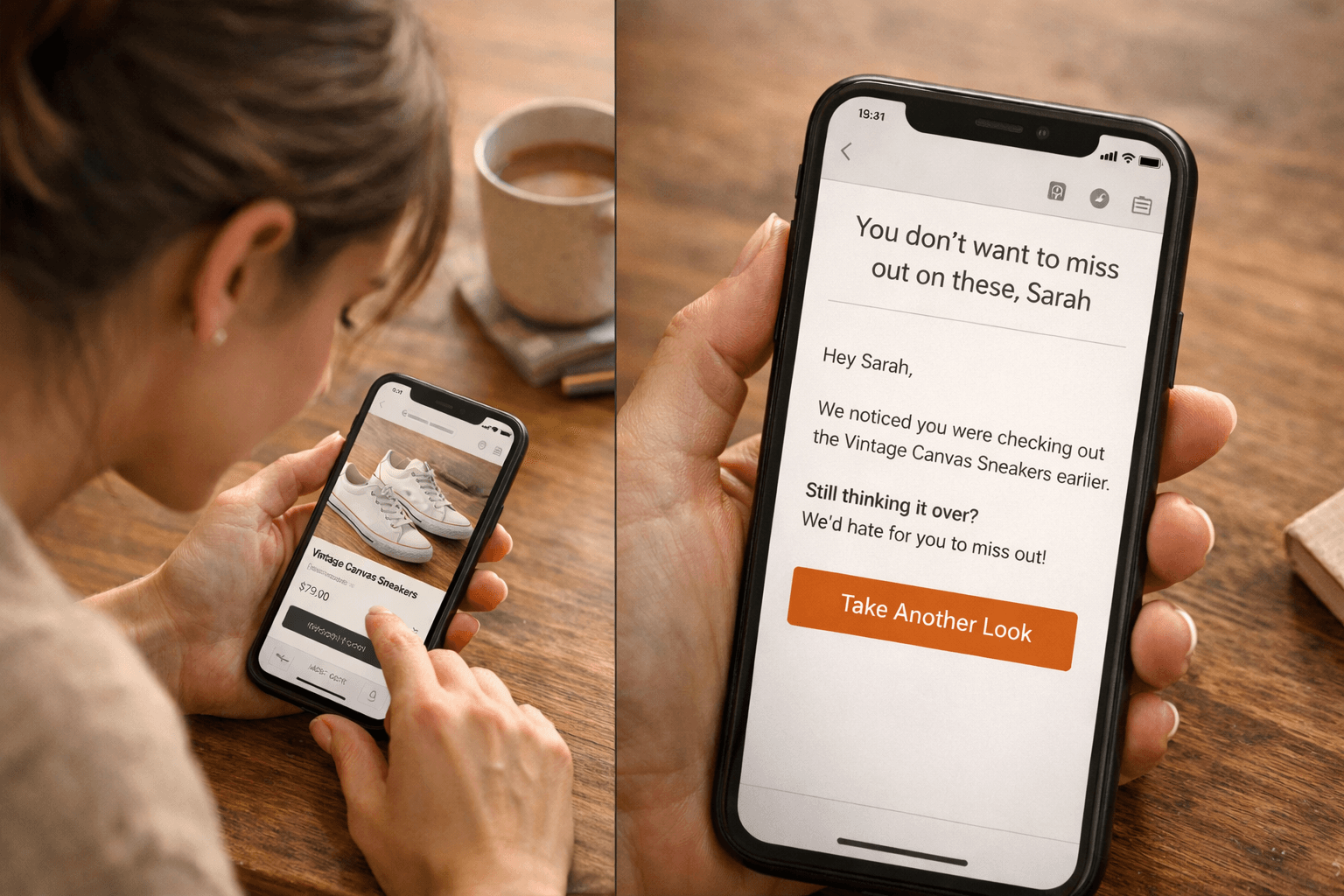
Browse Abandonment Emails: The Complete Strategy Guide for DTC Brands
(Or: why 94% of your visitors leave without buying — and what your email program can actually do about it)
Ninety-four percent.
That's approximately how many people visit your ecommerce store and leave without buying anything. They arrive. They look around. Some of them find a product they genuinely like — they read the description, zoom in on the images, maybe scroll the reviews. Then they close the tab.
Gone.
For most brands, that's where the story ends. The ad spend that brought them in is written off. The acquisition cost is sunk. The relationship that almost started never gets a chance to begin.
Browse abandonment emails exist to change that outcome.
But here's the problem: most brands that run browse abandonment emails treat them like a slightly watered-down version of cart abandonment — the same template, the same urgency tactics, just with a different product image swapped in. They set the flow up once, declare it "running," and move on.
That is a significant missed opportunity.
Done thoughtfully, browse abandonment is one of the highest-ROI flows in your entire email program. Klaviyo's data shows browse abandonment emails drive 9.6 times the conversion rate of a standard marketing email. Omnisend reports open rates of 34.55% and click-to-conversion rates above 11% — numbers most campaign sends will never touch.
Done poorly, browse abandonment emails feel like surveillance. They erode trust. They train your subscribers to tune you out.
The difference between those two outcomes is almost entirely strategic. It has almost nothing to do with which email platform you're using.
This guide covers the strategy. The philosophy. The frameworks that the best retention marketers in DTC use to build browse abandonment programs that actually convert — and that customers are glad to receive.
We'll start at the beginning: what browse abandonment really is, where it fits in your email program, and what it can (and cannot) do for your business.
What Browse Abandonment Actually Is — And What It Isn't
Browse abandonment is one of four behavioral triggers in what Chase Dimond — whose agency has generated over $200 million in email-attributed revenue for ecommerce clients — calls the abandonment funnel. Understanding where browse fits in that funnel is the first step to building a flow that performs.
Here's how the four levels break down, from lowest to highest purchase intent:
1. Site Abandonment — triggered when a subscriber visits your site but doesn't view any specific product. They browsed the homepage, maybe a collection. Then left.
2. Browse Abandonment — triggered when a subscriber views a specific product page but doesn't add it to their cart. They saw something they were interested in. Then left.
3. Cart Abandonment — triggered when a subscriber adds a product to their cart but doesn't complete checkout. They committed enough to select a product. Then left.
4. Checkout Abandonment — triggered when a subscriber begins the checkout process but doesn't complete the purchase. They were this close. Then left.
Each level represents a different psychological state. Each requires a different email strategy.
The most common mistake in browse abandonment is treating it like cart abandonment with the discount removed. It isn't. A browse abandoner didn't take the step of adding something to their cart. That distinction matters enormously for how you write to them, what you offer, and what you're actually trying to accomplish.
A cart abandoner has made a decision. They chose a specific product, in a specific configuration, at a specific price. They need a push to complete a transaction they'd already started.
A browse abandoner is still forming a decision. They saw something that interested them. They haven't chosen yet. They need a reason to come back and look closer — not a checkout link.
The email that serves a cart abandoner is not the email that serves a browse abandoner. Writing the same message for both audiences is like a car salesman skipping the test drive and asking for a deposit as soon as someone walks on the lot.
The Intent Spectrum: Where Browse Abandonment Lives
Think of customer intent as a spectrum, running from cold curiosity on one end to completed purchase on the other.
Browse abandonment sits in the early-middle zone. These are subscribers who are:
- Actively exploring your brand (not just aware of it)
- Interested in at least one specific product (not just browsing categories)
- Not yet committed to a purchase (not ready to be sold to)
That position on the spectrum has direct implications for your strategy.
Because they're further from purchase than cart abandoners, the conversion rates from browse abandonment flows will be lower. That's not a problem with your flow — it's a function of where these customers are in their decision process. Don't benchmark browse abandonment conversion against checkout abandonment. Benchmark it against doing nothing, which has a 100% non-conversion rate.
Because they're actively interested in your brand, browse abandonment emails land with unusually high relevance. You're not interrupting them with something unrelated — you're following up on something they chose to look at. That relevance is why open rates are so high. Earn it.
The Val Geisler Principle: Conversation, Not Campaign
Val Geisler has spent the better part of a decade arguing that the fundamental problem with ecommerce email marketing is that brands think in campaigns instead of conversations.
Her Dinner Party Strategy — a framework she developed to help brands build email sequences that feel human rather than automated — makes this concrete with a memorable metaphor.
When you host a dinner party, you don't serve the main course the moment your guests walk in the door. You invite them in. You offer them a drink. You give them a tour. You let them settle. The meal arrives when they're comfortable, when they're ready, when the relationship between host and guest has been established.
Email — especially browse abandonment email — works the same way.
The browse abandonment email is not the main course. It's the host noticing what a guest was admiring on the bookshelf and mentioning it warmly before the night is over. It's a moment of genuine attentiveness, not a transaction.
When browse abandonment emails convert well, it's usually because they feel like that: a relevant, human, low-pressure acknowledgment of something the customer was genuinely interested in.
When they fail — or worse, when they provoke unsubscribes and spam complaints — it's usually because they feel like the opposite: a surveillance system announcing that it noticed what you did and is now sending you a discount to exploit that moment.
Before you write a single line of copy, or choose a send time, or debate whether to include an offer, the most important question to ask about any browse abandonment email is this: Would a gracious host say this? Or does it sound like a tracking pixel talking?
If the answer is the latter, rewrite it.
This is the standard. Every browse abandonment email you send should pass it.
The Alex Greifeld Reality Check: What Browse Abandonment Can't Fix
One of the most useful things you can do before investing heavily in browse abandonment optimization is to read Alex Greifeld's work.
Greifeld runs No Best Practices, a newsletter and consulting practice built around a simple, uncomfortable premise: most ecommerce brands are optimizing tactics when they should be interrogating fundamentals.
Her position on retention email — including browse abandonment — is worth taking seriously, especially if you're tempted to treat flow optimization as a substitute for brand-building.
The core argument: genuine retention improvements don't come primarily from clever automated sequences. They come from product quality, customer experience, and a value proposition that people actually believe in. Email is a communication layer. It can accelerate and surface what's already working. It cannot manufacture desire that doesn't exist.
Applied to browse abandonment, this has a specific practical implication.
If people are browsing your product pages and consistently leaving without adding to cart, ask the harder question first: Why? Is the product page unclear? Is the pricing out of step with the perceived value? Are the product photos not showing what customers need to see? Is there a sizing, ingredient, or fit question that the page doesn't answer?
Browse abandonment data is diagnostic as much as it is a revenue opportunity. A high browse abandonment rate on a specific product is a signal — not just an occasion to trigger an email, but an indicator that something on that product page might be creating friction worth fixing.
Fix the page, and you reduce abandonment. Run a well-built browse flow for the abandonment that remains, and you recover some of what you'd otherwise lose. Do both, and the compounding effect is significant.
The mistake is doing only the second thing and treating the flow as a solution to a problem that lives upstream of the email program.
Greifeld's view isn't an argument against browse abandonment emails. It's an argument for using browse data intelligently — as both an email trigger and a product and UX feedback signal.
The Eli Weiss CX Standard: Helpful or Creepy?
Eli Weiss spent years as the customer experience and retention lead at OLIPOP and Jones Road Beauty before joining Yotpo as VP of Retention Advocacy. His core belief — that customer experience is the most powerful retention lever a brand can pull — applies directly to browse abandonment.
Browse abandonment emails are a CX touchpoint. They are often the first proactive communication a potential customer receives from your brand after showing genuine interest. That makes them unusually high-stakes.
A browse abandonment email that feels intrusive — that references the specific product someone viewed in a way that reads as "we were watching you" rather than "we thought you'd want to know" — does damage to the customer relationship. It creates precisely the kind of friction that makes people associate your brand with discomfort rather than delight.
Weiss's standard for CX-first email: before asking whether it converts, ask whether the person receiving it is glad it arrived. The best retention emails are ones the customer would actually want to receive. Browse abandonment emails that pass that test earn trust, which compounds across the entire customer relationship. Browse abandonment emails that fail it might generate a short-term conversion at the cost of a long-term relationship.
The practical application: lead with helpfulness, not urgency. A browse abandonment email that says "we thought you might want to know that this product answers the question most people ask before buying" is more likely to be welcomed than one that says "you left this behind — here's 15% off."
The Strategic Role of Browse Abandonment in Your Email Program
Now that the philosophy is clear, let's get practical about where browse abandonment sits in the architecture of a full retention email program — and how to think about building it relative to other priorities.
The Priority Sequence
If you're building your email program from scratch, browse abandonment is not the first flow to build. This is the priority order most experienced operators follow:
- Welcome Series — Your highest-leverage automation, full stop. Every subscriber gets one. It sets the LTV trajectory of the relationship.
- Abandoned Checkout — Highest purchase intent of any flow. Easy to set up on Shopify + Klaviyo. High RPR.
- Abandoned Cart — Strong intent, strong conversion rates, relatively simple to build.
- Browse Abandonment — Lower intent than cart, but high volume. Meaningful revenue at scale.
- Post-Purchase / Winback — Equally important for LTV, but depends on having a customer base to re-engage.
If you haven't built the first three, start there. Browse abandonment amplifies a healthy email program. It doesn't rescue an underdeveloped one.
The Revenue Math
Here's how to think about browse abandonment's contribution to your email revenue:
Browse abandonment will always have a lower revenue-per-recipient (RPR) than cart or checkout abandonment — because intent is lower, so conversion rate is lower. But browse abandonment flows process more recipients than any other abandonment trigger, because browsing is far more common than carting.
Think about it this way: if only 6% of site visitors add something to their cart, then 88% of your visitors who engaged with a product page but didn't purchase are browse abandonment candidates. The pool is enormous.
Small improvements in conversion rate across a large pool of high-intent subscribers produce meaningful revenue gains. You don't need spectacular conversion rates from browse abandonment — you need a consistently good experience delivered at scale.
Thomas Lalas, author of Retention Economics and a fractional Director of Retention for eight-to-nine figure CPG brands, frames this as a compounding math problem. A 1% improvement in browse-to-purchase conversion rate may look small in isolation. Multiply it by the number of monthly browse abandonment-eligible contacts, multiply that by average order value, and multiply that by 12 months — and the number gets interesting quickly.
The Interaction Problem: When Flows Collide
One of the most common browse abandonment mistakes isn't in the email itself — it's in how the flow interacts with the rest of your email program.
If a subscriber is receiving your welcome series and triggers a browse abandonment flow at the same time, you may be sending that person three to five emails in the first week of your relationship. That's a fast way to train someone to unsubscribe.
Similarly, if a browse abandonment subscriber then adds something to their cart, they should immediately exit the browse flow and enter the cart abandonment flow — not receive both. The more-recent, higher-intent trigger should always win.
Getting these interactions right is a technical problem, but it starts as a strategic one. Before building the browse flow, map every other active flow your subscribers might be in, and establish clear rules for how browse abandonment should yield to or override them.
The "Does This Work for My Brand?" Question
Browse abandonment works best for brands with:
- Large product catalogs — more browse opportunities, more personalization potential
- Considered purchases — products where customers research before buying (apparel, home goods, beauty, supplements, higher-ticket items)
- High repeat-purchase potential — browse data is most valuable when the customer relationship extends beyond a single transaction
It works less well for:
- Commodity products with no brand differentiation — if price is the only decision factor, email can't add value that the product page didn't
- Impulse-buy categories with very short consideration windows — by the time the email arrives, the moment has passed
- Brands with very small lists — the volume may not justify the setup time
Know which situation you're in before setting expectations for what this flow will produce.
What You've Established Before Writing a Single Email
Before you touch a template, before you debate subject lines, before you decide whether to include a discount — you now have a strategic foundation to build from:
Browse abandonment is not cart abandonment. The purchase intent is lower, the tone should be different, and the goal is often to re-engage curiosity rather than close a transaction.
It is a conversation, not a campaign. Val Geisler's dinner party standard applies: every email should feel like a warm, attentive host — not a tracking pixel that has memorized your behavior.
It cannot substitute for product and UX quality. Alex Greifeld's operator lens keeps the flow in its proper place: a communication layer that amplifies what's working, not a solution to what isn't.
It is a CX touchpoint before it is a revenue tool. Eli Weiss's standard: is the customer glad this arrived? If not, the email is doing damage even when it converts.
It belongs in a well-built email program, not at the top of the priority stack. Build your welcome series and abandonment flows first. Then bring browse abandonment in with the strategic clarity it deserves.
In the next chapter, we go deeper: who actually qualifies for a browse abandonment email, how to segment those audiences for maximum relevance, and the suppression rules that protect your deliverability and your customer relationships.
This post is part of The Ultimate Guide to Browse Abandonment Emails — a multi-part series synthesizing the frameworks, tactics, and philosophies of 25 of the world's top retention email marketing experts.
Next in this series: Part 2: Audience Segmentation & Trigger Architecture — Who Gets This Email, When, and Why