Browse Abandonment Email Segmentation: Who Gets This Email, When, and Why
Not all browsers are equal. Learn the 4 segments that make browse abandonment emails feel relevant — and the suppression rules that protect your sender reputation.
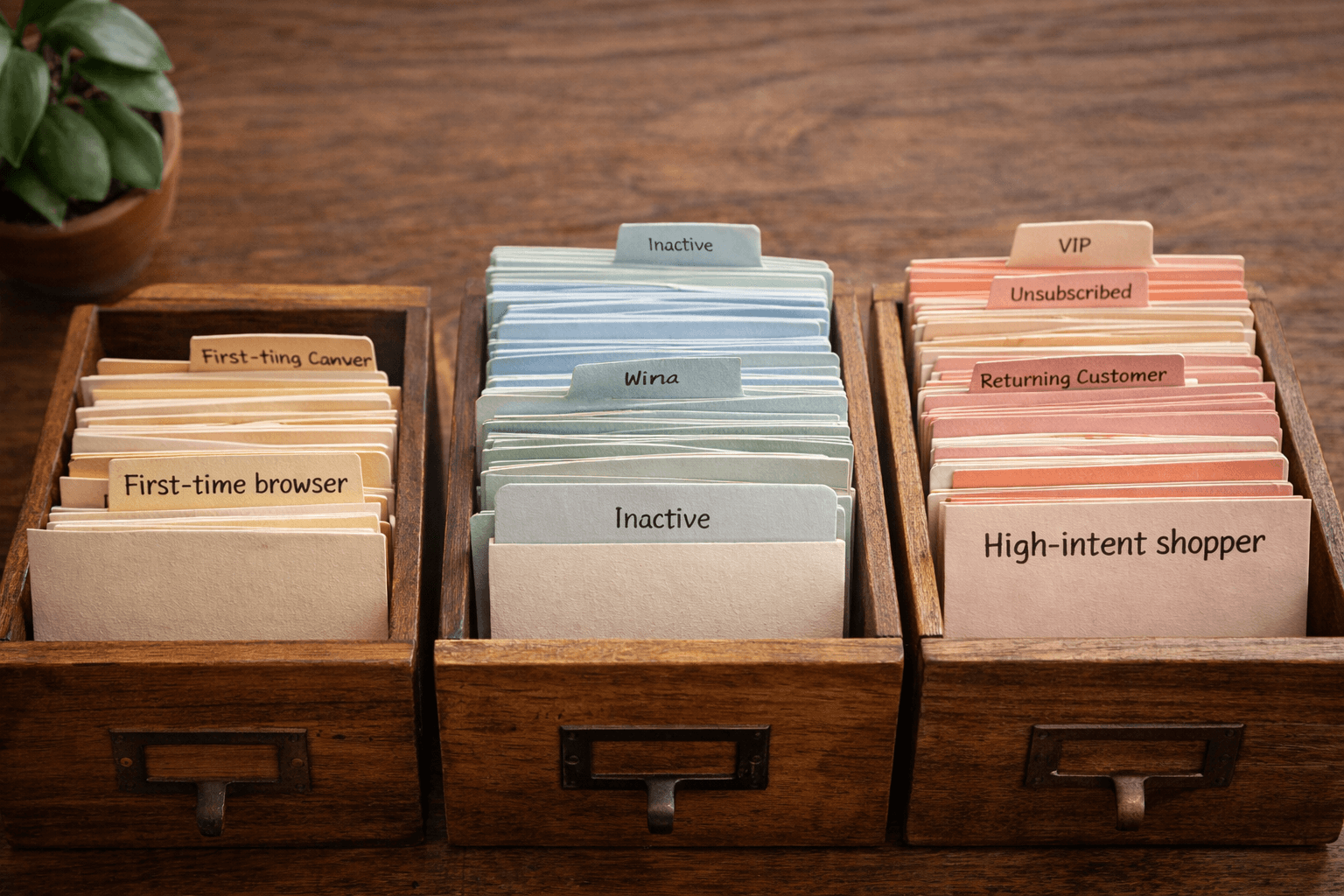
The brands generating the most revenue from browse abandonment aren't sending more emails. They're sending the right email to the right person at the right moment.
Part 2 of 7 in the Browse Abandonment Email Series. Previous: Strategy Guide ← | Next: Klaviyo Setup →
Most brands set up browse abandonment the same way.
Someone views a product. One hour later, every subscriber who did that gets the same email. Same subject line. Same product image. Same copy. Same offer — or no offer. Repeat.
It's a reasonable place to start. It's a poor place to stay.
The subscribers who browse your store are not a single audience. A first-time visitor who discovered you through a TikTok ad and spent four minutes reading the product page for your hero SKU is a fundamentally different prospect from a loyal customer who bought from you three times last year and is now browsing a product in a new category. Sending them the same email — with the same tone, the same urgency, the same offer — is the equivalent of a skilled salesperson using the same pitch on every customer who walks in the door regardless of what they know, what they've bought before, or how long they've been considering the purchase.
The email might still convert occasionally. But it leaves significant revenue on the table, and more importantly, it leaves relationship-building on the table.
This chapter covers the who, when, and why of browse abandonment segmentation — the decisions that determine whether your flow feels like a relevant, welcome message or a generic automation that your subscribers eventually stop noticing.
Start Here: The Non-Negotiable Prerequisite
Before a single segmentation decision gets made, one thing must be true: the person receiving a browse abandonment email must already be on your email list.
Unlike abandoned checkout flows, which can capture a subscriber's email mid-funnel and use it to trigger a recovery sequence, browse abandonment only works for identifiable contacts. Someone visits your store, views a product, and leaves — your email platform can only follow up with them if it already knows who they are.
This is simultaneously a limitation and a strategic advantage.
The limitation is obvious: the majority of your site visitors are anonymous. You can't email them. The pool of browse abandonment-eligible contacts is smaller than your total browse abandonment traffic.
The advantage is less frequently discussed. Every person you can send a browse abandonment email to has already opted into your list. They chose to give you their email address. That relationship — however early-stage — gives you permission, context, and history to work with. You're not reaching out to a stranger. You're following up with someone who has already raised their hand.
This is why list growth and browse abandonment are strategically linked. Your opt-in rate is the ceiling of your browse abandonment program's reach. Every percentage point improvement in your pop-up conversion rate, every additional opt-in source you develop, expands the audience available for this flow. The two investments compound together.
The Four Audience Segments That Actually Matter
Not every segmentation framework is worth building. More segments mean more emails to write, more flows to maintain, and more surface area for things to break. The goal is the minimum number of meaningful distinctions — segments that are different enough from each other that they genuinely need a different message.
For browse abandonment, four core segments cover the vast majority of situations and produce the most meaningful performance lift over a single undifferentiated flow.
Klaviyo's documentation, Chase Dimond's client work, and the pattern of what top-performing DTC brands actually build all point to the same basic architecture. Here it is, with the strategic rationale for each.
Segment 1: First-Time Browsers Who Have Never Purchased
Who they are: Subscribers on your list who have never placed an order. They've seen your brand, opted in — probably for an incentive or lead magnet — and are now browsing your products.
What their psychological state is: These are the most uncertain people in your audience. They're interested enough to look. They're not yet convinced enough to buy. They may be comparing you to competitors. They may have lingering doubts about quality, fit, or whether the product is right for them. They almost certainly don't fully trust you yet.
Joanna Wiebe's stage-of-awareness framework puts this subscriber at the "solution aware" stage: they know what they want; they're not sure if your product is the right version of it. Your job is not to close a sale — it's to close a trust gap.
What the email should do:
- Reinforce brand credibility (social proof, review count, customer photos)
- Answer the most common pre-purchase objection for that product category
- Make the first purchase feel low-risk (clear return policy, guarantee, quality signals)
- Introduce an incentive only if it's warranted — a first-purchase offer is defensible here, but deploy it in the second or third email, not the first
What the email should not do:
- Lead with urgency or manufactured scarcity
- Assume familiarity ("We know you love our products…" to someone who has never bought from you reads as false)
- Discount heavily and immediately — it signals that the original price wasn't real
The key flow filter: Placed Order equals zero times over all time
Segment 2: One-Time Buyers Browsing Again
Who they are: Subscribers who have placed exactly one order and are back on the site looking at products — either in the same category or exploring something new.
What their psychological state is: This is a subscriber in the middle of a critical transition. They took a chance on you once. That first purchase was a test. If the product experience met or exceeded expectations, their propensity to buy again is high — but they haven't fully committed to being a repeat customer yet. You're in the window between "trial" and "loyal."
The one-time-to-two-time buyer conversion rate is one of the highest-leverage numbers in DTC. Once a customer buys twice, repeat purchase probability increases substantially. Browse abandonment emails sent to first-time buyers browsing for a second purchase are not recovering lost revenue — they're fighting for a customer relationship.
What the email should do:
- Assume the prior purchase went well (don't rehash brand basics they already know)
- Acknowledge, subtly, that they're back — "glad you're exploring" rather than "did you forget something"
- Lead with product benefits and category expansion rather than trust-building
- Resist the discount. They bought once at full price. Offering a discount now trains them to wait for one next time.
What the email should not do:
- Send the same email as Segment 1 — these are different relationships and different psychological states
- Lead with a first-purchase incentive (they've already purchased — it signals either poor list hygiene or lazy segmentation)
- Over-sell. The trust is mostly there. The job now is relevance and inspiration, not persuasion.
The key flow filter: Placed Order equals 1 time over all time
Segment 3: Loyal and Repeat Buyers
Who they are: Subscribers who have purchased two or more times. They already like you. They've proven it with their wallet, more than once.
What their psychological state is: Val Geisler's principle is most important here. These customers don't need to be sold. They're browsing because they want to. The biggest risk with this segment isn't failing to convert — it's sending an email that makes them feel surveilled, pressured, or treated like a prospect instead of a loyal customer.
Alex Greifeld makes the operator's case: over-mailing loyal customers with abandonment-style emails is one of the faster ways to erode a relationship that took real effort and real marketing spend to build. These subscribers are your best customers. Treat them accordingly.
What the email should do:
- Keep it brief and low-pressure
- Lead with loyalty program status or points, if applicable
- Treat the browsed product as an opportunity to showcase complementary items or "new arrivals you might have missed"
- Sound human — a short, warm note rather than a templated abandonment flow
- Consider a VIP-style framing: "thought you'd want to know about this before it sells out" rather than "you left this behind"
What the email should NOT do:
- Send more than one email per browse session — this segment does not need a multi-email sequence
- Offer a discount. They are already loyal. Discounting erodes margin with your most valuable customers and sends the wrong signal about your brand's pricing integrity.
- Sound like every other browse abandonment email in their inbox — these subscribers have enough purchase history with you that generic template copy will register immediately as impersonal
The key flow filter: Placed Order at least 2 times over all time
Segment 4: High-Intent Browsers
Who they are: Subscribers who have viewed the same product multiple times — typically three or more product page views in a session or within a recent window — or who have viewed multiple products in the same category in a single session.
What their psychological state is: This is the browse abandonment segment closest to a cart abandoner in purchase intent. Viewing the same product page three times is not casual curiosity. It's someone working through a decision. They want it. Something is stopping them.
The question to write to is: what's the sticking point? It's rarely the product itself — if they've looked three times, they like it. It's more likely price uncertainty, a sizing or fit question, a concern about quality that the product page didn't fully resolve, or simple distraction at the moment of decision.
What the email should do:
- Write to the hesitation directly: "Most people who look at this product three times are wondering about [X]" — preempt the objection
- Use urgency and scarcity if — and only if — they are real. If stock is genuinely low, say so. If a price is genuinely temporary, say so. Don't manufacture it.
- Offer a limited-time incentive in Email 2 or 3 — this segment has earned it by demonstrating serious interest
- Include customer reviews that speak to the most common concern for that product (sizing runs small? Lead with a review that addresses it)
What the email should NOT do:
- Use fake scarcity or countdown timers that reset — the email marketing equivalent of the car salesman saying "I can only hold this price until end of day." It works once. It permanently damages trust after that. Chad White has written extensively on this: trust erosion from manufactured scarcity is real and cumulative.
- Lead with an immediate discount on the first email — high-intent browsers are close to buying anyway; you may not need to discount at all to convert them
The key flow filter: Viewed Product at least 3 times since starting this flow — or a separate segment built around session depth
The Suppression Rules: Who Should Never Get This Email
Segmentation is as much about who to exclude as who to include. Sending browse abandonment emails to the wrong people is worse than not sending them at all — it burns trust, increases unsubscribes, and degrades your sender reputation.
These suppression rules are non-negotiable.
Suppress active cart and checkout abandonment flow participants. If a subscriber moves from browsing to adding to cart while in your browse flow, they must exit the browse flow immediately and enter the cart abandonment flow. The more-recent, higher-intent trigger takes priority. Always. This is a flow filter, not a conditional split — flow filters check at every step, ensuring a subscriber who converts mid-sequence stops receiving browse emails in real time.
Suppress recent purchasers. Someone who placed an order in the last 30 to 60 days should not be receiving browse abandonment emails. They're in a post-purchase relationship with you — still in the honeymoon window of their last order. A browse abandonment email during this period is unnecessary at best and intrusive at worst. The window depends on your product's average replenishment cycle: a skincare brand might use 30 days; a furniture brand might use 90.
Suppress welcome series participants. A new subscriber who is actively receiving your welcome sequence and also triggers a browse abandonment flow can receive three to five emails in their first week. That is a fast path to unsubscribes. Suppress browse abandonment for the first seven days of the welcome series, or build a conditional split that de-prioritizes browse sends during the welcome window.
Suppress unengaged subscribers. Israa A., a deliverability specialist whose work focuses on DTC brands generating $120M+ in email-attributed impact revenue, is emphatic on this point: sending to unengaged subscribers is not a reach strategy — it's a deliverability liability. If a subscriber hasn't opened or clicked an email in the last 90 to 180 days (depending on your send frequency), they should not be receiving browse abandonment emails. Build an engagement segment — subscribers who have opened or clicked within your defined window — and limit your browse flow to that segment only. The conversion rates will go up. The spam complaints will go down. Your sender reputation will thank you.
Suppress subscribers in active winback flows. If a subscriber is already in a re-engagement or winback sequence, a browse abandonment email creates a confusing, conflicting message. Let the winback flow complete before browse abandonment re-qualifies them.
The Trigger: What Actually Fires a Browse Abandonment Email
The browse abandonment trigger is the Viewed Product event — fired when a subscriber views a specific product page on your site. In Klaviyo, this event passes through the product's name, image URL, price, and URL, which populates your email's dynamic product block.
Straightforward in theory. More complicated in practice.
The Identifiability Problem
Here's the part that most setup guides leave out: Klaviyo's default Shopify integration only fires the Viewed Product event for identifiable browsers — meaning subscribers who are already cookied from a previous session or who arrived at your site after clicking a link in one of your emails.
What this means practically: a subscriber who visits your site directly, or via a paid ad, without being cookied first, is invisible to the default Viewed Product event even if they're on your list. The pool of browse abandonment-eligible contacts is smaller than you probably assumed.
Server-side tracking solutions — such as Littledata's Shopify integration — address this by capturing the Viewed Product event at the server level rather than the browser level, dramatically increasing the proportion of returning subscribers who qualify for the flow. If list size is a concern and you're on Shopify, this is worth investigating early.
Flow Filters vs. Conditional Splits
This distinction matters more than most brands realize, and getting it wrong produces significant problems.
A conditional split checks a condition at a single point in the flow when the subscriber reaches it. If someone adds to cart after passing the conditional split, they continue receiving browse abandonment emails until the flow ends — because the split already evaluated them.
A flow filter checks a condition continuously, at every step of the flow. If a subscriber places an order at any point while in the browse abandonment flow, a flow filter catches that and removes them from the sequence in real time.
For browse abandonment, you need flow filters — not conditional splits — for the following conditions:
- Added to Cart: zero times since starting this flow
- Started Checkout: zero times since starting this flow
- Placed Order: zero times since starting this flow
Set these at the flow level, not the email level. They act as ongoing suppressors that protect the subscriber experience regardless of when they convert.
Smart Sending
Keep Smart Sending on for all browse abandonment emails. Klaviyo's Smart Sending setting prevents a subscriber from receiving more than one email from a flow within a set window (typically 16 hours by default, adjustable to your preference). For a browse-heavy subscriber who views six products in a day, Smart Sending is what stands between a relevant single email and six emails that feel like harassment.
The Re-Entry Throttle
The Viewed Product event fires every time a subscriber views a product. Without a re-entry limit, a subscriber who views ten products in a week can be entered into the browse abandonment flow ten times, generating up to twenty or thirty emails depending on your sequence length.
Set a re-entry frequency cap. The standard recommendation: no more than once every five to seven days. Some brands use seven to fourteen days for high-ticket or slow-consideration products. This single configuration change prevents one of the most common browse abandonment spam complaints.
Timing: When to Send the First Email
The timing of the first browse abandonment email is one of the highest-impact variables in the flow — and one of the most debated.
The general consensus across top practitioners: send within one to four hours of the browse session ending. Klaviyo's default is a two-hour delay, which is a reasonable starting point for most brands.
The reasoning is intuitive. You want to reach the subscriber while the product is still fresh in their mind — while they're still in the consideration window, still likely to be in a browsing mindset, still receptive to a gentle follow-up. Wait too long and the moment has passed. They've moved on, found an alternative, or simply forgotten.
But "too fast" has its own problem. A browse abandonment email that arrives two minutes after someone leaves your site signals one thing clearly: we were watching you in real time. That is not a feeling that helps conversion. Val Geisler's dinner party standard applies directly here: a host who calls you immediately after you leave to say "I noticed you were looking at the bookshelf" is not gracious. They're unsettling.
One hour is generally the minimum. Two hours is the most common default. Four hours works well for higher-ticket products where the consideration window is longer.
The variable to pay attention to is your product's average consideration cycle — how long does a typical customer research before buying? For an impulse-friendly $30 candle, the window is short and two hours is probably right. For a $400 leather bag or a $250 skincare device, four to eight hours is more appropriate and less likely to feel intrusive.
This is also one of the highest-value things to A/B test in your browse flow. Test one to two hours versus three to four hours, measure Revenue Per Recipient (not open rate), and let the data set your timing rather than defaulting to a platform recommendation.
How Many Emails: The Sequence Architecture
The instinct when building a browse abandonment series is to model it on cart abandonment — three emails, escalating urgency, discount in the final email. That instinct is wrong for most browse abandonment situations.
Klaviyo's performance data on browse abandonment is instructive: the top-performing brands in their network send two emails or fewer in their browse abandonment sequences. Not three. Not five. One or two — sent quickly and well.
Why? Because browse abandonment is not cart abandonment. The intent level is lower. The subscriber is earlier in their decision process. Sending five emails to someone who was casually browsing your sale section is a fast way to get unsubscribed.
The right sequence architecture depends primarily on segment.
For Segment 1 (first-time browsers): A two- or three-email sequence is defensible. Email 1 is a warm reminder with product showcase. Email 2, sent 24 hours later, handles education or social proof. Email 3, if used, is a soft incentive for subscribers who didn't respond to the first two.
For Segment 2 (one-time buyers): Two emails maximum. Email 1 is a product-focused reminder with brand confidence. Email 2, sent 24 to 48 hours later, offers related products and a gentle nudge.
For Segment 3 (loyal buyers): One email. Warm, brief, low-pressure. That's it.
For Segment 4 (high-intent browsers): Two to three emails with escalating specificity. Email 1 acknowledges the product. Email 2 handles the most likely objection. Email 3 — if used — is a genuine offer with a real time window.
The principle underlying all of these: add an email when it adds value to the subscriber. Remove an email when it's there only to add a conversion opportunity for you. Subscribers can feel the difference.
Putting It Together: The Segmented Flow Architecture
Here's what a well-built browse abandonment flow looks like in Klaviyo when all of the above is applied:
Trigger: Viewed Product
Flow-level filters (active at every step):
- Added to Cart: zero times since starting this flow
- Started Checkout: zero times since starting this flow
- Placed Order: zero times since starting this flow
- Received email from this flow: zero times in the last 5 days (re-entry throttle)
Smart Sending: On
Time delay: 1–2 hours
Conditional split A — Purchaser status:
- YES (Placed Order ≥ 1 over all time) → Purchaser path
- NO → First-time buyer path
First-time buyer path:
- Email 1 (immediate after delay): warm reminder, product showcase, brand credibility signals
- Time delay: 24 hours
- Email 2: education or social proof
- Time delay: 24 hours
- Email 3 (optional): soft first-purchase incentive
Purchaser path — Conditional split B — Purchase count:
- 1 purchase → One-time buyer path: Email 1 (product reminder, inspiration) + optional Email 2 (related products)
- 2+ purchases → Loyal buyer path: Email 1 only (brief, warm, low-pressure)
Optional advanced split (high-intent layer):
- Applied to any segment where
Viewed Product ≥ 3 times since starting this flow→ escalate Email 2 to objection-handling copy; add real urgency language if stock is low
What Segmentation Actually Buys You
The case for segmenting browse abandonment is not about vanity metrics. It is not about having a more sophisticated flow diagram to show in a QBR.
It is about this: the subscriber who receives a first-purchase incentive email as a loyal three-time buyer feels misrecognized. The subscriber who receives a generic product reminder after viewing the same SKU four times in two days feels unseen. The first-time browser who gets a warm, educational, trust-building email instead of a "you left this behind" template with a countdown timer feels like the brand is paying attention.
Samar Owais, whose lifecycle email work spans clients from HubSpot to Drip, frames it this way: personalization in lifecycle email is not about adding a first-name merge tag. It's about giving every subscriber content that reflects where they actually are in their journey with your brand. Browse abandonment segmentation is what makes that possible.
The goal is not just a flow that converts. It's a flow your subscribers are glad to receive. Get the segmentation right, and those two things are the same.
In the next chapter, we get into the mechanics: how to build and set up browse abandonment flows in Klaviyo from the ground up — including the technical details most setup guides leave out, the dynamic product block configuration, and how to coordinate your browse flow with SMS.
This post is Part 2 of The Ultimate Guide to Browse Abandonment Emails — a multi-part series synthesizing the frameworks, tactics, and philosophies of 25 of the world's top retention email marketing experts, published on Geysera.com.
Read the complete series:
Part 1: Browse Abandonment Strategy & Philosophy — What It Is and Why It Matters
Part 2: Segmentation & Trigger Architecture — Who Gets This Email, When, and Why (you are here)
Part 3: Technical Setup — How to Build the Flow in Klaviyo
Part 4: Copywriting — The Words That Turn Window Shoppers Into Buyers
Part 5: Design & UX — The Visual Experience That Gets Clicks
Part 6: Discount Debate - When to Offer an Incentive
Part 7: Testing, Analytics & Optimization — How to Improve What's Already Running
Frequently asked questions
Should I send the same browse abandonment email to everyone?
No, and this is where most brands leave money on the table. A first-time visitor who browsed once is a completely different prospect from a repeat customer browsing a new category. Segment by customer lifecycle stage (new vs returning), browse behavior (single view vs multiple views), and purchase history. Each group responds to different messaging.
How long should I wait before sending a browse abandonment email?
For most brands, 1-2 hours after the browse session ends. Shorter than that feels like surveillance. Longer than 4 hours and the product memory starts to fade. Some brands test 30-minute delays for high-intent segments (multiple product views in one session) and 2-hour delays for single-view browsers.
Should repeat customers get browse abandonment emails?
Yes, but different ones. A customer who has bought from you before does not need the same trust-building content a first-time browser needs. Skip the brand introduction. Lead with "back in stock" or "new arrival" framing. Reference their past purchases if relevant. The relationship already exists — act like it.
What should I suppress in browse abandonment flows?
At minimum: anyone who purchased the product in the last 30 days, anyone who added the product to cart (they should enter the cart abandonment flow instead), and anyone who received a browse abandonment email in the last 48-72 hours. Without suppression, you over-message and the flow starts hurting more than it helps.
How do I segment by intent level?
Use behavioral signals. Multiple product views in one session = high intent. Single page view for under 30 seconds = low intent. Viewed the same product on multiple visits = very high intent. Match your messaging aggressiveness to the intent level. High-intent browsers can handle a direct "still interested?" message. Low-intent browsers need something softer.

Co-Founder and CEO
Bob Thordarson is CEO and Co-Founder of Geysera, a serial entrepreneur with 25+ years and five co-founded ventures, including Cequint (acquired by TNS in 2010 for $112.5M) and Consumerware (acquired by ParkerVision). A graduate of the University of Washington and MIT Entrepreneurial Masters Program, based in Seattle, he serves on the boards of DRY Soda Co. and the Entrepreneurs' Organization Seattle chapter. He is an expert in retention marketing email systems and methodology for ecommerce and B2B brands — measured by incremental revenue, not vanity metrics.