What Is an Email Automation Layer? (And Why Ecommerce Brands Are Adding One)
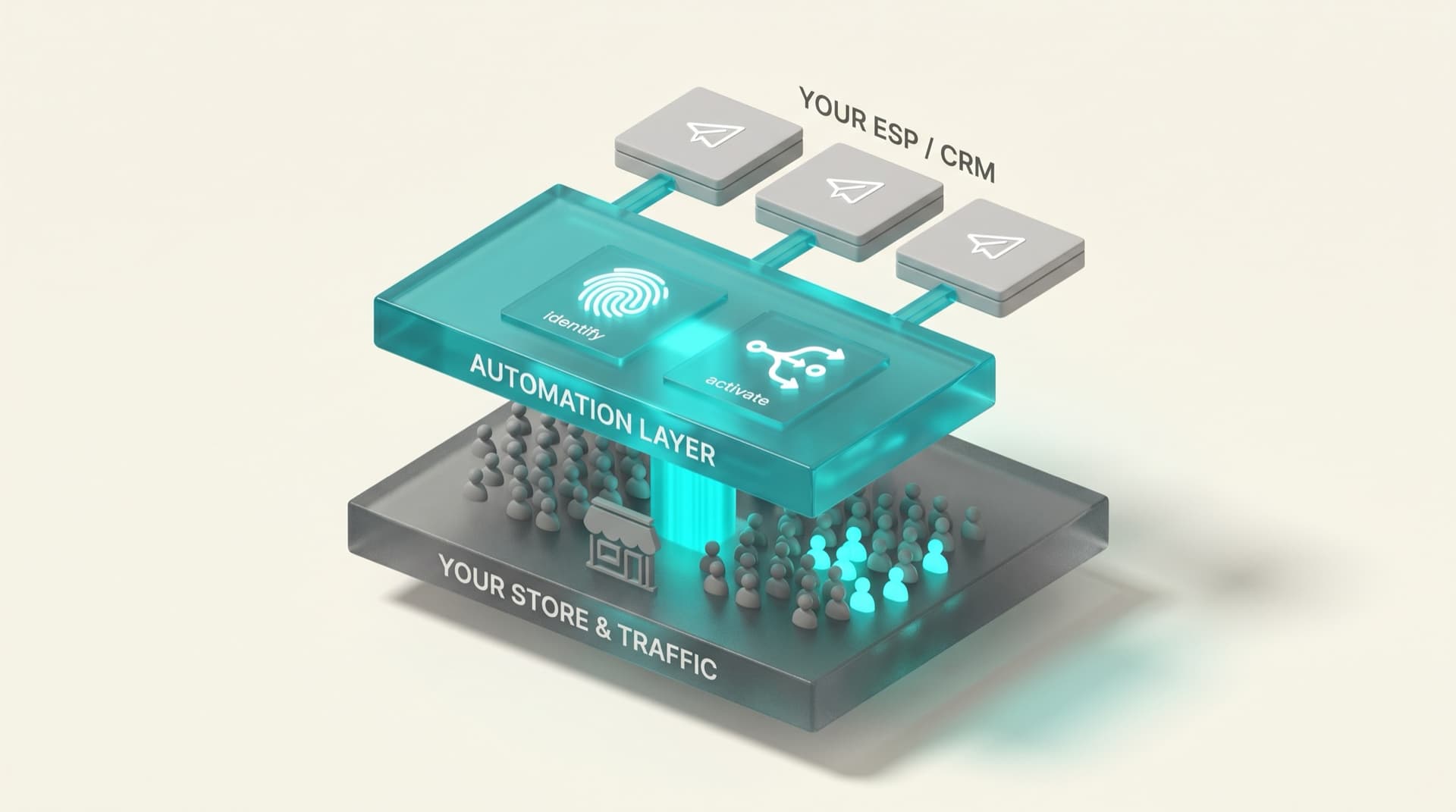
Search "automation layer" and you get generic email-automation definitions, because nobody has defined the category. An email automation layer is a behavior-and-identity layer that sits on top of the ESP or CRM you already use, resolves the anonymous traffic those tools never see into contacts, and runs the behavioral flows across whatever you send with. This is what it is, how it differs from an ESP, a CRM, and a CDP, and why ecommerce brands are adding one.
Last updated: June 13, 2026
This is post 17 of 17 in the WooCommerce Email Marketing in 2026 Series. Previous: Klaviyo vs Omnisend for WooCommerce: The 2026 Comparison
Search "automation layer" and the results are all generic definitions of email automation, the same "send emails based on triggers" explanation from every ESP glossary. Google even suggests "what is an email automation layer example" and "what is an email automation layer explain" as related searches, which means people are asking and nobody has actually answered. The category does not have a clean definition yet.
It should, because it is the thing every post in this series kept running into. Sixteen guides, on cohorts and comparisons and flows and tools, and each one hit the same wall from a different angle: whatever email tool you run, it only ever acts on the customers you have already identified. The automation layer is the name for what sits above that problem and solves it. So this final post defines the category plainly: what an email automation layer is, how it differs from the ESP, CRM, and CDP you may already know, and why ecommerce brands are adding one.
KEY STATS
- There is no established definition for "email automation layer" online; the query returns generic email-automation explainers, and Google's own related searches include "what is an email automation layer example" and "explain" (DataForSEO, June 2026)
- Adjacent categories are well-defined and heavily searched, with "customer data platform" at roughly 2,900 searches a month and "what is a CDP" at 1,600, which is the contrast the automation layer is best understood against (DataForSEO, June 2026)
- The recurring limitation across every ESP, CRM, and CDP is the same: they act on identified contacts, and 80-95% of paid ecommerce traffic never identifies (industry visitor-identification analyses, 2025-2026)
- An automation layer is defined by two functions a sending tool does not combine: identity (resolving anonymous visitors into contacts) and activation (running behavioral flows), on top of whatever ESP or CRM you already use
- The model is additive, not a replacement: it sits on top of your existing stack rather than asking you to migrate, which is why brands adopt it without ripping out tools that work
- Data sourced from the live "automation layer" and "what is an email automation layer" SERPs (DataForSEO, June 2026) and aggregated 2025-2026 ecommerce benchmarks
What's in this guide:
- What an email automation layer is
- How it differs from your ESP, CRM, and CDP
- Why ecommerce brands are adding one
- What it actually does
- Do you need one?
- The pattern this whole series kept hitting
- Frequently asked questions
What an email automation layer is
An email automation layer is a behavior-and-identity layer that sits on top of the email tools you already use, does two things they do not combine, and works regardless of which sending platform you run.
The two things are identity and activation. Identity means resolving a share of your anonymous website traffic into contactable profiles, so visitors who browsed and left without subscribing become people you can actually reach. Activation means running behavioral flows (cart recovery, browse, post-purchase, winback) off real-time store behavior, including for those newly identified visitors. The defining trait is the position: it is a layer on top, not another destination tool. You keep your ESP for sending and your CRM for records, and the layer adds the identity and behavioral activation neither provides, feeding what it learns back into them.
That is the whole definition. It is not a new ESP, it is not a CRM, and it is not a replacement for anything. It is the tier that turns the traffic you already paid for into contacts your existing tools can market to, and orchestrates the flows across whatever you send with. The WooCommerce-specific version of how this is built is in The Modern Ecommerce Email Stack; this post is about the category itself.
How it differs from your ESP, CRM, and CDP
The fastest way to understand the automation layer is by what it is not, because it is often confused with three tools that each do part of the job.
An ESP (Klaviyo, Omnisend, Mailchimp, SendGrid) sends email and SMS to your list. It is a sending and campaign tool. It does not identify anonymous visitors, and it only acts on contacts already on the list.
A CRM (Jetpack CRM, FluentCRM, HubSpot, Salesforce) is a system of record for the customers and, in the sales sense, the deals you have. It stores and organizes known contacts. Like the ESP, it has nothing to say about the anonymous majority.
A CDP, a customer data platform, unifies customer data from many sources into a single profile. It is the closest relative, and the most useful contrast. A CDP is built to consolidate and model data about customers you can already identify, often as a heavy, enterprise-grade data project. An automation layer overlaps on the data idea but differs in two ways that matter for an ecommerce store: it resolves anonymous visitors into new contacts rather than only unifying known ones, and it acts, running the flows rather than just organizing the data for some other tool to use.
| Tool | What it does | The gap it leaves |
|---|---|---|
| ESP | Sends email/SMS to your list | No identity; only reaches known contacts |
| CRM | Stores and organizes known contacts | No identity; no behavioral activation of the unknown |
| CDP | Unifies data on identified customers | Built for known data; heavy; does not act |
| Automation layer | Identifies anonymous traffic + runs flows, on top of your stack | It is additive; you still keep your ESP/CRM |
An email automation layer differs from an ESP, a CRM, and a CDP in two ways: it resolves anonymous visitors into contactable profiles (none of the others do), and it runs behavioral flows on top of whatever sending tool you already use rather than replacing it. An ESP sends, a CRM stores, a CDP unifies known data; the automation layer identifies the unknown and activates it.
Brian Coords, a WordPress and WooCommerce developer advocate, has long argued for composing a stack from focused tools rather than buying one platform that claims to do everything (briancoords.com). The automation layer fits that philosophy exactly: it does not ask you to replace the tools that work, it adds the one capability they share a blind spot on.
Why ecommerce brands are adding one
The category is emerging now for reasons specific to how ecommerce works in 2026.
The first is the anonymous-traffic problem. Stores spend heavily on Meta and Google ads, and between 80 and 95 percent of that paid traffic never identifies. Every dollar of acquisition brings visitors that the ESP and CRM cannot see, browse, and leave. As paid acquisition gets more expensive, the cost of letting that majority walk away anonymous gets harder to justify, and the automation layer is the only part of the stack that addresses it.
The second is tool and pricing fatigue. ESPs charge per contact, CRMs add another subscription, and stitching flows across them is brittle. The layer-on-top model lets a brand keep what works and add the missing capability without a migration, which is far easier to adopt than replacing a platform.
Patrick Garman, CEO of the WooCommerce agency Mindsize, has spent his career on high-traffic stores where the math is starkest: at real paid-traffic volume, the anonymous visitors are not a rounding error but the single largest pool of lost revenue (Mindsize). That is the economic engine behind the category. When the biggest leak in the funnel is the traffic your tools cannot see, a layer that sees it becomes the highest-impact addition to the stack.
What it actually does
In practice, an automation layer does three concrete things, in order.
It identifies. Using identity resolution and server-side tracking, it turns a share of anonymous visitors into contactable profiles, including returning shoppers whose client-side cookies have expired. The mechanics, identity graphs, server-side capture, and the privacy and consent posture around them, are in our website visitor identification guide.
It activates. It runs the behavioral flows that drive ecommerce revenue, cart recovery, browse abandonment, post-purchase, and winback, off real-time store behavior, and it runs them for the newly identified visitors who were previously unreachable, not just the existing list.
It feeds back. The profiles and behavior it captures flow into your existing ESP and CRM, so your list grows with real, engaged contacts and your other tools get richer rather than being replaced. That is the additive part, and it is what makes the layer adoptable without a teardown.
Adrian Tobey, founder of Groundhogg, has argued for years that automation works best when it acts close to the store data and on real behavior rather than as a detached, generic layer (Do the Woo). An automation layer done right embodies that: it lives against your store's real-time behavior and identity, which is exactly why it can do what a distant sending tool cannot.
Do you need one?
Not every store does, and it is worth being honest about when the category earns its place.
You likely do not need one yet if you are a small store with little paid traffic, where the anonymous majority is small in absolute terms and your opt-in list plus your ESP cover the job. Build the fundamentals first.
You likely do need one if you are spending real money on paid acquisition, watching most of that traffic leave without identifying, and already running a capable ESP or CRM whose flows only ever reach your known list. That is the exact situation the category was created for: the tools are good, the strategy is sound, and the ceiling is who you can reach. The fuller decision framework, across every ESP and tool, is in the WooCommerce email marketing 2026 pillar.
Where this is heading is worth a note. As first-party data becomes more valuable, third-party cookies keep degrading, and agentic commerce begins to change how shoppers and even AI agents interact with stores, the ability to identify and act on your own traffic in real time becomes more central, not less. Beau Lebens, a longtime engineering leader at Automattic, is among the platform voices pointing to that shift on the WooCommerce side (Do the Woo). The automation layer is, in part, a bet that owning identity and activation will matter more over the next few years than owning another sending tool.
The pattern this whole series kept hitting
If you have read the series, you have seen this argument arrive sixteen times from sixteen directions, and naming it is the point of this final post.
In the cohort guides, Mailchimp, Klaviyo, HubSpot, and SendGrid each turned out to share one blind spot: the anonymous traffic none of them could see (the pillar maps all four). In the comparisons, the real answer to Mailchimp versus Klaviyo and Klaviyo versus Omnisend was the same, that the choice decides how you serve the contacts you have and says nothing about the ones you do not. In the flow posts, on cart recovery and list growth, the biggest lever was always the traffic that never became a contact. Even the AI post landed there: AI optimizes the contacts you have and cannot reach the ones you never identified.
That recurring wall is not a coincidence. It is the shape of the problem, and the automation layer is the shape of the answer. Every tool in the stack is built to act on identified contacts; the layer is the piece that makes more of your traffic identified in the first place, then activates it through the tools you already run.
I have spent a lot of words in this series being fair to other tools, because they deserve it. Klaviyo is excellent. Omnisend is a great value. FluentCRM and Groundhogg keep your data where you want it. None of that was the point. The point is that all of them, every single one, only ever talk to the people who already raised their hand, and on a store running paid ads that is the small minority. An automation layer is just the name for the thing that fixes the actual problem: it identifies the people who didn't raise their hand, and it puts them into the flows your good tools already run. You don't replace anything. You stop throwing away the majority of what you paid for. That is the whole idea, and it took seventeen posts to say it plainly.
— Bob Thordarson, Geysera CEO
Frequently asked questions
What is an email automation layer?
An email automation layer is a behavior-and-identity layer that sits on top of your existing email tools. It does two things they do not combine: it identifies a share of your anonymous website visitors and turns them into contactable profiles, and it runs behavioral flows (cart recovery, browse, post-purchase, winback) off real-time store behavior, including for those newly identified visitors. It is additive, working on top of your ESP and CRM rather than replacing them.
How is an automation layer different from an ESP?
An ESP (like Klaviyo, Omnisend, or Mailchimp) sends email and SMS to the contacts on your list. It does not identify anonymous visitors and only ever acts on people who already subscribed or bought. An automation layer adds the missing capability: it resolves anonymous traffic into new contacts and runs flows on top of whatever ESP you use. The ESP sends; the layer expands who there is to send to.
Is an automation layer the same as a CDP?
No, though it is the closest relative. A customer data platform unifies data about customers you can already identify, usually as a heavy, enterprise data project, and it organizes data rather than acting on it. An automation layer resolves anonymous visitors into new contacts (a CDP does not) and runs the behavioral flows itself rather than just feeding another tool. Think of it as the lighter, activation-focused, ecommerce-practical relative of a CDP.
Why are ecommerce brands adding an automation layer?
Two reasons. First, the anonymous-traffic problem: 80-95% of paid ad traffic never identifies, and as acquisition gets more expensive, letting that majority leave anonymous is increasingly costly, and the automation layer is the only part of the stack that addresses it. Second, the additive model: it sits on top of existing tools rather than requiring a migration, so brands keep what works and add the missing capability.
Do I need an automation layer for my store?
Probably not if you are small with little paid traffic; your opt-in list and ESP cover the job, so build fundamentals first. You probably do if you spend real money on paid acquisition, watch most of that traffic leave without identifying, and run a capable ESP or CRM whose flows only reach your known list. The layer's value scales with how much anonymous, paid traffic you are currently unable to reach.
Does an automation layer replace my email platform?
No. That is the defining feature. It sits on top of your ESP and CRM and feeds identified contacts and behavioral data back into them, so your existing tools get richer rather than replaced. You keep sending from the platform you know, and the layer adds the identity and activation it lacks. Adoption does not require a migration, which is a large part of why the category is growing.
How does an automation layer identify anonymous visitors?
Through identity resolution and server-side tracking: matching site signals against identity data and capturing first-party identifiers on the server so a returning visitor stays known even after browser cookies expire. This is done within a privacy and consent framework. The result is that a share of visitors who browsed and left without subscribing become contactable profiles your existing tools can then market to.
Continue the series
This is post 17 of 17, the final post in the WooCommerce Email Marketing in 2026 series.
- Start with the pillar: WooCommerce email marketing 2026 — the complete stack
- Previous in series: Klaviyo vs Omnisend for WooCommerce: The 2026 Comparison
- The WooCommerce implementation: The Modern Ecommerce Email Stack: Why Two Tools Beat One
If you want the WooCommerce-specific automation layer that identifies your anonymous traffic and runs the flows on top of whatever ESP you already use, that is what Geysera is built for.
Sources
- What is email automation — Klaviyo glossary
- What is a customer data platform — industry reference
- Website visitor identification for ecommerce — Geysera
- CRM Insights and the Future of WordPress with Adrian Tobey — Do the Woo
- Mindsize — WooCommerce agency (Patrick Garman)
- Brian Coords — WordPress & WooCommerce developer advocate

Co-Founder and CEO
Bob Thordarson is CEO and Co-Founder of Geysera, a serial entrepreneur with 25+ years and five co-founded ventures, including Cequint (acquired by TNS in 2010 for $112.5M) and Consumerware (acquired by ParkerVision). A graduate of the University of Washington and MIT Entrepreneurial Masters Program, based in Seattle, he serves on the boards of DRY Soda Co. and the Entrepreneurs' Organization Seattle chapter. He is an expert in retention marketing email systems and methodology for ecommerce and B2B brands — measured by incremental revenue, not vanity metrics.