Klaviyo vs Omnisend for WooCommerce: The 2026 Comparison
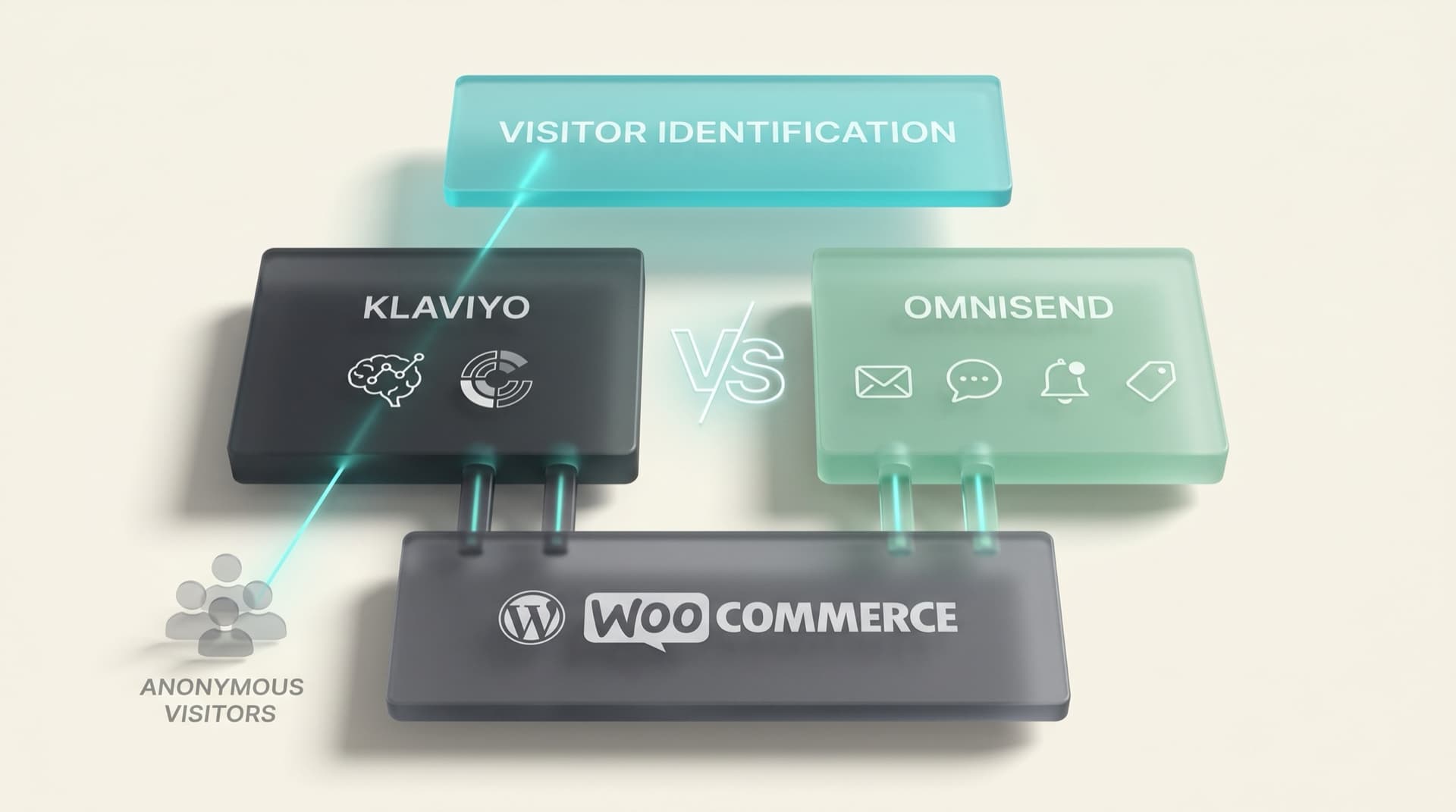
Klaviyo and Omnisend are the two leading ecommerce-native email platforms, and every comparison ranking for them is written for Shopify. This is the WooCommerce-specific version: where Klaviyo's depth and predictive AI win, where Omnisend's ease, price, and multichannel win, how each integrates with WooCommerce, and the one limitation both share that no ESP comparison mentions, the anonymous traffic neither can email.
Last updated: June 13, 2026
This is post 16 of 17 in the WooCommerce Email Marketing in 2026 Series. Previous: AI Email Marketing for WooCommerce: What's Working in 2026
Klaviyo and Omnisend are the two email platforms built specifically for ecommerce, and the choice between them is one of the most-searched comparisons in the category. The trouble, if you run WooCommerce, is that nearly every comparison you find assumes you are on Shopify. The Reddit threads, the YouTube breakdowns, the AI Overview, all framed around a Shopify store.
The platforms themselves do not work meaningfully differently on WooCommerce, but the framing matters, because the right choice depends on your store, your scale, and how you run it, not on a Shopify-centric feature checklist. So here is the WooCommerce version: what each platform is genuinely better at, how the pricing actually compares, how each one fits a WooCommerce store, and the limitation both share that no Klaviyo-versus-Omnisend article mentions.
KEY STATS
- "omnisend vs klaviyo" and "klaviyo vs omnisend" together draw roughly 400 searches a month with a detailed AI Overview, yet the ranking results are almost entirely Shopify-framed, with nothing WooCommerce-specific (DataForSEO, June 2026)
- Both are ecommerce-native platforms built around store data, unlike a broadcast tool such as Mailchimp, and both offer native WooCommerce integrations
- Omnisend is generally 20-35% cheaper than Klaviyo at comparable contact tiers; at 5,000 contacts that is roughly $65/mo versus $100-125/mo (onsaas and industry pricing comparisons, 2026)
- Klaviyo's edge is depth: predictive AI, advanced segmentation, and granular automation for larger, data-driven stores. Omnisend's edge is ease, price, native multichannel including web push, and a strong free plan
- Both are cloud ESPs that can only email contacts they have, so the 80-95% of paid traffic that never identifies is invisible to either, the one thing the comparison never covers
- Data sourced from the live "klaviyo vs omnisend" SERP and AI Overview (DataForSEO, June 2026) and aggregated 2026 platform comparisons and pricing
What's in this guide:
- Two ecommerce-native ESPs
- Klaviyo vs Omnisend: the head-to-head
- Where Klaviyo wins
- Where Omnisend wins
- The WooCommerce angle
- What both share: the gap neither closes
- How to choose
- Frequently asked questions
Two ecommerce-native ESPs
Start with what makes this a fair fight. Klaviyo and Omnisend are both built for ecommerce from the ground up, which sets them apart from a broadcast newsletter tool like Mailchimp that bolted ecommerce features on later. We covered that distinction in Mailchimp vs Klaviyo for WooCommerce; the short version is that both Klaviyo and Omnisend understand carts, products, and orders natively, so neither is the wrong tool the way a pure newsletter platform would be.
Both also integrate with WooCommerce directly, syncing store data so you can build flows off real purchase and browse behavior. So this is not a question of which one works with WooCommerce. They both do. It is a question of fit: depth versus simplicity, and cost versus capability.
Bob Dunn, who chronicled the WooCommerce ecosystem for years as the founder of the Do the Woo podcast, has long made the point that the best tool for a Woo store is the one that matches how the owner actually operates, not the one with the most features on paper (Do the Woo). That is exactly the lens for Klaviyo versus Omnisend, because on raw capability both are strong, and the deciding factor is who you are.
Klaviyo vs Omnisend: the head-to-head
Both platforms do email, SMS, automation, segmentation, and ecommerce reporting. The differences are in depth, price, and how much they ask of you.
| Dimension | Klaviyo | Omnisend |
|---|---|---|
| Best fit | Larger, data-driven stores and teams | Small-to-mid stores wanting speed and value |
| Ease of use | Powerful but steeper learning curve | Intuitive, pre-built workflows, fast to launch |
| Segmentation & analytics | Deep, predictive AI, advanced lifecycle | Effective and simpler, easier to set up |
| Multichannel | Strong email + SMS, plus WhatsApp | Email + SMS + native web push in one flow |
| Pricing | Higher, scales steeply with list size | ~20-35% cheaper at comparable tiers; strong free plan |
| Support | Tiered | 24/7 live support across plans |
| WooCommerce | Native integration | Native integration |
The honest summary matches what the comparison sites and the AI Overview all converge on: Klaviyo is the more powerful, more expensive platform that rewards stores with the data and team to use its depth. Omnisend is the easier, cheaper, multichannel platform that gets a smaller store live fast without a learning project. Neither is "better" in the abstract.
Where Klaviyo wins
Klaviyo is the deeper platform, and for stores that can use that depth it is worth the premium.
Its predictive analytics are the standout: predicted lifetime value, predicted next-order date, and churn-risk scoring that drive genuinely sophisticated flows. Its segmentation is granular enough to build almost any audience you can describe, and its automation handles complex, branching logic. For a larger catalog, a data-literate team, and a store doing enough volume that small percentage gains are real money, Klaviyo's ceiling is higher.
The cost of that depth is a steeper learning curve and a bill that climbs faster as your list grows. Klaviyo rewards investment; it punishes stores that pay for the depth and never use it. Chase Dimond, one of the most-followed voices in ecommerce email, has consistently held that Klaviyo's flow and segmentation capabilities are best-in-class for brands that actually operate them, a view we drew on in Klaviyo for WooCommerce. The key phrase is "actually operate them."
Where Omnisend wins
Omnisend wins on the things that matter most to a store that wants results without a project.
It is faster to learn and launch, with pre-built ecommerce workflows you can turn on rather than build. It is materially cheaper, generally 20 to 35 percent less than Klaviyo at comparable contact tiers, and its free plan is genuinely usable for a beginning store. It includes native web push notifications alongside email and SMS in a single flow, which Klaviyo does not match. And it offers 24/7 live support on all plans, which matters when you are a small team without a dedicated email specialist.
The trade-off is a lower ceiling. Omnisend's segmentation and analytics are effective but simpler, and a large, data-driven brand may eventually want more than it offers. For most small-to-mid WooCommerce stores, that ceiling is higher than they will reach for a long time, which is why Omnisend is often the better practical choice even though Klaviyo is the more powerful platform.
The WooCommerce angle
Because the popular comparisons assume Shopify, a few WooCommerce-specific points are worth making.
Both platforms integrate with WooCommerce natively, but WooCommerce is self-hosted, which means your store's performance, your hosting, and your data setup are yours to manage in a way a Shopify merchant never thinks about. A clean WooCommerce data layer (accurate product feeds, reliable order events) is what makes either platform's automation and recommendations work well, and it is on you to maintain it.
Mitchell Callahan, co-founder of the WooCommerce agency Saucal, has made the point that at scale the platform choice matters less than the discipline around it, clean data, a real strategy, and attention to where revenue actually leaks (Saucal). For Klaviyo versus Omnisend on WooCommerce, that means the decision is real but secondary; both will perform if your store data and strategy are solid, and neither will save a store where they are not.
The fuller picture of how an ESP fits into a WooCommerce stack, alongside everything else, is in the WooCommerce email marketing 2026 pillar.
What both share: the gap neither closes
Here is the part no Klaviyo-versus-Omnisend comparison covers, and it is the same for both.
Klaviyo and Omnisend are both cloud ESPs, and an ESP can only email a contact it has. To be in either platform, a shopper had to subscribe, register, or check out. On a WooCommerce store running paid acquisition, that is the minority of visitors. Between 80 and 95 percent of paid Meta and Google traffic never identifies, so it never becomes a contact in Klaviyo or Omnisend, and the most advanced flows in either platform have no one to send to.
So whichever you pick, you are choosing how to market to the contacts you already have. Neither does anything for the larger anonymous group. Closing that gap takes a visitor-identification layer that resolves a share of anonymous traffic into contactable profiles and feeds them into whichever ESP you chose, the mechanics of which are in our website visitor identification guide. The layer is ESP-agnostic; it works on top of Klaviyo or Omnisend equally, and the architecture is in The Modern Ecommerce Email Stack.
The practical reframe: Klaviyo versus Omnisend decides how well you serve the audience you have. Adding identification decides how big that audience is. The second question moves more revenue than the first, and almost nobody asks it.
How to choose
Match the platform to your store, not to the feature sheet. This table covers the common cases.
| Your store | Pick | Why |
|---|---|---|
| Small-to-mid, wants speed and value | Omnisend | Easier, cheaper, multichannel out of the box, strong free plan |
| Large, data-driven, with a team | Klaviyo | Predictive AI and depth justify the premium when you use them |
| Tight budget or just starting | Omnisend | Lower cost and a usable free plan to grow into |
| Wants native web push with email and SMS | Omnisend | Native web push in one flow; Klaviyo lacks it |
| Complex segmentation and high volume | Klaviyo | Higher ceiling for sophisticated, data-heavy programs |
| $5K+/mo paid traffic, lots of anonymous visitors | Either, plus a visitor-identification layer | The ESP serves known contacts; the layer recovers the rest |
The thread through the table: this is a fit decision, not a winner. And the bigger lever sits above both, in whether you do anything about the anonymous traffic neither platform can reach. Rodolfo Melogli, who has taught WooCommerce store owners through Business Bloomer since 2011, puts it simply: pick the tool that matches the job, then spend your energy on the strategy around it (Business Bloomer). If you want the WooCommerce-specific layer that adds anonymous-visitor identification on top of Klaviyo or Omnisend, that is what Geysera is built for.
Klaviyo versus Omnisend is a real decision, and people spend weeks on it. Klaviyo is the Ferrari, Omnisend is the very good car that costs a third as much, and most stores buy the Ferrari and drive it to the grocery store. Pick honestly: if you have the team and the data to use Klaviyo's depth, use it; if you do not, Omnisend will do more for you for less. But understand that either way you are arguing about how to talk to the people already on your list. The ninety percent who showed up, looked around, and left without a trace do not care which ESP you picked. Those are the ones worth a week of thinking.
— Bob Thordarson, Geysera CEO
Frequently asked questions
Is Klaviyo or Omnisend better for WooCommerce?
Neither is universally better; it depends on your store. Both integrate with WooCommerce natively and are built for ecommerce. Klaviyo is more powerful, with predictive AI and deep segmentation, and suits larger, data-driven stores with a team to operate it. Omnisend is easier, cheaper, and includes native web push, which suits small-to-mid stores that want results fast. Match it to your scale and how you work.
Is Omnisend cheaper than Klaviyo?
Yes, generally 20 to 35 percent cheaper at comparable contact tiers, and the gap widens as your list grows. At roughly 5,000 contacts, Omnisend runs around $65 a month versus about $100 to $125 for Klaviyo, and Omnisend has a more usable free plan. Klaviyo's higher cost buys depth and predictive features, which is worth it only if you use them.
Why do people choose Klaviyo over Omnisend?
For depth. Klaviyo's predictive analytics (lifetime value, churn risk, next-order prediction), granular segmentation, and complex automation are best-in-class, and larger stores with the data and team to use them get real value from that ceiling. Stores that do not need that depth often overpay for it, which is why Omnisend is frequently the better practical choice for smaller teams.
Does Omnisend work with WooCommerce?
Yes. Omnisend has a native WooCommerce integration that syncs your store data so you can run automated flows (welcome, cart recovery, post-purchase, winback) off real behavior, plus email, SMS, and web push in one place. Klaviyo integrates with WooCommerce too. The comparison is about fit and cost, not whether either connects to your store.
Will switching between Klaviyo and Omnisend fix my email results?
Usually not on its own. Both are capable ecommerce platforms, so if your results are weak the cause is more often strategy, list size, or deliverability than the platform. Switching is a project; before doing it, confirm the tool is actually the bottleneck. And remember that neither platform reaches the anonymous majority of your traffic, which is often the bigger limit on results than the ESP.
Can Klaviyo or Omnisend email anonymous website visitors?
No. Both are cloud ESPs that can only act on contacts they have, meaning people who subscribed, registered, or checked out. The majority of paid traffic never identifies and so never enters either platform. Reaching that anonymous traffic requires a visitor-identification layer that resolves some of it into profiles and feeds them into whichever ESP you use.
Should a WooCommerce store use an ecommerce ESP or a WordPress-native tool?
It depends on whether you want to own your data and stay in WordPress (favoring a native tool like FluentCRM or Groundhogg) or want a managed, ecommerce-native cloud platform (Klaviyo or Omnisend). We compare the native route in FluentCRM vs Groundhogg. Either way, neither reaches anonymous visitors without an added identification layer.
Continue the series
This is post 16 of 17 in the WooCommerce Email Marketing in 2026 series.
- Start with the pillar: WooCommerce email marketing 2026 — the complete stack
- Previous in series: AI Email Marketing for WooCommerce: What's Working in 2026
- The other comparison: Mailchimp vs Klaviyo for WooCommerce (and the Third Option)
If you want the WooCommerce-specific layer that adds anonymous-visitor identification on top of whichever ESP you choose, that is what Geysera is built for.
Sources

Co-Founder and CEO
Bob Thordarson is CEO and Co-Founder of Geysera, a serial entrepreneur with 25+ years and five co-founded ventures, including Cequint (acquired by TNS in 2010 for $112.5M) and Consumerware (acquired by ParkerVision). A graduate of the University of Washington and MIT Entrepreneurial Masters Program, based in Seattle, he serves on the boards of DRY Soda Co. and the Entrepreneurs' Organization Seattle chapter. He is an expert in retention marketing email systems and methodology for ecommerce and B2B brands — measured by incremental revenue, not vanity metrics.