AI Email Marketing for WooCommerce: What's Working in 2026
Every AI email marketing guide is the same generic list of tools and the same promise: personalize, optimize send times, write copy faster. Useful, but none of it is specific to WooCommerce, and none of it addresses the lever that matters most. This guide covers what AI genuinely does for a WooCommerce store's email today, what is overhyped, where it is heading with agentic commerce, and why the biggest AI win is not better copy but expanding who you can email in the first place.
Last updated: June 13, 2026
This is post 15 of 17 in the WooCommerce Email Marketing in 2026 Series. Previous: WooCommerce Email List Growth: Turning Anonymous Traffic Into Subscribers
Search AI email marketing and you get the same article fifteen times: a list of AI tools, a promise that AI will personalize your emails, optimize your send times, and write your copy, and a closing line about how AI is transforming marketing. The guides are not wrong, exactly. They are just generic, written for no platform in particular, and they skip the part that actually decides whether AI moves the needle for your store.
This guide is specifically about WooCommerce. What does AI genuinely do for a WooCommerce store's email today, in the tools you actually run? What is real and what is hype? Where is it heading as agentic commerce arrives? And, most importantly, what is the AI investment that matters more than any subject-line generator: the one that changes who you can email at all. We have a broader take on the whole category in AI and email marketing in 2026; this post is the WooCommerce-specific version.
KEY STATS
- "ai email marketing" draws roughly 590 searches a month and "ai email marketing tools" about 210, but the entire ranking SERP is generic, platform-agnostic listicles with nothing WooCommerce-specific (DataForSEO, June 2026)
- Most AI email features are not standalone tools; they are built into the ESPs and CRMs a WooCommerce store already uses, so "AI for WooCommerce email" mostly means the AI inside Klaviyo, Mailchimp, FluentCRM, or AutomateWoo
- The mature, genuinely useful AI wins today are send-time optimization, predictive segmentation, subject-line and copy drafting, and product recommendations, all of which act on contacts you already have
- No AI feature can email a visitor who was never identified, so on a store where 80-95% of paid traffic never identifies, the contact list is the ceiling on what AI can do
- The highest-leverage AI investment for most WooCommerce stores is not better copy; it is expanding the audience AI has to work with, by identifying anonymous traffic
- Data sourced from the live "ai email marketing for ecommerce" SERP and AI Overview (DataForSEO, June 2026) and aggregated 2025-2026 AI email benchmarks
What's in this guide:
- What AI actually does for WooCommerce email today
- What's overhyped
- Where AI helps a WooCommerce store most
- The limit no AI feature fixes
- Agentic commerce and where this is heading
- How to actually use AI for WooCommerce email now
- Frequently asked questions
What AI actually does for WooCommerce email today
Start with the honest, unglamorous truth: most of the AI you will use for WooCommerce email is not a new tool you install. It is already inside the platforms you run.
If you use Klaviyo, Mailchimp, FluentCRM, or AutomateWoo, you already have access to the AI features that matter, and they cluster into four genuinely useful jobs. Send-time optimization predicts when each contact is most likely to open and schedules accordingly. Predictive segmentation groups contacts by likely behavior, such as who is about to churn or who is likely to buy again, rather than by static rules you write by hand. Subject-line and copy assistance drafts variants and rewrites in seconds, turning a blank page into something to edit. And product recommendations use purchase and browse data to populate emails with items a given contact is likely to want.
All four are real, and all four save time or lift performance. The thing they have in common, which the generic guides never point out, is that every one of them operates on contacts you already have. AI is making the emails to your known audience smarter. That is valuable. It is also not the whole game.
What's overhyped
The gap between the AI marketing pitch and what AI delivers for a store is worth naming, because believing the pitch leads to disappointment.
AI does not fix strategy. A subject-line generator will not save a campaign with nothing to say, and predictive segmentation cannot segment a list that is too small or too cold to have patterns. If the underlying email program is weak, AI makes weak emails faster.
AI personalization is still mostly shallow. The promise is one-to-one relevance; the reality for most stores is a first name merged in and maybe a product block. Real personalization needs real behavioral data, and AI only amplifies the data you actually have on a contact.
AI-written copy still needs a human and a brand voice. It is a strong first-draft engine and a poor final-draft one. Shipped unedited, it reads like everyone else's AI copy, because it is trained on everyone else's copy.
And AI does nothing for deliverability or list quality. If your emails land in spam or your list is full of people who never engage, no amount of AI on the content changes that. Katie Keith of Barn2, whose plugins run on more than 100,000 WooCommerce stores, has consistently made the point that tools earn their place by doing a specific job well, not by adding an "AI" label (Barn2). That is the right lens for every AI email feature: what specific job does it do, and do you have the data and strategy for it to matter?
Where AI helps a WooCommerce store most
Used for what it is good at, AI is a real productivity gain. The pattern that works is to point it at the grunt work and keep the judgment for yourself.
Let AI draft and you edit. Generate five subject lines, ten variations of a cart-recovery email, or a first pass at a winback sequence, then cut, fix the voice, and ship. The blank page is the expensive part, and AI removes it.
Let AI handle the math you would not do by hand. Send-time optimization and predictive segmentation are genuinely better than manual rules because they process per-contact patterns at a scale no person would. This is where AI quietly outperforms, and it needs no prompting once enabled.
Let AI surface what you are missing. Several tools now run automated audits of your flows and campaigns and flag gaps, an underperforming step, a missing segment, a flow you never built. That is AI doing the review your team keeps postponing.
Adrian Tobey, founder of Groundhogg, has argued that automation, AI included, pays off when it acts close to your store data and on real behavior, rather than as a generic layer bolted on top (Do the Woo). For WooCommerce email, that means the AI worth using is the AI working on your actual store and customer data, not a detached copy generator.
The limit no AI feature fixes
Here is the ceiling that no send-time model, segmentation engine, or copy generator can lift: AI can only act on a contact that exists.
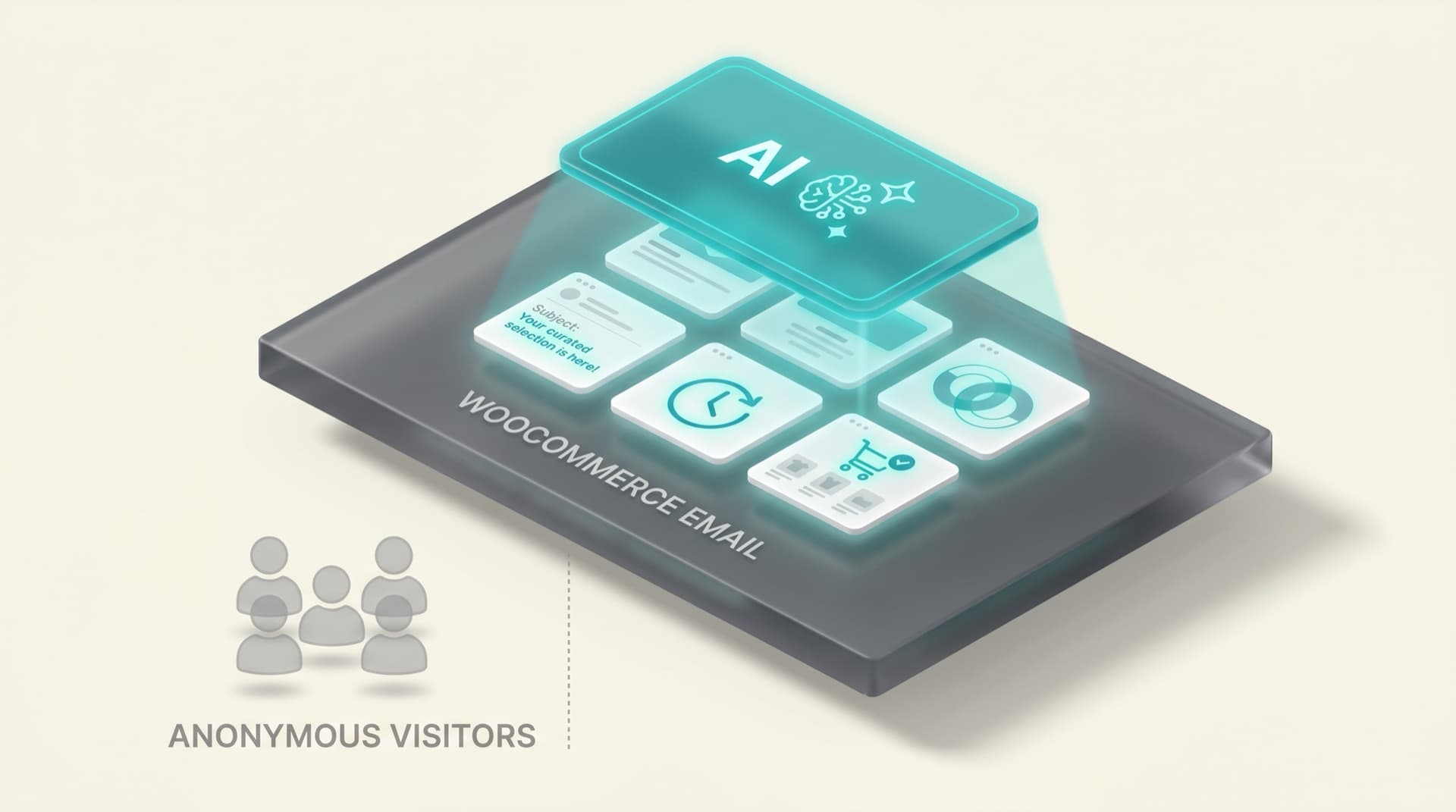
Every AI email feature personalizes, optimizes, and times messages to people who are already on your list. None of them can email a visitor who was never identified. On a WooCommerce store running paid acquisition, that is the catch, because between 80 and 95 percent of paid traffic never identifies and so never becomes a contact. You can run the most advanced AI email stack in the world and it will still only ever touch the minority of your audience that opted in or bought.
This reframes where the highest-leverage AI investment actually is. It is not a better subject-line model for the contacts you have. It is expanding the audience AI gets to work on in the first place, by identifying a share of the anonymous traffic so it becomes contactable. The mechanics are in our website visitor identification guide, and the way it fits with everything else is in The Modern Ecommerce Email Stack.
Put simply: AI makes your emails to known contacts better; identification decides how many contacts AI has to make better emails for. The second number is the one most stores are leaving small.
Agentic commerce and where this is heading
The more interesting AI shift is not in the email editor. It is in how people will shop.
Agentic commerce, where AI assistants browse, compare, and buy on a shopper's behalf, is moving from concept to roadmap, and WooCommerce, owned by Automattic, is building toward it. It is a recurring theme in the WooCommerce community and on the Do the Woo podcast, where platform leaders like Automattic's Beau Lebens discuss where the ecosystem is heading (Do the Woo). If agentic commerce arrives at scale, it changes what "email marketing" even means, because some of your customers will be software, and the signals your store sends will need to be machine-readable as well as human-readable.
That is a longer horizon, and it is easy to over-rotate on. The practical takeaway for now is narrower: the stores that will adapt well are the ones with clean data, structured product information, and a real handle on who their customers are. Those fundamentals serve you today through better AI email and tomorrow through whatever agentic commerce becomes. Chasing the latest AI email feature while neglecting the data underneath is optimizing the wrong layer.
How to actually use AI for WooCommerce email now
Skip the hype and the hand-wringing. Here is the practical posture for a WooCommerce store in 2026.
| Do this with AI | Don't expect AI to |
|---|---|
| Draft subject lines, variants, and first-pass copy you then edit | Write finished, on-brand copy you can ship unedited |
| Turn on send-time optimization and predictive segmentation | Fix a list that is too small or too cold to have patterns |
| Use AI flow audits to find gaps you would have missed | Replace email strategy or a clear offer |
| Populate product recommendations from real store data | Personalize meaningfully without behavioral data to draw on |
| Keep your store and customer data clean and structured | Improve deliverability or list quality on its own |
And above all, do the thing none of the AI guides mention: pair your AI email features with a way to grow the audience they act on. Optimizing emails to a small known list is a small win. Expanding who you can email, by identifying anonymous traffic, multiplies the value of every AI feature you turn on. The full architecture is in the WooCommerce email marketing 2026 pillar, and if you want the WooCommerce-specific layer that does the identifying, that is what Geysera is built for.
AI is the most useful intern email marketing has ever had. It drafts fast, it does the tedious math, it never gets bored optimizing send times. What it cannot do is decide what to say, sound like your brand without help, or email a single person who is not already on your list. I watch stores pour energy into AI subject-line tools while ninety percent of the people they paid to acquire walk out anonymous and unreachable. The AI is optimizing a puddle. Grow the lake first. Then let the AI go to work on it.
— Bob Thordarson, Geysera CEO
Frequently asked questions
Can I use AI for WooCommerce email marketing?
Yes, and you probably already are. Most AI email features are built into the platforms WooCommerce stores use (Klaviyo, Mailchimp, FluentCRM, AutomateWoo), covering send-time optimization, predictive segmentation, subject-line and copy drafting, and product recommendations. The catch is that all of these act only on contacts you already have, so AI improves your emails to known subscribers but cannot reach the anonymous traffic that never identified.
What is the best AI email marketing tool for WooCommerce?
There is no single best one, because the AI you will use is mostly inside the ESP or CRM you already run rather than a separate tool. If you use Klaviyo, its AI handles send times and segmentation; FluentCRM and AutomateWoo add AI assistance inside WordPress; general drafting tools help with copy. Choose based on the platform that fits your store (covered across this series), not on which one markets "AI" hardest.
Does AI actually improve email marketing results?
For specific jobs, yes. Send-time optimization and predictive segmentation reliably outperform manual rules, and AI drafting saves real time. But AI does not fix weak strategy, a thin or cold list, poor deliverability, or the absence of behavioral data. It amplifies what you already have, which is why the results depend more on your data and list than on the AI itself.
Will AI replace email marketers?
No, it changes the job. AI handles drafting, optimization, and analysis faster than a person can, which removes grunt work but not judgment. Deciding what to say, keeping a brand voice, building the offer and the strategy, and growing the audience all remain human work. The marketers who do best treat AI as a fast intern, not a replacement.
Is AI personalization in email real or hype?
Both. Real personalization needs real behavioral data, and AI can only personalize as deeply as the data you have on a contact. For most stores that means it goes a bit beyond a first name but falls short of true one-to-one relevance. The way to make AI personalization meaningful is to feed it better data, including by identifying more of your visitors so there is a profile to personalize against.
What is agentic commerce and does it matter for WooCommerce email?
Agentic commerce is AI assistants browsing, comparing, and purchasing on a shopper's behalf. It is an emerging shift that WooCommerce and Automattic are building toward, and over time it could change what email marketing means as some customers become software. For now the practical move is to keep your store and customer data clean and structured, which serves both today's AI email features and whatever agentic commerce becomes.
How should a small WooCommerce store start with AI email?
Turn on the AI features already in your email platform (send-time optimization, segmentation), use AI to draft copy you then edit, and run an AI audit of your flows to find gaps. Do not buy a separate AI tool before using what you have. And remember the bigger lever: a small store gains more from growing its list, including by identifying anonymous traffic, than from optimizing emails to the few contacts it already has.
Continue the series
This is post 15 of 17 in the WooCommerce Email Marketing in 2026 series.
- Start with the pillar: WooCommerce email marketing 2026 — the complete stack
- Previous in series: WooCommerce Email List Growth: Turning Anonymous Traffic Into Subscribers
- The broader AI take: AI and email marketing in 2026: what's working, what's overhyped
If you want the WooCommerce-specific layer that expands who your AI email features can actually reach, by identifying anonymous traffic, that is what Geysera is built for.
Sources
- AI in Email Marketing: A Complete Guide — Salesforce
- Pros and Cons of AI in Email Marketing — Klaviyo
- Barn2 — Katie Keith (WooCommerce plugins)
- CRM Insights and the Future of WordPress with Adrian Tobey — Do the Woo
- Do the Woo — WooCommerce community podcast (agentic commerce, Beau Lebens / Automattic)

Co-Founder and CEO
Bob Thordarson is CEO and Co-Founder of Geysera, a serial entrepreneur with 25+ years and five co-founded ventures, including Cequint (acquired by TNS in 2010 for $112.5M) and Consumerware (acquired by ParkerVision). A graduate of the University of Washington and MIT Entrepreneurial Masters Program, based in Seattle, he serves on the boards of DRY Soda Co. and the Entrepreneurs' Organization Seattle chapter. He is an expert in retention marketing email systems and methodology for ecommerce and B2B brands — measured by incremental revenue, not vanity metrics.