WooCommerce Email List Growth: Turning Anonymous Traffic Into Subscribers
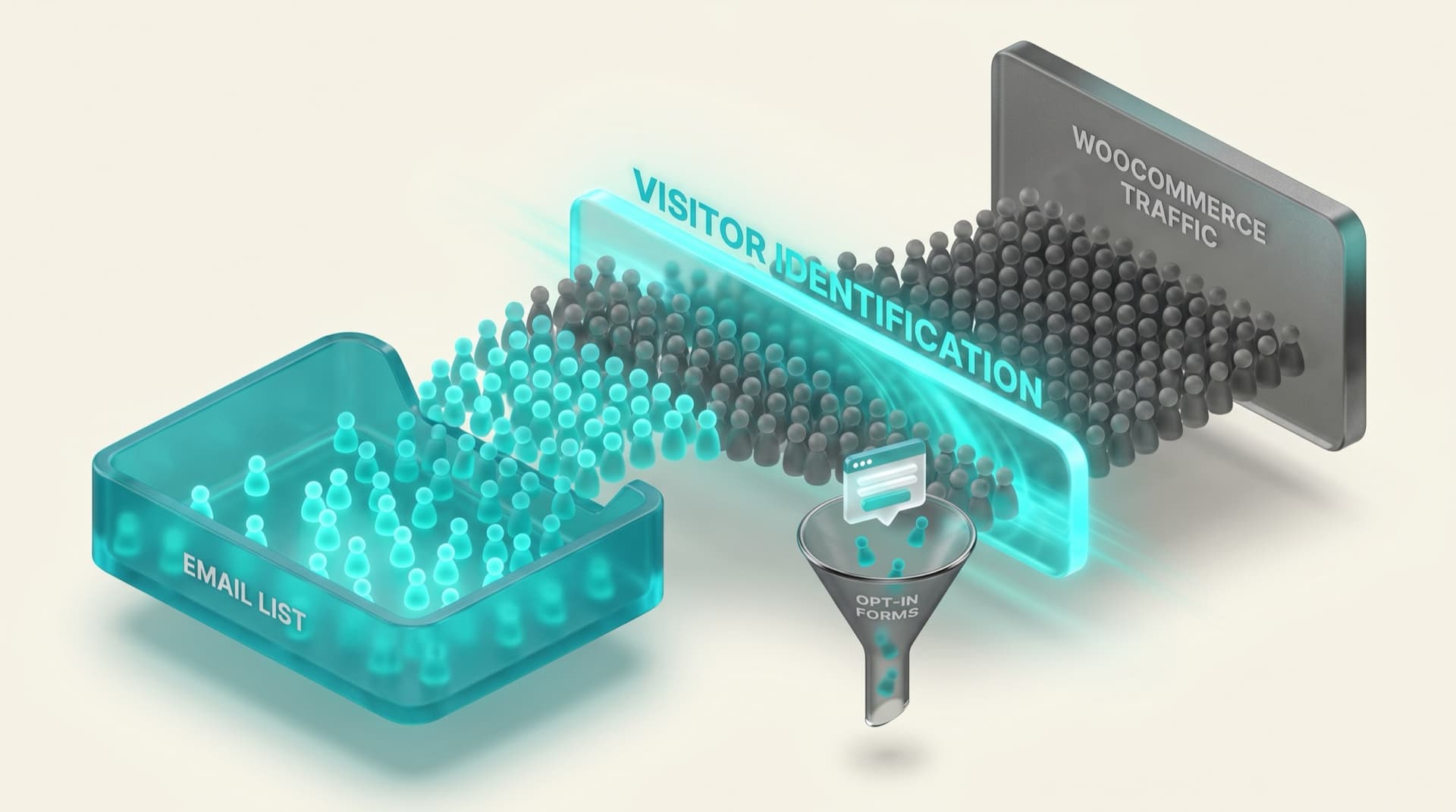
Every list-growth guide gives you the same advice: popups, forms, lead magnets, opt-in at checkout. It works, but it only captures the small share of visitors who choose to hand over an email, and on a WooCommerce store running paid traffic that is the minority. This guide covers both halves of WooCommerce list growth: how to do opt-in capture well, and the bigger lever almost nobody mentions, identifying the anonymous traffic that browses and leaves without ever filling out a form.
Last updated: June 13, 2026
This is post 14 of 17 in the WooCommerce Email Marketing in 2026 Series. Previous: FluentCRM vs Groundhogg for WooCommerce: The WordPress-Native Automation Route
Search how to grow an email list and every result tells you the same things: add a popup, build a signup form, offer a lead magnet, capture emails at checkout, run a giveaway. Klaviyo, Mailchimp, Shopify, and a dozen others all publish the same list, and the advice is not wrong. Those tactics work.
The problem is what they leave out. Every one of those tactics captures the same kind of person: a visitor who decided to hand over an email. On a WooCommerce store running paid traffic, that is a small minority of the people who show up. The rest browse, maybe add to cart, and leave without ever filling out a form, and the standard playbook has nothing to say about them. This guide covers both halves of WooCommerce list growth: how to do opt-in capture well, and the larger lever almost nobody writes about, turning the anonymous traffic that never opts in into subscribers you can actually email.
KEY STATS
- The standard list-growth advice across every major guide converges on the same tactics: opt-in popups, signup forms, lead magnets, giveaways, and capture at checkout (Klaviyo, Mailchimp, Shopify, AdRoll list-building guides, 2025-2026)
- Email opt-in forms and popups convert a low single-digit share of visitors, commonly around 2-4% even when well-optimized, so the large majority of traffic never subscribes through a form (OptinMonster and industry popup benchmarks, 2025-2026)
- 80-95% of paid Meta and Google traffic to a typical store never identifies, which is the same pool the opt-in playbook leaves on the table (industry visitor-identification analyses, 2025-2026)
- WooCommerce captures an email natively at checkout, but only from people who buy, so it grows your list with customers and never with the browsers who left
- List growth has two levers, not one: opt-in capture (the visitors who choose to subscribe) and identification (resolving a share of the anonymous visitors who never would)
- Data sourced from the live "how to build an email list for ecommerce" SERP and AI Overview (DataForSEO, June 2026) and aggregated 2025-2026 list-building and visitor-identification benchmarks
What's in this guide:
- The two levers of WooCommerce list growth
- Opt-in capture, done right on WooCommerce
- Why opt-in capture has a ceiling
- The bigger lever: identifying anonymous traffic
- Putting both levers together
- Don't let new subscribers go cold
- How to grow your WooCommerce list
- Frequently asked questions
The two levers of WooCommerce list growth
Most stores treat list growth as a single problem: get more people to subscribe. It is actually two different problems, and conflating them is why list growth stalls.
The first lever is opt-in capture: convincing a visitor to voluntarily give you their email through a form, a popup, a lead magnet, or checkout. This is the entire subject of the standard playbook, and it is worth doing well.
The second lever is identification: resolving a share of the visitors who never opt in into contactable profiles anyway, using a visitor-identification layer. This is the lever the guides skip, and on a paid-traffic store it is the larger of the two, because the pool it draws from (everyone who did not subscribe) is far bigger than the pool the forms draw from.
A store that only works the first lever is competing for the small slice of traffic willing to fill out a form. A store that works both is growing its list from the whole audience. The rest of this guide covers each lever, and how they feed the same list.
Opt-in capture, done right on WooCommerce
The opt-in tactics are not the problem; doing them lazily is. Here is what separates capture that works from a popup everyone closes.
Offer a real reason. "Subscribe to our newsletter" converts poorly because it asks for something and offers nothing. A discount on the first order, early access, a useful guide, or entry to a giveaway gives the visitor a reason to trade their email. The incentive is the conversion lever, not the form design.
Time it to intent. A popup that fires the instant someone lands converts worse than one triggered by behavior: scroll depth, time on a product page, or exit intent. The goal is to ask when the visitor has shown interest, not before they have seen anything.
Capture at checkout, deliberately. WooCommerce already collects an email at checkout, and a marketing opt-in checkbox there is the highest-intent subscriber you will get. Make the opt-in clear and compliant rather than buried or pre-checked.
Use WooCommerce-friendly tools. The conversion-optimization tools that lead this category (OptinMonster among them) run on WordPress and integrate with WooCommerce, so you can target offers by cart contents, product page, or customer status. Syed Balkhi, founder of Awesome Motive, whose products including OptinMonster are built around exactly this problem, has long argued that the highest-converting opt-ins are the most targeted ones, shown to the right visitor at the right moment rather than blasted at everyone (OptinMonster). That targeting is the difference between a 1% form and a 4% one.
Done well, opt-in capture meaningfully grows your list. But there is a ceiling, and it is lower than most stores realize.
Why opt-in capture has a ceiling
Here is the uncomfortable math. A well-optimized popup or form converts somewhere in the low single digits of visitors, often around 2 to 4 percent. That means even excellent opt-in capture collects emails from a small fraction of the people on your site, and by definition it only ever captures the visitors who were willing to subscribe.
Everyone else, the 95-plus percent who saw the offer and kept moving, or never saw it, or were not the type to fill out a form, leaves no contact behind. They are not bad traffic. Many of them browsed products, compared options, even added to cart. They simply did not opt in, and the opt-in playbook has no way to reach them.
This ceiling is especially expensive for stores running paid acquisition. You are paying to bring visitors to the site, and between 80 and 95 percent of that paid traffic never identifies. Optimizing the popup harder does not change that ceiling; it just competes a little better for the same small slice. To grow the list past it, you need a way to add the visitors who were never going to fill out a form.
Patrick Garman, CEO of the WooCommerce agency Mindsize, has spent his career on high-traffic stores where this gap is most visible, and the pattern is consistent: the money is not in the visitors who subscribe, it is in the far larger group who do not (Mindsize).
The bigger lever: identifying anonymous traffic
The second lever is identification, and it works on the pool the opt-in playbook ignores.
A visitor-identification layer resolves a share of your anonymous traffic into contactable profiles without requiring them to fill out a form. It does this by matching signals from your site against identity data, and on the durable version, by capturing first-party identifiers server-side so a returning visitor stays known even after browser cookies expire. The result is that visitors who browsed and left without subscribing can become subscribers you can email, added to the same list your forms feed.
The mechanics matter here, including identity graphs, server-side tracking, and the privacy and consent posture around all of it, and we cover them in depth in our website visitor identification guide. The point for list growth is the scale: because identification draws from the anonymous majority rather than the opt-in minority, it can add more contacts than your forms do, from traffic you already paid to acquire.
This is not a replacement for opt-in capture. A visitor who actively subscribes is a high-intent contact worth having. Identification is additive: it grows the list from everyone the forms miss, which on most stores is the larger number.
Putting both levers together
Run together, the two levers stop competing for the same slice and start covering the whole audience.
Opt-in capture brings in the high-intent visitors who choose to subscribe, with targeted offers timed to behavior and a clean checkout opt-in. Identification brings in a share of the anonymous majority who never would have filled out a form, resolved into profiles and added to the same list. One list, fed from both the people who raised their hand and the people who did not.
That combined approach is the architecture this series is built on, and we lay it out in The Modern Ecommerce Email Stack: keep the tools you use for capture and sending, and add an identification layer that grows the list from the traffic those tools cannot see. The full picture across every ESP is in the WooCommerce email marketing 2026 pillar.
| Lever | Who it captures | Typical share of traffic | Best practice |
|---|---|---|---|
| Opt-in capture | Visitors who choose to subscribe | Low single digits (2-4%) | Real incentive, behavior-timed forms, checkout opt-in |
| Checkout (native) | People who buy | Your conversion rate | Clear, compliant marketing opt-in at checkout |
| Identification | A share of anonymous, non-subscribing traffic | The larger remainder | A visitor-identification layer with server-side capture |
WooCommerce list growth has two levers. Opt-in capture (popups, forms, lead magnets, checkout opt-in) collects the small share of visitors willing to subscribe, typically a few percent. Visitor identification resolves a share of the anonymous majority that never opts in, drawing from a far larger pool. Running both grows the list from the whole audience rather than just the subscribers, which is the only way past the opt-in ceiling.
Don't let new subscribers go cold
Growing the list is only worth it if the new subscribers hear from you while they are still warm. A subscriber who joins and then gets nothing for three weeks is close to a wasted acquisition.
This is where list growth hands off to the rest of your program. Every new subscriber, whether they opted in or were identified, should drop into a welcome series that introduces the brand and earns the first or next purchase, which we map in the WooCommerce welcome series guide. From there they enter the behavioral flows, cart recovery, browse, post-purchase, that turn a contact into revenue. Growth without that follow-through just inflates a list that does not convert.
Rodolfo Melogli, who has taught WooCommerce store owners through Business Bloomer since 2011, makes the point that store owners chase the acquisition number and neglect what happens after (Business Bloomer). A subscriber is not the goal. A subscriber who becomes a customer is, and that depends on what you send next, not just on how you captured them.
How to grow your WooCommerce list
Match the effort to where your store is. This table maps the common cases.
| Your situation | Start with | Why |
|---|---|---|
| New store, small or no list | Opt-in capture with a real incentive | Cheapest, fastest way to start; a discount or guide converts the willing |
| Decent traffic, list growing slowly | Behavior-timed popups + checkout opt-in | You are likely under-using timing and the checkout opt-in |
| $5K+/mo paid traffic, list not keeping pace | Add a visitor-identification layer | You are paying for traffic that never subscribes; identification recovers it |
| Capturing fine but subscribers don't convert | Fix the welcome series first | The leak is after signup, not at capture |
| Want list growth from the whole audience | Run both levers together | Opt-in for the willing, identification for the rest |
The through-line: optimizing opt-in forms is worth doing and has a ceiling. Identification is how you grow past it, by turning the anonymous traffic you already paid for into subscribers. If you want the WooCommerce-specific layer that does that on top of your existing capture and email tools, that is what Geysera is built for.
Every store obsesses over the popup. What converts better, what discount to offer, when to fire it. Fine questions, small stakes. You are optimizing for the two or three percent who were going to give you their email anyway. Meanwhile the other ninety-plus percent, the people you paid good money to bring to the site, walk out the door and you never even knew their name. That is the list-growth problem worth solving. Capture the people who want to subscribe, absolutely. But if that is the whole strategy, you are growing your list from the smallest room in the building and ignoring the crowd outside.
— Bob Thordarson, Geysera CEO
Frequently asked questions
How do I build an email list for my WooCommerce store?
Use two levers. First, opt-in capture: a targeted popup or signup form with a real incentive (a first-order discount, a useful guide, or a giveaway), timed to behavior rather than fired on arrival, plus a clear marketing opt-in at checkout. Second, identification: a visitor-identification layer that resolves a share of the anonymous visitors who never fill out a form into contactable subscribers. Opt-in captures the willing few; identification grows the list from the larger group that never subscribes.
What is a good email opt-in conversion rate?
Well-optimized popups and forms typically convert in the low single digits, often around 2 to 4 percent of visitors, with the best targeted offers reaching higher. The important implication is the ceiling: even strong opt-in capture reaches only a small fraction of your traffic, which is why stores that want real list growth pair it with identification of the anonymous majority.
How do I add a newsletter signup or popup to WooCommerce?
Use a WordPress-native conversion tool (OptinMonster and similar) or your email platform's form builder, which integrate with WooCommerce so you can target offers by product page, cart contents, or customer status. Keep the offer specific, time the popup to behavior like scroll depth or exit intent, and always pair it with a clean marketing opt-in at checkout, which is your highest-intent capture point.
Does WooCommerce collect email addresses automatically?
Yes, but only from buyers. WooCommerce captures an email at checkout for every order, so your customer list grows automatically as you make sales. It does not capture anything from visitors who browse and leave without buying, which is the majority of traffic. Reaching those requires opt-in forms for the ones willing to subscribe and a visitor-identification layer for the ones who are not.
Can I grow my email list from anonymous website visitors?
Yes, with a visitor-identification layer. It resolves a share of anonymous, non-subscribing traffic into contactable profiles by matching site signals against identity data and capturing first-party identifiers server-side, without requiring a form fill. Because it draws from the large pool of visitors who never opt in, it can add more subscribers than your forms do, from traffic you already paid to acquire.
Is buying an email list a good way to grow fast?
No. Purchased lists are unconsented, hurt deliverability, often violate anti-spam law and platform terms, and convert poorly because the contacts never asked to hear from you. Grow with opt-in capture and identification of your own traffic instead, which produces engaged subscribers who actually came to your store.
What should happen right after someone joins my list?
A welcome series. A new subscriber is most engaged the moment they join, so they should immediately enter a sequence that delivers any promised incentive, introduces the brand, and earns the first or next purchase, then roll into your behavioral flows. Growing the list without a welcome series in place wastes the acquisition, because the new contact goes cold before you ever sell to them.
Continue the series
This is post 14 of 17 in the WooCommerce Email Marketing in 2026 series.
- Start with the pillar: WooCommerce email marketing 2026 — the complete stack
- Previous in series: FluentCRM vs Groundhogg for WooCommerce: The WordPress-Native Automation Route
- What to send after they join: WooCommerce Email Notifications and Templates: The Complete 2026 Setup Guide
If you want the WooCommerce-specific layer that grows your list from the anonymous traffic your opt-in forms never capture, that is what Geysera is built for.
Sources

Co-Founder and CEO
Bob Thordarson is CEO and Co-Founder of Geysera, a serial entrepreneur with 25+ years and five co-founded ventures, including Cequint (acquired by TNS in 2010 for $112.5M) and Consumerware (acquired by ParkerVision). A graduate of the University of Washington and MIT Entrepreneurial Masters Program, based in Seattle, he serves on the boards of DRY Soda Co. and the Entrepreneurs' Organization Seattle chapter. He is an expert in retention marketing email systems and methodology for ecommerce and B2B brands — measured by incremental revenue, not vanity metrics.