FluentCRM vs Groundhogg for WooCommerce: The WordPress-Native Automation Route
If you want to run WooCommerce email automation inside WordPress instead of renting a SaaS ESP, FluentCRM and Groundhogg are the two real choices, and most of the comparisons ranking for them are years old or written by one of the vendors. This is an honest, WooCommerce-focused head-to-head: where each one wins, how they handle store data and sending, where AutomateWoo and FunnelKit fit, and the one thing neither the WordPress-native route nor any CRM does on its own.
Last updated: June 13, 2026
This is post 13 of 17 in the WooCommerce Email Marketing in 2026 Series. Previous: WooCommerce CRM: Do You Need One, and Which Kind?
If you have decided you want to run your WooCommerce email automation inside WordPress rather than renting a cloud ESP, two plugins dominate the choice: FluentCRM and Groundhogg. They are the serious WordPress-native CRM and marketing-automation tools, and picking between them is a real decision with real trade-offs.
The trouble is the comparisons you find. The top result is Groundhogg's own page arguing for Groundhogg. Several others date to 2020 and 2021, before either plugin matured into what it is now. So here is an honest, WooCommerce-focused head-to-head in 2026: what the WordPress-native route actually buys you, where each tool wins, how AutomateWoo and FunnelKit fit alongside them, and the one gap neither plugin, nor any CRM, closes on its own. If you are still deciding whether you need a CRM at all, start with WooCommerce CRM: do you need one; this post assumes you have chosen the native route.
KEY STATS
- FluentCRM and Groundhogg are the two leading WordPress-native CRM and marketing-automation plugins, drawing roughly 1,000 and 170 brand searches a month respectively (DataForSEO, June 2026)
- Both are self-hosted: contact data lives in your own WordPress database and never syncs out to a third-party cloud, which is the defining advantage of the native route (FluentCRM and Groundhogg documentation, 2026)
- Self-hosted means no per-contact SaaS subscription; you pay a flat license and your own sending costs, so cost scales with sends rather than list size
- Because both send through your own server or SMTP rather than a managed ESP, email deliverability is your responsibility, not the platform's
- Neither tool, like every CRM, can act on a visitor it cannot identify, so the 80-95% of paid traffic that never identifies stays out of reach without an added identification layer
- Data sourced from the live "fluentcrm vs groundhogg" SERP and AI Overview (DataForSEO, June 2026) and the FluentCRM and Groundhogg product documentation
What's in this guide:
- What the WordPress-native route actually buys you
- FluentCRM vs Groundhogg: the head-to-head
- Where FluentCRM wins
- Where Groundhogg wins
- Where AutomateWoo and FunnelKit fit
- What the native route still misses
- How to choose
- Frequently asked questions
What the WordPress-native route actually buys you
Before comparing the two, it is worth being clear about what the whole category gives you, because it is the reason to look at FluentCRM or Groundhogg instead of Klaviyo or Mailchimp in the first place.
The native route means your CRM and automation run as plugins inside your own WordPress install. Three things follow from that. Your contact data lives in your database, not a vendor's cloud, which matters for ownership and privacy. You pay a flat license instead of a subscription priced on list size, so a big list does not mean a big monthly bill. And the tool reads WooCommerce data directly, with no sync to maintain and no lag between an order and the automation that should fire off it.
The cost of those advantages is that you are now the host. Email sending runs through your server or an SMTP service you connect, so deliverability is on you rather than on a managed platform, a point we cover in the WooCommerce email setup guide. And you are responsible for performance as your list grows. For stores that want control and predictable costs, that is a fair trade. For stores that want someone else to handle sending and scaling, a managed ESP is the better fit.
Adrian Tobey, the founder of Groundhogg, has argued for years that automation works better when the engine sits next to the store data rather than syncing it out to a distant platform (Do the Woo). He has a stake in that view, but the underlying point is sound and it is the whole case for the native route: the closer your automation lives to your WooCommerce data, the less friction between behavior and response.
FluentCRM vs Groundhogg: the head-to-head
Both plugins do the core job: store contacts, segment them, send broadcasts, and run automated sequences off WooCommerce events. The differences are in philosophy and depth.
| Dimension | FluentCRM | Groundhogg |
|---|---|---|
| Data ownership | Self-hosted in WordPress | Self-hosted in WordPress |
| Pricing model | Flat annual license | Flat annual license, tiered by extensions |
| Automation builder | Clean, linear funnel builder, fast to learn | Deep visual flow builder with more branching and logic |
| WooCommerce integration | Native, strong for purchase-based segments and sequences | Native, with extensive WooCommerce benchmarks and actions |
| Email sending | Your SMTP or sending service | Your SMTP or sending service |
| Ecosystem | Tight with the Fluent suite (Fluent Forms, FluentBooking) | Large extension library and integrations marketplace |
| Best fit | Stores wanting clean, fast setup inside WordPress | Stores wanting maximum automation depth and control |
The honest summary is that these are both good tools that made different bets. FluentCRM optimized for a clean experience and fast time-to-value; most people find it quicker to learn. Groundhogg optimized for depth and flexibility, with a more powerful flow builder and a wider extension library, at the cost of a steeper start.
Brian Coords, a WordPress and WooCommerce developer advocate, makes the point that the right tool is the one whose model matches how you actually work, not the one with the longest feature list (briancoords.com). That applies cleanly here: the feature sheets overlap enough that the deciding factor is usually how each one feels to build in, which is why the next two sections are about fit rather than checklists.
Where FluentCRM wins
FluentCRM is the easier of the two to pick up. The interface is clean, the funnel builder is mostly linear, and a store owner can have a working welcome or post-purchase sequence running in an afternoon without a manual. For teams that want marketing automation without a learning project, that speed is the feature.
It also benefits from the broader Fluent suite. If you already run Fluent Forms or other WPManageNinja plugins, FluentCRM slots in with shared conventions and tight integrations, so form submissions, bookings, and contacts live in one familiar ecosystem. And its purchase-based segmentation on WooCommerce is strong out of the box, which covers the most common ecommerce flows without add-ons.
FluentCRM is the better choice when you want clean, fast, in-WordPress automation and you value time-to-value over maximum configurability.
Where Groundhogg wins
Groundhogg is the more powerful automation engine. Its flow builder handles branching, conditional logic, and complex multi-path journeys that go beyond what a linear builder does comfortably. For a store with genuinely complex segmentation, or one that wants to model customer journeys in detail, that depth is the reason to choose it.
It also carries a large extension library and a wide set of integrations, so edge cases and third-party connections are more likely to be covered without custom work. The trade-off is the learning curve: Groundhogg asks more of you up front, and the payoff is control once you are past it.
Groundhogg is the better choice when automation depth and flexibility matter more than a fast start, and when you expect your flows to grow complicated enough that a linear builder would fight you.
Where AutomateWoo and FunnelKit fit
Two other names come up constantly in this conversation, and they are not quite the same category, so it is worth placing them.
AutomateWoo is WooCommerce's own automation extension. It runs triggers and workflows (including abandoned cart, follow-ups, and review requests) directly on store events, and it is excellent at that. What it is not is a full CRM with contact management and broadcast email; it is an automation engine for WooCommerce actions. Many stores run AutomateWoo for store-event workflows alongside a CRM for contact-based marketing.
FunnelKit (formerly Autonami) leans toward sales funnels and checkout optimization, with marketing automation attached. It overlaps with the CRM tools on automation but comes at the problem from the funnel-and-checkout side. We map the full tool landscape, including all of these, in Top 10 WooCommerce email automation tools.
The practical point: FluentCRM and Groundhogg are the contact-CRM-plus-automation choices for the native route. AutomateWoo is the store-event automation engine you might run alongside either. They are not strictly either-or.
What the native route still misses
Here is the limit that applies to FluentCRM, Groundhogg, AutomateWoo, and every CRM regardless of where it is hosted.
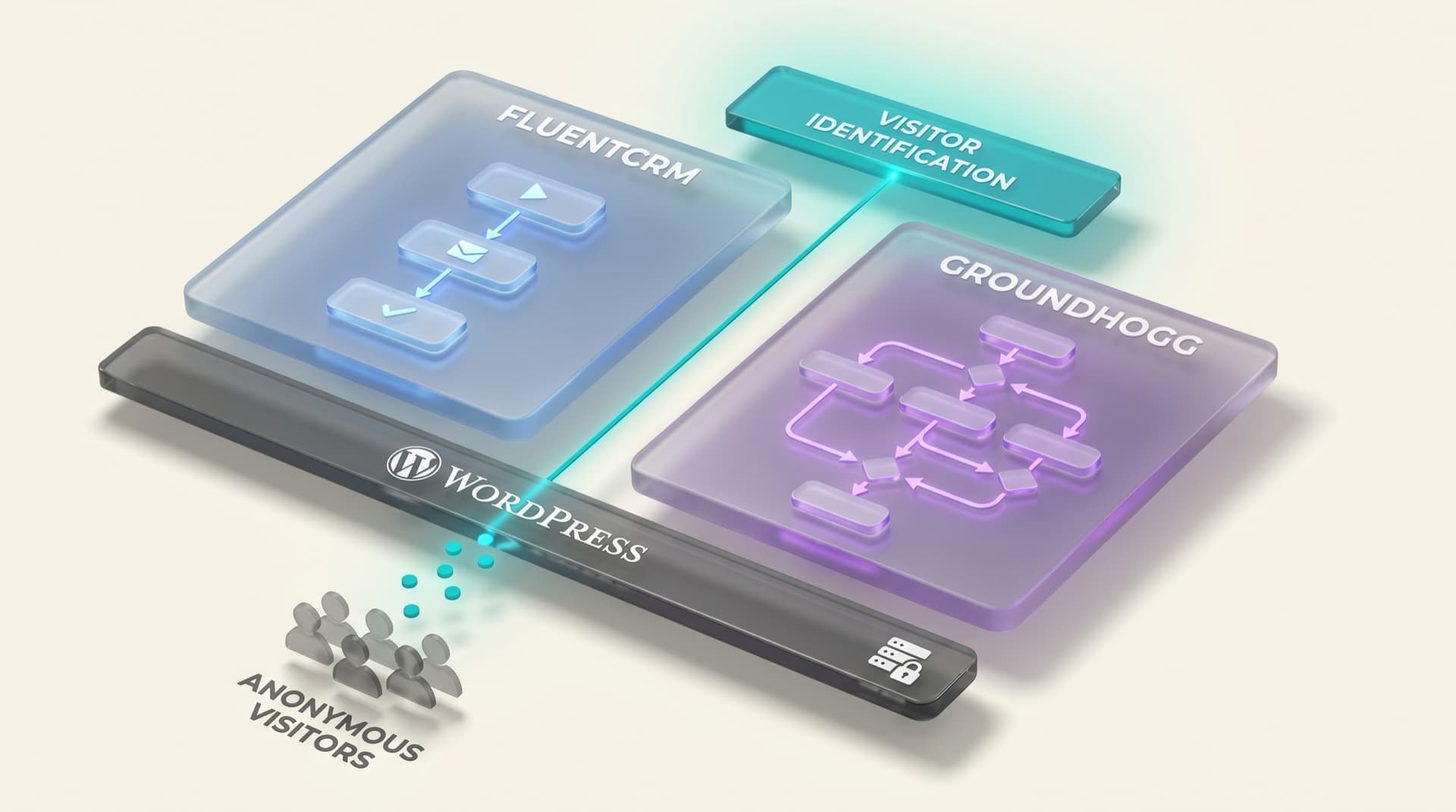
All of them act on contacts. To run a flow for someone, the tool needs that person as a record, which means they subscribed, registered, or checked out. On a store running paid acquisition, most visitors do none of those things. Between 80 and 95 percent of paid Meta and Google traffic never identifies, so it never becomes a contact in FluentCRM or Groundhogg, and the automation, however deep, has no one to act on. Self-hosting your CRM changes where the data lives. It does not change who is in it.
Closing that gap takes a visitor-identification layer that resolves a share of anonymous traffic into contactable profiles and feeds them into whichever native tool you chose. The mechanics, identity graphs and server-side tracking and the privacy posture around them, are in our website visitor identification guide, and the layer-on-top architecture is in The Modern Ecommerce Email Stack.
So the native route and the identification layer are not competitors. You pick FluentCRM or Groundhogg to own your automation, and you add identification on top so the automation has the anonymous majority to work with, not just the contacts who already raised their hand.
How to choose
Match the tool to how you work and what you are trying to run. This table covers the common cases.
| Your situation | Pick | Why |
|---|---|---|
| Want clean, fast automation inside WordPress | FluentCRM | Quicker to learn, strong WooCommerce segments out of the box |
| Need deep branching and complex journeys | Groundhogg | More powerful flow builder, larger extension library |
| Already run Fluent Forms or the Fluent suite | FluentCRM | Shared ecosystem and conventions |
| Want store-event workflows (cart, follow-ups) | AutomateWoo alongside either | It is an automation engine, not a full CRM |
| Running $5K+/mo paid traffic with lots of anonymous visitors | Either tool plus a visitor-identification layer | The CRM holds contacts; the layer recovers the traffic that never became one |
| Want someone else to handle sending and scaling | Reconsider a managed ESP | The native route puts deliverability and scaling on you |
The thread through the table: FluentCRM and Groundhogg are both good, and the choice is about fit, not a winner. The decision that moves revenue more than FluentCRM-versus-Groundhogg is whether you do anything about the anonymous traffic neither one can see. The full stack this fits into is in the WooCommerce email marketing 2026 pillar.
People treat FluentCRM versus Groundhogg like a cage match, and it mostly is not. They are both solid, they both keep your data in WordPress, and you will do fine with either one. I have watched stores spend a month agonizing over that choice and zero minutes on the fact that whichever they pick only ever talks to the customers who already gave them an email. That is the decision that actually moves the number. Pick the tool that feels right to build in, and then go solve for the traffic that never became a contact, because that is where the money you are missing actually is.
— Bob Thordarson, Geysera CEO
Frequently asked questions
Is FluentCRM better than Groundhogg?
Neither is strictly better; they made different bets. FluentCRM is cleaner and faster to learn, with a mostly linear automation builder, which suits stores that want working flows quickly. Groundhogg has a more powerful, branching flow builder and a larger extension library, which suits stores that need deep, complex automation and will invest in the steeper learning curve. Both are self-hosted in WordPress, so the choice is about how you work, not data ownership.
Do FluentCRM and Groundhogg work with WooCommerce?
Yes. Both have native WooCommerce integrations that read orders and customer data directly and let you trigger sequences off purchase events, segment by what people bought, and run flows like welcome, post-purchase, and winback. Because they live inside WordPress, there is no external sync to maintain between your store and your CRM.
Are FluentCRM and Groundhogg cheaper than Klaviyo or Mailchimp?
Often, because they use a flat license rather than per-contact SaaS pricing, so cost does not climb with list size. But you also take on email sending through your own SMTP or a sending service, and the deliverability and scaling work that a managed ESP would otherwise handle. The right comparison is total cost and effort, not just the license fee.
Is the WordPress-native route good for email deliverability?
It can be, but deliverability becomes your responsibility. FluentCRM and Groundhogg send through your server or a connected SMTP service rather than a managed ESP's infrastructure, so you handle authentication, sending reputation, and scaling. With a proper sending service and correct domain authentication it works well; without that setup, deliverability suffers.
What is the difference between AutomateWoo and FluentCRM or Groundhogg?
AutomateWoo is WooCommerce's automation engine for store events (abandoned cart, follow-ups, review requests) but it is not a full CRM with contact management and broadcast email. FluentCRM and Groundhogg are CRM-plus-automation platforms that manage contacts and send campaigns. Many stores run AutomateWoo for store-event workflows alongside one of the CRMs for contact-based marketing.
Can FluentCRM or Groundhogg market to anonymous website visitors?
No. Like every CRM, they can only act on contacts they have, which means people who subscribed, registered, or checked out. The majority of paid traffic never identifies and so never becomes a contact in either tool. Reaching that anonymous traffic requires a visitor-identification layer that resolves some of it into profiles and feeds them into your CRM.
Should I use a WordPress-native CRM or a cloud ESP for WooCommerce?
Use the native route (FluentCRM or Groundhogg) if you want to own your data, avoid per-contact pricing, and keep automation close to your store, and you are willing to handle sending and scaling. Use a cloud ESP if you want managed deliverability and scaling and do not mind subscription pricing and a data sync. Either way, neither reaches anonymous visitors without an added identification layer.
Continue the series
This is post 13 of 17 in the WooCommerce Email Marketing in 2026 series.
- Start with the pillar: WooCommerce email marketing 2026 — the complete stack
- Previous in series: WooCommerce CRM: Do You Need One, and Which Kind?
- The architecture behind the layer: The Modern Ecommerce Email Stack: Why Two Tools Beat One
If you want the WooCommerce-specific automation layer that adds anonymous-visitor identification on top of whichever native tool you choose, that is what Geysera is built for.
Sources
- FluentCRM: Marketing Automation for WordPress
- Groundhogg: CRM & Marketing Automation for WordPress
- Abandoned Cart and automation documentation — AutomateWoo / WooCommerce
- CRM Insights and the Future of WordPress with Adrian Tobey — Do the Woo
- Brian Coords — WordPress & WooCommerce developer advocate

Co-Founder and CEO
Bob Thordarson is CEO and Co-Founder of Geysera, a serial entrepreneur with 25+ years and five co-founded ventures, including Cequint (acquired by TNS in 2010 for $112.5M) and Consumerware (acquired by ParkerVision). A graduate of the University of Washington and MIT Entrepreneurial Masters Program, based in Seattle, he serves on the boards of DRY Soda Co. and the Entrepreneurs' Organization Seattle chapter. He is an expert in retention marketing email systems and methodology for ecommerce and B2B brands — measured by incremental revenue, not vanity metrics.