What Website Visitor Identification Costs in 2026
Website visitor identification is sold from $0 a month to $96,000 a year, and the published figure tells you very little on its own. Vendors charge in at least seven different units, so two plans at the same price can buy volumes that differ tenfold. This guide lists every published price as of September 2026, normalises them to cost per identified person, and gives you four questions that make the comparison fair.
Key benchmarks at a glance
| Metric | Figures |
|---|---|
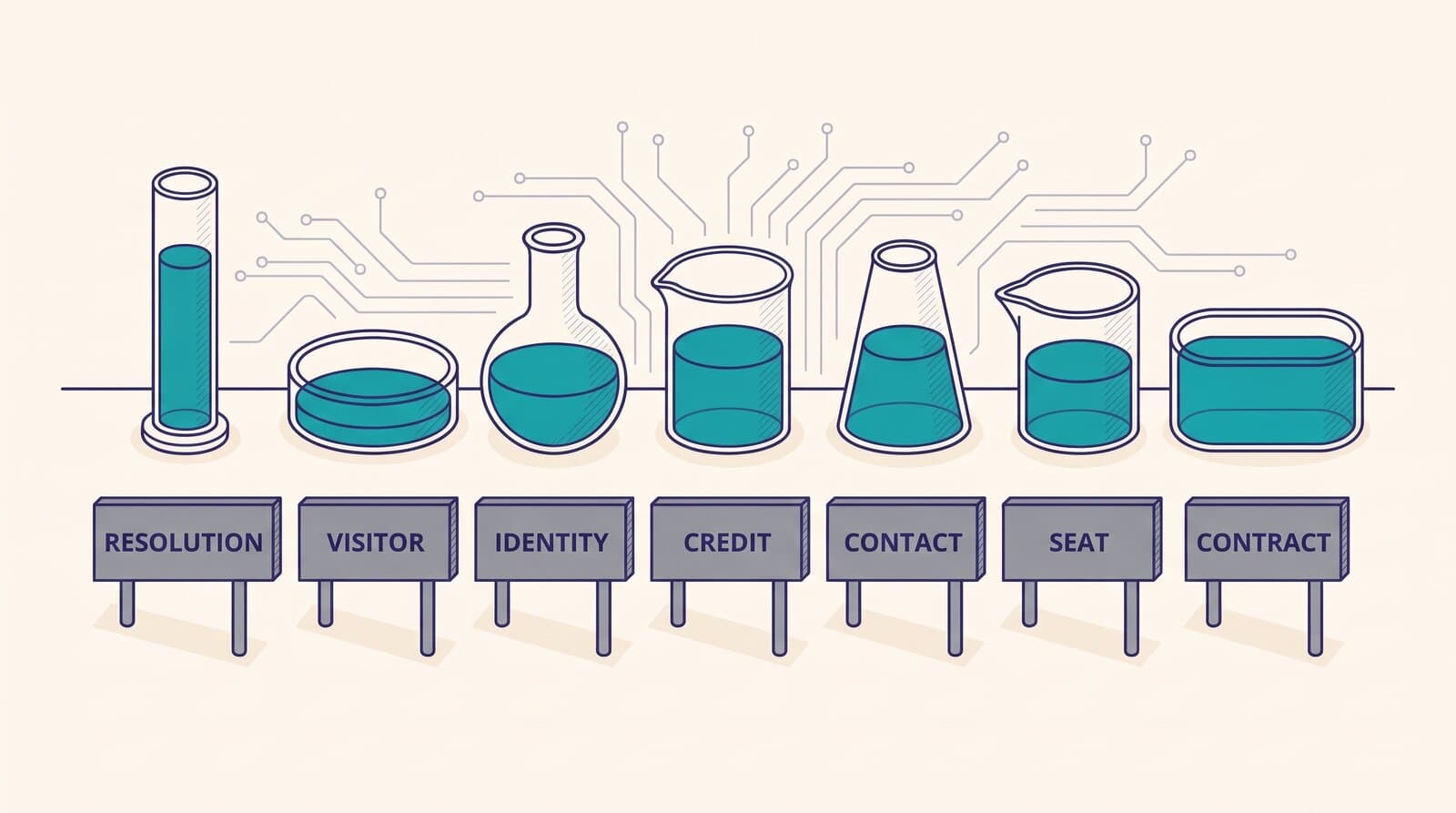
| Distinct pricing units in use across the vendor set | 7 — Ten vendors bill in seven different units: resolution (RB2B, Geysera Signal), unique monthly visitor scanned (Untitled), identity (Opensend), credit (Warmly, Knock), activated contact (Knock), seat (Coffee) and annual platform contract (Vector). |
| Vendors billing per identified person | 3 — Of the ten vendors, three bill in a unit that is one identified person: RB2B and Geysera Signal in resolutions, Opensend in identities. The other seven bill in credits, seats, activated contacts, scanned visitors or annual platform contracts, none of which converts to a person without a published match rate. |
| Lowest published paid entry price | $69 — Geysera Signal Starter at 69 US dollars a month for 300 resolutions. RB2B Starter is 79 dollars for 300 monthly resolutions. Two vendors also publish a free tier at 150 a month, though RB2B's free tier is company-level while Signal's includes person resolution. |
| Highest published plan price | $96000 — Vector's Scale preset at 96,000 US dollars a year, read 6 October 2026. Vector's Starter preset starts at 36,000 dollars a year, Warmly's top tier is 30,000 dollars a year and Knock's entry is from 1,000 dollars a month; all are quoted as starting prices rather than full rate cards. |
| Cost per identified person at 300 a month, upper bound | $0.26 — At a matched volume of 300 identified people a month the two comparable plans are Geysera Signal Starter at about 0.23 dollars each and RB2B Starter at about 0.26 dollars each. The two are not identical products: RB2B's 79 dollar tier states No Email Addresses. |
| Cost per identified person at 2,500 a month, lower bound | $0.07 — At 2,500 identified people a month, Geysera Signal Pro+ works out near 0.07 dollars each. Vector priced 2,500 identified visitors at about 0.16 dollars each in September 2026, then moved to annual platform contracts in October and no longer publishes a per-person volume. |
| Vendors publishing a full rate card with included volumes | 5 — Five of ten publish both a price and the volume it includes: Geysera Signal, RB2B, Coffee, Opensend and Untitled. Four publish a starting price only (Knock, Warmly, Dealfront, Vector) and one quotes after a demo (MarketBetter). |
| Vendors publishing their own cost per identified person | 1 — Opensend is the only vendor in the set that states the per-unit figure itself rather than leaving the buyer to divide, publishing 0.20 dollars per identity at 400 dollars a month, 0.186 at 800 and 0.168 at 1,600. |
Website visitor identification is sold from $0 a month to $96,000 a year, with entry-level paid plans clustering between $69 and $500. The published figure tells you little on its own, because vendors charge in at least seven different units, so two plans at the same price can buy volumes differing more than tenfold.
KEY STATS
- Published prices span $0/mo to $96,000/yr across 10 vendors
- The category charges in at least 7 units: resolutions, unique monthly visitors, identities, credits, activated contacts, seats and annual platform contracts
- Across B2B plans, cost per identified person runs $0.07 to $0.26, and most of that spread is volume rather than vendor
- 2 vendors publish a free tier at 150 a month, RB2B and Geysera Signal, though the two return different things
- 5 of 10 publish a full rate card with volumes, 4 publish a starting price, and 1 quotes after a demo
- Only 3 of the 10 bill per identified person, and they use 2 different words for that unit
- Data sourced from each vendor's own pricing page, read 6 September 2026 (Vector re-read 6 October 2026)
What's in this guide:
- The unit matters more than the number
- What the published prices say
- Resolution and identity: the same idea, two words
- Normalising: cost per identified person at matched volume
- When a vendor changes its unit, the old price stops comparing
- Free tiers, and what free means
- What to ask before you compare
- Frequently asked questions
The unit matters more than the number
Ask what a visitor identification tool costs and you'll get a number that isn't comparable to the next one. These products resolve different things for different buyers, and each vendor picked the unit that matches the job its product does, which is why one vendor can quote $69, another $10,000, and both be reasonable.
The seven units, and what one of each buys:
| Unit | Who prices this way | What one unit is |
|---|---|---|
| Resolution | RB2B, Geysera Signal | One identified person, counted once |
| Unique monthly visitor scanned | Untitled | One person who lands on your site, counted once a month whether or not they get identified |
| Identity | Opensend | One person resolved from your traffic |
| Credit | Warmly, Knock | A unit of work that gets spent on identification, enrichment, or another action |
| Activated contact | Knock | A buyer record the platform is allowed to engage |
| Seat | Coffee | One person on your team, with identification bundled in |
| Annual platform contract | Vector | One price for the whole platform, set by target accounts scored, signal volume and ad audience size |
The takeaway: Seven units are in play across ten vendors, and only two of them count identified people. Resolutions and identities both mean one named person. A unique monthly visitor scanned counts everyone who lands, identified or not, so it is a traffic ceiling. Credits and activated contacts are units of work, seats price your team instead of your traffic, and an annual platform contract prices the accounts you target.
Untitled prices on volume alone and never gates a feature behind a tier, which is the trade its own pricing page leads with:
"One bundle. Zero feature gates. Identity resolution, enrichment, audience building, activation and targeting." — Untitled, pricing page, read 6 September 2026
A credit is not a resolution. You spend credits on identification, on enrichment, on whatever else the platform bills for, so a plan with 10,000 credits will never name 10,000 people and no vendor here claims it will. Seats work differently again. Coffee charges for the people on your team, not for the visitors you identify, so its bill moves entirely when you hire and not at all when your traffic doubles overnight.
What the published prices say
Every figure below came from the vendor's own pricing page on 6 September 2026, except Vector's, re-read on 6 October 2026 after it changed its pricing. Where a vendor shows both an annual and a monthly price, the annual one is marked, because that difference alone accounts for a lot of apparent disagreement between comparison articles.
| Vendor | Entry paid plan | Published price | What it includes |
|---|---|---|---|
| Geysera Signal | Starter | $69/mo | 300 resolutions/mo |
| RB2B | Starter | $79/mo | 300 monthly resolutions |
| Coffee | Grande | $40/seat/mo billed annually, $50 monthly | Visitor identification bundled with the CRM |
| Opensend | Tier 1 | $400/mo billed annually | 2,000+ identities |
| Untitled | Starter | $500/mo billed annually | Up to 25,000 unique monthly ID Tag visitors |
| Knock | Pipeline Foundation | From $1,000/mo | Activated contacts plus de-anonymization credits |
| Warmly | AI Web-Deanonymization | $10,000/yr | From 10,000 credits/mo |
| Vector | Starter | From $36,000/yr | The whole platform on one annual contract; Growth $60,000/yr and Scale $96,000/yr presets, priced from usage |
| Dealfront | Free forever | €0 | Company identification; paid tiers published in euros |
| MarketBetter | — | Quoted after a demo | — |
The takeaway: Entry paid plans run from $69 to $500 a month, and the three enterprise plans start at $1,000 a month, $10,000 a year and $36,000 a year. Five of the ten publish a full rate card with the volume included at each tier. Where a vendor shows both an annual and a monthly figure, the gap runs 10 to 30%, which is large enough to reverse a comparison between two vendors on its own.
Coffee and MarketBetter both need a note. Coffee's $40 and $50 are one plan on annual and monthly billing, not a price change, so a comparison quoting one vendor's annual column against another's monthly column lands about 25% out before it has said anything about the products. MarketBetter moved to a demo-led model during 2026, and the change is easy to miss: in July it published four self-serve tiers starting at $49 a month, and today that same pricing URL redirects to a booking form. Five of the ten vendors here hold back a full rate card in some form, which usually means the vendor is fitting the price to the account instead of publishing it.
Resolution and identity: the same idea, two words
The three vendors that bill per identified person use two different words for it, and the words are not interchangeable. Every definition in the table is quoted from the vendor's own pricing page or FAQ, because a paraphrase of these terms can commit a vendor to something it never said.
| Word | Used by | The vendor's definition | What one unit returns |
|---|---|---|---|
| Resolution | RB2B, Geysera Signal | One match, counted once a month | Varies by tier. RB2B's free tier is "Company-Level ID... no person-level ID, no email addresses". Its $79 tier adds the person and a LinkedIn URL but states "No Email Addresses". Business email arrives at $149. Signal's free tier is "Company + person resolution (US)" |
| Identity | Opensend | An "identity delivered", with unused credit rolling over | A consumer record for ecommerce marketing, synced to your ESP |
The takeaway: Both describe an anonymous visitor matched to a real person, and they differ on three things that change what you are buying: whether a company-only match counts, whether contact data comes with it or waits for a higher tier, and whether the population is business buyers or consumers. RB2B is the clearest case, because a resolution on its free plan is a company and a resolution on its $149 plan is a person with a work email.
A free tier advertised as 150 a month settles very little when one vendor returns a company name and the other returns a person. Read the feature line.
Normalising: cost per identified person at matched volume
Divide the published price by the people the plan includes and the order changes. Compare rows at similar volume, because per-unit price in this category falls steeply as volume rises, and a cheap-looking unit price usually just means a bigger plan.
Sorted by volume, not by price, for the B2B person-level plans:
| Identified people / month | Vendor | Plan | Price | Per person |
|---|---|---|---|---|
| 300 | Geysera Signal | Starter | $69/mo | $0.23 |
| 300 | RB2B | Starter | $79/mo | $0.26 |
| 600 | RB2B | Pro | $149/mo | $0.25 |
| 1,000 | Geysera Signal | Pro | $129/mo | $0.13 |
| 2,500 | Geysera Signal | Pro+ | $169/mo | $0.07 |
Opensend is listed separately for two reasons. Its buyers are ecommerce teams, not B2B ones, and it is the only vendor here that publishes the per-unit price itself instead of leaving you to divide: $0.20 per identity at $400/mo, $0.186 at $800, $0.168 at $1,600. It also publishes a match rate, stating that it "typically identifies around 25-35% of anonymous visitors."
The takeaway: Read down the volume column, not across the price column. At 300 people a month both vendors charge 23 to 26 cents each. Signal's own rows fall from 23 cents at 300 to 7 cents at 2,500, so most of the apparent gap between vendors is plan size rather than vendor, and the rows that compare cleanly are the pair at 300.
Two things stop those rows being a ranking, and both matter before you act on the numbers.
Matching the volume does not match the product. At 300 a month, RB2B's $79 plan states "No Email Addresses" while its $149 plan adds them, so the two rows at 300 are not offering the same record. Per-person price is generally one column of a comparison and rarely the deciding one, so read it beside what the vendor says a unit actually contains, and beside the person-level identification your team needs.
Untitled is missing from that table for a related reason. Its plans are sized in unique monthly ID Tag visitors, roughly everyone who lands on your site, identified or not. That is a traffic ceiling rather than a count of people, so $500 divided by 25,000 gives you the cost of scanning a visitor and never the cost of identifying one. Converting between the two needs a match rate, and Untitled publishes none, so the row stays out.
The comparison that does hold is Signal Starter against RB2B Starter. Same unit, same volume, $69 against $79.
We priced Signal on resolutions after a seat model broke on us. A two-person team put the script on a site doing 40,000 sessions a month, and on seats they'd have paid us almost nothing while costing us more to serve than any other account we had. Resolutions track what the product actually spends money doing. That's the whole reason we charge for them. — Bob Thordarson, Geysera CEO
When a vendor changes its unit, the old price stops comparing
Untitled changed both its floor and its unit between July and September 2026. One change makes the plan look worse and the other makes it look better.
In July its entry plan was $250 a month and its published mechanic was the daily unique visitor resolution, where one identified person returning across five days counted five separate times. Today the entry plan is $500 a month and the capacity row reads "unique monthly ID Tag visitors," which counts everyone who lands, once a month, identified or not.
The floor doubled, and the $250 tier is gone. The published numbers can't tell you whether the plan is better or worse value now, because 25,000 scanned visitors and roughly 5,000 daily resolutions are not the same quantity, nothing published converts between them, and only Untitled knows the match rate that would settle it. Anyone reporting this as a straightforward price rise is reading across a unit change without noticing. Ask what the new number counts.
Vector made a larger change of the same kind in October 2026. In September its Reveal plans ran $399 to $999 a month for 2,500 to 10,000 identified visitors. On 6 October its pricing page sells the whole platform on one annual contract, with presets at $36,000, $60,000 and $96,000 a year, and says the contract is priced from the target accounts you score, your signal volume and your ad audience size. No figure on that page counts identified people, so Vector has left the per-person table above.
Free tiers, and what free means
Free tiers here are real, and two of them advertise the same number without selling the same thing. RB2B and Geysera Signal both publish 150 a month at $0, but RB2B's free tier states "Company-Level ID" with no person-level identification, while Signal's states "Company + person resolution". Dealfront publishes a free-forever company identification tier priced in euros. Warmly runs its free entry point on a separate page from its pricing, and describes it in low-commitment terms:
"Sign up in 30 seconds. No credit card. Swipe a card monthly when you need more." — Warmly, free tier page, read 6 September 2026
At the free tier vendors almost always hold back the two things that make identification usable, work email addresses and integrations past a Slack push. RB2B is precise about it, gating business email to its $149 tier and stating "No Email Addresses" in plain text on the $79 one, which is far more than most pricing pages tell you. That's a sensible way to let someone watch real traffic resolve before paying anything. Because a free tier often resolves less deeply than the plan you would buy, a fortnight on it will tell you how much traffic you have and almost nothing about how well a vendor names the people in it. Budget a paid month for that question.
What to ask before you compare
Before you set one price beside another, get four things from the vendor.
What is one unit? A resolution, a monthly unique, a credit or a seat. Always get this first, because everything else depends on it, and because the volume a vendor quotes is only meaningful once you know what it counts. Match rates are the other half of the same question.
Is the price annual or monthly? A 10 to 30% gap between the two columns is standard here, and it is the most common single source of disagreement between comparison articles.
What happens past the cap? RB2B publishes per-resolution overage at 25 to 45 cents. Others roll unused volume forward. Some do neither, and you find out in month two.
What's included at the tier you'd actually buy? Person-level identification, work email and CRM integrations sit at different tiers with different vendors, so the plan that looks cheapest on the pricing page is frequently not the plan that contains the feature you came for.
Signal's tiers are priced in resolutions per month, from 150 on the free plan to 2,500 on Pro+.
Frequently asked questions
How much does website visitor identification cost?
Entry-level paid plans run from $69 to $500 a month, and enterprise plans reach $96,000 a year. As of September 2026 the lowest published paid tier among the vendors reviewed here is $69/mo for 300 resolutions, and two vendors publish a free tier at 150 identifications a month.
Why do visitor identification prices vary so much?
Because vendors charge in at least seven different units, and only three of the ten bill per identified person. Across the B2B plans, cost per identified person runs about $0.07 to $0.26, and most of that spread is the size of the plan rather than the vendor. Per-unit price falls steeply with volume, so compare plans at similar volume.
Is there a free website visitor identification tool?
Yes. RB2B and Geysera Signal both publish a free tier at 150 a month, and Dealfront publishes a free-forever company identification tier priced in euros. The two 150-a-month tiers are not the same offer: RB2B's states "Company-Level ID" with no person-level identification and no email addresses, while Signal's states "Company + person resolution". Free tiers generally hold back work email and the integrations that make the data usable.
What is a resolution?
A resolution is one identified person, counted once. It's the unit RB2B and Geysera Signal price on. It differs from a unique monthly visitor, which counts a returning person once per calendar month, and from a credit, which is a unit of work that may be spent on identification or on something else.
Should I pick the lowest cost per identified person?
Not on its own. The lowest per-unit price in this category also carries the highest monthly floor, so a small site pays more per person than the table suggests. Per-unit figures are only comparable between vendors resolving the same kind of person, so establish what each one resolves first, then compare on price.
Do these prices change often?
Often enough to check. Between July and October 2026, two vendors in this set changed their billing unit, one of them removing its entry tier, and a third moved from published pricing to demo-led pricing. Anything you read in a comparison article is worth confirming against the vendor's own page.
Sources
All vendor pricing read 6 September 2026 from each vendor's own pricing page, except Vector's, re-read 6 October 2026. Baseline figures for the July comparison were recorded 7 July 2026.
- RB2B pricing — rb2b.com/pricing
- Geysera Signal pricing — geysera.com/signal/pricing
- Coffee pricing — coffee.ai/pricing
- Opensend pricing — opensend.com/pricing
- Untitled pricing — getuntitled.ai/pricing
- Vector pricing — vector.co/pricing
- Knock AI pricing — knock-ai.com/pricing
- Warmly pricing — warmly.ai/p/pricing
- Dealfront pricing — dealfront.com/pricing
- MarketBetter — marketbetter.ai/pricing

Co-Founder and CEO
Bob Thordarson is CEO and Co-Founder of Geysera, a serial entrepreneur with 25+ years and five co-founded ventures, including Cequint (acquired by TNS in 2010 for $112.5M) and Consumerware (acquired by ParkerVision). A graduate of the University of Washington and MIT Entrepreneurial Masters Program, based in Seattle, he serves on the boards of DRY Soda Co. and the Entrepreneurs' Organization Seattle chapter. He is an expert in retention marketing email systems and methodology for ecommerce and B2B brands — measured by incremental revenue, not vanity metrics.